

For most UK small and medium-sized service businesses, a hybrid AI and human answering model is the right choice. AI handles the volume, the hours, and the repetitive enquiries; a human steps in for the calls that need judgement, empathy, or authority. That combination gives you cost control, 24/7 coverage, and the quality of service your clients expect.
Quick verdict by business type:
- Choose AI-only if your calls are predominantly bookings, FAQs, or lead capture, and you have no walk-in traffic or complex regulatory enquiries.
- Choose human-only if your brand depends on high-touch relationships, you handle sensitive or crisis calls regularly, or you have significant in-person admin.
- Choose hybrid if you run a trades, hospitality, salon, or clinic business with mixed call types, after-hours demand, and a need to capture every lead without a full-time receptionist salary.
Research consistently shows that hybrid models are the pragmatic recommendation for most service businesses, balancing AI's availability and consistency against human judgement where it genuinely matters. UK GDPR and ICO rules apply to any call recording or data processing solution you choose, and Captasolutions offers a free 30-day trial with no card required and no contract, so you can test the approach with zero financial risk.
Table of Contents
- How does an AI call service compare to a human receptionist?
- When does an AI call service outperform a human?
- When is a human receptionist the better choice?
- How does an effective hybrid AI and human setup work?
- What does a hybrid model actually cost, and what is the ROI?
- How do you implement AI call handling, and what are the UK compliance requirements?
- How Captasolutions works for UK businesses
- Key takeaways
- What most businesses get wrong about AI call handling
- Try Captasolutions free for 30 days
- Useful sources and further reading
How does an AI call service compare to a human receptionist?
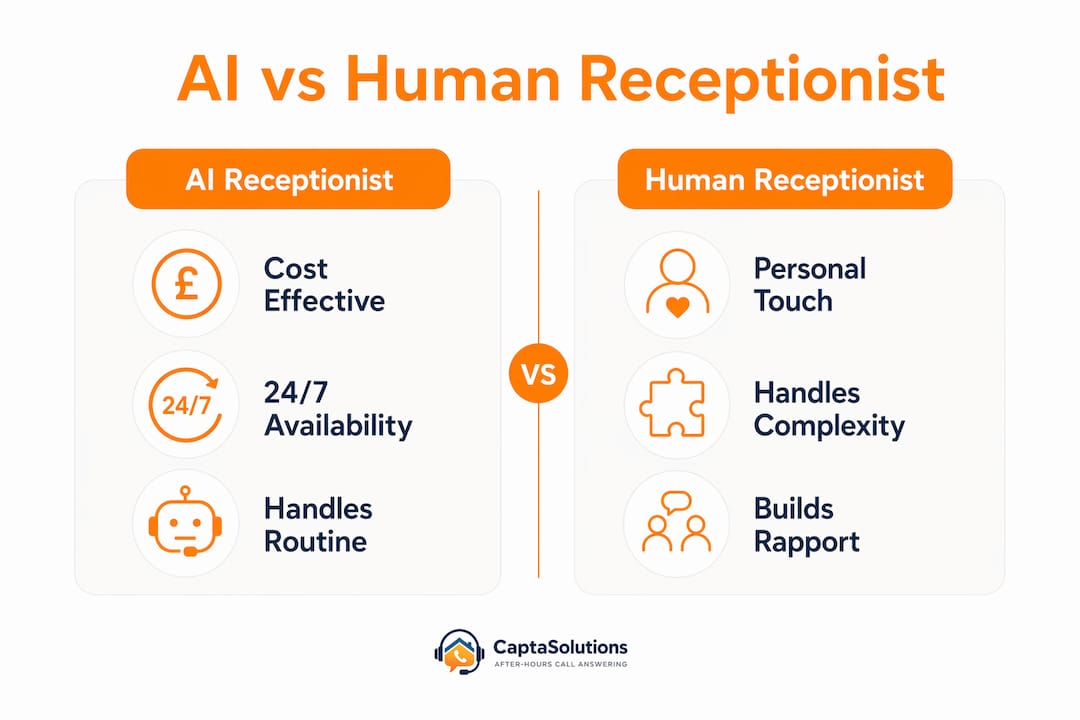
The table below maps the eight dimensions that matter most when choosing between an AI call service vs human receptionist, or a hybrid of both.
| Dimension | AI receptionist | Human receptionist | Hybrid |
|---|---|---|---|
| Typical cost (GBP) | £100–£200/month subscription + setup fee | £14,000–£18,000/year fully loaded | AI subscription + part-time human cover |
| Hours/coverage | 24/7, no gaps | Business hours; overtime costly | 24/7 AI + human during core hours |
| Simultaneous calls | Unlimited concurrent calls | One call at a time | Unlimited via AI; human handles escalations |
| Call types handled | Bookings, FAQs, lead capture, directions | Routine and complex; nuanced judgement | Routine via AI; complex via human |
| Customer experience | Consistent, fast, no hold time | Warm, empathetic, relationship-led | Fast for routine; personal for complex |
| Handoff and escalation | Transfers with transcript and context | Direct; no structured handoff needed | Structured transfer with caller context |
| Data, recording and GDPR | Configurable; requires ICO-compliant setup | Manual records; GDPR applies equally | Both layers need compliant configuration |
| Multilingual support | Available in multiple languages | Depends on staff; costly to scale | AI covers multilingual; human for nuance |
Figures are illustrative. Calculate ROI using your own call volumes and current salary costs.
Three trade-offs stand out:
- Cost vs empathy. AI cuts monthly phone handling costs substantially compared with a fully loaded receptionist, but consumers still prefer human agents for complex or sensitive interactions.
- 24/7 coverage vs walk-in presence. AI answers at 2 AM; it cannot greet a client at your front desk.
- Scalability vs personalised relationships. AI handles unlimited concurrent calls without adding headcount; a human receptionist builds the kind of rapport that retains VIP clients.
When does an AI call service outperform a human?
AI call handling wins decisively in five situations:
- High after-hours or peak call volume. If a meaningful share of your calls arrive outside 9–5, a human receptionist simply misses them. AI answers every one.
- Predictable, repeatable call types. Bookings, directions, pricing FAQs, appointment confirmations — these are exactly the flows AI resolves end-to-end without human input.
- Rapid campaign scaling. A marketing push can triple inbound volume overnight. AI scales instantly; hiring does not.
- Multilingual requirements. AI voice agents support multiple languages without the cost of bilingual staff.
- Lead capture at all hours. Every missed call is a potential customer who moves on. AI captures the caller's details and qualifies the enquiry even when your team is unavailable.
Vendor analyses report that AI resolves 60–80% of routine enquiries, which translates directly into receptionist time freed for higher-value tasks. For a small trades business, the financial case is straightforward: a monthly AI subscription at £100–£200 versus a fully loaded receptionist at £2,000–£2,700 per month in salary, National Insurance, pension, and desk costs. Even accounting for the calls that still need a human, the savings are significant for businesses with predominantly routine inbound traffic. You can find sector-specific ROI examples for UK tradespeople that illustrate this in more detail.
Pro Tip: Start AI on your lowest-risk flow first: after-hours calls only, or daytime overflow when your team is engaged. Measure how many leads are captured versus previously missed, then expand once you are confident in the conversion rate.

When is a human receptionist the better choice?
Human receptionists remain the right answer in specific, well-defined situations:
- Crisis and emotional calls. Medical practices, bereavement services, and mental health providers need a human voice. No AI should handle a caller in distress without an immediate warm transfer.
- High-touch VIP or concierge models. Luxury services where the receptionist is part of the brand experience cannot be replicated by automation.
- Significant walk-in traffic. If your receptionist also greets clients, manages a waiting room, or handles physical admin, AI cannot substitute for physical presence.
- Regulatory or inspector calls. Calls requiring on-the-spot professional judgement, such as those from a local authority or a compliance body, need a human who can respond with authority and discretion.
Watch for these red flags when evaluating AI for your business: a high proportion of atypical or unpredictable enquiries; frequent calls from regulators, solicitors, or insurers; or a brand identity built around receptionist-led relationships where callers expect to speak to the same person repeatedly.
On staffing economics: a part-time or job-share receptionist (three days per week) costs roughly £14,000–£18,000 per year fully loaded and makes sense when walk-in presence and complex call handling are both required but full-time cover is not. Pair that with AI for the remaining hours and you have a cost-effective hybrid without the full salary burden.

Pro Tip: Before concluding you need a full-time human receptionist, run a one-week call audit. Log every call by type and time of day. You may find that a significant share of your calls are routine enough for AI, which changes the staffing calculation entirely.
How does an effective hybrid AI and human setup work?
A well-designed hybrid model follows a clear sequence on every call.
- AI answers immediately, greets the caller in your business name, and begins qualifying the enquiry.
- AI completes routine actions — takes a booking, captures lead details, answers an FAQ, or confirms an appointment — and ends the call if no escalation is needed.
- Escalation triggers fire when the caller requests a human, sentiment detection flags distress or frustration, the AI's confidence score falls below a set threshold, or the call type matches a pre-defined VIP or regulatory flag.
- AI transfers to a human with a structured context packet: caller name, reason for call, a transcript snippet, and the confidence score.
- The human picks up with full context, resolves the call, and logs the outcome.
The context packet at handoff is the detail most businesses overlook. Passing structured context at transfer materially reduces the number of times a caller has to repeat themselves, which is one of the most common complaints about transferred calls. Configure your handoff to pass at minimum: caller name, stated reason, last AI response, and intent classification.
Practical thresholds to configure:
- Escalate if sentiment score drops below a defined negative threshold.
- Escalate if the caller says "speak to someone" or "manager" at any point.
- Escalate all calls tagged as complaints, legal, or regulatory.
- Escalate if the AI fails to match an intent after two attempts.
Pro Tip: When booking calls are handled by AI, map your calendar availability rules precisely and test what happens when two callers request the same slot simultaneously. Implement immediate confirmation messages to the caller to reduce double-booking risk and avoid confusion.
What does a hybrid model actually cost, and what is the ROI?
The numbers below illustrate typical UK cost ranges. Apply your own figures for a precise calculation, as these vary by region, sector, and provider.
Ranges reflect variation by region, sector, and provider. Verify current National Insurance rates with HMRC.
Sample calculation for a small trades business:
Assume 200 inbound calls per month, with a notable share arriving outside business hours, and a missed-call rate after hours that represents a significant opportunity for capture. At an average job value of £300 and a 25% conversion rate from answered calls, each missed call costs roughly £75 in lost revenue. Capturing the previously missed monthly calls with AI can yield substantial potential revenue recovery, against a relatively low AI subscription cost. Break-even can occur quickly.
Small business guides consistently identify after-hours capture and predictable task handling as the primary ROI drivers for AI call handling, with substantial cost savings on routine phone tasks compared with full human coverage.
Key figure: A meaningful share of service business calls arrive outside standard business hours. Those calls go unanswered without AI or out-of-hours cover, and most callers do not leave a voicemail.
The role of AI in reducing receptionist costs for UK employers is covered in more detail in Captasolutions's financial analysis, which breaks down the employer cost components specific to UK payroll.
How do you implement AI call handling, and what are the UK compliance requirements?
Implementation phases
- Discovery. Run a one-week call audit: log volume by hour, common call intents, and after-hours share. This single step is the best predictor of whether AI will pay back quickly.
- Call flow mapping. Define which intents AI handles end-to-end and which trigger escalation. Document the handoff criteria.
- Knowledge base construction. Write the answers to your 20 most common caller questions. This feeds the AI's responses.
- Integration. Connect to your phone system (via number forwarding or SIP) and your CRM or booking tool if applicable. Modern AI voice agents can update CRM fields and send follow-ups directly within the call.
- Pilot. Run AI on after-hours or overflow calls for two to four weeks. Monitor transcripts, escalation rates, and caller feedback.
- Go live and monitor. Expand to full coverage. Review call transcripts weekly for the first month and adjust intent handling as needed.
A small deployment typically goes live within hours to days. A medium-sized business with complex call flows and CRM integration should allow two to four weeks for pilot and refinement.
UK GDPR and ICO compliance
Call recording and AI transcription are subject to UK GDPR. The practical steps are:
- Recording notice. Include a brief statement in your answer message that calls may be recorded and processed. This satisfies the transparency requirement under UK GDPR Article 13.
- Lawful basis. Document your lawful basis for processing call data (legitimate interests is the most common basis for service businesses; consent is required for marketing calls).
- Retention policy. Set a defined retention period for transcripts and recordings. Delete data automatically once the period expires.
- Access controls. Restrict access to recordings and transcripts to staff with a genuine business need.
- Record of processing activities. Maintain a ROPA entry covering your call handling system, as required for most UK businesses under UK GDPR Article 30.
This article provides general information, not legal advice. Confirm your specific compliance obligations with the ICO or a qualified data protection adviser.
How Captasolutions works for UK businesses
A typical Captasolutions scenario: a sole-trader plumber receives 15–20 calls per day. During jobs, calls go unanswered. Captasolutions answers every call in the business name, captures the caller's details and the nature of the job, qualifies the enquiry against the owner's criteria (location, job type, urgency), and logs everything to the client portal. The owner reviews new leads between jobs and calls back the ones worth taking. No calls are missed. No answerphone. No leads lost to a competitor who picked up.
What the trial covers: 30 days of live AI call answering in your business name, full lead capture and qualification, call transcription, access to the client portal, and schedule-based call handling. Captasolutions can be live within the hour. No card required. No contract.
Getting started takes three steps:
- Prepare your call data. Note your average daily call volume, your core business hours, and the five to ten most common reasons people call you.
- Set up your AI profile. Configure your business name, the greeting, your availability schedule, and the qualifying questions you want the AI to ask.
- Forward your number and go live. Point your existing business number to Captasolutions. The AI answers from that moment. Review your first leads in the portal within hours.
The practical UK guide to switching on the Captasolutions blog walks through each configuration step in detail, including how to handle number porting and schedule exceptions.
Pro Tip: Do not wait until you have a perfect FAQ list before going live. Start with your five most common call types, review the first week's transcripts, and add to the knowledge base based on what callers actually ask. Real call data is far more useful than assumptions.
Key takeaways
For most UK service businesses, a hybrid AI and human answering model delivers the best balance of cost, coverage, and call quality.
| Point | Details |
|---|---|
| Hybrid wins for most UK SMEs | AI handles volume and after-hours; human handles complex and sensitive calls. |
| AI ROI is fastest on routine calls | After-hours capture and booking flows deliver the quickest payback on AI subscription costs. |
| Compliance is non-negotiable | UK GDPR requires recording notices, a lawful basis, retention policies, and access controls for all call data. |
| Start small, then expand | Pilot AI on after-hours or overflow first; expand once escalation workflows are stable and conversion is measured. |
| Captasolutions offers a risk-free start | A 30-day free trial, no card, no contract, live within the hour — test the hybrid approach before committing. |
What most businesses get wrong about AI call handling
The conventional wisdom says: pick AI for cost, pick human for quality. That framing is too simple, and it leads businesses to make the wrong call in both directions.
The businesses that struggle with AI call handling are almost always the ones that over-configured before they had data. They spent weeks building elaborate call flows, scripting every possible scenario, and worrying about edge cases that never materialise. Then they went live and discovered that 80% of their calls were three intents they could have mapped in an afternoon.
The businesses that get it right start with a call audit, identify their top five intents, go live in a day, and let real transcripts tell them what to build next. That approach is faster, cheaper, and produces a better outcome because it is grounded in what callers actually do rather than what you think they might do.
There is also a cultural point worth making for UK businesses specifically. British callers tend to be more tolerant of a brief, professional AI greeting than many vendors assume, provided the AI sounds natural, answers promptly, and does not make them navigate a phone tree. What callers will not tolerate is being put on hold, being asked to repeat themselves, or reaching voicemail. An AI that answers immediately and captures their details is, for most callers, a better experience than a human who is busy and puts them on hold.
The mistake to avoid is treating AI as a cost-cutting measure and nothing else. The businesses that see the strongest results treat it as a lead capture system: every call answered, every enquiry logged, every lead qualified. That shift in framing changes what you measure and, consequently, what you improve.
Try Captasolutions free for 30 days
Missing calls costs UK service businesses real revenue every day. Captasolutions answers every inbound call in your business name, 24 hours a day, captures the caller's details, qualifies the enquiry, and organises everything into your client portal. You stay in control without being tied to your phone.
The free 30-day trial covers full AI call answering, lead capture and qualification, call transcription, and portal access. No card required. No contract. Live within the hour. Before you start, have your call volume estimate, business hours, and a short list of common caller questions ready. That is all the preparation you need.
Trades businesses, restaurants, salons, clinics, and service businesses across the United Kingdom use Captasolutions to capture leads they would otherwise miss. Start your free trial at captasolutions.co.uk, or call 07346 811329 to discuss a bespoke setup.
Useful sources and further reading
Captasolutions resources:
- Switch to AI phone answering: a practical UK guide — step-by-step implementation for UK businesses
- Examples of AI call answering uses for UK businesses — sector use cases for trades, hospitality, and clinics
- Benefits of automated call answering for UK businesses — advantages and common pitfalls
- Phone booking wins: real AI call answering results — outcome examples and performance data
- Captasolutions free trial — 30 days, no card, no contract
External references:
- SurveyMonkey: customer service statistics — consumer preference data on human vs AI interactions
- SchedulingKit: AI vs human receptionist comparison — decision criteria and cost guidance for small businesses
- ICO: UK GDPR guidance — authoritative source for call recording and data processing obligations in the UK