
Running a business with a human receptionist costs far more than most owners realise. The role of AI in reducing receptionist costs is no longer a theoretical talking point for large corporations. In 2026, UK businesses of every size, from sole traders to multi-site service firms, are making the switch and the numbers are compelling. Before you budget for another year of salaries, employer National Insurance, sick pay, and empty desks, it is worth understanding exactly what you are paying for and what a credible alternative actually looks like.
Table of Contents
- Key takeaways
- The role of AI in reducing receptionist costs: the real numbers
- Hidden costs: missed calls and coverage gaps
- Operational considerations when implementing AI
- Real-world applications for UK businesses
- My perspective on where this is all heading
- How Captasolutions helps UK businesses cut front desk costs
- FAQ
Key takeaways
| Point | Details |
|---|---|
| True cost is far higher than salary | A full-time UK receptionist costs £35,000 to £45,000 annually when all employer obligations are included. |
| AI is a fraction of the price | AI receptionist services typically cost £1,800 to £6,000 per year, about 5% to 15% of full-time human costs. |
| Missed calls cost real revenue | Up to 62% of calls go unanswered during peak times, and AI eliminates this gap entirely. |
| Hybrid models deliver the best savings | Pairing AI with part-time human cover can cut total front desk costs from £40,000 to around £18,000. |
| Setup quality determines results | The ROI from AI receptionists depends on well-designed call routing, escalation paths, and CRM integration. |
The role of AI in reducing receptionist costs: the real numbers
Most business owners compare AI to a receptionist's salary. That is the wrong comparison, and it dramatically understates the saving on offer.
Full-time receptionist costs in the UK range from £35,000 to £45,000 per year when you include employer National Insurance at 13.8%, statutory pension contributions, holiday pay, sick pay, recruitment fees, training, and the desk space and equipment the role requires. Many small business owners do not tally these figures together. When they do, the shock is real.
UK employment overhead adds 25% to 40% beyond base wage in steady-state years, and up to 150% to 180% in year one when turnover and onboarding costs are factored in. A £28,000 salary quickly becomes a £40,000 annual commitment once all obligations are accounted for.
Now compare that to AI. AI receptionist services in the UK typically cost between £150 and £500 per month, putting the annual total at roughly £1,800 to £6,000. There is no employer NI. No sick pay. No holiday cover to arrange.
| Cost component | Human receptionist (annual) | AI receptionist (annual) |
|---|---|---|
| Base salary / subscription | £26,000 to £30,000 | £1,800 to £6,000 |
| Employer NI (13.8%) | £3,500 to £4,100 | £0 |
| Pension contributions | £1,000 to £1,500 | £0 |
| Holiday and sick pay | £2,000 to £3,500 | £0 |
| Recruitment and training | £2,000 to £5,000 (year one) | £0 |
| Equipment and workspace | £500 to £1,000 | £0 |
| Total | £35,000 to £45,000 | £1,800 to £6,000 |
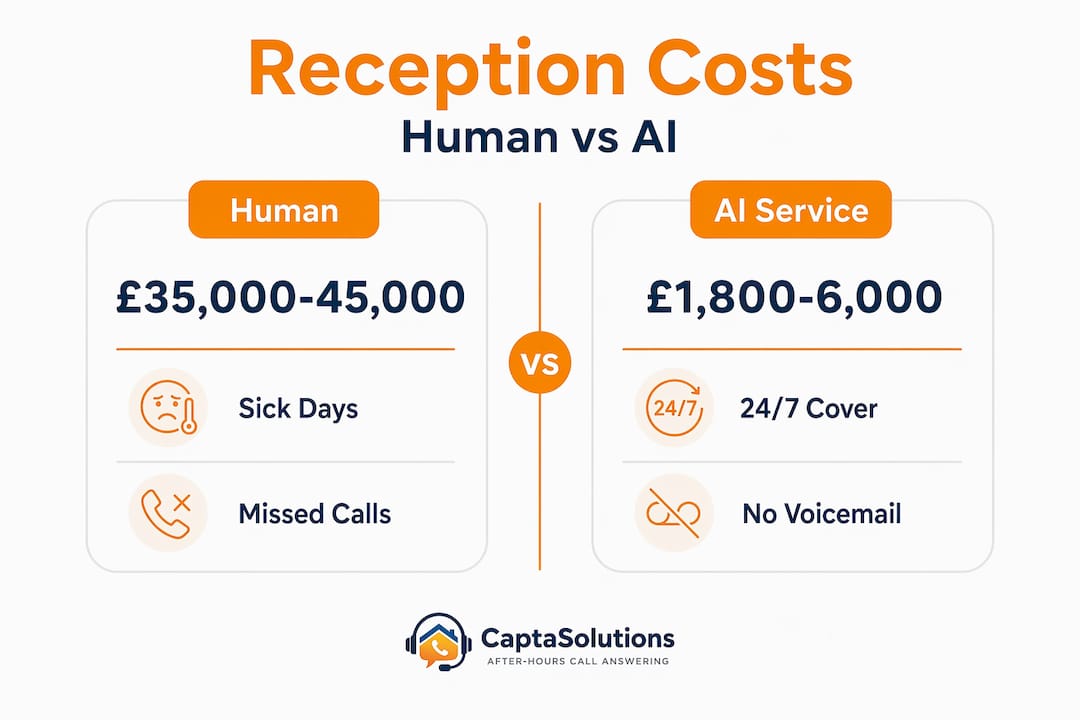
The percentage saving is not marginal. It is transformational. For most UK small businesses, this represents £30,000 or more redirected back into operations, marketing, or growth.
Hidden costs: missed calls and coverage gaps
Salary is only one part of the equation. The coverage problem is where human receptionists silently bleed revenue.
A person can handle one call at a time. They go on lunch. They take annual leave. They call in sick. They leave at 5pm. Every one of those moments is a window where your phone rings and nobody answers. Up to 62% of calls during peak times go unanswered, and the caller does not wait. They move on to the next business in their search results.
AI receptionists operate 24 hours a day, seven days a week, with no breaks and no gaps. They answer every call simultaneously, which matters enormously for busy periods. A plumber on a job, a salon mid-service, or a restaurant in the middle of a Saturday evening rush cannot afford to drop calls. The financial impact of AI eliminating missed calls has been measured at a 40% to 60% reduction in front desk operational costs, with some workloads seeing reductions of up to 84% to 96% where repetitive, high-volume tasks dominate.
The automation of routine tasks compounds the saving further. A well-configured AI receptionist handles:
- Appointment booking and rescheduling directly into your calendar
- FAQ responses covering opening hours, pricing, and availability
- Call triage and basic qualification before escalation to staff
- Call notes pushed into your CRM without manual data entry
Integrated AI receptionists that connect directly with scheduling and CRM systems reduce admin effort substantially more than basic call-answering tools. The admin time saved across a week adds up to hours that your team gets back to focus on billable work.
Pro Tip: Track the number of voicemails and missed calls your business receives in a single week. That figure, multiplied by your average job value, gives you a concrete estimate of the revenue currently walking out the door.
Operational considerations when implementing AI
Switching to an AI receptionist is not a case of flipping a switch and watching costs fall. The businesses that see the best results invest time upfront in configuration. Those that skip this step often find the AI shifts work back to humans rather than removing it.
Here are the key operational factors to address before going live:
-
Define what the AI handles fully versus what it escalates. Callers with complex or sensitive enquiries should reach a human quickly. Scripting these boundaries carefully, including urgency triggers and caller identification for existing clients, prevents costly errors and frustrated customers. Well-designed escalation paths are the single biggest predictor of a successful AI rollout.
-
Integrate with your scheduling and CRM systems from day one. An AI that answers calls but cannot book directly into your calendar or log notes to your CRM is only solving half the problem. The admin reduction from direct booking integration is where many of the non-salary savings come from.
-
Configure call routing to avoid abandonment. Callers who are immediately forwarded to an AI with long delays or silence will hang up. Routing calls to AI after three to four rings prevents abandonment while preserving the option for a human to answer first if available. Effective call routing protects revenue by keeping callers engaged rather than sending them to voicemail.
-
Plan for a hybrid model where appropriate. Not every call is suited to AI. Relationship-driven enquiries, large contract negotiations, and emotionally sensitive calls benefit from a human. A practical hybrid approach, where AI handles volume and out-of-hours calls while a part-time human covers complex interactions, maximises both savings and caller satisfaction.
Pro Tip: Build your AI knowledge base before launch by pulling your 20 most common caller questions from call logs or your reception team. Pre-loading these answers dramatically reduces the number of escalations in the first month.
Real-world applications for UK businesses
The businesses seeing the strongest returns from AI receptionists are those where call volume is high, hours are unpredictable, and staff cannot always be at a desk. Trades businesses, salons, clinics, restaurants, and professional services firms all fit this profile.
Consider a practical example. Replacing a £40,000 full-time receptionist with a combination of a £3,000 annual AI subscription and a £15,000 part-time human receptionist for complex calls brings the total front desk cost to £18,000. That is a saving of £22,000 per year from a single operational change, while maintaining human presence for the calls that genuinely need it.
The results reported by SMBs adopting AI receptionists are consistent. AI receptionist adoption produces 75% fewer missed calls and a 300% first-year ROI for small and medium businesses through increased bookings. Lead conversion rates improve from 49% to 70% when callers receive an immediate, informed response rather than reaching voicemail.
Beyond the numbers, there are specific scenarios where the impact on cost is direct and measurable:
- After-hours enquiries: A caller ringing a tradesperson at 7pm does not want voicemail. An AI that captures their details, qualifies the job, and flags it for morning follow-up converts cold enquiries into booked work that would otherwise be lost.
- Peak-time overflow: A salon or clinic handling a queue of clients in person cannot also manage a busy phone line. AI handles the overflow without requiring additional staff hours.
- Consistency of response: Human receptionists vary in quality depending on the day, mood, or experience level. AI delivers the same response, in your business name, every single time.
For business owners wondering how to cover business calls without staff, an AI receptionist is no longer an experimental option. It is a proven operational choice with documented returns.
You can explore how AI specifically supports trades and service businesses in this guide on call answering for UK tradespeople.
My perspective on where this is all heading
I have spoken with enough UK business owners to know that the biggest barrier to adopting an AI receptionist is not the cost. It is the assumption that "it won't sound like us" or "customers will know it's not human." Both concerns are legitimate at the low end of the market. But they are increasingly irrelevant when you are working with a well-configured, professionally built solution.
What I find most interesting is that businesses consistently underestimate the revenue side of this equation. They focus on cost reduction and miss the fact that answering every call, at any hour, converts callers who would have moved on. An AI receptionist is not just a cheaper receptionist. It is a receptionist who never loses you a lead.
The implementation work is where most businesses stumble. I have seen companies deploy AI and then wonder why nothing improved. Nine times out of ten, the escalation paths were never defined and the knowledge base was thin. The technology is not the challenge. The operational design is.
My honest advice: start with a trial, run it alongside your existing setup for 30 days, and measure missed calls before and after. The data will do the convincing for you. By 2030, I expect the majority of UK small businesses will use some form of AI call handling as a default. The question is whether you adopt it early enough to gain the competitive edge or follow when it is standard practice.
— Daniel
How Captasolutions helps UK businesses cut front desk costs
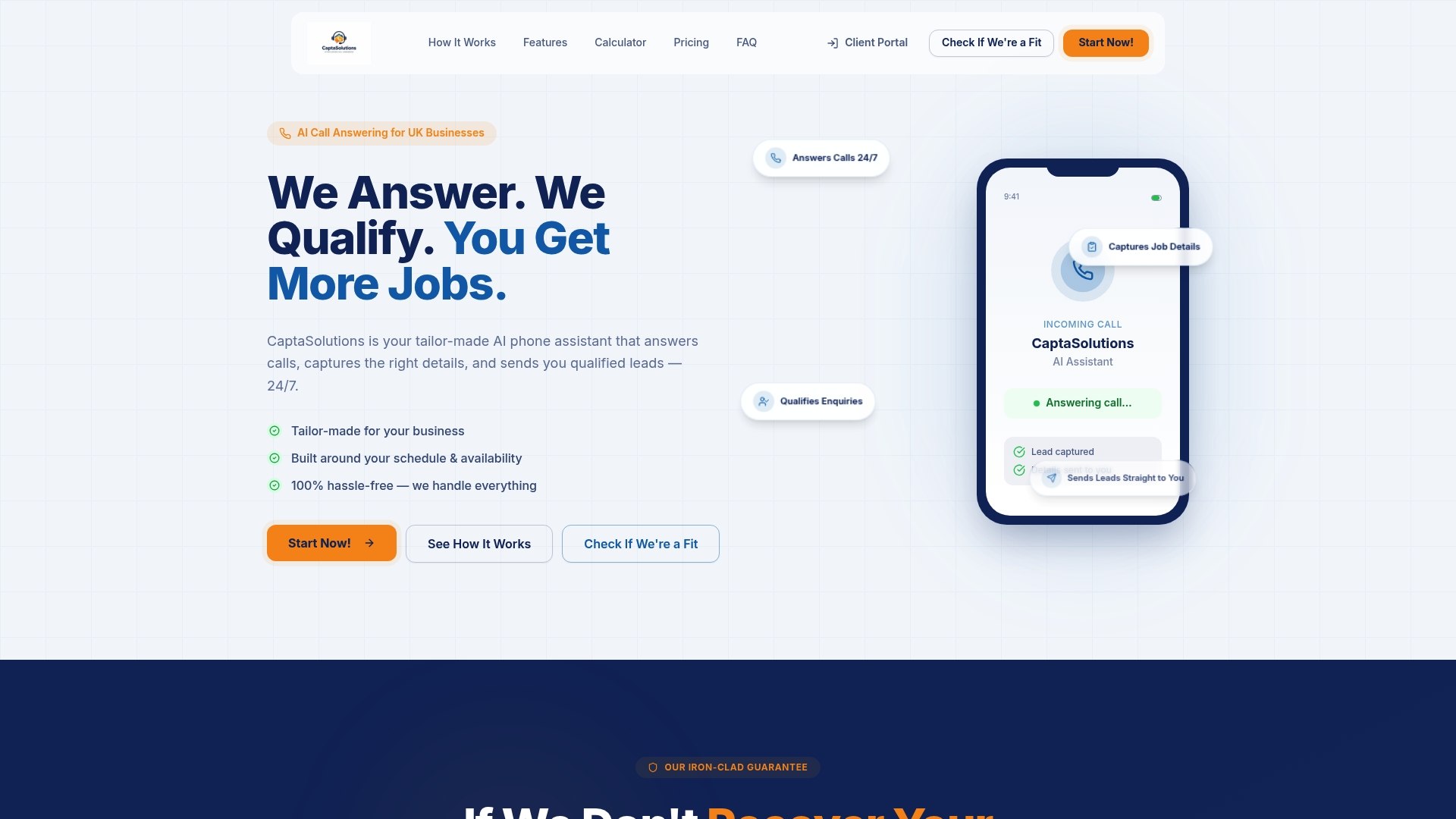
Captasolutions is an AI-powered call answering service built specifically for UK businesses that cannot afford to miss a call. Whether you run a trades business, a salon, a clinic, or a professional office, Captasolutions answers every call in your business name, 24 hours a day, seven days a week. It captures caller details, qualifies the enquiry, and organises everything into your client portal so you stay in control without being chained to a desk.
There are no contracts, no hidden fees, and no card required to get started. The service goes live within the hour and includes a free 30-day trial. For UK business owners who want to reduce receptionist costs without sacrificing call quality, Captasolutions delivers a practical, cost-effective solution that has already helped businesses across the country capture more leads and save thousands annually. Visit captasolutions.co.uk or call 07346 811329 to get started today.
FAQ
What is the typical cost saving of an AI receptionist vs a human?
UK businesses typically spend £35,000 to £45,000 per year on a full-time receptionist including all employer costs, compared to £1,800 to £6,000 for an AI service. The saving is typically between £28,000 and £42,000 per year.
Can AI receptionists handle calls as well as humans?
AI receptionists handle routine enquiries, bookings, FAQs, and call triage reliably and consistently. Complex, relationship-driven calls still benefit from a human, which is why many UK businesses use a hybrid model combining both.
How does AI help with missed calls and lost revenue?
Up to 62% of calls during peak periods go unanswered without AI cover. An AI receptionist answers every call simultaneously, eliminating missed calls and the revenue that walks away with them.
How difficult is it to set up an AI receptionist for a UK business?
Setup varies by provider, but quality solutions like Captasolutions can go live within an hour. The most important work is configuring escalation paths and the knowledge base, which determines how well the AI handles calls without human intervention.
Does AI work for small trades businesses and sole traders?
Yes. Trades businesses are among the primary beneficiaries because they are frequently on jobs and unable to answer calls. AI captures every lead, qualifies the enquiry, and logs it for follow-up, which directly protects revenue that would otherwise be lost to voicemail or unanswered calls.