

Every time you're up a ladder, under a sink, or mid-installation and your phone rings, you face an impossible choice: stop the job or miss the call. Up to 80% of calls to contractors go unanswered, and the vast majority of those callers move on without leaving a message. The call answering benefits for UK tradespeople from AI-powered services are now well-documented and financially significant. This article covers the criteria for choosing the right service, how these systems actually work on the ground, and how to make the decision that fits your business.
Table of Contents
- Key criteria to consider when choosing call answering for tradespeople
- How AI answering services work for UK tradespeople
- Top 5 benefits of AI call answering for UK tradespeople
- Comparing AI call answering options for tradespeople
- How to decide the right call answering solution for your trade business
- Why treating AI as a safety net is the smartest approach
- How CaptaSolutions can help tradespeople with call answering
- Frequently asked questions
Key Takeaways
| Point | Details |
|---|---|
| Prevent lost revenue | AI call answering captures calls you miss on job sites, protecting your income from lost opportunities. |
| Improve customer experience | Calls are answered promptly with relevant questions, reducing customer frustration and boosting trust. |
| Customised for trades | Trade-specific AI collects precise job details and routes emergencies appropriately for better service. |
| Save time and reduce stress | Automated call handling frees you from phone anxiety and administrative overhead. |
| Affordable solution | AI answering offers a cost-effective alternative to full-time receptionists for small trade businesses. |
Key criteria to consider when choosing call answering for tradespeople
Not all call answering services are built the same. A generic virtual receptionist reading from a script will frustrate a caller who wants to know whether you cover boiler repairs in their postcode. The service you choose needs to understand trades work, not just answer phones.
Here are the essential criteria to evaluate:
- Trade-specific intake questions. The AI should ask about job type, location, urgency, and access requirements. Generic chatbots ask for a name and email and stop there.
- Conditional call forwarding. The service should only intercept calls you cannot answer, not every call. You remain the primary point of contact.
- Emergency escalation. There must be a clear process for urgent jobs, such as a burst pipe or no heating in winter, that routes those calls to a live person immediately.
- CRM and scheduling integration. Captured lead data should feed directly into your existing systems, not sit in a separate inbox you have to check manually.
- Transparent pricing. Pricing models vary widely, from per-minute billing with a monthly minimum, to per-call buckets with overage charges, to flat monthly rates. Know what you are paying before you commit.
- Clear call handling rules. The AI must not promise appointment times, job costs, or availability it cannot confirm. Overpromising damages your reputation before you have even spoken to the customer.
Pro Tip: Ask any provider whether their system is built specifically for trades or adapted from a general customer service platform. The difference shows up immediately in the quality of the questions the AI asks callers.
A useful way to frame this is that a contractor answering service works best as a constrained intake mechanism: collecting the right job details and escalating complex cases to humans, rather than trying to handle everything autonomously.
How AI answering services work for UK tradespeople
With those criteria in mind, here is how a well-configured AI call answering service actually operates in practice.
- Conditional forwarding activates after 3 to 4 rings. If you answer, the call goes through normally. If you cannot pick up, it forwards to the AI. You stay in control of every call you are available for.
- The AI greets the caller in your business name. It does not announce itself as a bot. It answers professionally, collects the caller's name, number, job type, location, and urgency level.
- Urgency classification happens in real time. Most well-built systems use a four-tier model: routine enquiry, quote request, time-sensitive job, and emergency. Each tier triggers a different response.
- Emergencies escalate immediately. For tier-four calls, the system attempts to reach you or a designated colleague by phone or SMS before the caller hangs up.
- A structured handoff is sent to you. You receive a summary containing the caller's details, job description, urgency tag, and a full call transcript or audio log. Nothing is lost and nothing needs to be chased.
"An AI receptionist works best as a safety net handling overflow and after-hours calls, capturing caller information, and escalating emergencies to a human promptly." Stop Losing Leads on the Ladder
The four-piece handoff is what separates a useful service from a frustrating one. Structured data, a plain-English summary, an acknowledgement sent to the caller, and a full audit trail mean you can call back with context rather than asking the customer to repeat everything they already said.
Top 5 benefits of AI call answering for UK tradespeople
Having understood how AI answering functions, here are the concrete benefits it delivers for your trade business.
-
24/7 call capture without interrupting field work. Your business answers calls at 7am, during lunch, and at 9pm on a Sunday. You do not have to be available for any of those calls unless you choose to be.
-
Significant reduction in lost revenue. Missing just three calls a week can cost tradespeople thousands of pounds per month in lost job opportunities. Those are not just missed calls. They are missed jobs that went to a competitor who picked up.
-
Better customer experience from the first contact. Callers receive a professional greeting, have their details taken accurately, and get a confirmation that someone will be in touch. That first impression matters, particularly for new customers comparing multiple tradespeople.
-
Automated lead data and reduced admin. Every call is logged, tagged, and organised without you typing a single note. If your service integrates with your CRM or job management software, new leads appear there automatically.
-
Measurable return on investment. AI receptionists reduce missed calls from 15 to 25 per week down to 2 to 4, recovering between £1,500 and £3,200 in weekly revenue and delivering a return of 10 to 30 times the cost of the service at around £200 per month.
Pro Tip: Track your missed call rate for two weeks before signing up to any service. That number becomes your baseline, and it makes the ROI calculation straightforward once you start recovering those calls.
The fifth benefit is one that does not appear in most comparisons: reduced phone anxiety. Many tradespeople avoid answering unknown numbers mid-job because they cannot give the call proper attention. Knowing the AI is handling it removes that pressure entirely.
Comparing AI call answering options for tradespeople
Let's compare the key options so you can identify the best fit for your business.
| Option | Best for | Key features | Typical cost | Limitations |
|---|---|---|---|---|
| Live answering service | High-volume businesses needing human touch | Human receptionists, flexible scripting | £300 to £800/month | Expensive, inconsistent quality, limited hours |
| Dedicated AI receptionist | Most UK tradespeople | Trade-specific intake, CRM sync, 24/7 | £100 to £300/month | Requires setup and configuration |
| Generic virtual assistant | Very low call volumes | Basic message taking | £50 to £150/month | No trade knowledge, no escalation logic |
| In-house receptionist | Large trade businesses | Full control, relationship building | £2,000+/month | High cost, limited to working hours |
The dedicated AI receptionist sits in the strongest position for most sole traders and small trade businesses. It costs a fraction of a live service, operates around the clock, and can be configured with trade-specific knowledge that a generic platform simply does not have.
Key features to look for in any AI option:
- Emergency routing to a live number for urgent calls
- CRM integration so leads land in your job management system automatically
- Custom greeting using your business name
- Call recording and transcripts for quality control and dispute resolution
- Scalable pricing that does not penalise you for a busy week
Pricing models vary significantly across providers, so read the small print on overage charges before committing. A per-call model with a low included bucket can become expensive quickly during busy periods.
How to decide the right call answering solution for your trade business
Now that you know the options, here is how to make the best choice for your trade business.
- Calculate your current missed call cost. Estimate how many calls you miss per week and the average value of a job enquiry. Multiply those figures and you have a monthly revenue leak that any solution needs to address.
- Prioritise conditional forwarding. Any service that answers every call, rather than only the ones you miss, will interfere with your normal working pattern. Conditional forwarding is non-negotiable.
- Check integration with your existing tools. If you use job management software, a diary system, or a CRM, confirm the answering service can connect to it. Manual data entry defeats the purpose.
- Evaluate total cost of ownership. Include setup fees, monthly subscription, and any overage charges. A £99/month plan with £2 per call overage can cost significantly more during a busy month.
- Start with AI as a safety net, not a full replacement. Deploy it for overflow and after-hours calls first. Once you trust the system and have refined the intake questions, you can extend its role.
Pro Tip: Run a free trial during a genuinely busy period, not a quiet week. The service needs to prove itself when call volume is high and you are least able to answer the phone yourself.
Why treating AI as a safety net is the smartest approach
There is a temptation, once you see how capable AI call answering has become, to hand over all call handling and walk away. That instinct is understandable. It is also the fastest way to damage customer trust.
The tradespeople who get the most value from these services are the ones who deploy AI with clear boundaries. The AI captures, classifies, and escalates. Humans make commitments, confirm appointments, and handle anything that requires judgement. That division of labour is not a limitation. It is the correct architecture.
Over-promising full automation risks damaging trust. An AI that tells a caller "we can have someone with you by 3pm" when you have no idea what your afternoon looks like creates a problem that no amount of follow-up can fully fix. The caller feels misled. You spend the first minute of your callback managing their disappointment.
The smarter framing is this: every call the AI handles is a call you would have missed entirely. It is not replacing a conversation you would have had. It is recovering a lead that would have gone to voicemail and then gone to your competitor. That is a meaningful distinction. It keeps expectations realistic and it keeps the technology in a role it can genuinely fulfil.
UK tradespeople who treat AI answering as a permanent safety net rather than a full front-of-house solution consistently report better customer feedback and fewer complaints about miscommunication. The technology earns trust incrementally. That is the right pace.
How CaptaSolutions can help tradespeople with call answering
If missed calls are costing your trade business jobs and revenue, the practical next step is a service built specifically for businesses like yours.
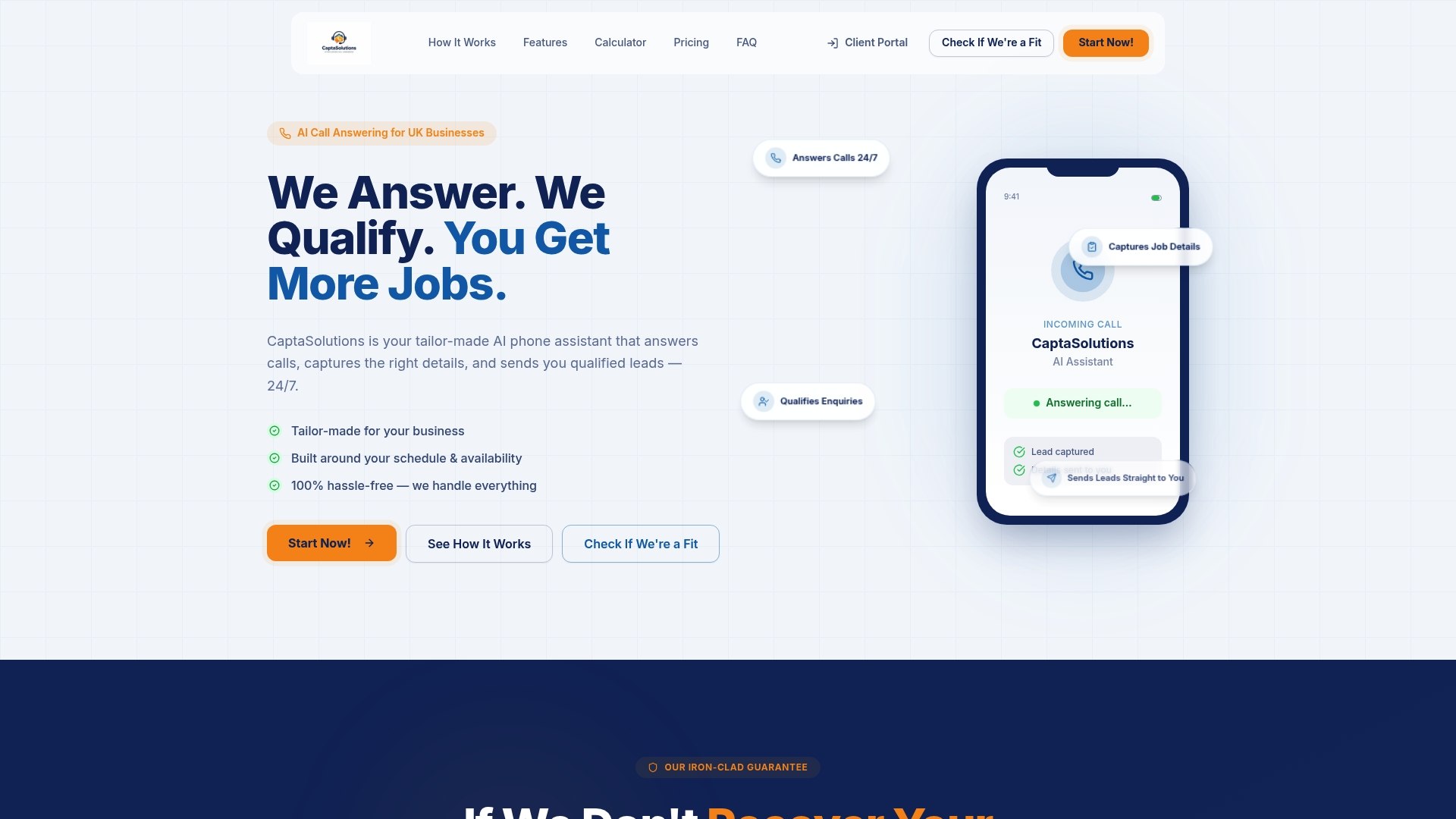
CaptaSolutions AI call answering is designed for UK tradespeople who cannot afford to miss a call while working on-site. The AI answers every call in your business name, 24 hours a day, seven days a week. It captures caller details, qualifies the enquiry, and organises everything into your client portal so you can review every lead and decide what to take on. Emergency escalation, CRM integration, and conditional forwarding are all included. There is no contract, no card required to start, and the service goes live within the hour. A free 30-day trial gives you the data to see exactly how many calls you were missing and what they were worth. Visit captasolutions.co.uk or call 07346 811329 to get started today.
Frequently asked questions
How does AI call answering benefit UK tradespeople on job sites?
AI call answering ensures no calls are missed while you work on-site by capturing lead details and escalating emergencies immediately. Up to 80% of calls go unanswered without a system in place, meaning a significant portion of your potential jobs are lost before you even know about them.
Can AI call answering services book jobs directly for tradespeople?
Most AI answering services capture lead information and schedule callbacks, but leave final job booking to humans. AI answering layers do not commit technicians or appointment times, as those remain human responsibilities to maintain accuracy and avoid overpromising.
Is AI call answering suitable for small trade businesses on tight budgets?
Yes, AI call answering is a cost-effective alternative to a full-time receptionist and delivers a strong return on investment. Missed calls cost thousands monthly, while AI call answering tools typically deliver 10 to 30 times the return at around £200 per month.
How should tradespeople set up call forwarding for AI answering services?
Use conditional forwarding so calls only reach the AI after 3 to 4 rings, keeping you as the primary answerer. Conditional call forwarding after 3 to 4 rings is the recommended setup to retain control while ensuring no call goes unanswered.