

Every missed call is a missed booking. For UK small businesses, that reality is more costly than most owners realise. Understanding how AI answers booking calls is no longer a matter of curiosity — it is a practical decision that directly affects revenue. AI voice assistants now handle enquiries, capture caller details, and confirm appointments without a human picking up the phone. Whether you run a plumbing firm, a hair salon, or a dental clinic, this guide explains exactly how the technology works and what it means for your business.
Table of Contents
- How AI handles booking calls and customer enquiries
- Key features of AI voice agents in managing booking calls
- The importance of smooth AI-to-human handoffs in booking calls
- How to apply AI answering calls solutions in your small business
- Why seamless AI answering is a game changer for UK small businesses
- Discover tailored AI call answering solutions with CaptaSolutions
- Frequently asked questions
Key Takeaways
| Point | Details |
|---|---|
| AI improves booking efficiency | AI can resolve a large portion of booking calls, reducing costs and missed opportunities. |
| Seamless AI-human transitions | Smooth handoffs with context preserve customer experience and reduce call abandonment. |
| Key AI features to consider | Multilingual support, policy adherence, and real-time escalation are essential for effective AI call handling. |
| Small businesses benefit greatly | AI enables small UK businesses to offer 24/7 service and compete with larger firms. |
| Choose tailored solutions | Selecting AI services fitting your business needs and policies ensures better results and trust. |
How AI handles booking calls and customer enquiries
To understand how AI answers booking calls, let's look first at the underlying technologies and real-world results.
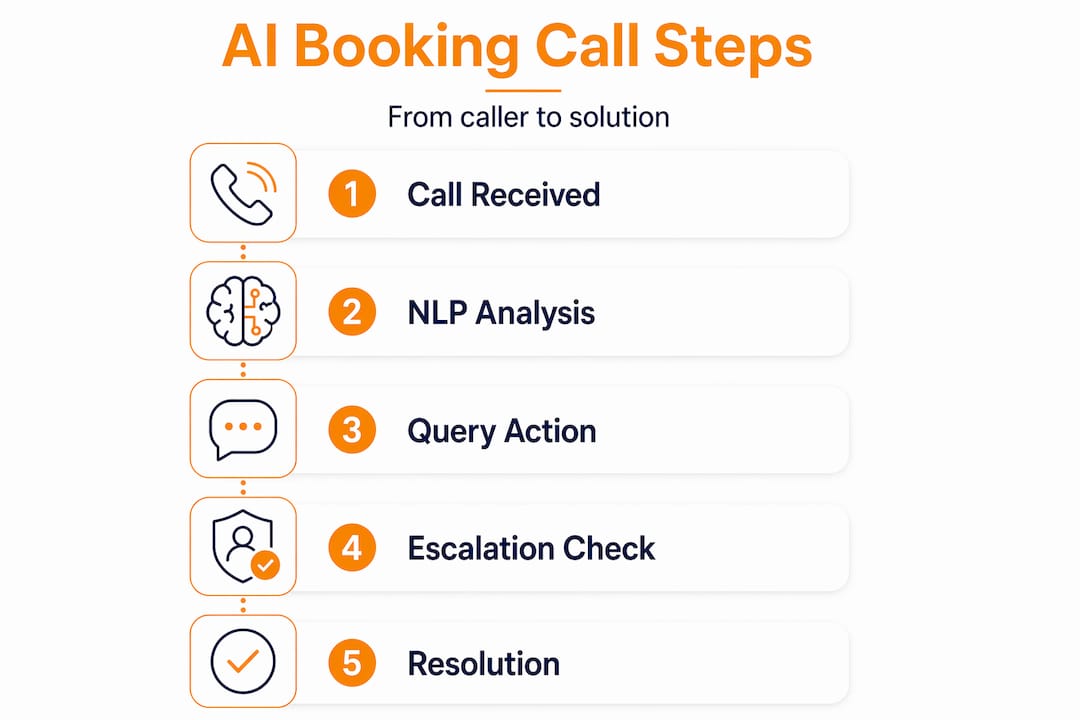
At the core of every AI call handling system is natural language processing, or NLP. This is the technology that allows a computer to understand spoken words in the same way a human receptionist would. When a caller says "I'd like to book a service for next Tuesday afternoon," the AI does not just hear words. It identifies the intent (booking), the time reference (next Tuesday afternoon), and the action required (check availability and confirm). That entire process happens in under a second.
AI-powered systems can handle bookings, cancellations, rescheduling, and general enquiries without any human involvement. They do not put callers on hold, they do not miss calls at 7pm on a Friday, and they do not forget to log the details. The results from larger companies using this technology are striking. Airbnb's AI assistant resolved 40% of customer enquiries, reducing cost per booking by 10% year over year. That is not a marginal gain. That is a structural shift in how customer service operates.

Travel platforms have seen similarly strong outcomes. Expedia reported over 30% of 250 million interactions powered by AI, reducing wait times during high-demand periods. For a small business fielding dozens of calls per week, even a fraction of that efficiency would be transformative.
The key benefit for small business owners is this: AI handles the routine interactions so that when a call genuinely needs a human, the human is available and focused.
- AI identifies caller intent from natural speech
- Automated booking systems confirm appointments in real time
- Cancellations and rescheduling are handled without staff involvement
- Enquiries about pricing, availability, and services are answered instantly
- Every interaction is logged automatically for review
"The most effective AI systems do not replace the human element. They protect it by removing the volume of routine calls that exhaust staff and cause missed opportunities."
Key features of AI voice agents in managing booking calls
With an understanding of the technology landscape, let's explore the specific features that make AI voice agents effective for booking calls.
Not all AI call answering technology is built the same. The best systems share a set of features that directly determine whether callers have a positive experience or hang up in frustration. Here is what to look for.
-
End-to-end booking management. A capable virtual assistant for bookings does not just take a message. It checks availability, confirms the appointment, sends a follow-up, and updates your calendar. Zendesk voice AI agents manage bookings end-to-end, escalate unresolved calls immediately, and create detailed tickets for tracking.
-
Instant escalation to a human. When a caller asks something outside the AI's scope, or simply requests to speak to a person, the system escalates immediately. There is no loop, no delay, no dead end.
-
Multi-turn conversation memory. A caller might say "I want to book for next week" and then add "actually, make it the week after." A good AI system tracks the full conversation and updates its understanding accordingly, rather than treating each sentence as a new request.
-
Policy-based accuracy. This is where many businesses underestimate the work involved. Effective AI customer service requires training on nearly 100 policies and millions of data points for accuracy and compliance. Your AI needs to know your cancellation terms, your service areas, your pricing, and your availability rules before it can handle calls reliably.
-
Multilingual capability. For businesses serving diverse communities across the UK, the ability to handle calls in multiple languages is a practical advantage, not a luxury.
Pro Tip: Define clear escalation triggers before you go live. Decide exactly when the AI should hand a call to a human — for example, when a caller mentions a complaint, requests a refund, or asks a question the AI answers with low confidence. Getting this right from the start prevents customer frustration.
The importance of smooth AI-to-human handoffs in booking calls
Understanding AI's capabilities is vital, but equally important is how it hands off complex calls to humans without losing customer context.
One of the most common complaints about automated phone systems is having to repeat yourself. A caller who has already explained their situation to an AI should never have to explain it again to a human agent. This is not just an inconvenience — it erodes trust and signals disorganisation.
Modern AI-to-human handoff systems solve this by passing a full conversation summary to the human agent before they even say hello. The agent sees the caller's name, their enquiry, what the AI attempted, and why escalation was triggered. Twilio's AI-human handoff preserves conversation context to avoid customers repeating information, directly improving satisfaction scores.
The business case for getting this right is clear. Delays or poor escalation cause 20-30% hang-up rates, while warm handoffs with summaries reduce this significantly. For a small business where every caller is a potential booking, a 20% hang-up rate is not an abstract statistic. It is real revenue walking out the door.
- Escalation should trigger immediately when a caller requests a human
- The AI should pass a written summary of the conversation to the agent
- Customer history from your CRM should be visible to the agent at the point of transfer
- Low confidence scores from the AI should automatically flag for escalation
- Agents should never ask a caller to repeat information already captured
"A warm handoff is not a technical feature. It is a customer experience decision. Businesses that treat it as an afterthought pay for it in abandoned calls and negative reviews."
How to apply AI answering calls solutions in your small business
Having covered AI technology and best practices, here is how to implement and benefit from AI answering calls in your business.
The gap between understanding AI call handling and actually deploying it is where many small business owners stall. The steps below are practical and sequenced to avoid the most common mistakes.
-
Audit your current call volume and patterns. Before selecting any system, know how many calls you receive per day, when your busiest periods are, and what percentage of calls are routine bookings versus complex enquiries. This data shapes every decision that follows.
-
Identify your compliance requirements. UK businesses must comply with GDPR when capturing and storing caller data. Any AI system you choose must process data lawfully, store it securely, and give callers clear information about how their data is used. This is non-negotiable.
-
Choose a system with genuine handoff capability. Not every automated booking system supports smooth AI-to-human transfer. Confirm this before committing. A system that traps callers in an automated loop is worse than no system at all.
-
Train the AI on your specific business. Feed it your service list, your pricing, your availability rules, your cancellation policy, and your geographic coverage. The more it knows about your business, the more accurately it represents you.
-
Track the metrics that matter. Resolution rate (how many calls the AI handles without escalation), customer satisfaction, and call abandonment rate are your three core indicators. AI-powered filters and servicing agents increase repeat bookings and customer conversion — but only when the system is properly configured and monitored.
| Feature | Why it matters | What to check |
|---|---|---|
| 24/7 availability | Captures calls outside business hours | Confirm always-on operation |
| Booking confirmation | Reduces no-shows and admin | Real-time calendar integration |
| GDPR compliance | Legal requirement in the UK | Data storage and processing policy |
| Escalation to human | Handles complex calls correctly | Escalation trigger configuration |
| CRM integration | Personalises customer experience | Compatible platforms listed |
| Multilingual support | Serves diverse caller base | Languages supported |
| Call recording and logging | Audit trail and quality review | Access via client portal |
Using AI for appointment scheduling is not a set-and-forget decision. Review your metrics monthly, update the AI's knowledge base when your services or pricing change, and refine escalation triggers based on what you observe.
Why seamless AI answering is a game changer for UK small businesses
Here is the perspective that most articles on this topic miss entirely.
The conversation about AI in customer service tends to focus on large enterprises. Call centres with hundreds of agents. Platforms processing millions of interactions. That framing is misleading for small business owners, because the relative impact of AI is actually greater at the small end of the market.
A national hotel chain that misses 5% of calls has a problem. A sole-trader plumber who misses 5% of calls has a crisis. The stakes per call are higher, the staff buffer is smaller, and the cost of a missed booking hits the bottom line directly. Over 80% of routine interactions can be autonomously resolved by AI while maintaining context and integrating with CRM systems. For a small team, that figure represents the difference between keeping up and falling behind.
There is also a trust dimension that rarely gets discussed. Callers who reach a professional, responsive AI system at 8pm on a Sunday form a different impression of your business than callers who hit voicemail. Consistency builds credibility. An AI that answers in your business name, captures the enquiry accurately, and follows up promptly signals that you take your customers seriously, regardless of whether you personally answered the phone.
The businesses that will benefit most from AI call answering technology are not the ones with the biggest budgets. They are the ones willing to invest time upfront in training the system properly and monitoring its performance. A virtual assistant for bookings that knows your business inside out is more valuable than a generic system with impressive features you never configure.
Pro Tip: Invest in training your AI on your unique business policies from day one. A system that knows your specific cancellation terms, service areas, and pricing will outperform a generic one every time, regardless of the underlying technology.
AI tools genuinely allow small teams to compete with larger companies on customer service quality. That is not marketing language. It is a structural shift in what is possible for a business of five people.
Discover tailored AI call answering solutions with CaptaSolutions
If you are ready to enhance your booking calls with AI, CaptaSolutions provides expert solutions designed for businesses like yours.
CaptaSolutions is an AI-powered call answering service built specifically for UK small businesses that cannot afford to miss a call. Whether you are a tradesperson mid-job, a salon with a full appointment book, or a clinic outside office hours, the system answers every call in your business name, captures the caller's details, qualifies the enquiry, and organises everything into your client portal. You stay in control of every lead. Explore AI call answering solutions from CaptaSolutions and get live within the hour. Free 30-day trial, no card required, no contract.
Frequently asked questions
How accurate is AI in answering booking calls compared to human agents?
AI voice agents autonomously resolve over 80% of routine booking call interactions accurately, escalating complex issues to humans when needed, which ensures consistent service quality without requiring a full-time receptionist.
Can AI assistants handle multilingual booking calls?
Yes. Leading AI assistants are multilingual, allowing them to manage calls in multiple languages and serve the diverse customer base that many UK businesses work with daily.
What happens if the AI cannot resolve a booking call?
AI escalates unresolved calls immediately to a human agent with full conversation context, so the caller never has to repeat themselves and the handoff feels professional rather than disjointed.
How can small businesses implement AI answering services effectively?
Start by auditing your call volume, confirm the system is GDPR-compliant, train it thoroughly on your business policies, and track resolution rate and call abandonment monthly to measure and improve performance over time.