
For UK sole traders and small business owners, the challenge of how to cover business calls without staff is one of the most persistent operational headaches. You cannot be on a job, serving a customer, or taking a break while also answering every incoming call. Miss one, and that potential client is already dialling the next number on their search results. Fortunately, modern business phone services, automated call handling technology, and virtual assistant for calls solutions have made it entirely possible to maintain professional, reliable call coverage without paying a full-time salary.
Table of Contents
- Understanding call forwarding and routing essentials
- Preparing to cover calls without staff: tools and prerequisites
- Step-by-step setup of call forwarding to cover business calls
- Avoiding common pitfalls and ensuring reliable call coverage
- Verifying the setup and measuring success for your call coverage system
- Rethinking call coverage without staff: new possibilities and pragmatic tips
- Cover your business calls seamlessly with CaptaSolutions
- Frequently asked questions
Key Takeaways
| Point | Details |
|---|---|
| Call forwarding basics | Call forwarding lets you redirect business calls to mobiles, extensions, or answering services to ensure coverage without staff. |
| Careful configuration needed | Match forwarding ring timeout with voicemail pickup to avoid missed calls from voicemail conflicts. |
| Tools and options vary | Small businesses can combine hosted VoIP, virtual receptionists, and AI answering to cover calls cost-effectively. |
| Regular testing essential | Testing and monitoring call handling helps fine-tune settings to maintain reliable coverage and customer satisfaction. |
| Innovate with AI | Emerging AI assistants offer scalable 24/7 support to supplement traditional call forwarding and virtual answering. |
Understanding call forwarding and routing essentials
Having outlined the problem, let's explore the key call forwarding features you will rely on to cover business calls without staff.
Call forwarding (sometimes called call diverting) is the process of redirecting an incoming call from your main business number to another destination. That destination could be your mobile, a colleague's phone, an answering service, or an automated system. The goal is simple: ensure no call goes unanswered, regardless of whether you are available.
There are three main forwarding types you should understand:
- Unconditional forwarding: Every call is immediately redirected to another number, regardless of whether the original line is engaged or idle.
- No-answer forwarding: Calls are diverted only if the original number is not answered within a set number of rings. This is the most commonly used type for small businesses.
- Busy forwarding: Calls are redirected only when the original line is already in use.
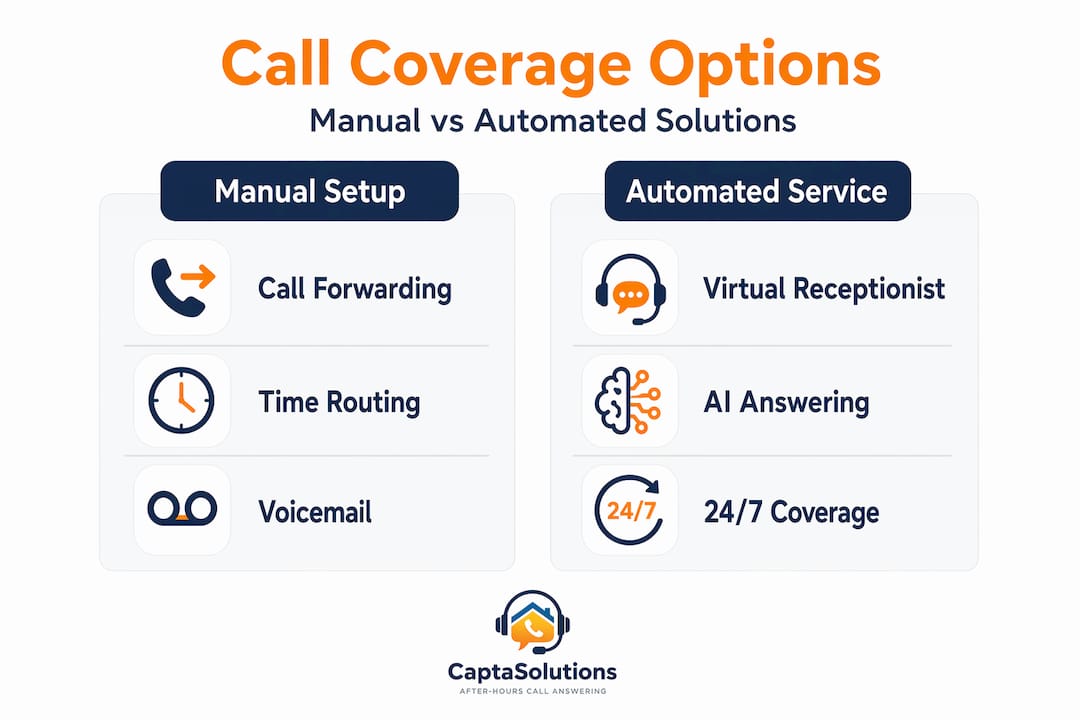
Beyond these basics, modern cloud phone systems give small businesses access to features that were once only available to large corporations. UK businesses can cover calls without staff using call divert and more advanced VoIP routing features such as time-based routing and auto-attendants. Time-based routing sends calls to different destinations depending on the time of day, so your business number behaves differently at 9am on a Monday than at 7pm on a Friday. Simultaneous ring dials multiple numbers at once, and hunt groups work through a list of numbers in sequence until someone answers.
For handling customer calls efficiently, the right forwarding setup can make a sole trader appear as capable as a business with a full reception team.
Preparing to cover calls without staff: tools and prerequisites
Now that you understand call forwarding basics, let's look at the tools and preparations needed to effectively cover calls without staff.
The essentials you need to get started are straightforward:
- A hosted VoIP (Voice over Internet Protocol) phone system or cloud phone service with a web-based management portal
- A mobile phone or secondary device to receive forwarded calls
- A clear understanding of your VoIP plan's call allowances
- A chosen answering destination, whether that is your own mobile, a virtual receptionist, or an AI-powered service
The cost issue is one most providers understate. Calls forwarded to external numbers such as mobiles, landlines, or answering services may incur additional charges under certain VoIP plans. Before configuring any forwarding rules, check what your plan covers. Forwarding ten calls a day to a mobile could add up meaningfully over a month if those minutes are not included.
For businesses that want a more professional setup, external answering services and AI-powered virtual assistants offer a reliable layer beyond simple forwarding. Here is how the main options compare:
| Option | Typical monthly cost | Coverage hours | Key features |
|---|---|---|---|
| Basic call forwarding | £0 to £10 (included in most VoIP plans) | Business hours only | Redirects calls to another number |
| Virtual receptionist service | £50 to £300+ | Extended or 24/7 | Live human answering, message taking |
| AI-powered answering service | £30 to £150 | 24/7 | Automated answering, lead capture, FAQ handling |
For small business phone system options, choosing the right tier depends on your call volume, budget, and how important personalised handling is to your customers.
Step-by-step setup of call forwarding to cover business calls
With the necessary tools ready, follow these steps to set up your call forwarding for reliable coverage without staff.
- Log in to your hosted VoIP portal or app. Most cloud phone providers give you a browser-based dashboard where all settings are managed. No engineer visit is required.
- Select your forwarding type. Decide between unconditional, no-answer, or busy forwarding. For most small businesses, no-answer forwarding is the right starting point.
- Enter your forwarding destination. This could be your mobile number, a colleague's extension, or the number provided by your virtual assistant or AI answering service.
- Set your ring timeout. This is the number of seconds the original line will ring before the call is diverted. Four to six rings is standard. Do not set it too short, or callers will feel rushed.
- Save your changes. Forwarding settings take effect immediately in most hosted VoIP systems, so you can test straight away.
- Test the configuration. Call your business number from a separate mobile and confirm the call reaches the forwarding destination correctly.
For out-of-hours coverage, configure time-based routing so that calls placed after 6pm automatically go to an answering service or AI system rather than ringing unanswered. For busy lines, set busy forwarding to a secondary number or a voicemail with a professional greeting.
Pro Tip: Match your forwarding ring timeout carefully with your voicemail pickup delay. If your voicemail activates at 20 seconds and your forwarding is set to trigger at 25 seconds, voicemail will answer first and your forwarding rule will never fire. Set forwarding to trigger at least five seconds before voicemail kicks in.

For a call forwarding system setup tailored to your business type, getting the timeout sequence right is the single most important configuration step most small businesses overlook.
Avoiding common pitfalls and ensuring reliable call coverage
Having set up forwarding, it is vital to avoid these common mistakes to ensure reliable call coverage without staff.
The most frequent issues small businesses encounter are:
- Voicemail conflicts: Forwarding timeout not set relative to voicemail pickup causes calls to land in voicemail before forwarding can trigger.
- Missed calls despite forwarding being active: Often caused by unconditional forwarding sending calls to a mobile that is itself on silent or engaged.
- Unexpected charges: Forwarding to mobile numbers on a plan without inclusive minutes generates costs that accumulate quickly.
- Testing neglect: Many businesses configure forwarding once and never check it again, only discovering it has stopped working when a customer mentions it.
"Businesses that miss calls lose significant revenue. Research shows that up to 85% of people whose calls go unanswered will not call back, choosing a competitor instead."
Synchronising your ring timeout with voicemail is not just a technical detail. It is the difference between a customer reaching your answering service and a customer hearing a generic voicemail and hanging up. Review your call logs weekly to check the ratio of answered calls to missed ones.
Pro Tip: Use simultaneous ring thoughtfully. Ringing your mobile and a colleague's phone at the same time improves the chance of someone answering, but if both parties are available, the first to pick up wins. Brief whoever is on the simultaneous ring list so they know how to handle calls professionally.
For guidance on troubleshooting call coverage issues, reviewing your system logs is always the first step. Patterns in missed calls often reveal configuration gaps you would not otherwise spot.
Verifying the setup and measuring success for your call coverage system
Once the system is live, verifying its performance helps maintain excellent call coverage without staff.
Follow these steps to confirm your setup is working as intended:
- Call from an external mobile to your business number and time how long before the forwarding triggers.
- Test each forwarding scenario individually: no-answer, busy, and out-of-hours if you have configured time-based routing.
- Review your call logs in your VoIP portal. Most systems show answered versus missed call data, which gives you a clear picture of how many enquiries are getting through.
- Check your monthly bill for unexpected forwarding charges and compare against your plan allowances.
- Adjust settings based on patterns. If you notice a cluster of missed calls between 12pm and 2pm, consider adding lunch-hour forwarding to an answering service.
Call forwarding settings can be reconfigured via web portal with immediate effect, which means you can adapt quickly without waiting for technical support. Here is a practical verification checklist:
| Check item | What to confirm |
|---|---|
| Forwarding trigger | Call diverts after correct number of rings |
| Destination answered | Forwarding destination picks up reliably |
| Timeout accuracy | Forwarding fires before voicemail activates |
| Voicemail fallback | Voicemail activates only when forwarding fails |
| Out-of-hours routing | After-hours calls reach the correct destination |
| Cost review | No unexpected charges from external forwarding |
For monitoring call system performance long-term, monthly log reviews combined with quarterly configuration checks will keep your coverage consistent as your business changes.
Rethinking call coverage without staff: new possibilities and pragmatic tips
Basic call forwarding solves one problem: it ensures your phone does not simply ring out. But it does not solve the bigger issue, which is what happens when the call reaches its destination and nobody picks up. A forwarded call to an unattended mobile is barely better than no forwarding at all.
This is where most advice on ways to manage calls solo stops short. The conversation tends to focus on technical configuration and ignores the actual caller experience. A customer who is forwarded to a mobile voicemail does not know they reached a "forwarding destination." They know they did not speak to anyone, and they move on.
Virtual receptionist services address this by placing a real person at the end of the forwarding chain. The cost is higher than basic forwarding, but the conversion rate on answered calls is significantly better because the caller feels heard. For businesses where each enquiry is worth hundreds or thousands of pounds, such as trades, legal, or medical, this is not an optional extra.
The more interesting development is the emergence of AI-powered answering services that can sit at the end of your call routing and handle routine enquiries, book appointments, and reduce dependence on human staff while maintaining a professional tone. These are not the clunky interactive voice response systems of ten years ago. Modern AI call handling captures caller details, qualifies the enquiry, and organises the information for you to review. The caller rarely realises they are not speaking with a member of your team.
The pragmatic approach for most UK small businesses is a layered one. Start with call forwarding to your mobile during working hours. Add an AI answering service for out-of-hours calls and for moments when you cannot answer. Reserve a virtual receptionist service for high-value leads that need a personal touch. This combination gives you reliable coverage at a fraction of the cost of a full-time member of staff, and it scales naturally as your call volume grows. Modern call handling solutions built on this layered model are where the industry is heading, and small businesses that adopt them early gain a clear advantage over those still relying on voicemail.
Cover your business calls seamlessly with CaptaSolutions
With these insights, CaptaSolutions can help you implement effective call coverage solutions tailored for your small business.
Configuring call forwarding correctly is a strong foundation. But if no one answers at the forwarding destination, or your after-hours calls are still going to voicemail, you are still losing business.
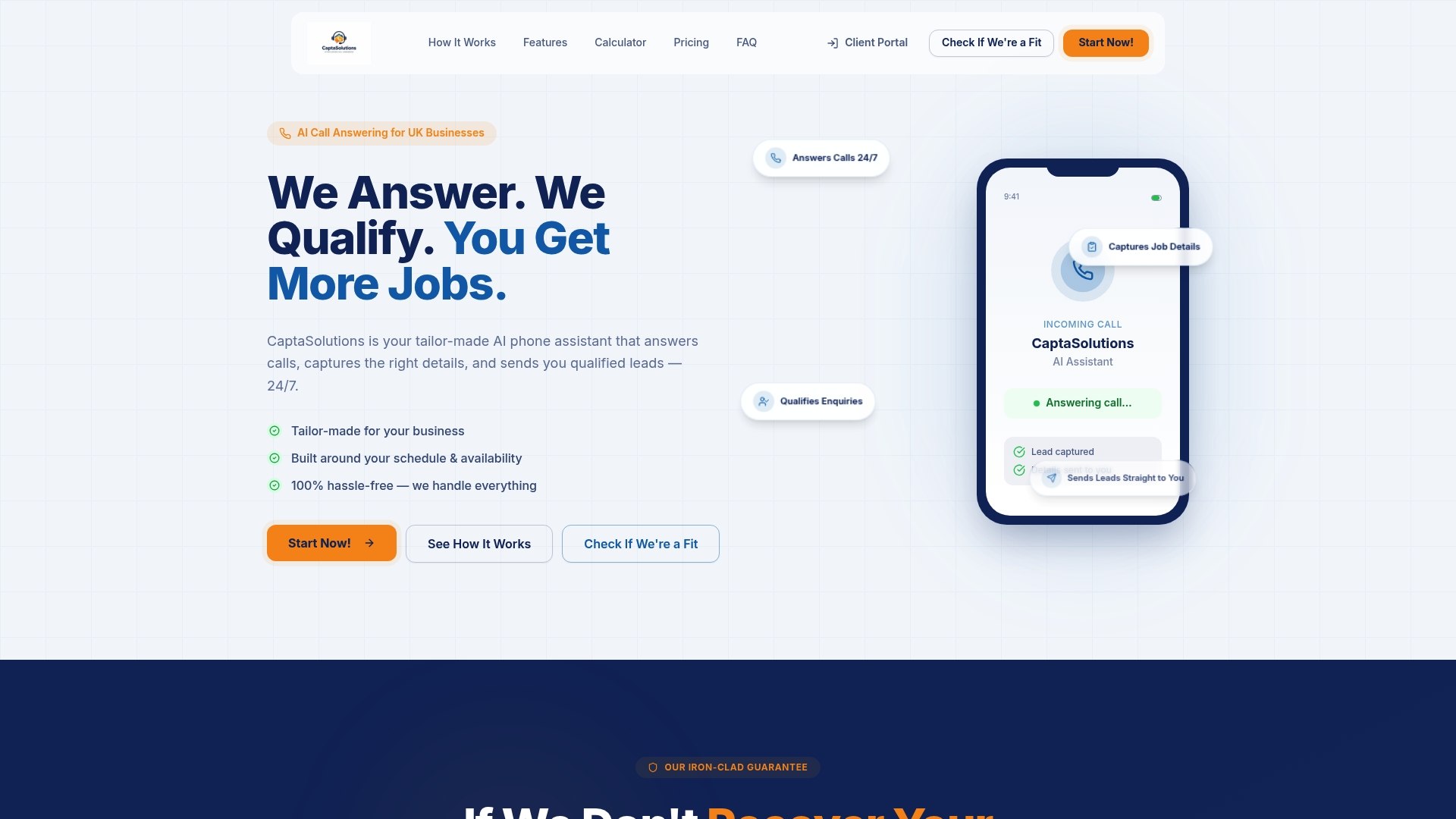
CaptaSolutions is an AI-powered call answering service built specifically for UK businesses that cannot afford to miss a call. Whether you are a tradesperson mid-job, a salon with clients in the chair, or a professional office after hours, CaptaSolutions answers every call in your business name, 24 hours a day, 7 days a week. It captures caller details, qualifies the enquiry, and organises everything into your client portal. You stay in control without needing to be available every minute. There is a free 30-day trial with no card required and no contract. Visit captasolutions.co.uk or call 07346 811329 to go live within the hour.
Frequently asked questions
Can I cover business calls without hiring full-time staff?
Yes, you can use call forwarding, virtual receptionist services, or AI answering systems to handle calls without full-time staff efficiently. UK businesses can cover calls without staff using call divert, VoIP routing features, and auto-attendants.
What is the most common type of call forwarding used by small businesses?
No-answer forwarding, which diverts calls if the initial number is not answered within a set time, is the most commonly used forwarding type. If you do not answer within a set number of rings, the call is forwarded to another number automatically.
How can I prevent my forwarded calls from going to voicemail unexpectedly?
Ensure your forwarding ring timeout is shorter than your voicemail pickup time to avoid calls ending up in voicemail unexpectedly. Forwarding timeout not set relative to voicemail pickup is one of the most common causes of missed calls despite forwarding being active.
Are there cost implications when forwarding calls to mobiles or external numbers?
Yes, forwarding calls to mobiles or external numbers may incur additional charges depending on your VoIP plan's call allowances. Ensure your VoIP plan includes appropriate call allowances to avoid unexpected costs from external forwarding.
Can AI answering services replace human receptionists for small businesses?
AI answering services can handle routine enquiries and appointments effectively, but some businesses prefer combining them with virtual receptionists for personalised care. AI answering services extend coverage without adding headcount by handling calls, FAQs, and scheduling with professionalism.