

AI phone answering is defined as an automated call handling service that uses natural language understanding to answer, qualify, and route inbound calls without human intervention. For UK business owners who want to switch to AI phone answering, the core benefit is immediate: every call gets answered, every time, regardless of whether you are on a job, with a client, or closed for the evening. Advanced platforms achieve 99% accuracy in intent detection, which means callers get the right response rather than a dead end. The technology works on top of your existing phone infrastructure, so there is no need to replace hardware or disrupt your current setup. For trades businesses, salons, clinics, and hospitality venues across the UK, that combination of accuracy, availability, and low disruption makes AI call handling a practical choice rather than a distant ambition.
What do you need before switching to AI phone answering?
The switch requires less preparation than most business owners expect. AI phone answering platforms are designed to sit on top of existing contact centre and business phone infrastructure, meaning no new hardware is required and your current phone number stays in place. The primary inputs the system needs are your business information: opening hours, pricing, frequently asked questions, and the types of enquiries you typically receive.
Before going live, gather the following:
- Your call data. Review the last three months of inbound calls. Identify the top ten reasons customers ring you. These become the foundation of your AI's intent recognition.
- Your FAQs and scripts. Write down how you would answer common questions. The AI learns from this content.
- CRM access. If you use a customer management system, CRM integration allows the AI to pull caller history and route contacts based on their account status or previous enquiries.
- Escalation contacts. Decide which call types must reach a human immediately, and provide the direct numbers or routing rules for those scenarios.
Pro Tip: Keep your initial FAQ list to 15–20 questions. A focused, well-trained AI outperforms a broadly configured one that has been given too much ambiguous information at once.
CRM integration is worth prioritising from the start. When the AI has access to caller data, it can personalise the interaction and pass structured context to your team when a handoff is needed. That context reduces the time your staff spend re-asking questions the caller has already answered.

How do you switch to AI phone answering step by step?
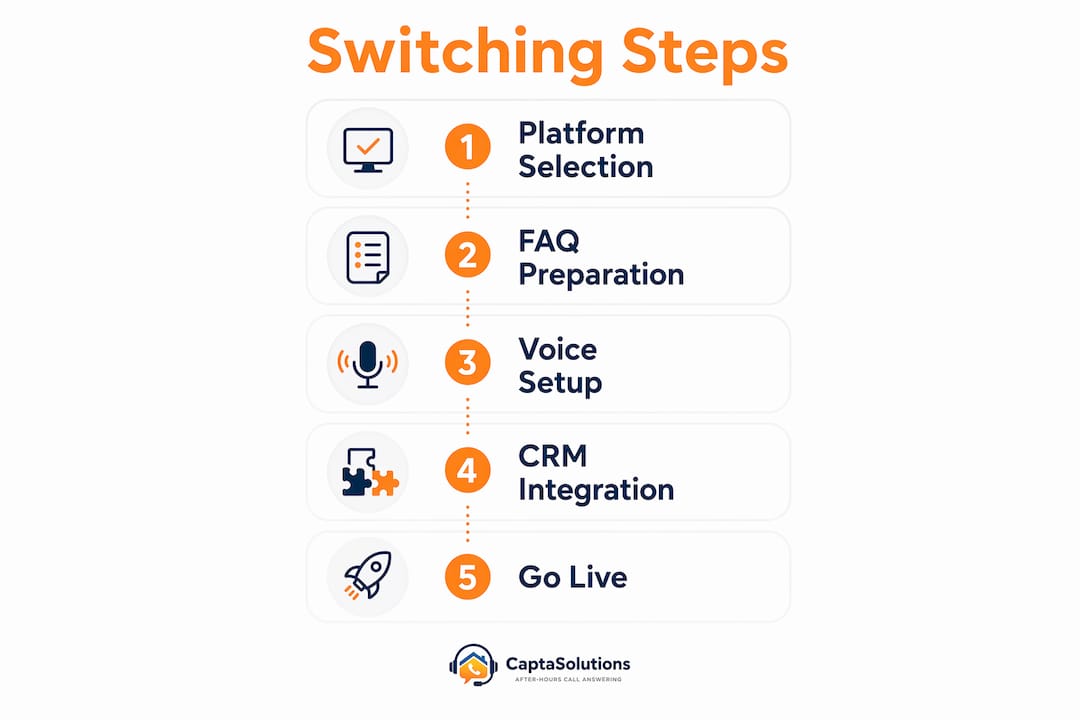
Switching to automated phone answering follows a clear sequence. Skipping steps, particularly testing, is the most common reason businesses experience a poor launch.
-
Select a platform based on your call volume and integration needs. Entry-level AI receptionist services suit businesses with straightforward enquiry types. Enterprise platforms handle complex routing, multi-department transfers, and deep CRM integration. Match the platform to your actual call patterns, not your aspirational ones.
-
Configure your greetings and call flows. Write your opening greeting in plain, conversational language. Avoid corporate scripts. Callers respond better to natural phrasing, and natural language interaction reduces call abandonment compared to rigid keypad menus.
-
Set up intent recognition rules. Define the categories of calls you receive: booking requests, pricing enquiries, complaints, emergencies. Assign each category a routing action, whether that is capturing a message, transferring to a mobile, or booking directly into your calendar.
-
Run demo calls and iterate. Call your own number and test every scenario. Record where the AI misinterprets intent. Adjust the training data and call flow rules before going live. Most platforms allow deployment within 60 days on existing infrastructure, but a focused business can be live within a week for simpler setups.
-
Launch with monitoring in place. Review call logs daily for the first two weeks. Flag any misrouted calls and retrain the AI on those examples. Set a fallback rule so that unrecognised intents transfer to a voicemail or a live number rather than dropping the call.
| Step | Action | Outcome |
|---|---|---|
| 1. Platform selection | Match features to call volume and complexity | Right fit from day one |
| 2. Greeting configuration | Write natural, conversational prompts | Lower call abandonment |
| 3. Intent rules | Define call categories and routing actions | Accurate call handling |
| 4. Demo testing | Test every scenario before launch | Fewer errors at go-live |
| 5. Live monitoring | Review logs and retrain daily for two weeks | Continuous improvement |
Pro Tip: Record your own voice for the greeting if the platform allows it. Callers who recognise a familiar tone are less likely to hang up when they realise they are speaking with an automated system.
What are the common challenges when switching to AI phone answering?
Transitioning to AI call handling surfaces predictable issues. Knowing them in advance means you can address them before they affect your customers.
- Initial misinterpretations. The AI will occasionally misread caller intent in the first week. This is normal. Log every misrouted call and use those examples to retrain the system. The accuracy improves quickly with real call data.
- Technical integration glitches. Connecting the AI to your existing phone system or CRM can produce routing errors if configuration settings are mismatched. Test every integration point before going live, not after.
- Customer experience concerns. Some callers will ask to speak to a person immediately. Build a clear escalation path into every call flow. Intelligent routing that passes full caller context to a live agent means the handoff feels natural rather than disruptive.
- Overly complex call flows. Business owners often try to automate every possible scenario at launch. Callers get confused when a menu has too many branches. Start with your top five call types and expand from there.
"The most effective AI phone answering systems are not the most complex ones. They are the ones trained on real call data, with clear escalation paths and a human fallback that carries full context. Businesses that launch with a simple, well-tested flow consistently outperform those that try to automate everything at once."
Balancing automation with personalisation is the central challenge of AI call handling. The goal is not to replace human interaction entirely. It is to handle routine calls automatically so your team can focus on the calls that genuinely need a person.
How do you maximise the benefits of your AI phone answering system?
Getting the system live is the beginning, not the end. The benefits of automated call answering compound over time when you actively use the data the system generates.
- Use call analytics weekly. Review which intents are being triggered most often. If a new question type appears repeatedly, add it to your FAQ and train the AI on it. The system gets more accurate with every update.
- Integrate your CRM from day one. Passing caller history to the AI allows it to greet returning customers by name and route them based on their account status. CRM-integrated routing reduces customer repetition and improves first-call resolution.
- Ensure handoffs carry full context. When a call transfers to a live agent, the agent should receive a structured summary of the conversation. This means the caller does not have to repeat themselves, which is one of the most common complaints in customer service.
- Update your scripts quarterly. Your pricing, hours, and services change. Your AI's knowledge base needs to reflect those changes. A quarterly review of your FAQ and call scripts keeps the system accurate.
- Use after-hours coverage actively. AI phone systems answer calls at 2AM as reliably as at 2PM. Configure your after-hours flow to capture lead details and send them to your client portal or CRM automatically. You can learn more about how AI receptionist systems work to make the most of this capability.
Pro Tip: Set a monthly calendar reminder to listen back to five random calls. You will spot patterns in caller language that no analytics dashboard will surface automatically.
The after-hours use case is particularly valuable for UK trades businesses and service providers. A caller who rings at 7PM on a Friday and gets a clear, helpful response is far more likely to book than one who reaches a voicemail. AI answering services provide consistent coverage during spikes and offline periods, using natural language rather than rigid menus.
Key takeaways
Switching to AI phone answering is the most effective way for UK business owners to reduce missed calls and improve customer engagement without adding headcount.
| Point | Details |
|---|---|
| No hardware needed | AI platforms run on existing phone infrastructure, so setup is fast and low cost. |
| Train on real call data | Use your top ten inbound call types to configure intent recognition from the start. |
| Test before going live | Run demo calls across every scenario and retrain on errors before launch. |
| CRM integration matters | Passing caller context to live agents reduces repetition and improves resolution speed. |
| After-hours coverage pays | Capturing leads at evenings and weekends converts callers who would otherwise move on. |
Why I think UK businesses are still underestimating this shift
Most of the business owners I speak with assume AI phone answering is either too expensive or too complicated for a small operation. Neither is true, and the misconception is costing them real revenue.
The businesses that hesitate longest tend to do so because they worry the AI will feel impersonal. What they discover after switching is the opposite. A caller who gets an immediate, accurate response at 8PM on a Sunday feels better served than one who reaches a voicemail that nobody checks until Monday morning. The AI does not replace the relationship. It protects the first impression.
The second misconception is that the transition requires a large IT project. For most UK small and medium businesses, the setup takes hours, not weeks. The real work is writing clear FAQs and deciding your call routing rules. That is work you should be doing anyway.
My honest view is that the businesses which will struggle most over the next few years are those still relying on a mobile that rings unanswered when the owner is busy. Every missed call is a completed booking for a competitor. The technology to fix that is available now, it works, and it costs less than a part-time receptionist.
— Daniel
Captasolutions: AI phone answering built for UK businesses
Captasolutions is an AI-powered call answering service built specifically for UK businesses that cannot afford to miss a call. Whether you run a trades business, a salon, a clinic, or a hospitality venue, Captasolutions answers every call in your business name, 24 hours a day, 7 days a week. It captures caller details, qualifies the enquiry, and organises everything into your client portal so you stay in control.
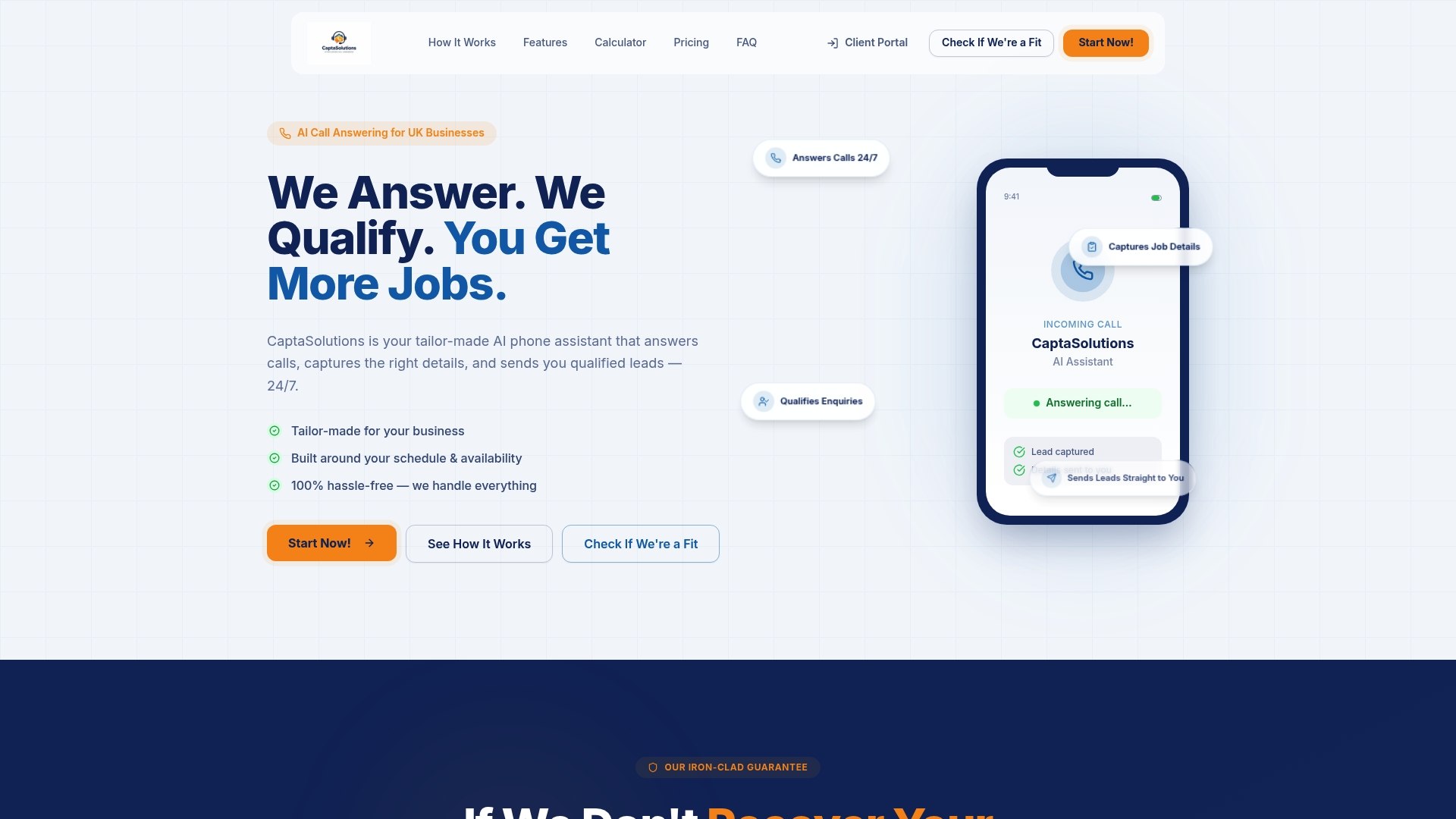
There is no new hardware to install, no contract to sign, and no card required to get started. The service goes live within the hour. Captasolutions offers a free 30-day trial so you can see the results before committing. Visit captasolutions.co.uk or call 07346 811329 to get started today.
FAQ
What is AI phone answering?
AI phone answering is an automated service that uses natural language understanding to answer inbound calls, capture caller details, and route enquiries without human intervention. It operates 24 hours a day, 7 days a week.
How long does it take to switch to AI phone answering?
Most businesses can go live within a day for simple setups. More complex integrations with CRM systems typically complete within a few weeks, and advanced platforms can deploy within 60 days on existing infrastructure.
Will callers know they are speaking to an AI?
Callers may or may not realise they are speaking with an AI, depending on how the greeting is configured. Natural language interaction reduces call abandonment because callers can speak freely rather than pressing keypad options.
Does AI phone answering work with my existing phone system?
Yes. AI phone answering platforms are designed to run on top of existing telecom infrastructure without requiring new hardware or changes to your current phone number.
Is AI phone answering reliable enough for customer-facing use?
Advanced AI voice platforms achieve 99% accuracy in intent detection, making them reliable for routine customer enquiries. A well-configured fallback to a live agent handles any calls the AI cannot resolve confidently.