
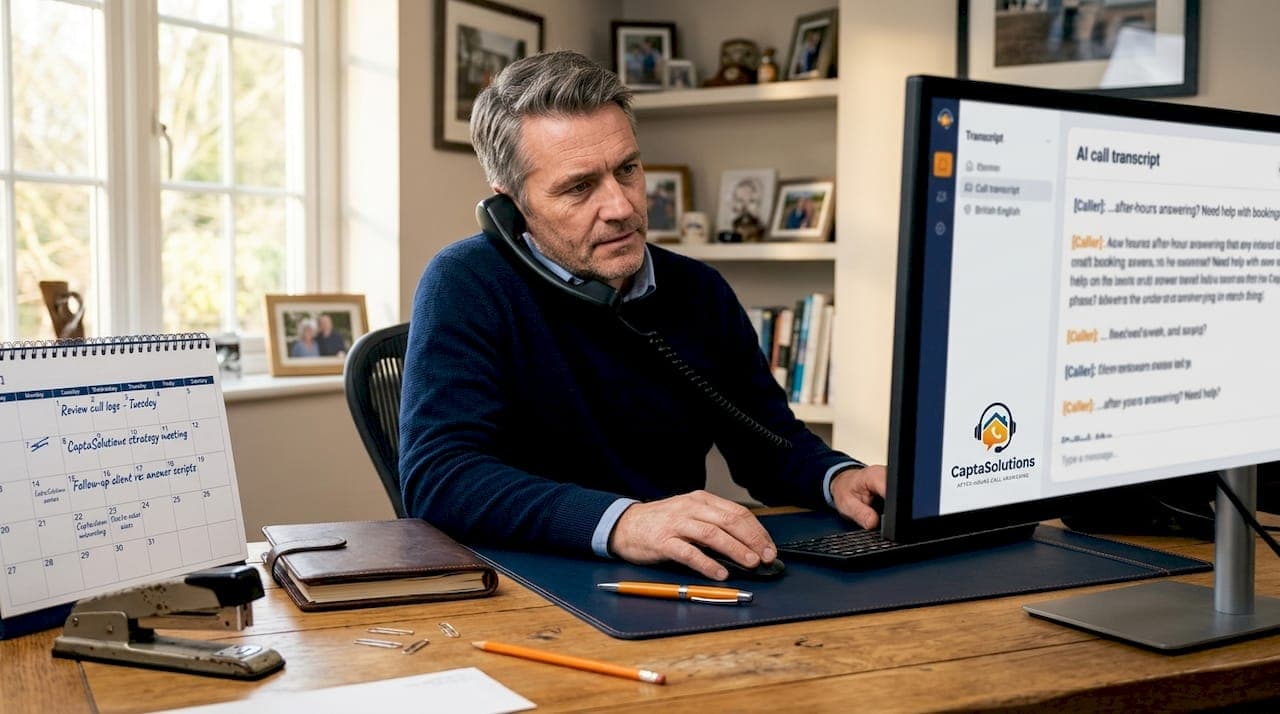
Every time your phone rings and goes to an answerphone, you are gambling with your business. Understanding how AI receptionist replaces UK answerphone setups is not a technical curiosity. It is a business decision with real revenue consequences. Traditional answering machines record a message and do nothing else. 78% of customers will contact a competitor if they do not receive a response within one hour. An AI receptionist answers instantly, qualifies the caller, captures their details, and organises everything for you. That is a fundamentally different outcome from a recorded beep.
Table of Contents
- Key takeaways
- How AI receptionists work versus traditional answerphones
- Real business benefits over answerphones
- Challenges and considerations for deployment
- Transitioning from an answerphone to an AI receptionist
- My perspective on AI versus answerphones in UK businesses
- How Captasolutions can replace your answerphone
- FAQ
Key takeaways
| Point | Details |
|---|---|
| AI answers, answerphones record | AI receptionists interact with callers in real time, while answerphones simply capture a message with no follow-up. |
| Missed calls cost real revenue | Businesses using AI voice answering capture up to 28% more leads per month compared to voicemail-only setups. |
| Cost per call is far lower | AI handles calls for as little as £0.24 each, compared to £9 to £12 for a human receptionist. |
| Deployment requires planning | Clear call flows, escalation rules, and CRM integration are necessary for AI to perform reliably. |
| AI supports humans, not replaces them | The strongest results come from AI handling routine calls while humans manage complex or sensitive enquiries. |
How AI receptionists work versus traditional answerphones
A traditional UK answerphone does one thing. It waits for a caller to stop speaking and records whatever they say. There is no interaction, no qualification, and no routing. The business owner listens back later, often hours after the call, and by then the caller has moved on.
An AI receptionist operates entirely differently. It answers the call within seconds, greets the caller using your business name, and holds a natural conversation. It uses natural language understanding to interpret what the caller needs, whether that is booking an appointment, requesting a quote, or asking a question about your services. It then qualifies the enquiry, captures the caller's contact details, and routes the call or logs the information depending on what you have configured.
AI voice agents can book appointments, qualify leads, answer frequently asked questions, and route calls without any human involvement. When a query falls outside its knowledge base, it escalates to a human. That combination of autonomous handling and intelligent handoff is something an answerphone cannot approach.
| Feature | Traditional answerphone | AI receptionist |
|---|---|---|
| Answers instantly | Yes (after rings) | Yes (immediate) |
| Holds a conversation | No | Yes |
| Qualifies the caller | No | Yes |
| Books appointments | No | Yes |
| Routes calls | No | Yes |
| Available 24/7 | Yes (records only) | Yes (fully interactive) |
| Captures structured data | No | Yes |
Pro Tip: When evaluating any AI phone solution, ask the provider to demonstrate a live call where the AI handles an unexpected question. If it cannot adapt naturally, it is not ready for real customer calls.
Real business benefits over answerphones
The commercial case for switching from an answerphone to an AI receptionist is straightforward. The numbers are clear and the operational advantages compound over time.
Here is what the data shows:
- Businesses using AI voice assistants saw a median 62% reduction in missed call rates and a 41% improvement in lead qualification speed.
- After-hours call capture with AI generated 28% more leads per month compared to voicemail-only setups.
- The cost per call with AI is as low as £0.24, compared to £9 to £12 for a human receptionist.
- AI receptionists handle unlimited simultaneous calls, so no caller ever gets a busy signal.
- Appointment booking integrations reduce no-shows by confirming details and sending follow-up notifications automatically.
Consider a trades business like a plumbing company. An engineer is on a job. The phone rings. With an answerphone, the caller leaves a message or hangs up. With an AI receptionist, the caller is greeted, their job details are captured, and they are told when to expect a callback. The lead is not lost. The customer does not feel ignored. That is the practical difference at street level.
The role of call answering in revenue is direct and measurable. Every qualified call that is handled well is a potential booking, sale, or retained customer. Every missed call or poor answerphone experience is a lead that walks straight to a competitor.

The 24/7 availability factor deserves emphasis. An answerphone is technically available at all hours, but it offers nothing beyond a recording prompt. An AI receptionist available overnight means a caller at 10pm on a Friday gets a proper response, their enquiry is logged, and you wake up to a structured list of leads in your portal. That is not the same as 47 voicemails to sort through on Monday morning.
Challenges and considerations for deployment
Switching from an answerphone to an AI receptionist is not simply a matter of plugging in a new system. There are genuine considerations that determine whether the deployment succeeds or fails.
-
Define your call flows before you configure anything. An AI receptionist is only as good as the logic it follows. If you have not mapped out what questions it should ask, what answers trigger which actions, and where calls should escalate, you will end up with a confused system that frustrates callers.
-
Set clear escalation rules. A key failure mode in AI call handling is the absence of clear handoff protocols. When a caller has a complex complaint, a legal query, or an emotionally charged situation, the AI must know to transfer the call or notify a human immediately. Without that rule, callers are left unsupported.
-
Avoid solutions that are answerphones in disguise. Many AI solutions marketed as intelligent agents are merely rebranded chatbots with a voice layer. Authentic agentic AI requires architectural redesign and proper data governance. Ask vendors specific questions about how the system learns, integrates, and handles edge cases.
-
Integrate with your existing tools. An AI receptionist that cannot connect to your calendar, CRM, or job management software creates more admin, not less. Integration is what turns a call into a booked job without you touching anything.
-
Plan for ongoing supervision. The most successful deployments treat AI as a member of staff that needs regular review. Check call recordings weekly. Identify where the AI underperformed. Refine the knowledge base and update escalation rules accordingly.
The risk of poor deployment is real. Over 40% of agentic AI projects are projected to be cancelled by 2027 due to poor implementation and "agent washing." Treating the project as a workforce redesign and integrated systems initiative rather than a simple tech swap significantly reduces that risk.
Pro Tip: Start with one call type, such as appointment booking or quote requests, and perfect the AI's handling of that flow before expanding to other call categories. Phased deployment produces far more consistent results.
Transitioning from an answerphone to an AI receptionist
The practical steps to make the switch are straightforward if you approach them methodically.
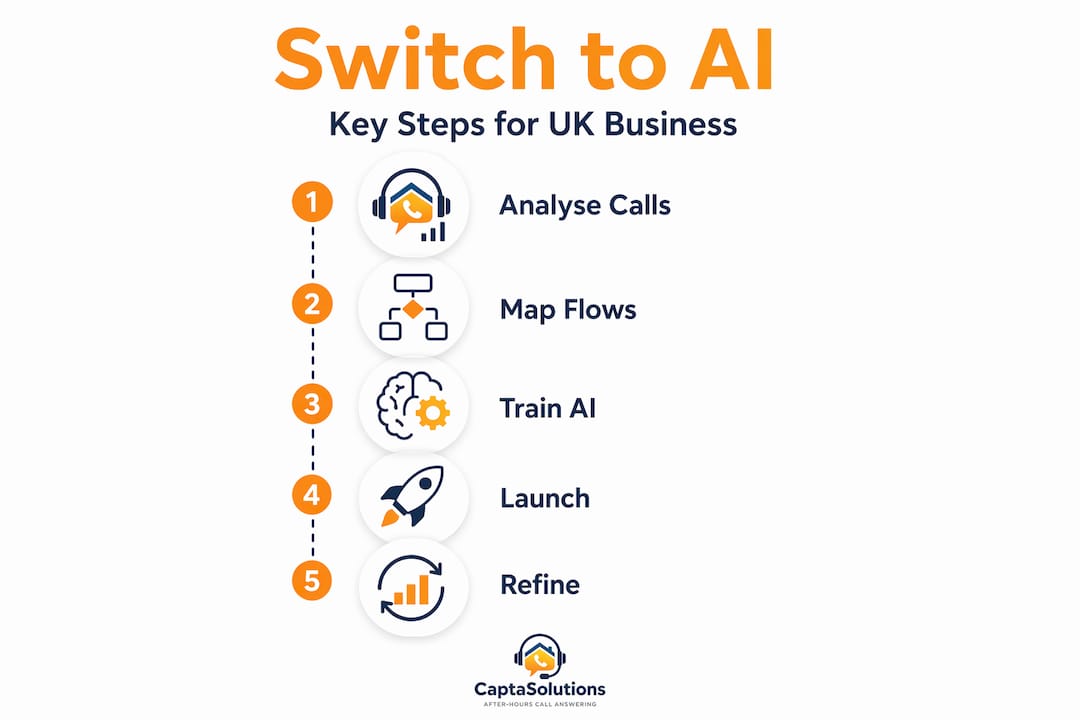
Analyse your current call patterns. Pull your phone records and identify your peak call times, average call duration, the most common reasons people call, and the times you miss the most calls. This gives you a factual baseline to measure improvement against.
Map your ideal call flows. For each call type, write out the ideal conversation. What should the AI ask? What qualifies a lead as worth following up? What triggers an immediate transfer to you? This document becomes the configuration brief for your AI receptionist.
Configure the voice and knowledge base carefully. Your AI receptionist will answer calls in your business name. It should sound consistent with your brand. Load it with accurate information about your services, pricing ranges, availability, and frequently asked questions. The more it knows, the more it can handle without escalation.
The table below outlines a practical deployment timeline:
| Phase | Action | Timeframe |
|---|---|---|
| Audit | Review call logs, identify peak times and call types | Week 1 |
| Design | Map call flows, escalation rules, and qualification criteria | Week 1 to 2 |
| Configure | Set up AI with knowledge base, voice, and integrations | Week 2 to 3 |
| Test | Run live test calls across all call types | Week 3 |
| Deploy | Go live with full monitoring and weekly review | Week 4 onwards |
Phased deployment starting with clear call flow mapping and regular refinement consistently yields better business outcomes. Weekly review of call recordings and AI learning improves lead qualification rates over time.
You should also consider how to cover business calls without staff as a parallel strategy. AI handles the volume. A defined escalation process handles the exceptions. Together, they produce a call handling operation that outperforms any answerphone setup without requiring a full-time receptionist.
My perspective on AI versus answerphones in UK businesses
I have worked with enough UK businesses to say with confidence that the answerphone is not a safety net. It is a polite way of letting a customer down.
What I have seen repeatedly is that business owners underestimate how quickly a caller forms a judgement. A ringing phone that ends with a recorded message does not convey availability. It conveys absence. And in most service sectors, absence reads as unreliability.
The most common misconception I encounter is that AI receptionists are designed to replace human contact entirely. That framing misses the point. 85% of service leaders are expanding human agent responsibilities rather than cutting them. The AI handles the volume. The human handles the nuance. That division is what makes the whole system work well.
What I find genuinely compelling about AI receptionists is not the cost saving, impressive as it is. It is the consistency. Every caller gets the same professional greeting at 9am or 11pm, on a Tuesday or a bank holiday. That level of consistency is not achievable with an answerphone, and it is not affordable with a full-time human receptionist. The call answering benefits for UK tradespeople are particularly pronounced because their working day leaves almost no space to answer calls. AI fills that gap without compromise.
The businesses that benefit most are not the ones that treat AI as a cost-cutting exercise. They are the ones that treat it as a capability upgrade.
— Daniel
How Captasolutions can replace your answerphone
If this article has made clear one thing, it is that the gap between an answerphone and a proper AI receptionist is not marginal. It is the difference between a business that captures leads and one that hopes callers leave a message.
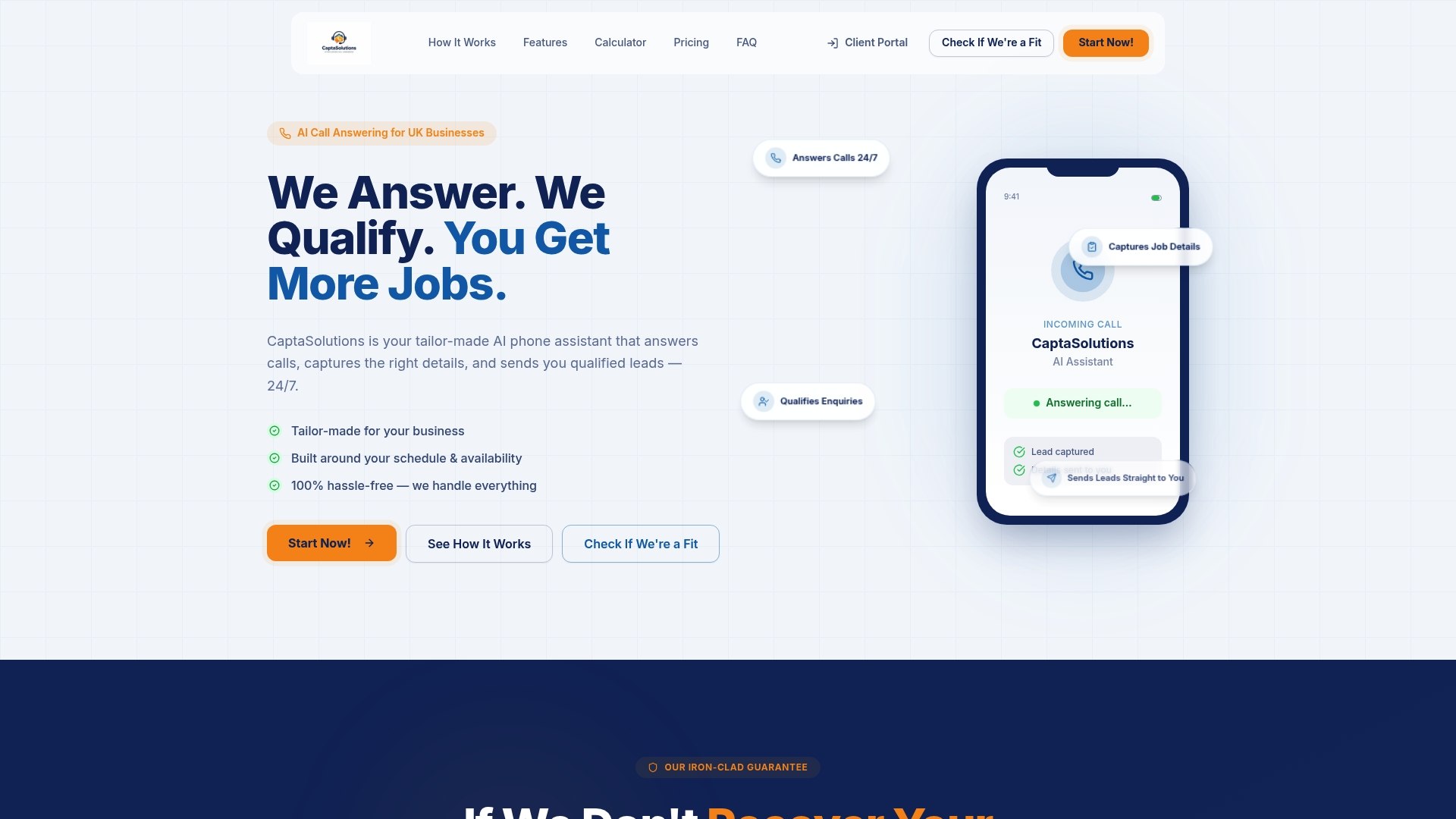
Captasolutions is an AI-powered call answering service built specifically for UK businesses. It answers every call in your business name, 24 hours a day, seven days a week. It qualifies the enquiry, captures the caller's details, and organises everything into your client portal. You stay in control without being tied to the phone. Whether you run a trades business, a salon, a clinic, or a hospitality venue, Captasolutions gives you a fully functional AI receptionist with no contract, no card required, and a free 30-day trial. You can be live within the hour.
Visit captasolutions.co.uk or call 07346 811329 to get started today.
FAQ
What does an AI receptionist do that an answerphone cannot?
An AI receptionist holds a real-time conversation with callers, qualifies their enquiry, books appointments, and captures structured lead data. An answerphone only records a message with no interaction or follow-up capability.
How much does AI call answering cost compared to a human receptionist?
The cost per call with AI can be as low as £0.24, compared to £9 to £12 for a human receptionist, making it a significantly more cost-efficient option for high call volumes.
Will an AI receptionist work with my existing phone system?
Most AI receptionist solutions integrate with existing phone numbers, CRM platforms, and calendar tools. You do not typically need to change your phone number or provider to get started.
Is AI call handling reliable for complex or sensitive calls?
AI receptionists are best suited to routine, high-volume calls. For complex or emotionally sensitive situations, a properly configured AI will escalate to a human agent, ensuring callers are never left without appropriate support.
How quickly can a UK business switch from an answerphone to an AI receptionist?
With the right provider, deployment can happen within hours. Captasolutions, for example, can have a business live within the hour, with full configuration available from the outset.