

Every missed call during business hours is a lost opportunity. A potential client rings, nobody answers, and within minutes they are calling your competitor. For UK small businesses, the ability to reliably answer calls during business hours is not a nice-to-have; it is a direct line to revenue. This guide walks you through setting up call routing, choosing the right answering coverage, and building the habits that keep every caller looked after. Whether you run a plumbing firm, a salon, or a professional practice, the principles here apply directly to your situation.
Table of Contents
- Understanding business hours call routing for small businesses
- Preparing for live call answering during business hours
- Executing call answering best practices during business hours
- Verifying and optimising call answering performance
- Why call answering during business hours is about more than just picking up
- Discover reliable call answering solutions with CaptaSolutions
- Frequently asked questions
Key Takeaways
| Point | Details |
|---|---|
| use call routing effectively | Automate directing calls within your business hours to ensure no call is missed or mishandled. |
| prepare onboarding thoroughly | Complete necessary setup and verification promptly to activate live answering services fast. |
| answer promptly and politely | Respond to calls quickly with professional greetings and clear communication to meet customer expectations. |
| monitor and optimise | Regularly review call performance data and adjust instructions to constantly improve call handling quality. |
| focus on customer experience | Go beyond just answering by managing expectations and integrating with CRM for quick resolution. |
Understanding business hours call routing for small businesses
Call routing is the process of directing incoming calls to the right destination based on rules you set in advance. For small businesses, the most important rule is time. Business hours call routing lets calls arriving outside your chosen window be sent elsewhere automatically, based on a schedule you control.
Think of it as a traffic system for your phone lines. During working hours, calls go straight to your team or receptionist. Outside those hours, the system takes over and handles the call without any manual input from you.
Common destinations for out-of-hours calls include:
- Voicemail with a professional, branded message
- Mobile forwarding to a designated on-call number
- A recorded message with your opening hours and website
- An AI-powered answering service that captures caller details around the clock
Modern VoIP (Voice over Internet Protocol) systems give you granular control over this. You can set different rules for Monday mornings versus Saturday afternoons. You can route calls differently by department, by team member, or by the nature of the enquiry. That flexibility is what separates a professional call setup from a basic phone line.
| Routing option | Best for | Customer experience |
|---|---|---|
| Voicemail | Low call volumes, simple messages | Acceptable if checked promptly |
| Mobile forwarding | Owner-led businesses, urgent calls | Good if answered quickly |
| Recorded message | Retail hours, basic information | Limited, no interaction |
| AI answering service | Trades, hospitality, clinics, salons | Excellent, available 24/7 |
The table above is not exhaustive, but it illustrates a clear pattern. The more interactive your out-of-hours option, the better the caller experience. A voicemail that sits unchecked until Tuesday morning is not a solution. An AI service that captures the caller's name, number, and reason for calling at 7pm on a Friday absolutely is.
Preparing for live call answering during business hours
Before you sign up for any call answering service, there is groundwork to do. Providers need to represent your business accurately, which means you need to give them the right materials from the start.
Prerequisites before going live with a call answering service:
- Company verification: Most providers require proof of your business identity before activating coverage
- Call scripts: A basic script covering your greeting, common questions, and call transfer instructions
- Key information: Opening hours, address, services offered, and escalation contacts
- Call handling preferences: Which calls to transfer live, which to take a message for, and which to resolve directly
UK small businesses typically go live with answering coverage within about one business day after identity verification, with dashboard access provided for monitoring calls in real time. That is a fast turnaround, and it means you can have professional coverage in place before your next working day begins.
The dashboard is worth paying attention to. It is where you update instructions, review call logs, and spot patterns in your call traffic. A good provider gives you live access, not a weekly summary email.

| Preparation step | Time required | Impact on call quality |
|---|---|---|
| Writing call scripts | 1 to 2 hours | High |
| Identity verification | Same day to 24 hours | Required to go live |
| Dashboard orientation | 30 minutes | Medium to high |
| Testing with a trial call | 10 minutes | High |
Pro Tip: Write your call script as if you were briefing a new receptionist on their first day. Cover the greeting, the most common questions you receive, and exactly what to do if a caller needs urgent help. The clearer your script, the better your answering service will represent you.
Executing call answering best practices during business hours
Having the right system in place is only half the job. How calls are handled once they arrive determines whether customers feel valued or frustrated. Here is a practical sequence for getting it right.
Step-by-step call handling during business hours:
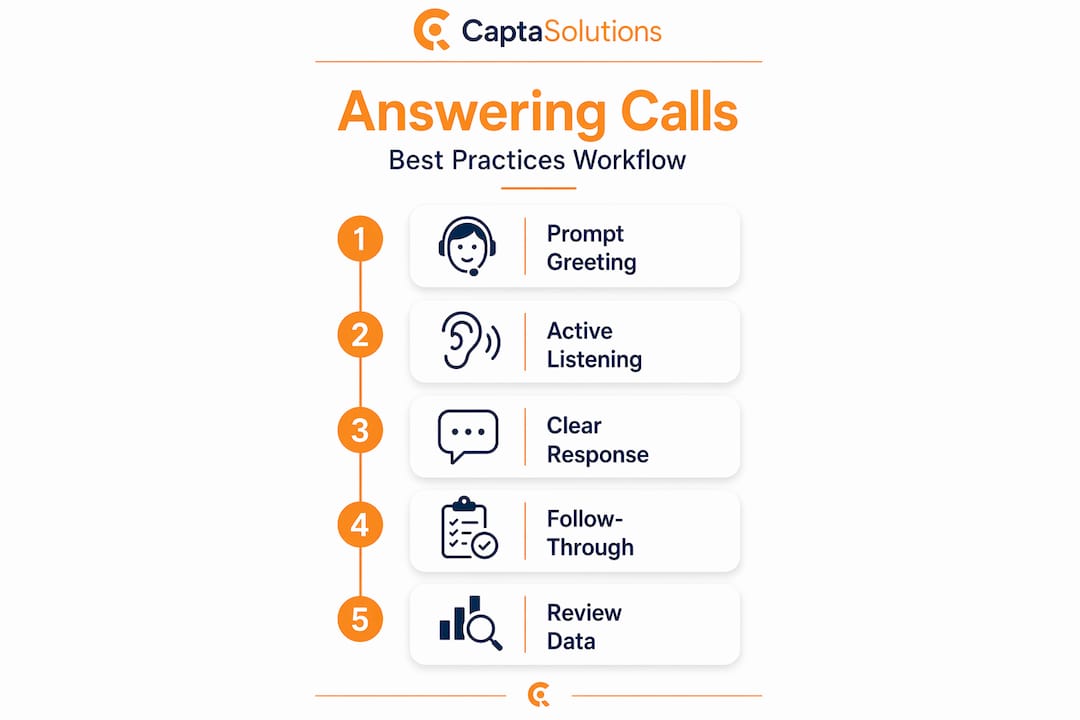
- Answer within three rings. This is the industry standard and the expectation most callers carry. Longer than that and doubt sets in.
- Use a consistent greeting. State your business name, your name or the receptionist's name, and offer to help. "Good morning, Hartley Plumbing, this is Sarah, how can I help you today?" is clear and professional.
- Confirm the caller's name early. Using a caller's name during the conversation builds rapport and reduces the chance of miscommunication.
- State wait times honestly. If a transfer will take more than 30 seconds, say so. Silence feels longer than it is.
- Summarise and confirm before ending. Repeat back the action you are taking so the caller knows what happens next.
- Log the call outcome immediately. Whether it is a booking, a message, or a callback request, record it before the next call arrives.
Many customers interpret "immediate" as a response within 10 minutes, and long waits or abandoned calls directly damage customer perception of your business. That figure should inform how you staff your phones and how quickly messages are acted upon.
Additional practices that make a measurable difference:
- Equip whoever answers calls with access to your booking system or CRM (Customer Relationship Management software, which stores client records and history)
- Route calls by enquiry type so the right person handles the right call from the start
- Avoid putting callers on hold without a time estimate
- Train your team or service provider on your top five most common caller questions
Pro Tip: Integrate your call answering service with your CRM so that when a repeat caller rings, their history is visible immediately. This cuts average call handling time and dramatically reduces the number of callbacks needed.
Verifying and optimising call answering performance
Setting up a call answering system is not a one-time task. The businesses that get the best results treat it as an ongoing process, reviewing performance regularly and making targeted adjustments.
Key metrics to track through your service dashboard:
- Total call volume by day and time of week
- Average time to answer
- Number of calls missed or abandoned
- Call outcomes (booking made, message taken, transferred, resolved)
- Repeat caller rate
Reviewing call logs and refining your instructions in the first week of service using dashboards measurably improves call capture and the quality of customer interactions. That first week is your most valuable window for identifying gaps.
| Performance indicator | Target | Action if below target |
|---|---|---|
| Calls answered within 3 rings | 90% or above | Review staffing or routing rules |
| Abandoned call rate | Below 5% | Reduce hold times, add coverage |
| First-call resolution rate | 70% or above | Improve scripts and staff knowledge |
| Message delivery time | Under 15 minutes | Update notification settings |
Practical adjustments to make based on your data include refining your opening greeting if callers frequently ask for clarification, adding qualifying questions to your script if too many calls are being transferred unnecessarily, and updating your routing rules if call volumes spike at specific times you had not anticipated.
Pro Tip: Set a fixed 15-minute slot each Monday morning to review the previous week's call data. Involve any staff who handle calls in that review. Their frontline observations will surface issues that the dashboard alone cannot show you.
Why call answering during business hours is about more than just picking up
Here is an uncomfortable truth that most guides on this topic avoid: answering the phone quickly is the minimum, not the goal. Many small businesses invest in call answering coverage, hit their pick-up targets, and still haemorrhage clients. The reason is almost always the same. The call was answered, but the caller's actual need was not met.
Customer patience depends on clear communication and realistic expectations. Simply answering calls is not enough to ensure satisfaction. What callers want is to feel heard, to know what happens next, and to trust that someone is genuinely dealing with their issue.
This is where most small businesses underinvest. They focus on the technology, the routing rules, the scripts, and the dashboards. All of that matters. But the receptionist or AI agent who actually speaks to the caller needs to communicate with empathy, not just efficiency. A caller who waits 90 seconds and then receives a warm, informed response will rate their experience higher than a caller who is answered in five seconds and then passed around three times without resolution.
The other underrated element is follow-through. A call that ends with "someone will call you back" is only a success if the callback actually happens, at the time promised, with the information the caller needed. Integrating your call handling into your CRM and booking systems is what closes that loop. Without that integration, you are answering calls but not necessarily solving problems.
Dynamic instruction updates matter too. Your business changes. New services, seasonal hours, staff changes, and pricing updates all affect how calls should be handled. Businesses that review and update their call handling instructions regularly see consistently better outcomes than those who set their scripts once and forget them.
The soft skills dimension is also worth naming directly. Technical call handling can be trained in an afternoon. Caller empathy, active listening, and the ability to de-escalate a frustrated customer take longer to develop but deliver far greater returns. If you are using a live answering service, ask specifically how their agents are trained on these skills, not just on your call script.
Discover reliable call answering solutions with CaptaSolutions
If the strategies in this guide have highlighted gaps in how your business currently handles calls, you are not alone. Most UK small businesses reach a point where manual call answering during business hours simply cannot keep up with demand.
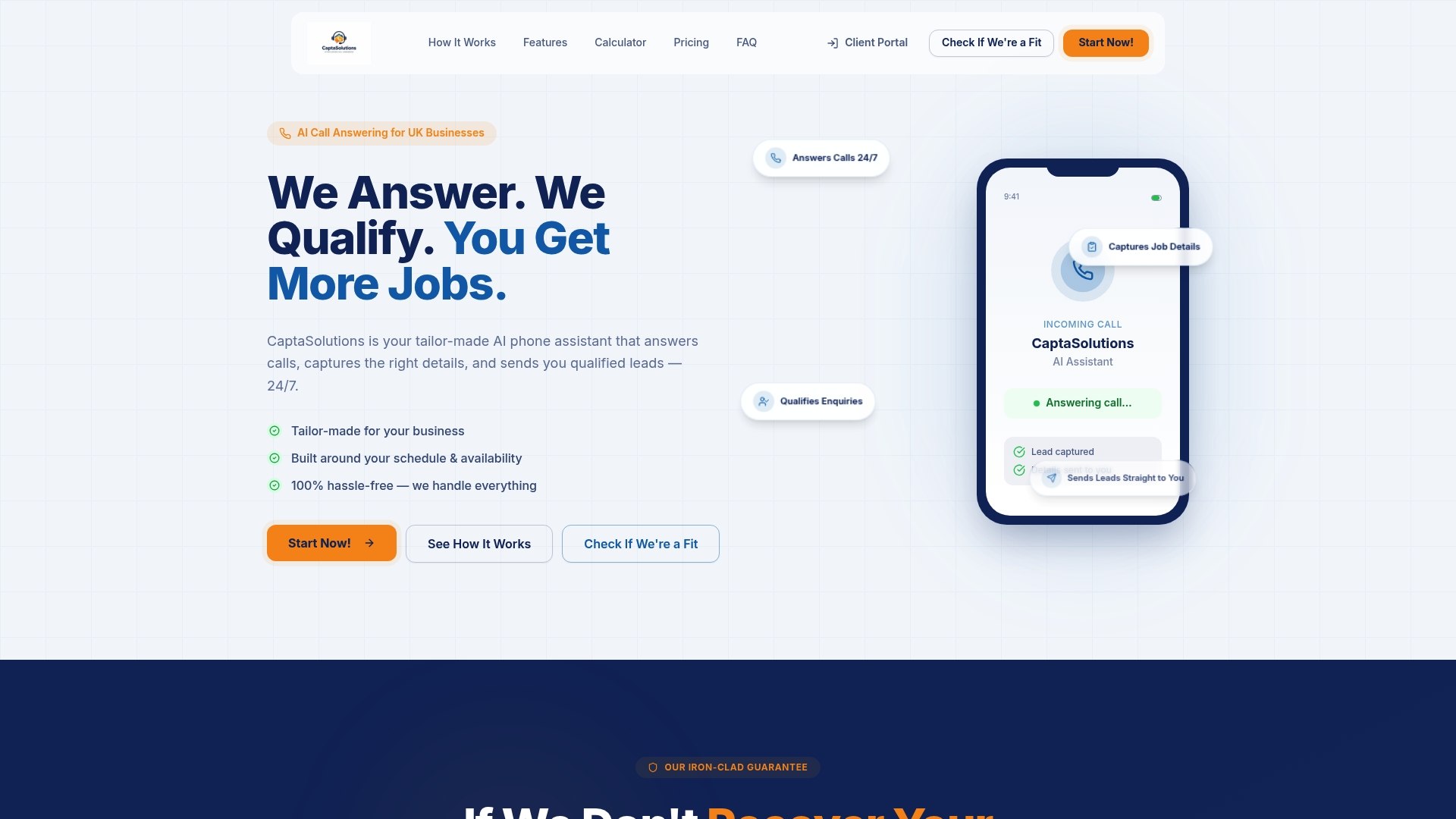
CaptaSolutions provides AI-powered call answering built specifically for UK small businesses. Every call is answered in your business name, with caller details captured, enquiries qualified, and everything organised into your client portal. You stay in control of which leads to act on, without being tied to your phone. Trusted by trades businesses, salons, clinics, hospitality venues, and service businesses across the UK, CaptaSolutions is live within the hour, with no contract and no card required for your free 30-day trial. Call 07346 811329 or visit captasolutions.co.uk to get started today.
Frequently asked questions
What does 'answer calls during business hours' mean for small businesses?
It means having systems or services in place so that all calls received within your designated working times are promptly and professionally handled or redirected. Business hours call routing lets calls arriving outside chosen times be sent elsewhere based on custom schedules.
How quickly should calls be answered during business hours to meet customer expectations?
Most customers expect calls to be answered within a very short window to feel the response is immediate. Research shows that 60% of customers define "immediate" as under 10 minutes, which directly affects satisfaction and retention.
Can I use a live answering service immediately after signing up?
Typically yes. Providers generally onboard live answering coverage within about one business day after identity verification, allowing quick integration into your existing workflow.
What happens if calls come outside my business hours?
Calls outside business hours can be automatically forwarded to voicemail, to a mobile number, or handled by an AI answering service. Business hours routing allows redirection to voicemail, another number, or a custom recorded message based on settings you configure.
How can I improve call answering effectiveness over time?
Regularly reviewing call logs, updating your call instructions, and refining greetings based on outcomes is the most reliable method. Reviewing and refining instructions using your service dashboard in real time improves both call capture rates and the overall quality of customer interactions.