

AI phone enquiry qualification is the process by which an automated voice agent answers inbound calls, applies a structured conversational framework such as BANT or MEDDIC, scores the caller against an ideal customer profile, and routes or books the lead in real time. This is the industry term for what many UK businesses now call "automating call screening." Platforms including Retell AI, Twig, and Captasolutions deploy this capability to ensure no call goes unanswered and no lead detail goes uncaptured. For trades businesses, clinics, salons, and service firms across the UK, understanding how AI qualifies phone enquiries is the difference between a full diary and a missed opportunity.
How AI frameworks qualify and score inbound phone enquiries
AI qualification systems are built on proven sales frameworks, not generic conversation scripts. BANT and MEDDIC enable AI to capture budget, authority, need, and timeline during a live call, mirroring the questioning discipline of a trained sales development representative. SPICED (Situation, Pain, Impact, Critical Event, Decision) is a newer framework gaining traction for service businesses where emotional context matters as much as budget.
The critical difference between AI and a static web form is adaptive branching. Rather than following a fixed script, the AI adjusts its next question based on what the caller just said. If a caller says they need a plumber "sometime next month," the system probes for a more specific date. If they mention a burst pipe, it flags urgency and escalates the call. Adaptive branching questions improve qualification quality far beyond what rigid scripts can achieve.
Structured data captured during a typical AI qualification call includes:
- Company size or household type
- Budget range or willingness to pay
- Timeline and urgency level
- Decision-maker status
- Specific pain point or service required
- Preferred contact method and availability
Once captured, this data feeds directly into a lead score. Typical AI qualification output includes an ICP score such as 92 out of 100, a booked next step, and structured notes ready for human handoff. That score tells your team exactly which leads to prioritise and which to deprioritise without anyone listening back to a recording.
Pro Tip: Configure your AI qualification flow with a minimum of three branching paths per question. Single-path flows treat every caller identically and miss the nuance that separates a serious lead from a time-waster.
How does AI phone qualification work technically?
AI inbound call agents operate on large language models combined with natural language processing to understand spoken intent in real time. AI agents answer calls within about one second and handle multiple concurrent calls around the clock, which means a busy Friday afternoon and a quiet Sunday night receive identical service quality.

Voice AI systems require different engineering trade-offs than text chatbots. Successful AI systems work under 500ms perceived latency with acoustic urgency recognition, meaning the system detects when a caller sounds stressed or rushed and adjusts its pace accordingly. This is not a minor detail. A caller reporting a gas leak does not want a leisurely conversation.
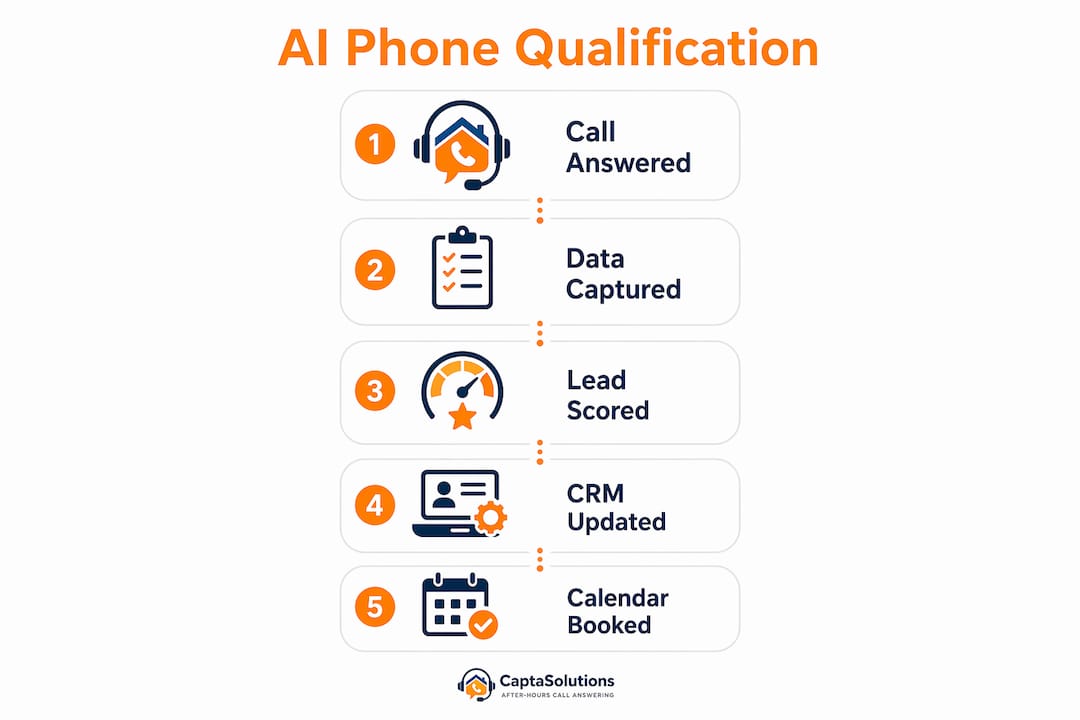
The technical workflow for a qualified call typically follows these steps:
- Call is answered within one second in your business name.
- The AI identifies the caller's intent from the opening sentence.
- Qualification questions are asked in sequence, with branching based on responses.
- Structured data fields are populated in real time.
- A lead score is calculated against your ideal customer profile.
- The system either books a calendar appointment, transfers the call to a human agent with full context, or logs the lead for follow-up.
- CRM records are updated automatically via API before the call ends.
Real-time CRM updates and calendar bookings during the call itself are what separate modern AI qualification from older interactive voice response systems. The caller books their appointment before they hang up. Your team sees the lead scored and scheduled without lifting a finger.
Pro Tip: Set intent confidence thresholds in your AI system. If the system scores caller intent below 70% confidence, it should escalate to a human rather than guess. Misclassified calls damage trust faster than a missed call does.
What are the UK compliance rules for AI phone qualification?
UK businesses deploying AI in phone support must satisfy both UK GDPR and the Privacy and Electronic Communications Regulations (PECR). Lawful basis, caller transparency, and documentation are required before any call is recorded or AI-processed. Legitimate interest or explicit consent are the two most commonly used lawful bases for inbound call recording.
Ofcom's 2025 rules mandate that any AI-generated or AI-handled call must disclose this fact within the first five seconds. A compliant opening sounds like: "Hello, this is an AI assistant handling calls for [Business Name]. This call may be recorded for quality and training purposes." This is not optional. Failure to disclose exposes a business to regulatory action.
Practical compliance requirements for UK businesses include:
- Announce AI handling and call recording at the start of every call.
- Document the lawful basis for processing caller data.
- Store recordings securely with access controls and defined retention periods.
- Honour subject access requests from callers within the statutory timeframe.
- Obtain explicit consent before using AI for outbound automated marketing calls under PECR.
UK businesses must treat AI phone qualification as a data processing activity under UK GDPR, not merely a telephony feature. Every call that captures personal data requires a documented lawful basis and a clear retention policy.
The compliance burden is manageable when built into the system from the start. Captasolutions, for example, configures compliant disclosure scripts as part of its standard setup for UK clients, removing the risk of an oversight during deployment.
AI qualification vs traditional phone and form-based methods
Static web forms and generic phone menus are the two most common alternatives to AI qualification. Both fail at the same point: they cannot adapt to what the caller actually says. A form captures only what you thought to ask. A phone menu routes calls by number press, not by intent.
Human SDRs take 8 to 12 minutes per qualification call and apply frameworks inconsistently across a working day. AI reduces this to approximately four minutes with perfect consistency on every call. That consistency matters enormously for data quality. When every lead is scored against the same criteria, your pipeline reporting becomes reliable.
| Method | Speed | Consistency | Availability | Data quality |
|---|---|---|---|---|
| Static web form | Instant submission, hours to follow up | Low, caller self-reports | 24/7 | Poor, incomplete fields |
| Human SDR | 8 to 12 minutes per call | Variable | Business hours only | Good when trained |
| AI qualification | Sub-60 seconds, real-time CRM update | Perfect, framework-applied | 24/7, concurrent calls | High, structured fields |
The human-in-the-loop model is the recommended operational structure. AI handles initial qualification for all inbound calls. High-fit or complex leads receive a warm transfer to a human agent, complete with the full conversation summary. This preserves the personal touch where it genuinely adds value while removing repetitive work from your team's day. You can read more about this approach in the context of AI receptionist systems for UK businesses.
Implementing AI phone enquiry qualification: a practical guide for UK businesses
Deploying an AI phone qualification system does not require a large IT team or a lengthy procurement process. The practical steps are straightforward when approached in the right order.
- Define your qualification criteria. Identify the five to seven data points that determine whether a caller is a good fit. For a plumbing business, this might be location, job type, urgency, and property ownership. For a clinic, it might be treatment type, insurance status, and preferred appointment time.
- Select a suitable platform. Tools such as Retell AI, Twig, and Captasolutions each offer configurable qualification flows. Captasolutions is built specifically for UK businesses and includes compliant disclosure scripts and a client portal as standard.
- Integrate with your existing systems. Connect the AI platform to your CRM and calendar via API. End-to-end integration with CRM and calendar systems provides immediate lead insights and scheduling during calls. Most platforms support integrations with tools such as HubSpot, Salesforce, and Google Calendar.
- Design your question flow and escalation rules. Map out the branching logic for each qualification question. Define the score threshold at which a call transfers to a human agent. Set a fallback for calls where the AI cannot classify intent with sufficient confidence.
- Test and iterate. Run the system on a subset of calls before full deployment. Review call transcripts weekly for the first month. Adjust question wording and branching logic based on real caller behaviour.
- Monitor KPIs. Track booking rate, containment rate (calls resolved without human intervention), average qualification time, and lead-to-conversion rate. These four metrics tell you whether your AI qualification system is performing or needs tuning.
For trades businesses and service firms, the benefits of AI for phone enquiries extend beyond lead quality. Every call answered is a job potentially won.
Key takeaways
AI phone enquiry qualification delivers consistent, real-time lead scoring by applying structured frameworks like BANT and MEDDIC during every inbound call, outperforming both human SDRs and static forms on speed, availability, and data quality.
| Point | Details |
|---|---|
| Framework-driven qualification | BANT, MEDDIC, and SPICED enable AI to capture structured lead data on every call. |
| Sub-60-second qualification | AI answers within one second and completes qualification faster than any human SDR. |
| UK compliance is non-negotiable | Ofcom 2025 rules require AI disclosure within five seconds; UK GDPR requires documented lawful basis. |
| Human-in-the-loop is best practice | AI handles initial qualification; complex or high-value leads transfer to humans with full context. |
| CRM integration closes the loop | Real-time API updates mean leads are scored, booked, and logged before the call ends. |
Why AI phone qualification is more nuanced than most businesses expect
Having worked with UK service businesses deploying AI call qualification, the pattern I see most often is this: businesses focus entirely on the technology and underinvest in conversation design. They configure a platform, connect it to their CRM, and assume the AI will do the rest. It will not.
The quality of your qualification output is directly proportional to the quality of your question flow. An AI asking "How can I help you today?" is no better than a voicemail. An AI that asks "Is this for a residential or commercial property, and when did the problem first occur?" captures data your team can act on immediately. The framework matters more than the platform.
The compliance dimension also catches businesses off guard. Many assume that because the call is inbound, they have implied consent to record and process it. UK GDPR does not work that way. Disclosure must be explicit, the lawful basis must be documented, and retention periods must be defined before you go live. Getting this right at the start is far less costly than addressing a complaint later.
The future of AI voice qualification is moving towards real-time sentiment analysis and intent prediction before the caller has finished their first sentence. Auditable call memory and per-call reporting are already enabling smooth human handoffs with exact quotes and prior decisions, reducing repeated questioning and improving conversion. Businesses that build these systems now will have a significant operational advantage within two years.
— Daniel
Qualify every call with Captasolutions
Captasolutions is an AI-powered call answering and lead qualification service built for UK businesses that cannot afford to miss an enquiry. The platform answers every call in your business name, applies your qualification framework, scores the lead, and organises everything into your client portal. Compliant disclosure scripts are included as standard, and the system goes live within the hour.
Captasolutions supports warm transfers for high-value leads, integrates with your existing CRM and calendar, and operates 24 hours a day, seven days a week. There is no contract, no card required, and a free 30-day trial is available now. Visit captasolutions.co.uk or call 07346 811329 to get started today.
FAQ
What is AI phone enquiry qualification?
AI phone enquiry qualification is the automated process of answering inbound calls, applying a structured framework such as BANT or MEDDIC to assess caller fit, and routing or booking leads in real time. It replaces manual call screening with consistent, data-driven lead scoring on every call.
How does AI analyse calls to qualify leads?
AI uses natural language processing and large language models to interpret spoken responses, apply adaptive branching questions, and populate structured data fields during the call. Successful deployments achieve sub-60-second qualification with real-time CRM updates.
Is AI call qualification legal in the UK?
Yes, provided the business complies with UK GDPR and PECR. Callers must be informed of AI handling and recording within the first five seconds of the call, and the business must document its lawful basis for processing caller data.
How does AI qualification compare to a human receptionist?
AI qualification applies the same framework to every call without fatigue, operates 24/7, and updates your CRM in real time. Human receptionists add value for complex or sensitive enquiries, which is why the human-in-the-loop model combining both is considered best practice.
What KPIs should I track for AI phone qualification?
Track booking rate, containment rate, average qualification time, and lead-to-conversion rate. These four metrics indicate whether your AI system is capturing quality leads or needs its question flow adjusted.