

Phone enquiry qualification steps are the defined sequence of actions a sales professional takes to assess whether a caller represents a genuine opportunity, covering Need, Authority, Budget, and Timing before committing further resource. Frameworks like BANT and GPCT have formalised this process for UK businesses, and the difference between structured qualification and ad hoc conversation is measurable. Businesses that follow a consistent phone inquiry assessment process convert more enquiries into booked appointments, waste less time on poor-fit callers, and make better decisions about where to focus their sales effort. This guide covers every step, from opening the call to legal compliance under UK telemarketing law.
1. Core phone enquiry qualification steps using BANT and GPCT
The two most widely used frameworks for qualifying phone inquiries are BANT (Budget, Authority, Need, Timing) and GPCT (Goals, Plans, Challenges, Timing), developed and popularised by HubSpot. BANT remains the default rapid qualification framework for mid-market and SMB sales, while GPCT suits consultative inbound leads where buyer motivation runs deeper than a simple purchase decision.
A typical 5-minute qualification call follows a clear sequence: introduction (0 to 0:30), discovery of need (0:30 to 1:30), current handling (1:30 to 2:30), authority check (2:30 to 3:30), budget and timing (3:30 to 4:30), and a close with a meeting offer or disqualification (4:30 to 5:30). That structure keeps the call focused and prevents the conversation from drifting into unpaid consultancy.

GPCT reverses the opening priority. Rather than leading with budget, GPCT starts with buyer goals and current plans, which surfaces deeper motivation and political context that a budget question alone would miss. This matters for inbound enquiries where the caller already has intent but needs to be understood before being sold to.
The key questions for each framework element are:
- Need: "What prompted you to call today?" and "What does the current situation look like?"
- Authority: "Who else is involved in making this decision?"
- Budget: "Do you have a figure in mind, or are you still scoping that out?"
- Timing: "When are you looking to have this in place?"
- Goals (GPCT): "What outcome are you trying to achieve in the next 90 days?"
- Challenges (GPCT): "What has stopped you from solving this already?"
Pro Tip: Ask one question at a time and wait for a full answer before moving on. Stacking two questions in one breath causes callers to answer only the second one, which is usually the less useful of the two.
Close every qualification call with a clear next step. Either book a meeting, confirm a callback time, or state clearly that the enquiry is not a fit and why. Ambiguous endings create pipeline clutter that costs time later.
2. A 15-step phone enquiry qualification checklist
A structured checklist converts the BANT or GPCT framework into a repeatable process. The SetSmart 15-step lead qualification checklist organises steps into four phases: pre-qualification, BANT signal capture, fit recap, and routing with handoff. Each phase has pass or fail markers that determine whether the lead moves forward or enters a nurture sequence.
Phase 1: Pre-qualification
- Confirm the caller is within your serviceable market (geography, sector, company size)
- Verify the channel is compliant (see Section 4 on TPS/CTPS)
- Identify the trigger event: what changed that prompted the call today?
- Confirm the caller's role and whether they are the decision-maker or an influencer
Phase 2: BANT signal capture
- Quantify the pain: ask for a number, a deadline, or a cost associated with the problem
- Identify the buying committee: who else must approve this?
- Anchor the budget: not an exact figure, but a range or a prior spend reference
- Anchor the timeline: a specific date or a conditional trigger ("once we hire our next person")
Phase 3: Fit recap
- Summarise what you have heard back to the caller to confirm accuracy
- State clearly how your offering addresses the need identified
- Confirm the caller agrees with the summary before proceeding
Phase 4: Routing and handoff
- Score the lead as Hot, Warm, or Cold based on the signals captured
- Route Hot leads to a senior sales contact or book a meeting immediately
- Place Warm leads into a structured follow-up sequence with a defined date
- Log Cold leads with a reason code and suppress from immediate outreach
| Lead tier | Criteria | Next action |
|---|---|---|
| Hot | Need confirmed, decision-maker present, budget range given, timeline within 30 days | Book meeting immediately |
| Warm | Need confirmed, influencer only, budget vague, timeline 30 to 90 days | Structured follow-up within 48 hours |
| Cold | Need unclear, no budget signal, timeline beyond 90 days or undefined | Nurture sequence or suppress |
Pro Tip: A 15-step qualification checklist only works if every person handling calls uses the same version. Store it in your CRM as a call disposition form so the data is captured consistently, not just remembered.
3. UK legal and compliance steps for phone qualification
UK outbound calling operates under PECR (Privacy and Electronic Communications Regulations) and GDPR, and the rules differ depending on who you are calling. UK outbound calling requires that you identify yourself and your company at the start of every call, honour opt-out requests immediately, screen your call lists against the TPS and CTPS registers every 28 days, and document your legitimate interest basis under GDPR. Fines for breaches reach £500,000, which makes compliance a commercial priority, not just a legal formality.
The distinction between business types matters. Limited companies can be called unless they are registered on the CTPS (Corporate Telephone Preference Service). Sole traders and partnerships are treated as individuals and are protected by the TPS (Telephone Preference Service) in the same way consumers are. Calling a sole trader on the TPS without consent is a breach, regardless of the business context.
The compliance steps to integrate into every qualification call are:
- State your name and company name within the first 30 seconds of the call
- Ask whether the contact has previously requested not to be called by your organisation
- If an opt-out is given at any point during the call, stop the call and log the suppression immediately
- Screen your outbound call list against TPS and CTPS before each calling campaign, at intervals no longer than 28 days
- Record the legitimate interest assessment that justifies each outbound call in your CRM
Compliance steps cannot be afterthoughts. Integrating identification, TPS/CTPS screening, and opt-out management directly into call workflows mitigates costly risks that no qualification framework can protect you from after the fact.
For businesses handling inbound enquiries, the compliance burden is lighter, but you must still record consent for any follow-up marketing and honour any suppression requests made during the call. Captasolutions builds these compliance checkpoints into its AI-powered call answering process, so every call handled on your behalf meets UK legal standards from the first second. You can read more about legal call handling requirements in the context of UK service businesses.
4. Practical tips and technology tools for efficient qualification
The greatest qualification challenge is not which framework you choose. Speed-to-call and call volume consistency limit qualification success more than framework choice. Combining a form-based GPCT pre-screen with an immediate live phone call within 60 seconds of form submission has increased conversion rates from 3 to 5 per cent up to 25 to 40 per cent. That gap is not explained by better questions. It is explained by faster execution.
Practical steps to improve qualification efficiency:
- Keep qualification calls to 3 to 7 minutes. The goal is to qualify, not to sell. Selling before qualification wastes time on poor-fit prospects.
- Use one question at a time. Compound questions reduce answer quality and make call scoring unreliable.
- Build an SMS fallback into your process. If a call goes unanswered, an automated SMS with a single qualifying question captures intent data that would otherwise be lost.
- Integrate your qualification checklist directly into your CRM as a call disposition form. This removes the reliance on memory and creates a consistent data record for every lead.
- Use deterministic qualification logic rather than open-ended AI judgement. AI voice agents using deterministic logic qualify leads in under 3 minutes with clear yes or no decision points, direct CRM integration, and immediate routing. This removes edge cases and produces consistent outcomes at scale.
Pro Tip: If you use an AI voice agent or automated call system, programme it with a strict decision tree rather than a conversational prompt. Deterministic qualification logic reduces inconsistency and makes your lead scoring data reliable enough to act on.
For UK businesses that cannot answer every call in real time, the risk is not just a missed conversation. It is a missed qualification signal. Every unanswered call that does not trigger an immediate callback or automated response is a lead that enters a competitor's pipeline instead. Captasolutions addresses this directly by answering every call, capturing qualification data, and routing leads into your portal without delay. You can see how this applies to growing your business through calls in the UK service sector.
Key takeaways
Effective phone enquiry qualification combines a structured framework, a consistent checklist, and UK-compliant call practices to convert more enquiries into genuine sales opportunities.
| Point | Details |
|---|---|
| Use BANT or GPCT as your base | BANT suits transactional SMB calls; GPCT suits consultative inbound leads where buyer goals matter more than budget. |
| Follow a 15-step checklist | Classify every lead as Hot, Warm, or Cold using defined pass or fail criteria before routing or following up. |
| Build compliance into every call | Screen against TPS and CTPS every 28 days, identify yourself immediately, and log opt-outs without delay. |
| Prioritise speed over perfection | Calling within 60 seconds of a form submission consistently outperforms a better script delivered an hour later. |
| Use deterministic logic for automation | AI or automated qualification tools perform best with clear decision trees, not open-ended conversational prompts. |
Why most qualification calls fail before the first question
The sales professionals I see struggle most with phone qualification are not asking the wrong questions. They are asking the right questions too late, too slowly, or not at all because no one answered the call in the first place.
The instinct to lead with budget is understandable. It feels efficient. But early budget questioning without context produces vague answers that tell you very little. A caller who says "we haven't set a budget yet" is not necessarily a cold lead. They may have a pressing problem and full authority to spend. The GPCT approach of starting with goals and current plans before addressing budget consistently surfaces that context, and it changes how you score the lead.
The compliance piece is where I see the most complacency. UK telemarketing law is not complicated, but it is unforgiving. Businesses that treat TPS screening as an occasional task rather than a pre-call standard are one complaint away from a significant fine. Integrating identification, opt-out logging, and list screening into the call workflow itself, rather than treating them as administrative tasks done separately, is the only reliable way to stay clean.
The deeper issue is volume and speed. A well-constructed BANT call that happens two hours after the enquiry is worth a fraction of a rougher call made within five minutes. The qualification signal richness drops sharply when leads cool. For most UK businesses, the bottleneck is not the script. It is the gap between the enquiry arriving and the phone being picked up.
— Daniel
How Captasolutions handles phone enquiry qualification for UK businesses
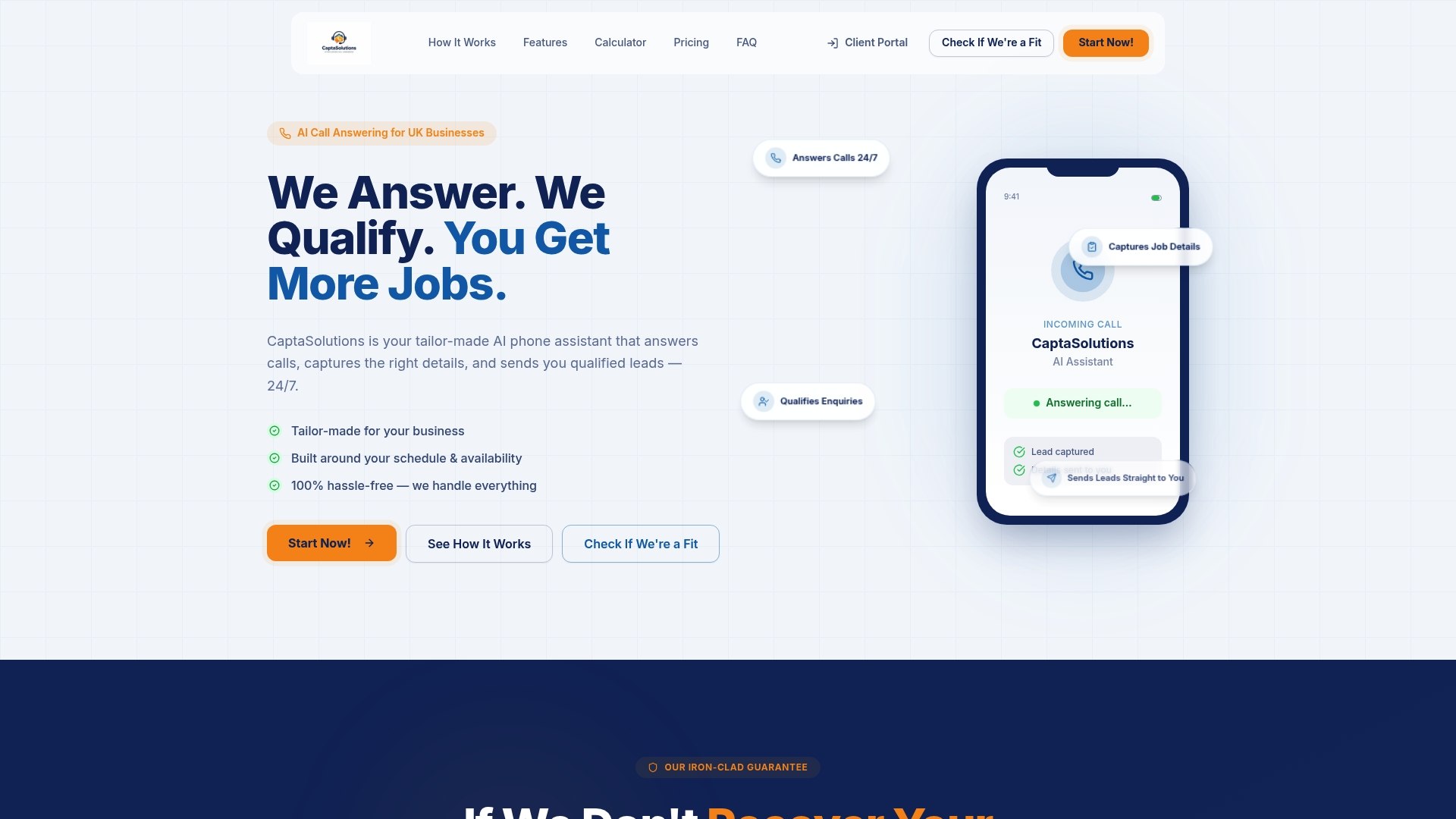
Captasolutions is an AI-powered call answering service built specifically for UK businesses that cannot afford to miss a call or lose a qualification signal. Every call is answered in your business name, 24 hours a day, 7 days a week. The AI captures caller details, works through a structured qualification process, and organises every lead into your client portal so you can review and act on it immediately.
The service is built around UK legal standards, including prompt caller identification and opt-out handling, so every call handled on your behalf meets PECR and GDPR requirements from the start. Whether you run a trades business, a clinic, a salon, or a professional office, Captasolutions gives you a consistent phone enquiry qualification process without the overhead of a full-time receptionist. Start your free 30-day trial at captasolutions.co.uk. No card required, no contract, and live within the hour.
FAQ
What are the main phone enquiry qualification steps?
The core steps are: confirm need, verify authority, establish budget range, and identify timing. A structured call following the BANT or GPCT framework completes this in 3 to 7 minutes and ends with a clear routing decision.
Is BANT or GPCT better for qualifying inbound calls?
GPCT is better suited to inbound enquiries because it starts with buyer goals and challenges rather than budget, which produces a richer qualification signal. BANT remains effective for transactional or outbound calls where speed is the priority.
What UK laws apply to outbound qualification calls?
Under PECR and GDPR, you must identify yourself at the start of every call, screen your list against TPS and CTPS every 28 days, honour opt-out requests immediately, and document your legitimate interest basis. Fines for breaches reach £500,000.
How quickly should you call back a phone enquiry?
Speed-to-call is the single biggest driver of qualification success. Calling within 60 seconds of a form submission or missed call has been shown to increase conversion rates from under 5 per cent to over 25 per cent compared with delayed callbacks.
Can AI handle phone enquiry qualification reliably?
Yes, when built on deterministic logic with clear yes or no decision points. AI voice agents using structured decision trees qualify leads in under 3 minutes, integrate directly with CRM systems, and produce consistent scoring data that human calls often do not.