

Understanding the full range of UK service industry enquiry types is what separates businesses that convert consistently from those that lose customers to the first competitor who picks up the phone. These enquiries, more formally known as customer contact interactions, vary enormously in nature, urgency, and preferred channel. CCMA research identifies five distinct customer personas that shape how people make contact with service businesses across the UK. This guide walks you through every major enquiry category, how customer behaviour differs by sector, and how to build processes that respond to each type with precision.
Table of Contents
- Key takeaways
- 1. Understanding UK service industry enquiry types
- 2. The five customer contact personas shaping enquiry behaviour
- 3. Common types of service enquiries in the UK
- 4. How enquiry types differ across UK service sectors and channels
- 5. Comparing enquiry handling approaches and tools
- 6. Choosing and optimising your enquiry handling process
- My perspective on managing service enquiries well
- How Captasolutions helps UK service businesses manage every enquiry
- FAQ
Key takeaways
| Point | Details |
|---|---|
| Persona-driven handling improves results | Tailor your enquiry routing and responses to the five key customer contact personas for better engagement. |
| Enquiry type determines the workflow | Complaints, bookings, and sales leads each require a distinct process, not a single catch-all response. |
| Phone dominates urgent contact | 68% of UK customers choose phone for urgent enquiries, making call capture a priority for service businesses. |
| AI tools raise booking conversion | AI appointment systems can qualify leads and respond within seconds, reducing the drop-off rate significantly. |
| FCA timelines apply to complaints | Regulated complaint handling requires a final response within eight weeks, with tighter deadlines in financial services. |
1. Understanding UK service industry enquiry types
The starting point for any service business is recognising that not all customer contact is the same. A call about a boiler breakdown is categorically different from an email asking about prices, even though both arrive through your phone line or inbox. Effective enquiry taxonomy combines type, persona, and preferred channel to produce the right routing and response.
Getting this right matters for two practical reasons. You allocate the right resource to each contact, and you meet customer expectations faster. A customer ringing in distress about a leak does not want to be asked to fill in a web form. A Knowledge Gatherer comparing insurance providers does not want a rushed sales pitch before they have had their questions answered.
2. The five customer contact personas shaping enquiry behaviour
CCMA's 2026 research identifies five distinct personas that directly influence how UK customers make and expect enquiries to be handled. Understanding them changes how you design every stage of your enquiry process.
- Efficiency Optimisers want speed above everything. They prefer digital self-service and phone calls when a quick answer is not available online. They become frustrated quickly if processes feel slow or repetitive.
- Knowledge Gatherers are research-led and ask detailed questions across multiple channels. They contact service providers far more frequently than other personas (49% vs 28% for Simplicity Seekers in banking) and expect thorough, accurate responses.
- Experience Enthusiasts prioritise the quality of the interaction itself. They value friendly, knowledgeable staff and are more likely to share experiences, both positive and negative, online.
- Simplicity Seekers want minimal steps and clear language. Complex forms, jargon, or long hold times will lose them entirely.
- Tradition Maintainers prefer phone and face-to-face contact. They are typically less comfortable with digital channels and need enquiry processes that do not assume digital fluency.
Each persona shapes not just which channel a customer uses, but how they phrase enquiries, how much detail they provide, and how quickly they expect a reply.
Pro Tip: When training front-line staff or configuring AI call systems, build a short qualifying question into early responses that helps you identify the persona type. A single question such as "Would you prefer I send the details by email or go through them now?" reveals a great deal about the customer's communication preference.
3. Common types of service enquiries in the UK
The following are the core customer service enquiry types that UK service businesses encounter daily, each with distinct characteristics that determine how they should be handled.
- Appointment booking enquiries focus on scheduling. Customers want to know availability, location, and how to confirm. AI booking systems respond within seconds and manage follow-up around the clock, which is particularly valuable for trades, clinics, and salons where staff are unavailable to answer calls mid-job.
- Information and product enquiries are research-led contacts. Customers ask about pricing, scope, materials, or processes before committing. These are common in home improvement, financial services, and professional services sectors.
- Sales and lead qualification enquiries sit adjacent to information requests but signal buyer intent. The customer is close to a decision and needs a reason to choose you. Speed and clarity here directly affect conversion.
- Complaint and dispute enquiries require a separate workflow entirely. Different enquiry types need distinct processes: complaints trigger evidence gathering, regulatory documentation, and formal response timelines that a sales lead never requires.
- Technical support enquiries are typically urgent. A customer whose boiler has failed or whose point-of-sale system is down needs a fast acknowledgement and a clear timeline. Delay here damages trust significantly.
- Account and billing enquiries relate to invoices, payments, subscriptions, and service agreements. These are routine but sensitive; errors in billing responses can escalate into formal complaints.
- General feedback and follow-up enquiries include post-service satisfaction calls, review requests, and check-in contacts. Often overlooked, these are high-value opportunities to build loyalty and gather intelligence.
Each category demands a different tone, a different response time, and different documentation. Treating them identically is one of the most common mistakes service businesses make.
4. How enquiry types differ across UK service sectors and channels
The types of service enquiries UK businesses receive vary considerably by sector. A hospitality venue deals primarily with booking requests, special requirements, and complaints. A financial services firm handles information requests, account queries, and regulated complaints. A home improvement tradesperson receives a mix of appointment requests, job scoping questions, and urgent callouts.
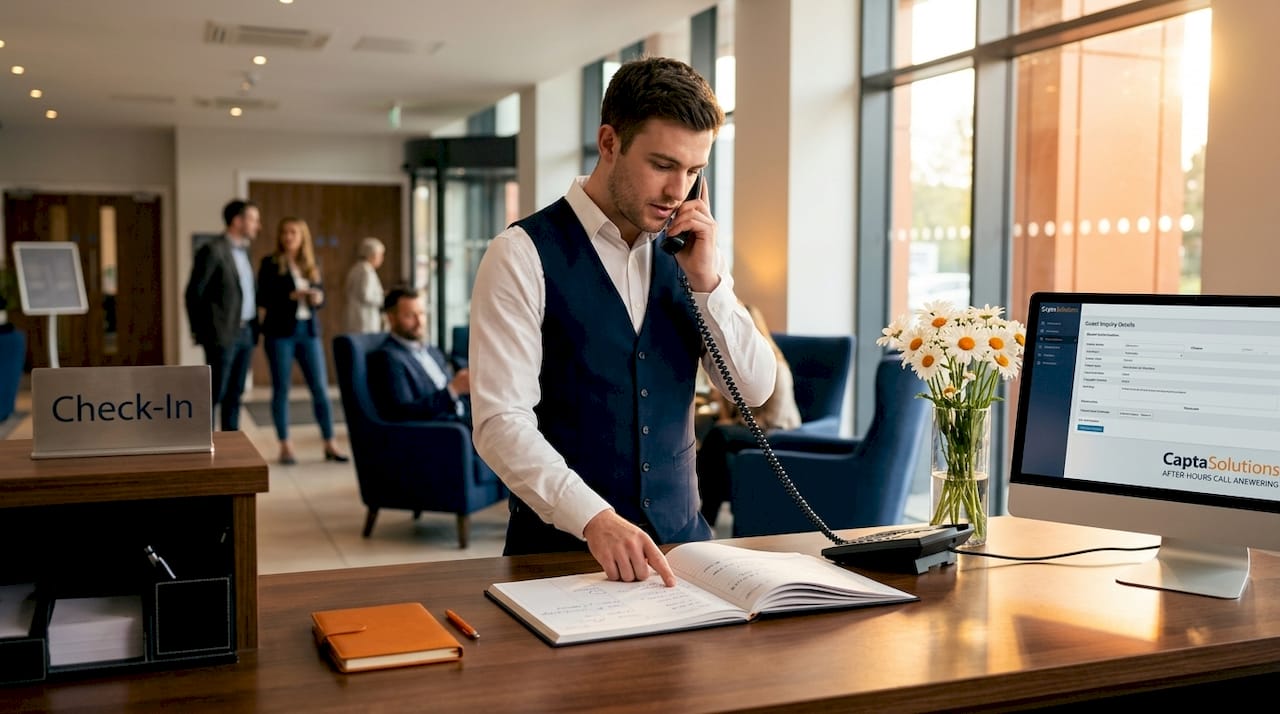
Channel preferences also shift depending on the nature of the enquiry. UK customers choose phone for urgent and complex queries: 68% prefer phone for urgent contact and 55% for complex matters. For routine queries, 48% favour email. This has real consequences for how you staff and route enquiries by time of day and urgency level.
Consider these sector-specific patterns:
- Hospitality and food service: High volume of booking enquiries via phone and online, often outside business hours. Complaints frequently arrive via social media or review platforms.
- Home improvement and trades: Enquiries from plumbing to pest control are often urgent and initiated by phone. Customers want a real-time response, not a callback tomorrow. Qualification questions around job type, location, and urgency significantly improve scheduling outcomes. Appointment conversion improves when AI systems filter by these criteria before confirming a booking.
- Professional services: Information and lead qualification enquiries dominate. Clients compare multiple providers and expect considered, professional replies.
- Financial services: Regulated complaint handling is a legal requirement, and account enquiries must be handled with accuracy and documented properly.
Pro Tip: Map your busiest enquiry types against the times of day they peak, then align your channel coverage accordingly. If 60% of your urgent calls come in between 5pm and 8pm, manual staffing will always fail you. That is the window where AI call answering pays for itself.
5. Comparing enquiry handling approaches and tools
The gap between a business that captures every enquiry and one that loses half of them often comes down to method, not effort. Here is how the main approaches compare across the enquiry types most common in UK service sectors.
| Method | Best for | Limitations | Sectors suited |
|---|---|---|---|
| Manual phone answering | Complex, sensitive, and urgent enquiries | Cannot scale; misses out-of-hours contact | Professional services, financial services |
| Web enquiry forms | Routine information requests, low urgency | Slow response cycle; loses Efficiency Optimisers | Home improvement, B2B services |
| AI call answering | All enquiry types, 24/7 capture and qualification | Needs good scripting for complex complaints | Trades, hospitality, salons, clinics |
| Live chat and chatbots | Information requests, basic booking queries | Poor for emotionally sensitive complaints | Retail services, tech support |
| Email autoresponders | Acknowledgement and routine follow-up | No real-time handling; frustrates urgent callers | Professional services, financial services |
The case for AI-powered systems is strongest where volume is unpredictable and out-of-hours contact is common. Professional service enquiry replies should acknowledge the contact, demonstrate understanding, outline next steps, and request any clarifying details. An AI system configured correctly can do all four within seconds of the call ending.
For complaint enquiries specifically, the process must align with regulatory requirements. FCA regulations require a final response within eight weeks, with payment service complaints resolved within 15 business days. Any business operating in financial services must treat complaint categorisation as a legal obligation, not an administrative preference.
6. Choosing and optimising your enquiry handling process
Getting the right process in place comes down to four decisions: what you prioritise, who handles it, how fast you respond, and how you measure results.
- Map your enquiry mix first. Audit the last three months of customer contact. What percentage is bookings? What percentage is complaints? Where are the drop-offs? You cannot optimise a process you have not measured.
- Separate urgent from routine. Route phone calls and real-time digital contacts to immediate response systems. Email and web forms can follow a slower process, but only if the channel is appropriate for the enquiry type. Using phone enquiry data to grow your business through answered calls is only possible if those calls are actually captured.
- Script responses by enquiry type, not generically. A booking confirmation script is useless for a complaint. Build distinct response frameworks for each category. Clear, prompt replies measurably improve conversion in professional services. Apply the same discipline to every enquiry type.
- Integrate AI where human capacity fails. Trades businesses, salons, and clinics cannot answer the phone whilst working. AI call answering systems capture the enquiry, qualify it, and organise the details so you review and respond when you are free. Understanding call answering for tradespeople shows how this approach prevents revenue loss without adding headcount.
- Track and refine. Monitor response times, conversion rates per enquiry type, and complaint escalation rates. If your Knowledge Gatherer enquiries have low conversion, review the depth of your information responses. If booking drop-offs are high, review your qualification process.
Pro Tip: Review your enquiry data quarterly rather than annually. Customer communication preferences shift, and a process that worked well in early 2025 may already be misaligned with how your customers want to contact you in 2026.
My perspective on managing service enquiries well
I've worked with a lot of UK service businesses that believe their enquiry handling is fine because they respond to most contacts eventually. What I've learned is that "eventually" is the most expensive word in customer service.
The businesses that consistently outperform their competition are not necessarily faster at everything. They are faster at the right things. They know which enquiry types carry the most revenue risk if mishandled, and they have built their processes around those categories. Complaint handling is airtight because it has to be. Booking capture is automated because the volume demands it. Sales lead follow-up is scripted because conversion depends on the first impression.
What I find genuinely underappreciated is the persona dimension. Most service businesses segment customers by demographics or spend, then wonder why their communication feels off to a large portion of their client base. A Tradition Maintainer in their 60s and an Efficiency Optimiser in their 30s may have identical spend and postcode. They want completely different things from your enquiry process. Misread that, and you lose one of them every time.
The tools available now, including AI call answering, smart routing, and enquiry portals, make it entirely possible for a small trades business or a single-practitioner clinic to match the responsiveness of a much larger operation. The barrier is not technology. It is willingness to look honestly at where enquiries are falling through the cracks and fix those points specifically.
— Daniel
How Captasolutions helps UK service businesses manage every enquiry
UK service businesses miss enquiries not because they do not care, but because they are busy doing the actual work. Captasolutions is an AI-powered call answering service that captures every call in your business name, 24 hours a day, seven days a week, qualifying the enquiry and organising the details into your client portal.
Whether you run a trades business, a clinic, a salon, or a hospitality venue, Captasolutions adapts to the enquiry types and volumes your sector generates. For hospitality call handling or any other service sector, the system goes live within the hour. No contract. No card required. Start your free 30-day trial at captasolutions.co.uk or call 07346 811329 today.
FAQ
What are the main types of service enquiries in the UK?
The main types include appointment booking, information requests, sales and lead qualification, complaint and dispute resolution, technical support, account and billing queries, and post-service follow-up. Each requires a distinct handling process and response timeline.
How should UK businesses handle complaint enquiries?
Complaint enquiries must be treated as a separate workflow from other contact types. Regulated businesses must comply with FCA timelines, which require a final response within eight weeks and a 15-business-day deadline for payment service complaints.
Which channel do UK customers prefer for urgent enquiries?
Phone is the dominant channel for urgent contact. Research shows 68% of UK customers choose phone for urgent enquiries, making reliable call capture a priority for service businesses operating across trades, hospitality, and professional services.
How do customer personas affect enquiry handling?
Customer contact personas such as Efficiency Optimisers and Tradition Maintainers have different channel preferences, response expectations, and communication styles. Matching your routing and tone to these personas improves engagement and reduces drop-off at the enquiry stage.
Can AI systems handle appointment booking enquiries effectively?
Yes. AI appointment booking systems can respond within seconds, qualify leads by job type, location, and urgency, and manage follow-up around the clock. This improves conversion rates and reduces the cost of missed or unqualified bookings.