

Phone calls are still the fastest route from enquiry to sale, yet 62% of small service business calls go unanswered every day across the UK. That is not just a customer service problem. It is a direct revenue loss, playing out quietly while you are on a job, serving a customer in front of you, or simply closed for the evening. If you want to grow business by answering calls, you need more than good intentions. You need the right systems, the right habits, and a clear understanding of what every missed ring actually costs you.
Table of Contents
- Key takeaways
- What to prepare before improving call answering
- How to manage business calls effectively
- Common mistakes that kill call-driven growth
- Measuring whether your calls are driving growth
- My view on what most business owners get wrong
- How Captasolutions helps you answer every call
- FAQ
Key takeaways
| Point | Details |
|---|---|
| Missed calls cost real money | Most callers who reach voicemail never ring back, so every unanswered call is a lost sale. |
| Speed of response decides the sale | Businesses that respond within one minute see dramatically higher conversion rates than those who wait. |
| Preparation unlocks performance | Knowing your call volumes, peak times, and having the right tools in place before you act makes every step more effective. |
| Call data drives growth | Tracking answer rates, conversion, and call quality reveals exactly where revenue is leaking. |
| After-hours calls carry premium value | Callers outside business hours are often urgent, high-intent prospects who will pay more for whoever responds first. |
What to prepare before improving call answering
Before you change anything, you need a clear picture of where you currently stand. Most business owners assume they answer most of their calls. The data rarely agrees.
Start by pulling your missed call rate from your phone system or network provider. If you do not have visibility on this, that is itself the first problem to solve. You need call tracking in place before you can improve anything, because you cannot manage what you cannot measure. Tools like basic call logging on a VoIP system, or a dedicated call tracking platform, give you answer rate, call duration, peak hour patterns, and missed call frequency.
The core tools every business should have in place:
- A dedicated business phone line, separate from personal use
- Call tracking software that logs all inbound calls with timestamps
- A CRM system where call outcomes and lead details are recorded
- A defined process for handling missed calls, including follow-up triggers
- A call answering solution for times when your team cannot get to the phone
Once you have the data, look at your peak call times. Most service businesses see spikes between 8am and 9am, lunchtime, and after 5pm. Those after-hours calls are worth particular attention. After-hours calls often represent urgent, high-value prospects willing to pay premium prices for whoever responds first.
The comparison between manual and automated answering systems is worth understanding clearly. A human receptionist offers warmth and flexibility but cannot handle multiple simultaneous calls and is unavailable outside office hours. AI-powered answering services handle volume without limit, operate around the clock, and feed structured lead data directly into your systems. The limitation has always been naturalness of conversation, though modern AI has largely closed that gap. For small business call coverage, an AI service often delivers better consistency than a stretched member of staff.
| Approach | Coverage | Cost | Call capacity | Data capture |
|---|---|---|---|---|
| In-house receptionist | Business hours only | High (£30,000+ annually) | Limited by headcount | Manual, inconsistent |
| Voicemail | 24/7 | Low | Unlimited | None (85% never call back) |
| AI call answering | 24/7 | Low to medium | Unlimited | Structured, automatic |
| Call answering service | Configurable | Medium | High | Variable |
How to manage business calls effectively
Once your tools are in place, execution is everything. The process below is what separates businesses that grow through calls from those that simply take calls.
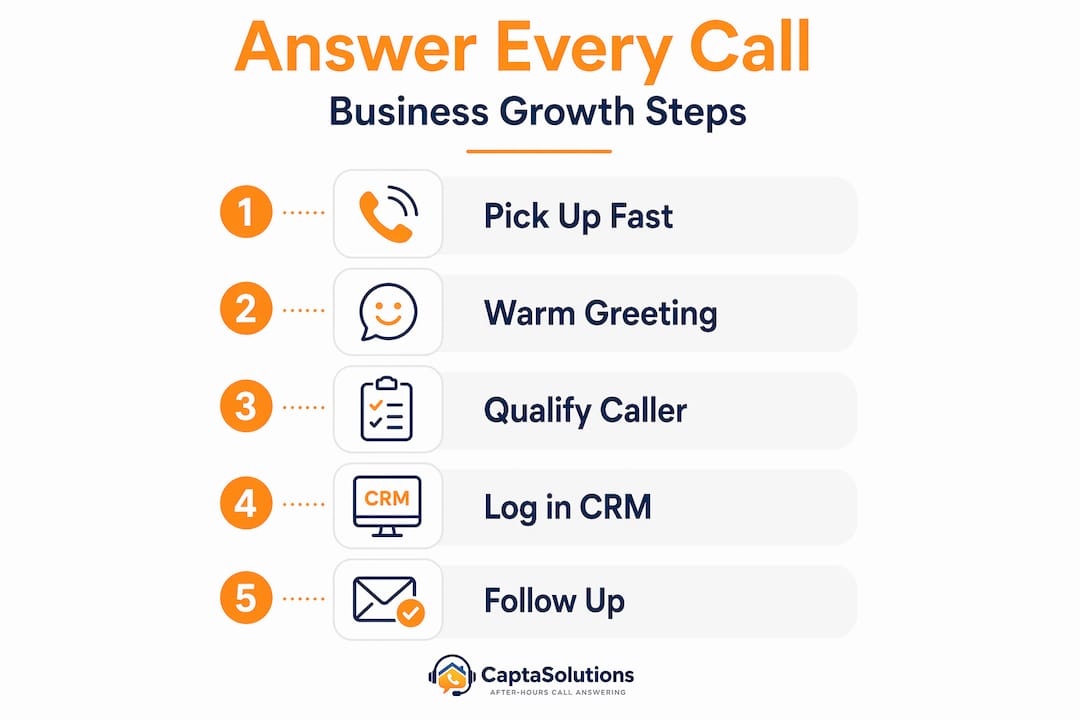
1. Commit to answering every call, not most calls. A dedicated line with clear coverage protocols removes ambiguity. Decide in advance who answers during business hours, what happens at lunch, and what covers evenings and weekends. There should be no gap. 78% of customers buy from the first business to respond to their enquiry, which means your competitor is one unanswered ring away from taking your sale.

2. Prioritise speed above almost everything else. Responding within the first minute can increase conversion by 391% compared to waiting five minutes or longer. This is not a marginal gain. It is the difference between winning and losing the lead entirely. If a missed call does happen, your follow-up must be immediate, not at the end of the day.
3. Open every call with a warm, professional greeting. The caller has often just searched online, looked at two or three businesses, and rung the first number they found. Your greeting is their first impression. A structured call handling flow that includes a warm greeting, genuine qualification questions, and clear next steps significantly increases conversions.
4. Qualify the lead during the call itself. Ask the right questions. What does the caller need? What is their timeline? Have they contacted anyone else? These answers help you prioritise follow-up and tailor your response. Avoid treating every call as identical. A quick job from someone 40 miles away needs a different response than an urgent, local, high-value enquiry.
5. Use scripts as frameworks, not scripts. A call guide keeps your team consistent. It prevents forgotten qualification questions and ensures next steps are always set. The mistake is reading it word-for-word, which callers detect immediately. Train your team to know the structure well enough that they never sound scripted.
6. Record and score calls to improve continuously. Recording and scoring all calls is one of the most direct ways to identify what is working and what is costing you sales. Listen for phrases that build rapport, question sequences that move leads forward, and moments where calls stall. Review weekly.
7. Connect every call to your CRM immediately. A call that is not logged is a lead that will likely fall through the cracks. Whether your team inputs this manually or your AI answering service does it automatically, every caller's details, enquiry type, and next action must live in your CRM before the conversation ends.
Pro Tip: Set a rule that any missed call receives a personal callback within ten minutes during business hours. Pair this with an AI answering service for out-of-hours calls, and you effectively remove the missed call problem entirely.
Common mistakes that kill call-driven growth
Most businesses do not lose growth opportunities because of poor products or bad service. They lose them in the space between a caller dialling and someone picking up. These are the mistakes that matter most.
- Ignoring the five-minute window. Failing to respond within five minutes results in losing 80% of potential leads. Most businesses take hours to call back, by which point the lead has moved on.
- Relying on voicemail. 85% of callers who reach voicemail never ring back. Voicemail is not a safety net. It is where leads go to disappear.
- Failing to qualify or set next steps. A pleasant conversation that ends without a clear next action rarely converts. Whether that is a booked appointment, a quote request, or a follow-up call, every call needs a defined outcome.
- Using robotic or over-rehearsed scripts. Callers recognise scripted responses quickly and it damages the trust you need to earn the sale. Use frameworks, not word-for-word scripts.
- Ignoring call data. Many business owners know their revenue figures but have no idea what their call answer rate is. Without that number, you cannot see the size of the opportunity you are missing.
- Treating after-hours calls as low priority. A caller ringing at 7pm is often in urgent need. They are highly motivated, will accept a premium price, and are searching for whoever responds first. Missing these calls is among the most expensive mistakes a service business can make.
Pro Tip: Review your voicemail inbox and count how many messages you have received in the past 30 days. Then check how many of those callers actually became customers. That gap is the cost of your current call answering approach.
You can read more about how calls drive revenue for small service businesses in the UK to understand the full picture.
Measuring whether your calls are driving growth
Improving call answering without measuring the results is guesswork. The businesses that consistently grow through calls treat their call data with the same seriousness as their sales figures.
The metrics that matter most are: call answer rate, average response time to missed calls, call-to-conversion rate, call quality score, and revenue attributed to inbound calls. Together, these tell you whether your investment in call management is paying off.
| Metric | What it tells you | Target benchmark |
|---|---|---|
| Call answer rate | Percentage of inbound calls answered live | Above 90% |
| Lead response time | Time between missed call and callback | Under 10 minutes |
| Call-to-conversion rate | Percentage of calls that become paying customers | Varies by industry |
| Call quality score | Scored review of call handling and technique | Improving week-on-week |
| Revenue per inbound call | Average value generated per answered call | Track trend over time |
Sales teams using call analytics for coaching see 12 to 15% higher win rates than those relying on intuition alone. That is not a small margin at scale. If you are handling 200 calls per month and converting 20%, a 12% improvement in win rate means 24 additional customers from the same call volume.
Measuring specific call behaviours such as talk-to-listen ratio and question count with AI analysis allows for precise coaching that improves close rates without requiring a sales manager in the room for every call. Set a monthly review cadence where you look at your numbers, listen to a sample of recorded calls, and make one or two specific adjustments to your process.
Proactive outreach to warm leads is also worth building in. Structured brief calls to warm leads can deliver 15 to 30% annual revenue growth on top of what your inbound calls already generate. Customer engagement through phone calls is not just reactive. The businesses that grow fastest use call data to identify warm prospects and ring them before they go elsewhere.
My view on what most business owners get wrong
I have worked with enough UK business owners to know that phone calls are consistently undervalued until the moment someone sits down and does the maths. The common assumption is that missed calls are a minor inconvenience. A customer rang, we were busy, they will ring again. They almost never do.
What I find most revealing is the after-hours pattern. Business owners often assume that calls outside opening hours are from time-wasters or people who will ring back tomorrow. In my experience, the opposite is true. The caller ringing at 7pm is usually someone who has tried to sort a problem all day, is now at home with time to act, and will hire whoever answers. Missing those calls consistently is not just lost revenue. It is handing your most motivated prospects to a competitor.
The other piece most people overlook is what the call data tells you about your marketing. If you are running paid adverts and a high percentage of inbound calls come from people asking about a service you barely promote, that is a signal. The calls are telling you where the demand really is.
My honest take: investing in AI call answering for booking and lead capture is not an overhead. It is one of the highest-return decisions a service business can make. The businesses I have seen grow fastest are not necessarily the best at their trade. They are the ones who never let a call go unanswered.
— Daniel
How Captasolutions helps you answer every call
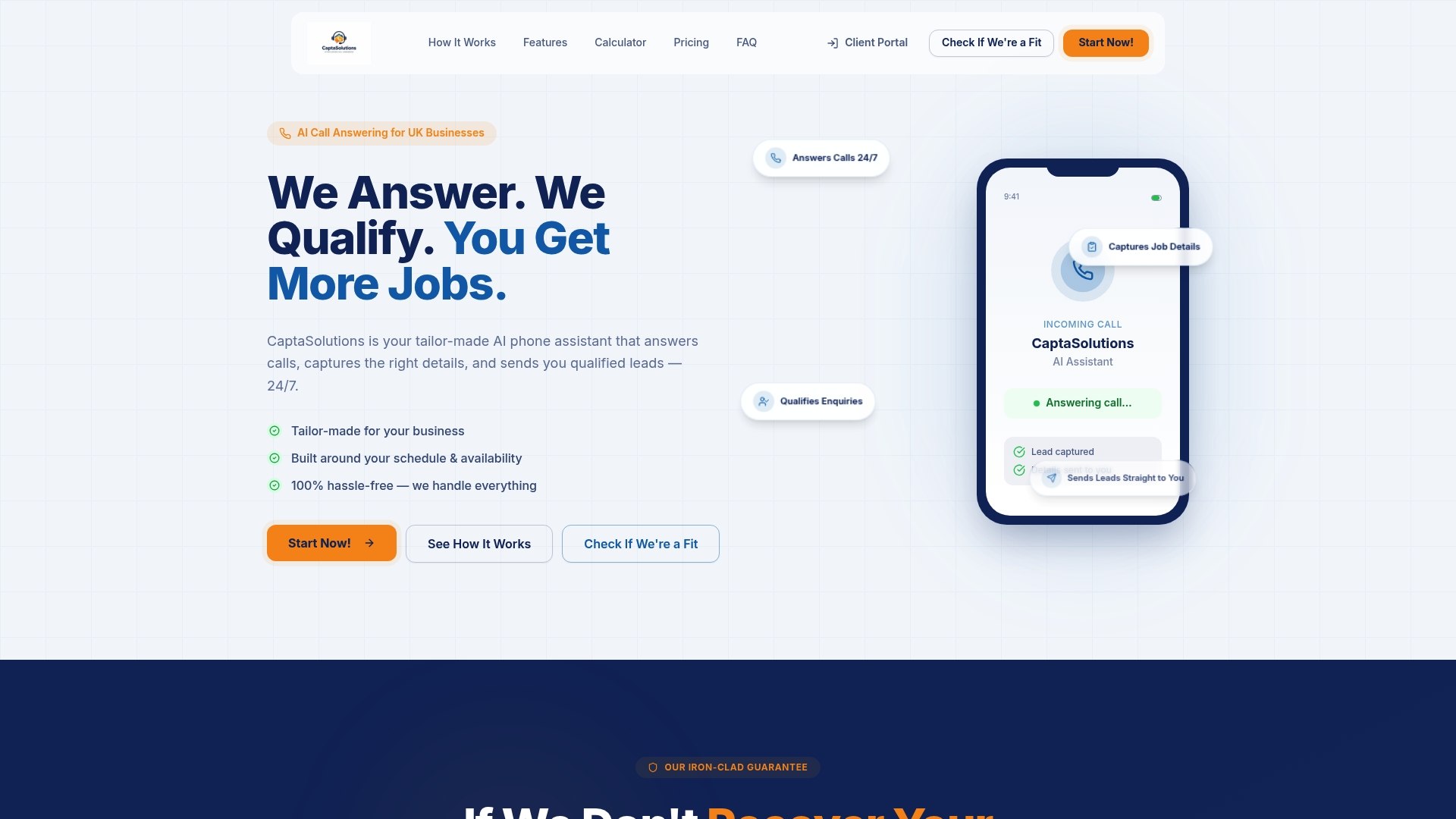
Captasolutions is an AI-powered call answering service built specifically for UK businesses that cannot afford to miss a lead. Whether you run a trades company, a salon, a clinic, or a hospitality venue, Captasolutions answers every call in your business name, 24 hours a day, seven days a week. It captures caller details, qualifies the enquiry, and organises everything into your client portal so you stay in control without being tied to your phone.
Compared to a full-time receptionist costing over £30,000 annually, Captasolutions delivers round-the-clock coverage at a fraction of the cost. There is a free 30-day trial with no card required and no contract. Visit captasolutions.co.uk to get started today or call 07346 811329. You could be live within the hour.
FAQ
How does answering calls help a business grow?
Answered calls convert to customers at a significantly higher rate than missed ones. 78% of customers buy from the first business to respond, so consistent call answering is one of the most direct ways to increase sales.
What is the cost of missing business calls?
The cost is substantial. 85% of callers who reach voicemail never call back, which means every missed call is effectively a lost lead unless you follow up within minutes.
How quickly should a business respond to a missed call?
Within ten minutes during business hours. Responding within the first minute increases conversion by up to 391% compared to a five-minute or longer wait.
What metrics should I track to measure call answering performance?
Focus on call answer rate, lead response time, call-to-conversion rate, and call quality scores. These four metrics give you a clear view of where growth is being lost and where improvement is generating revenue.
Can an AI service really handle business calls professionally?
Modern AI call answering services answer in your business name, qualify the enquiry, and capture all caller details accurately. For UK businesses managing volume or after-hours calls, they deliver consistent professional coverage that a stretched in-house team rarely can.