
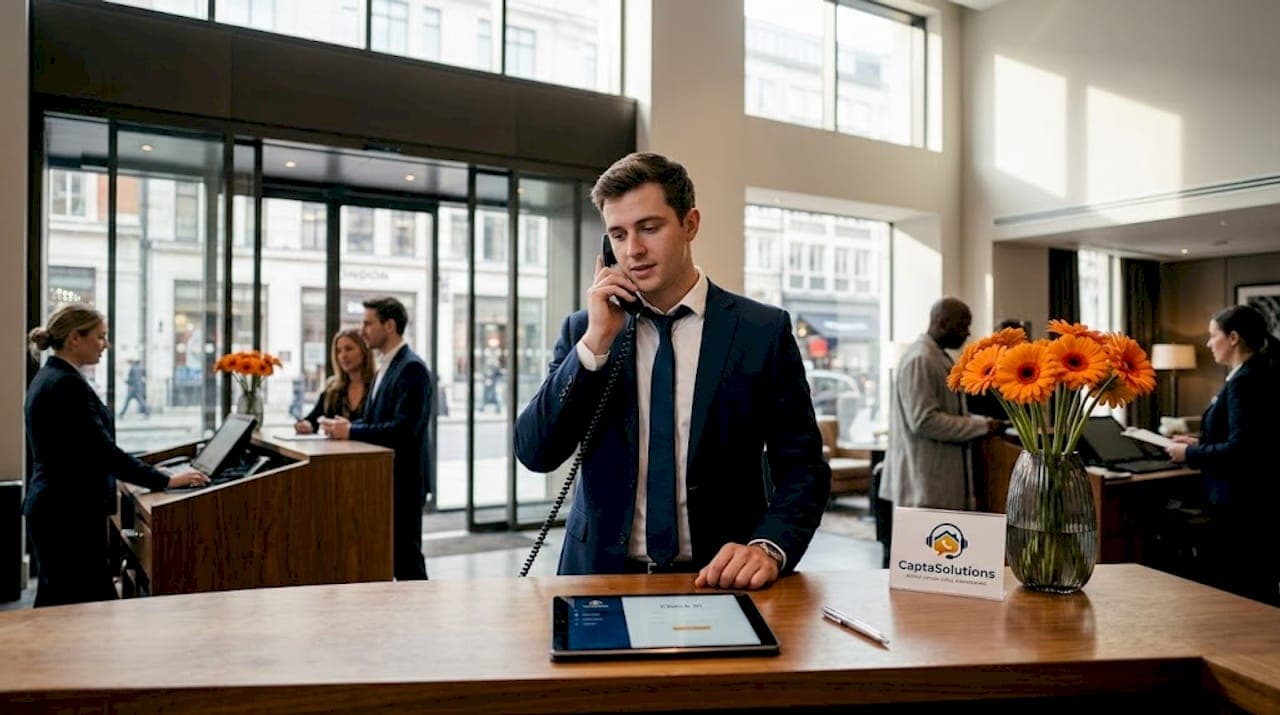
Despite the rise of online booking platforms and automated messaging, the role of phone answering in UK hospitality remains one of the most consequential touchpoints in the guest journey. A missed call during dinner service or an unanswered enquiry on a Sunday evening does not just mean one lost booking. It means a guest who moves on to a competitor within minutes. UK hospitality professionals who treat phone answering as a back-office function rather than a frontline revenue tool are leaving money on the table every single day.
Table of Contents
- Key takeaways
- Current expectations and challenges in phone answering
- The role of technology and AI in supporting phone teams
- Best practices for phone answering in hospitality teams
- Impact of phone answering on bookings and revenue
- Strategies to improve your phone answering service
- My view on the human touch in hospitality calls
- How Captasolutions supports UK hospitality venues
- FAQ
Key takeaways
| Point | Details |
|---|---|
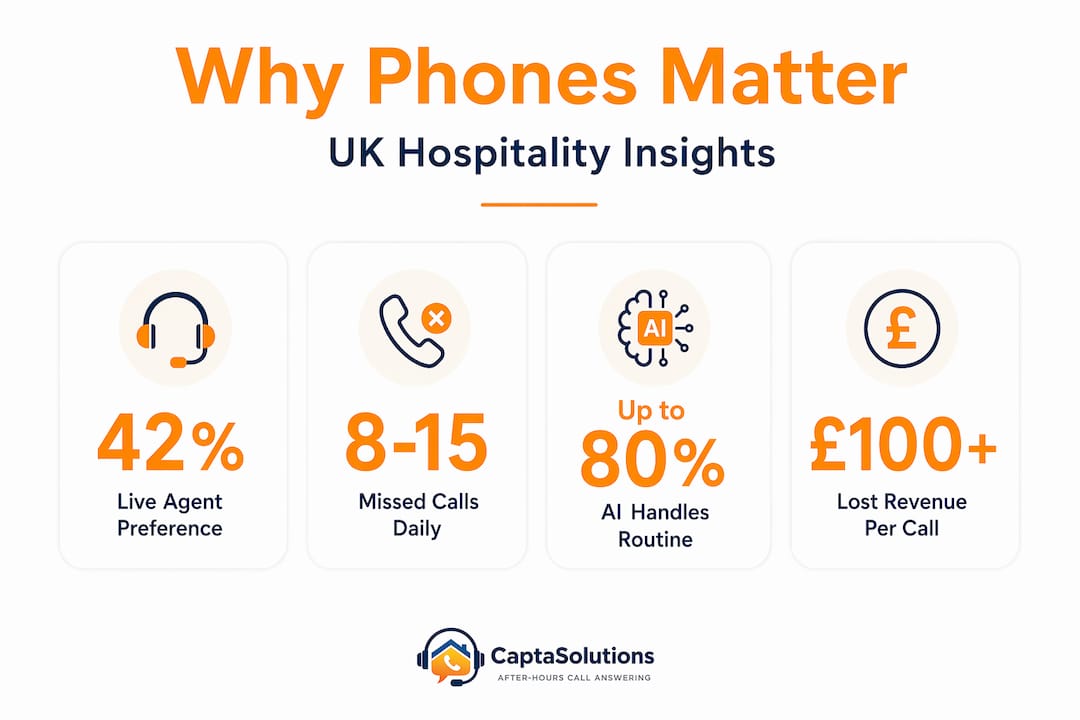
| Human preference is strong | 42% of British consumers prefer to speak with a live agent for customer service calls. |
| Missed calls cost real revenue | A restaurant missing just 10 calls daily can lose over £100,000 in annual revenue. |
| AI handles routine, humans handle nuance | AI manages up to 80% of routine enquiries, freeing staff for complex, emotional calls. |
| Speed and empathy convert bookings | Fast pick-up times paired with empathetic scripting directly improve booking conversion rates. |
| 24/7 availability is a competitive edge | Venues with round-the-clock call answering retain more guests and reduce peak-time operational stress. |
Current expectations and challenges in phone answering
The hospitality sector operates on emotion. Guests calling a hotel, restaurant, or event venue are rarely in a transactional frame of mind. They want reassurance, information, and the feeling that their booking matters. That emotional context makes phone calls in hospitality categorically different from, say, calling a utility provider.
42% of British consumers prefer a live agent when contacting customer service, and one in four will actively try to bypass automated systems to reach a real person. That figure is particularly relevant in hospitality, where calls frequently involve special dietary requirements, complaint resolution, last-minute cancellations, or sensitive group bookings. These are not enquiries that a recorded message handles well.
The common challenges UK hospitality businesses face with phone answering include:
- High call volumes during peak service times, when staff are occupied and calls go unanswered
- Inconsistent call handling, where tone and accuracy vary depending on who picks up
- No out-of-hours coverage, meaning evening and weekend enquiries fall straight to voicemail
- Long hold times, with 44% of consumers citing hold times as their primary frustration when calling a business
- Poor complaint handling on the phone, which escalates dissatisfaction rather than resolving it
The importance of phone communication in hospitality goes beyond convenience. A guest who cannot reach you does not wait. They book elsewhere, leave a negative review, or simply never return. The impact on customer loyalty and brand reputation compounds over time, particularly for independent venues that rely on repeat business and word-of-mouth referrals.
The role of technology and AI in supporting phone teams
The most common misconception in hospitality management is the binary choice: either you hire more staff, or you automate everything. Neither extreme works particularly well on its own.
AI effectively manages 70 to 80% of routine enquiries, including questions about opening hours, menu options, parking, and general availability. That is a significant volume of calls that do not require a skilled hospitality team member. When AI handles this tier of enquiry competently, it frees human agents to focus on calls that actually require judgement, empathy, and relationship-building.
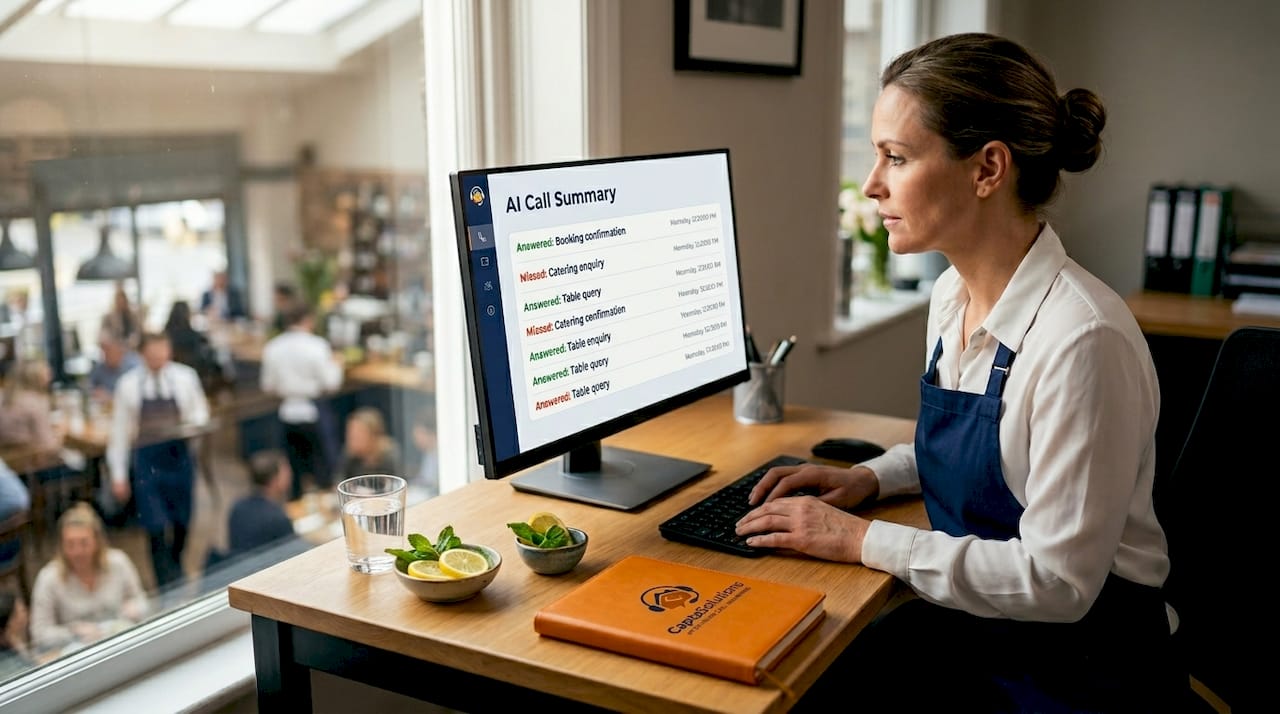
The critical element is the handoff. When a call moves from an AI system to a human agent, the guest should not have to repeat their name, their booking reference, or the reason they called. Structured call summaries passed to the human agent before the conversation begins speed up resolution and demonstrate to the caller that the business is organised and attentive. That detail alone changes how the guest perceives the brand.
Poor AI implementation creates the opposite effect. Systems that lose context mid-call, fail to recognise when a caller is distressed, or loop through menus without resolution do measurable damage to guest satisfaction. AI voice systems must avoid commitments they cannot keep, such as quoting specific prices or confirming availability without verified data, because errors create disputes that erode trust rapidly.
The strongest hospitality operations use technology as a support layer, not a replacement. Learn more about how AI is replacing answerphone systems across the UK service sector for practical examples of this approach in action.
Pro Tip: When evaluating any AI call solution for your venue, test its escalation logic first. Ask a complex question, then ask to speak to someone. If the handoff is smooth and the agent has context, the system is worth considering. If you have to start over, move on.
Best practices for phone answering in hospitality teams
Getting phone etiquette right in UK hotels and restaurants is not purely about politeness. It is about process. A well-structured call from pick-up to close builds confidence, captures accurate information, and converts enquiries into confirmed bookings.
Here is a practical framework that hospitality teams can apply directly:
- Answer within three rings. Speed signals that the business is attentive. A caller left on hold for more than 11 minutes, which is the average tolerance threshold according to consumer research, is likely to hang up and not call back.
- Open with your brand name and your own name. "Good afternoon, The Crown at Henley, this is Sarah" takes four seconds and immediately establishes professionalism and accountability.
- Use active listening, not passive acknowledgement. Reflecting back what the caller has said ("So you are looking for a table for six on the evening of the 14th, and one guest has a nut allergy") confirms accuracy and makes the caller feel genuinely heard.
- Avoid negative phrasing. Replace "I can't do that" with "What I can do is..." This keeps the conversation constructive without making promises you cannot fulfil.
- Do not ask the caller to repeat themselves. If notes are being taken, confirm details once at the end. Repetitive questioning is one of the fastest ways to frustrate a guest.
- Close with clear next steps. Fast, clear communication about what happens next reduces follow-up calls and sets accurate expectations. Tell the caller when they will receive confirmation and via which channel.
- Train staff on diverse caller needs. Guests with hearing difficulties, non-native English speakers, or anxiety around bookings require adapted communication. A brief section in any staff training programme covering these scenarios pays dividends in guest satisfaction scores.
Pro Tip: Record a sample of your venue's calls each month (with appropriate consent) and review them in team briefings. You will identify patterns in missed information, tone inconsistencies, and lost bookings far more quickly than relying on guest feedback alone.
Answering calls effectively during business hours is a discipline, not a natural talent. The best hospitality teams treat it as such.
Impact of phone answering on bookings and revenue
The financial case for investing in phone answering is not theoretical. Consider a mid-sized restaurant missing just 10 calls per day at an average booking value of £35 per head for a table of two. That is over £100,000 in lost annual revenue from an issue that is entirely fixable. For hotels with higher average booking values, the numbers are proportionally more severe.
The table below illustrates the measurable difference between venues with and without a professional phone answering process in place.
| Metric | Without professional answering | With professional answering |
|---|---|---|
| Missed calls per day | 8 to 15 | 0 to 2 |
| Booking conversion rate | 35 to 45% | 60 to 75% |
| Out-of-hours enquiries captured | Under 20% | Up to 95% |
| Guest complaint escalation rate | High | Significantly reduced |
| Revenue impact (annual) | Material loss | Recovery of missed revenue |
Telephone remains the channel of choice for high-emotion moments in the UK because callers want immediate reassurance. That reassurance translates directly into booking confidence. A guest who speaks to a calm, knowledgeable person and receives a clear confirmation is significantly more likely to follow through than one who submits an online form and waits.
The role of call answering in UK customer retention is equally concrete. Guests who feel valued during a phone interaction return. Those who feel dismissed or ignored do not. For venues operating in competitive markets, the quality of your phone answering is often what differentiates you from the property down the road, not your menu or your room rate.
Explore more on call answering and revenue impact for a deeper look at the numbers across UK service businesses.
Strategies to improve your phone answering service
Before making changes, assess what you are currently working with. Review your call volumes by time of day and day of week. Identify where calls are being missed, where hold times spike, and what types of enquiries are most common. Most hospitality businesses are surprised by how concentrated their peak call periods actually are.
Once you have that baseline, consider these approaches:
- Audit in-house capability honestly. If your front-of-house team is managing covers and calls simultaneously during a Friday dinner service, one of those tasks is being done poorly. Identify the gap before assuming it is a training issue.
- Evaluate outsourced answering services. A professional answering service or an AI-powered solution can cover out-of-hours calls, overflow during peak periods, and provide consistent quality regardless of staffing levels. Venues with 24/7 answering coverage maintain higher customer engagement and report reduced operational stress during high-demand periods.
- Consider a hybrid model. Use AI for the first layer of triage and routine enquiries, with clear escalation to human agents for complex or emotional calls. This approach manages costs without sacrificing the quality that hospitality guests expect.
- Integrate call answering with your booking and CRM systems. When a call results in a booking, the details should flow directly into your system without manual re-entry. This reduces errors and ensures nothing falls through the gaps.
- Track performance with clear metrics. Monitor call abandonment rates, average wait times, first-call resolution rates, and conversion from enquiry to booking. These figures give you an objective view of whether your current approach is working.
- Avoid the common mistake of switching systems without training. New technology without staff understanding creates confusion and inconsistency. Any change in call handling process needs a structured onboarding period before it delivers results.
Growing your business through call answering is achievable for venues of any size, but it requires deliberate investment in both process and tools.
Pro Tip: Set a call abandonment rate target of no more than 5%. If your current rate is higher, that single metric tells you everything you need to know about the scale of your missed revenue opportunity.
My view on the human touch in hospitality calls
I have worked with hospitality clients across the UK who were confident that their online booking systems had made phone answering largely irrelevant. Almost without exception, when they actually audited their missed calls and tracked what happened to those callers, the picture was sobering. Guests were not booking online instead. They were booking somewhere else by phone.
What I have learned from seeing this repeatedly is that the role of phone answering in UK customer experience is not diminishing. It is concentrating. The calls that come through now tend to be higher value, more emotionally charged, and more decisive for the guest. The enquiry about a wedding reception. The call about a birthday dinner for a parent with mobility needs. The complaint about a stay that did not meet expectations. These are not moments you want handled by a poorly briefed member of staff or an automated system that loses context.
My position is straightforward: technology should handle what it does efficiently, and human skill should be reserved for what only a person can do well. The businesses that get this balance right do not just answer more calls. They convert more of them, retain more guests, and build reputations that sustain them through difficult trading periods. Phone answering is not an overhead. It is a revenue function, and it deserves to be treated as one.
— Daniel
How Captasolutions supports UK hospitality venues
If you recognise the missed call problem but lack the staffing to solve it, Captasolutions offers a practical answer. Captasolutions is an AI-powered call answering service built specifically for UK businesses that cannot afford to let enquiries slip away, including restaurants, hotels, and event venues operating around the clock.
Captasolutions answers every call in your business name, 24 hours a day, seven days a week. It captures caller details, qualifies the enquiry, and organises everything into your client portal so you stay in control. There are no missed calls during service, no lost out-of-hours bookings, and no gaps in your customer journey. Visit Captasolutions to start a free 30-day trial with no contract and no card required. Your first call could be the one that pays for itself.
FAQ
Why does phone answering matter so much in UK hospitality?
Phone calls in hospitality often involve high-emotion, high-value decisions such as group bookings, special occasions, and complaint resolution. British consumers prefer live agents for these moments, making phone answering a direct driver of guest satisfaction and revenue.
How many calls is a hospitality business likely to miss?
During peak service periods, many venues miss between 8 and 15 calls per day. Over a year, that volume represents a significant and quantifiable loss in bookings and revenue that most managers underestimate until they measure it directly.
Can AI replace human phone answering in hotels and restaurants?
AI manages up to 80% of routine enquiries effectively, but complex and emotionally sensitive calls still require human judgement. The most effective approach combines AI for routine triage with human agents for nuanced interactions.
What are the most important elements of good phone etiquette in hospitality?
Answering within three rings, using the venue name and your own name in the greeting, practising active listening, and closing with clear next steps are the foundations. Consistency across all staff members is what separates good from exceptional.
How does out-of-hours call answering affect booking rates?
Venues with 24/7 coverage capture enquiries that would otherwise go unanswered, including weekend and late evening calls that are frequently high-intent bookings. Capturing these calls can recover a substantial portion of previously lost revenue with no change to daytime staffing.