

If you've ever wondered how an AI receptionist works without a human picking up the phone, you're not alone. Many UK business owners assume it requires expensive software, IT support, or a complete overhaul of their phone system. None of that is true. The technology behind automated receptionist systems, more formally known as AI voice agents, is far more accessible than most people realise. This article explains exactly what happens when a call comes in, why businesses across the UK are adopting this technology, and how you can have it running in under an hour.
Table of Contents
- Key takeaways
- How an AI receptionist works: the technical process
- The benefits of AI receptionists for UK businesses
- AI vs human receptionists: strengths and limits
- Setting up your AI receptionist: what to do first
- My honest take on AI receptionists for UK businesses
- Try Captasolutions for your business today
- Common questions
Key takeaways
| Point | Details |
|---|---|
| AI converts speech instantly | AI voice agents transcribe speech, match intent, and respond in under two seconds. |
| Setup is straightforward | Most businesses configure AI call answering via simple call forwarding, no developers required. |
| Significant cost savings | AI receptionist services can cost a tenth of what a human receptionist costs monthly. |
| Hybrid models work best | AI handles repetitive calls well, but human escalation paths are critical for complex queries. |
| 24/7 coverage captures more leads | AI receptionists answer every call, day or night, so no enquiry goes unanswered. |
How an AI receptionist works: the technical process
When a call comes in, the AI receptionist does not simply play a recording. It listens, understands, and responds in real time. The underlying process moves through several distinct stages, each happening faster than most callers notice.
The first stage is speech-to-text conversion. The caller speaks, and the AI transcribes their words into text almost immediately. This is the same fundamental technology used by voice assistants on smartphones, though AI receptionist technology is specifically trained for telephone audio quality and business contexts.
Once the speech is transcribed, the system moves to intent recognition. The AI matches what the caller said against a set of business rules. If a caller says "I'd like to book an appointment for next Tuesday," the AI recognises a booking intent and triggers the appropriate response. If the caller asks about opening hours, it retrieves that information from the business's knowledge base.
The response is then generated and delivered via text-to-speech. Modern AI voice agents sound increasingly human-like, with some systems featuring emotional tone modulation and sentiment analysis that adjust the AI's tone based on what the caller seems to be feeling.
After responding, the system can trigger actions automatically. This includes writing appointments to calendars and sending SMS confirmations to reduce no-shows, capturing caller details into a CRM, or routing the call to a member of staff. The entire sequence, from call answer to action, happens within two seconds.
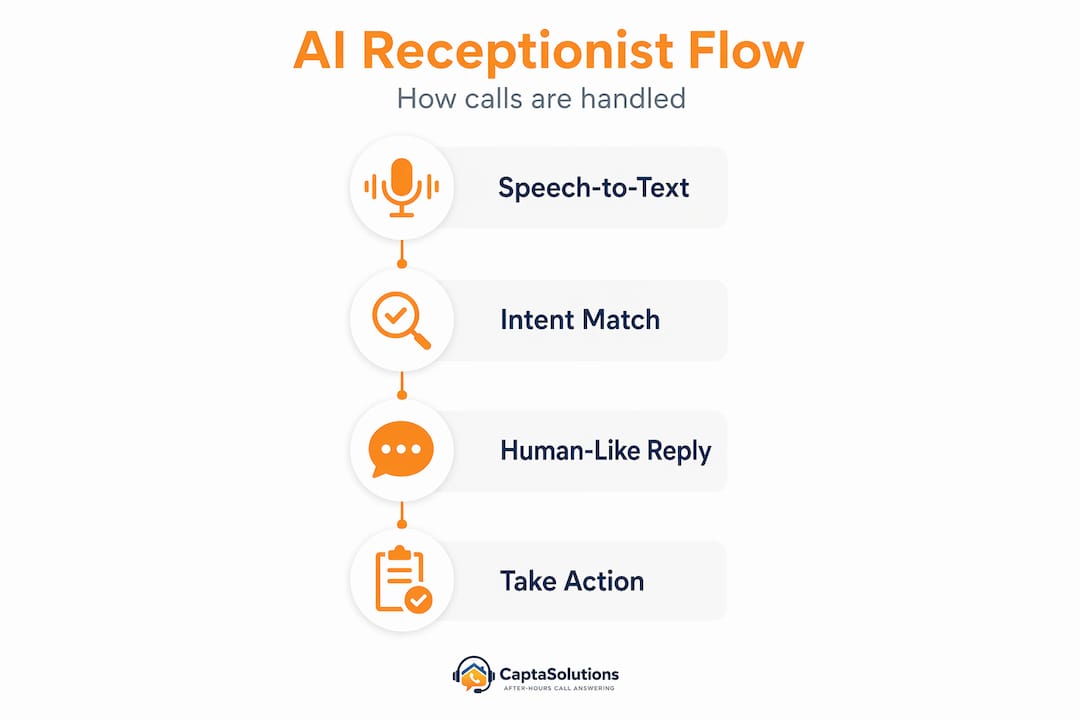
| Stage | What happens | Typical time |
|---|---|---|
| Speech-to-text | Caller's voice is transcribed | Under 0.5 seconds |
| Intent recognition | AI matches caller query to business rules | Under 0.5 seconds |
| Response generation | Text-to-speech reply is delivered | Under 1 second |
| Action trigger | Booking, SMS, CRM update, or call transfer | 1 to 3 seconds |
Pro Tip: When setting up your AI receptionist, spend time defining specific intent categories that match how your customers actually phrase their questions. Generic categories produce vague responses. The more specific your rules, the more accurate the AI's replies.
The benefits of AI receptionists for UK businesses
The most obvious advantage is availability. An AI receptionist answers calls at midnight on a Sunday just as readily as it does at 9am on a Monday. For trades businesses, restaurants, salons, and clinics across the UK, that kind of consistent coverage makes a material difference to how many enquiries are captured.

Cost is the other major factor. AI receptionist services start at around $99 per month, compared to £800 to £1,200 per month for a human receptionist. For a small business, that difference funds other priorities. You can read more about the financial case in this breakdown of AI receptionist cost savings.
Beyond availability and cost, here are the most significant operational benefits:
- No hold times. The AI answers every call instantly, regardless of how many calls come in simultaneously.
- Lead qualification. AI receptionists qualify callers based on your criteria before logging or forwarding the enquiry.
- Reduced staff workload. Routine calls, address queries, pricing questions, and appointment requests no longer eat into your team's time.
- CRM and calendar integration. Bookings are written directly to your calendar software, and caller details go straight into your client management system.
- Consistent messaging. Every caller hears the same professional greeting and accurate information, regardless of the time of day.
It is worth noting that 82% of employees globally now want AI-powered tools to support their customer-facing workflows. The shift is not just about automation. It is about freeing people to do work that actually requires human judgement.
Pro Tip: Upload a detailed FAQ document when you configure your AI receptionist. The more questions it can answer confidently, the fewer calls need to be escalated. Common FAQ topics include pricing, availability, service areas, and cancellation policies.
AI vs human receptionists: strengths and limits
Understanding the difference between an AI voice agent and a human receptionist is not about choosing one over the other. Hybrid models are the most successful deployments, with AI managing the volume work and humans stepping in for calls that require empathy, nuance, or complex problem-solving.
Here is how the two compare across the dimensions that matter most to a UK business owner:
| Capability | AI receptionist | Human receptionist |
|---|---|---|
| Availability | 24/7, no gaps | Business hours only unless overtime is paid |
| Call volume | Unlimited simultaneous calls | One call at a time |
| Consistency | Identical every time | Varies by individual and mood |
| Empathy | Improving, not yet equivalent | Strong, natural |
| Complex queries | Escalates when confidence is low | Handles directly |
| Monthly cost | Low fixed fee | £800 to £1,200 or more |
| Setup time | Under one hour | Recruitment and training required |
The concern that AI sounds robotic is increasingly outdated. Advanced AI voice agents now include emotional tone modulation, meaning the system adjusts its pace and register depending on whether a caller sounds anxious, frustrated, or straightforward. That said, human receptionists remain indispensable for high-stakes calls: complaints, safeguarding concerns, or anything that requires genuine judgement and empathy.
The key is designing clear escalation paths. Poor escalation design is the most common reason AI receptionist deployments fail. If the AI cannot confidently handle a query, it should transfer the call to a human immediately, not attempt to muddle through.
The most practical framing is this: AI handles repetitive tasks to prevent human burnout, while your team focuses on the calls where their skills genuinely add value.
Setting up your AI receptionist: what to do first
One of the biggest misconceptions about working with AI receptionists is that setup requires IT involvement. It does not. Most businesses go live in under an hour using simple call forwarding rules in their existing phone carrier account. You do not need to change your phone number, switch to VoIP, or hire a developer.
Here is a practical step-by-step approach to getting started:
- Choose your service provider. Select an AI receptionist service that has experience with UK phone systems and business types similar to yours.
- Configure call forwarding. Log into your phone carrier account and set calls to forward to the AI when unanswered, engaged, or always, depending on your preference.
- Upload your business information. This includes your address, services, pricing, opening hours, and a detailed FAQ document covering your most common caller questions.
- Connect your calendar or CRM. Grant the AI access to your booking software so it can write appointments directly without manual input.
- Define escalation rules. Decide which call types should be transferred to a human, and provide the relevant contact details.
- Test with real scenarios. Call your own number and run through the queries your customers typically ask. Refine the AI's responses where needed.
Common pitfalls to avoid include uploading too little information, which produces vague or incorrect answers, and failing to test escalation paths before going live. Also, do not skip the FAQ upload step. It is the single biggest factor in how useful the AI is from day one. For trades businesses specifically, this guide on AI and booking calls is worth reading before you configure your service.
The simplicity of setup is genuinely one of the strongest selling points of modern automated receptionist systems. This is not a six-month IT project. It is an afternoon's configuration.
My honest take on AI receptionists for UK businesses
I've spoken with enough UK business owners to know that the initial hesitation around AI receptionists rarely comes from the cost or the technology. It comes from the fear of seeming impersonal. Nobody wants their customers to feel fobbed off by a machine.
What I've found, though, is that a missed call is far more impersonal than an AI that answers professionally and captures the enquiry accurately. A caller who rings a plumber at 7pm and hears nothing will simply call the next number on the list. An AI that answers, takes the details, and says "Someone will be in touch first thing tomorrow" has done exactly what a good receptionist would do.
Where I've seen businesses get into trouble is not by using AI, but by using it without thought. No escalation path. No FAQ document. An AI that confidently gives wrong answers because nobody uploaded the right information. That creates a bad experience, and it is entirely avoidable.
The businesses I've seen get the most value from AI receptionists treat the technology as a capable colleague with specific strengths, not a magic solution to every call-handling problem. They let the AI handle the volume, the out-of-hours calls, and the repetitive queries. They keep humans in the loop for anything sensitive. And they review their call logs regularly to improve the AI's responses over time.
The future is not AI instead of people. It is AI doing the work that stops your people from doing their actual jobs.
— Daniel
Try Captasolutions for your business today
If you're a UK business owner who wants to stop missing calls without hiring additional staff, Captasolutions was built specifically for that problem.
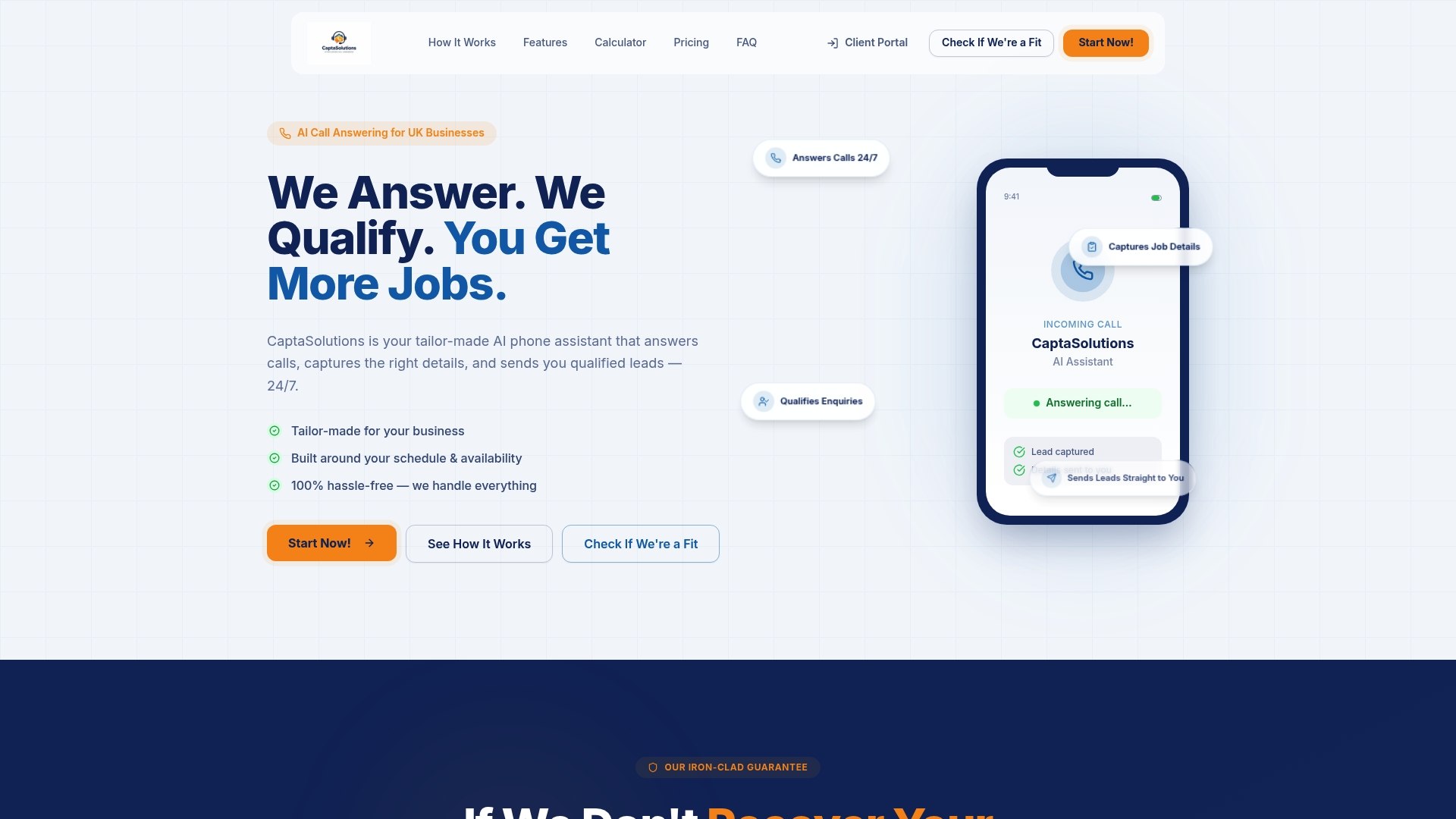
Captasolutions answers every call in your business name, 24 hours a day, 7 days a week. It captures caller details, qualifies the enquiry, and organises everything into your client portal. You review every lead and decide what to take on. Setup takes under an hour, there is no contract, and no card is required for the free 30-day trial. Whether you run a trades business, a clinic, a salon, or a hospitality venue, Captasolutions works with your existing phone number from day one. Find out more about 24/7 call answering at Captasolutions, or explore how AI reduces staff overload for businesses like yours.
Common questions
How does an AI receptionist answer calls without a human?
An AI receptionist uses speech-to-text technology to transcribe what a caller says, matches it against your business rules, and delivers a spoken response via text-to-speech. The entire process happens in under two seconds.
Can AI take phone calls without changing my phone number?
Yes. Most AI receptionist services work via call forwarding rules in your existing phone carrier account. You keep your current number and carrier, and no technical migration is required.
How much does an AI receptionist cost compared to a human?
AI receptionist services typically start at a low monthly flat fee, compared to £800 to £1,200 or more per month for a human receptionist. For most small UK businesses, the saving is significant.
What happens if the AI cannot answer a caller's question?
A well-configured AI receptionist will escalate the call to a human staff member when it cannot handle the query confidently. Defining clear escalation paths before going live is critical to a good caller experience.
Is an AI receptionist suitable for trades businesses in the UK?
Yes. Trades businesses are among the most common users of AI receptionist technology in the UK, particularly for capturing out-of-hours enquiries when operatives are on site and unable to answer calls.