

Phone answering is the frontline of customer interaction and one of the most direct levers for business growth available to UK businesses today. When a potential customer calls and no one answers, that opportunity is gone. They do not leave a voicemail and wait. They call the next business on the list. The role of phone answering in growth is not a soft, peripheral concern. It is a measurable, operational priority that affects revenue, retention, and reputation in equal measure. Whether you run a plumbing firm in Manchester, a salon in Bristol, or a restaurant in Edinburgh, the phone remains the primary channel through which customers choose to commit.
How does effective phone answering drive customer engagement and sales?
Prompt, professional call handling converts enquiries into paying customers at a significantly higher rate than delayed or missed responses. The connection between answering calls effectively and sales conversion is direct. A caller who reaches a knowledgeable, helpful voice within seconds is far more likely to book, buy, or commit than one who reaches a voicemail or an engaged tone.

The importance of phone answering becomes clearest when you consider what happens at the point of first contact. Customers calling a business for the first time are already in a buying mindset. They have searched, compared, and decided to make contact. A missed call at that moment does not just lose a sale. It hands that customer to a competitor who did answer.
Real-time problem solving is another underappreciated driver of sales conversion. When a caller can ask a question and receive an immediate, accurate answer, the friction that might otherwise delay or prevent a purchase disappears. This is particularly true in trades and professional services, where customers often have urgent needs and limited patience for callbacks.
- Immediate call response reduces the window in which a prospect can change their mind or contact a competitor.
- Personalised interaction, using the caller's name and referencing their specific situation, builds trust and signals competence.
- Clear, confident answers to pricing or availability questions accelerate purchase decisions without requiring a follow-up call.
- Consistent, professional greetings reinforce brand credibility from the very first second of contact.
Pro Tip: Record a sample of your incoming calls each week and listen back. You will quickly identify where callers are being lost, confused, or left on hold too long. This single habit has transformed call performance for many UK service businesses.
The impact of call handling on customer loyalty is equally significant. Customers who receive a positive first call experience are more likely to return, refer others, and leave positive reviews. The phone call is not just a transaction. It is the beginning of a relationship.
What operational efficiencies come from optimising call handling?
Structured call handling reduces wasted time, lowers costs, and improves the quality of every customer interaction. The operational case for investing in phone answering processes is backed by hard data, not theory.
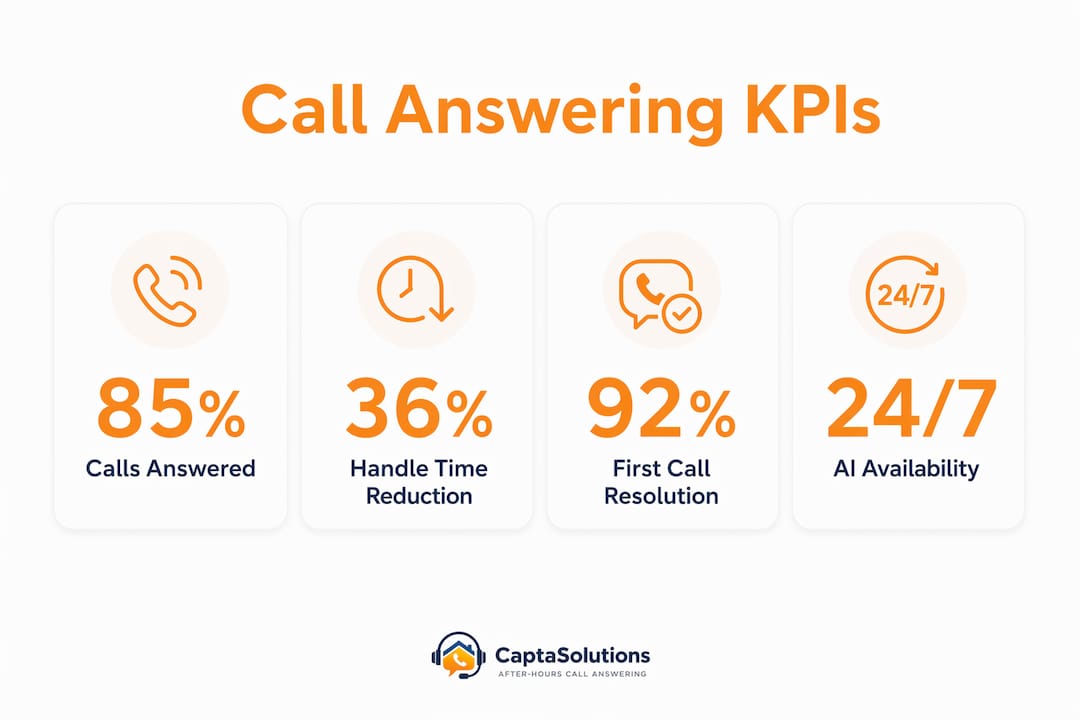
A Qualfon case study in the cybersecurity sector demonstrated that tailored agent scripts cut average handle time by 36%, dropping from 1,137 seconds to 729 seconds per call. That is 15 minutes saved per interaction, with annual cost savings of $41,000. Script adoption rose from 59.1% to 81.8% within weeks of implementation. The lesson for UK businesses is clear: standardisation is not bureaucracy. It is a performance tool.
| Metric | Before optimisation | After optimisation |
|---|---|---|
| Average handle time | 1,137 seconds | 729 seconds |
| Script adoption rate | 59.1% | 81.8% |
| Time saved per call | — | 15 minutes |
| Annual cost saving | — | $41,000 |
First-call resolution is the metric that most directly reflects call quality. When a caller's issue is resolved in a single interaction, the business avoids the cost and frustration of callbacks, rework, and escalation. Poor first-call resolution is one of the most common hidden costs in service businesses, and it almost always traces back to inadequate scripts, insufficient agent knowledge, or unclear call routing.
Continuous monitoring of script adherence and handle times creates accountability and enables rapid correction of workflow problems. Weekly tracking, rather than monthly reviews, allows businesses to catch performance dips before they become patterns. This is the kind of quality assurance discipline that separates businesses that grow from those that plateau.
Pro Tip: Start with a call audit before investing in new technology. Map your current call workflow from first ring to resolution. Identify where calls are dropped, transferred unnecessarily, or handled inconsistently. The bottlenecks are almost always obvious once you look.
How are human agents and AI combined to maximise call performance?
The most effective call answering operations in 2026 combine AI efficiency with human judgement, rather than choosing one over the other. This is not a compromise. It is a deliberate architecture that gets the best from both.
A Gartner survey of 321 leaders found that 85% of customer service leaders are expanding human agents' roles rather than cutting staff as AI automates routine calls. This finding challenges the assumption that AI replaces people. In practice, AI handles high-volume, low-complexity calls, freeing human agents to focus on complex, high-value interactions where empathy and judgement matter most.
The fastest cost reduction in call environments comes from routing high-volume, low-complexity calls to AI before they reach human agents. This reduces labour costs, shortens handle times, and improves job satisfaction for agents who are no longer fielding repetitive enquiries all day.
| Approach | Best suited for | Key benefit |
|---|---|---|
| AI answering only | High-volume, simple enquiries | 24/7 availability, low cost |
| Human agents only | Complex, sensitive interactions | Empathy, judgement, trust |
| Hybrid AI and human | Mixed call types | Efficiency plus personalisation |
Well-designed AI answering services treat escalation to a human agent as a deliberate feature, not a failure. When an AI system recognises that a call exceeds its confidence threshold, it transfers the caller cleanly and with context intact. This protects customer trust and avoids the frustration of a caller having to repeat themselves. The Gartner data reinforces this: 54% of customers trust human agents more than AI for recommendations, which means the escalation path is not just a technical feature. It is a trust mechanism.
AI-powered services like those offered by Captasolutions can handle calls 24/7, book appointments, and escalate cleanly, with setup under an hour and no changes to existing phone numbers required. For a small UK business, this means professional call coverage from day one without hiring additional staff.
What industry-specific approaches to phone answering boost growth in UK sectors?
The benefits of effective answering services vary by sector, but the underlying principle is consistent: missed calls cost money, and answered calls create opportunity. The difference between a business that grows and one that stagnates often comes down to how reliably the phone is answered during peak demand.
For UK tradespeople, prompt phone answering signals professionalism and readiness. A plumber who answers every call, even while on a job, wins work that a competitor who lets calls go to voicemail will never see. The trade sector is highly competitive and largely driven by first contact. Customers rarely wait for a callback when three other plumbers are a Google search away.
In hospitality, the phone answering experience shapes the guest's perception before they ever arrive. A restaurant that answers promptly, confirms reservations accurately, and handles dietary queries with confidence creates a positive expectation. Venues that struggle with phone answering in hospitality often find that the problem compounds: poor call handling leads to booking errors, which leads to complaints, which damages reputation.
Salons present a particularly clear case. Salons using answering services avoid staff interruptions during treatments, reduce missed calls during peak periods, and improve the overall customer experience. A stylist who has to stop mid-appointment to answer the phone delivers a worse experience to the client in the chair and risks losing the caller at the same time.
Pro Tip: If your business experiences seasonal peaks, such as a landscaping firm in spring or a restaurant at Christmas, set up overflow call handling before the rush begins. Reactive fixes during peak periods are always more expensive and less effective than proactive preparation.
Retail and professional services face similar dynamics. Seasonal fluctuations and marketing campaigns create call spikes that overwhelm staff and lead to missed opportunities precisely when demand is highest.
How can UK businesses implement better phone answering to support growth?
Improving call answering performance does not require a large budget or a complete operational overhaul. It requires a structured approach applied consistently. The following steps give UK business owners a practical path from where they are to where they need to be.
-
Map your current call workflow. Trace every call from first ring to resolution. Identify where calls are dropped, where hold times are longest, and where callers are transferred more than once. This audit reveals the specific bottlenecks that are costing you business.
-
Choose the right model for your business. Decide between AI answering, live answering, or a hybrid approach based on your call volume, the complexity of your typical enquiries, and your budget. A sole trader benefits from AI coverage during working hours. A larger team may need a hybrid model with human escalation for complex calls. Captasolutions offers a practical guide to growing your business through better call answering, tailored specifically for UK businesses.
-
Standardise your scripts. Write clear, tested scripts for your most common call types: new enquiries, appointment bookings, complaints, and out-of-hours messages. Scripts do not make calls robotic. They make calls consistent and efficient.
-
Train and coach your team. Script adoption only works if agents understand why the script exists and how to adapt it naturally. Regular coaching sessions, using real call recordings as examples, build competence and confidence faster than any training manual.
-
Monitor the right metrics. Track average handle time, first-call resolution rate, and call abandonment rate on a weekly basis. These three numbers tell you almost everything you need to know about call performance. If any of them moves in the wrong direction, you will know within days rather than months.
-
Adapt continuously. Customer expectations and business needs change. Review your call handling approach quarterly, incorporate customer feedback, and update scripts when products, prices, or services change. Static processes decay. Active processes improve.
The role of call answering in revenue is well documented for small businesses. The businesses that treat phone answering as a managed process, rather than an afterthought, consistently outperform those that do not.
Key takeaways
Effective phone answering drives measurable business growth by converting more enquiries into customers, reducing operational costs, and building the trust that generates long-term loyalty.
| Point | Details |
|---|---|
| First contact determines outcomes | A missed or poorly handled call loses the customer to a competitor almost immediately. |
| Scripts cut costs and time | Standardised scripts reduced average handle time by 36% and saved $41,000 annually in a documented case study. |
| AI and human agents work best together | 85% of service leaders are expanding human roles alongside AI, not replacing them. |
| Industry context shapes the approach | Trades, hospitality, and salons each face distinct call handling challenges that require sector-specific solutions. |
| Weekly monitoring sustains gains | Tracking handle time and first-call resolution weekly prevents performance drift and enables rapid correction. |
Why phone answering deserves a seat at the strategy table
I have spoken with enough UK business owners to know that phone answering is almost always treated as an operational detail rather than a strategic priority. It sits somewhere between admin and customer service on the organisational chart, and it rarely gets the attention it deserves until something goes wrong.
What I find consistently is that the businesses which grow fastest are not necessarily the ones with the best product or the lowest price. They are the ones that are easiest to reach. A customer who calls and gets through, gets a clear answer, and feels heard will choose that business over a competitor with a slicker website almost every time.
The AI conversation is important, but it is being misread by many owners. The question is not whether to use AI or keep human agents. It is how to use AI to handle the calls that do not need a human, so that your human capacity is reserved for the conversations that genuinely require it. That distinction, applied well, is where the real efficiency gains live.
The most common mistake I see is businesses investing in call handling technology without first fixing the underlying process. An AI answering service built on a broken workflow will automate the problem, not solve it. Map the process first. Then choose the technology that fits it.
— Daniel
How Captasolutions helps UK businesses answer every call
Captasolutions is an AI-powered call answering service built for UK businesses that cannot afford to miss a call. Whether you are a tradesperson on a job, a restaurant mid-service, or a salon with clients in the chair, Captasolutions answers every call in your business name, 24 hours a day, seven days a week. It captures caller details, qualifies the enquiry, and organises everything into your client portal so you stay in control without being tied to the phone. There is no contract, no card required for the free 30-day trial, and the service goes live within the hour. Visit Captasolutions to get started today, or call 07346 811329 to speak with the team.
FAQ
What is the role of phone answering in business growth?
Phone answering is the primary point of first contact between a business and its potential customers. Answering calls promptly and professionally converts more enquiries into sales, builds customer trust, and reduces the number of opportunities lost to competitors.
How does AI improve call handling for small UK businesses?
AI answering services handle calls 24/7, book appointments, and escalate complex enquiries to human agents, all without changes to existing phone numbers. This gives small businesses professional call coverage at a fraction of the cost of a full-time receptionist.
What metrics should I track to improve phone answering performance?
Track average handle time, first-call resolution rate, and call abandonment rate on a weekly basis. These three metrics identify where calls are being lost or mishandled and allow rapid correction before problems compound.
Can standardised scripts really make a measurable difference?
Yes. A documented case study by Qualfon showed that tailored agent scripts cut average handle time by 36% and saved $41,000 annually. Script adoption rose from 59.1% to 81.8% within weeks, demonstrating that standardisation delivers fast, measurable results.
Should UK businesses use AI or human agents for call answering?
The most effective approach combines both. AI handles high-volume, routine calls to reduce costs and free up human agents for complex interactions. A Gartner survey found that 85% of service leaders are expanding human roles alongside AI rather than replacing them.