

An AI receptionist is an automated system that handles inbound business calls using artificial intelligence to provide consistent, efficient, and cost-effective customer interactions. UK businesses are trialling these systems at a growing rate, driven by a clear economic case: a full-time human receptionist costs between £36,000 and £45,600 annually in employer costs, while an AI-powered alternative runs from £2,400 to £9,600 per year. That gap is the primary reason why UK businesses trial AI receptionists. Beyond cost, the technology answers calls around the clock, captures every lead, and delivers consistent quality that human staff cannot always guarantee during busy periods or out of hours.
Why UK businesses trial AI receptionists: the core case
The financial argument for AI call answering is straightforward. AI receptionists cost between £200 and £800 per month, plus an initial setup fee, compared to the full employer burden of a salaried receptionist. From the second year onwards, businesses typically save over £26,000 annually. That figure does not account for recruitment fees, sick pay, or the cost of covering holiday leave.
The operational case is equally strong. A missed call is a missed customer. For a plumber on a job, a salon with a client in the chair, or a restaurant during the dinner rush, answering the phone is simply not possible. AI call answering solves that problem directly. It answers every call in the business name, qualifies the enquiry, and stores the caller's details for follow-up.

UK business owners are also responding to a shift in customer expectations. Callers expect an answer, not a voicemail. An AI receptionist provides that answer at 11pm on a Sunday as reliably as it does at 9am on a Monday. That consistency builds trust and reduces the number of enquiries that go to a competitor instead.
How do AI receptionists compare to human receptionists in the UK?
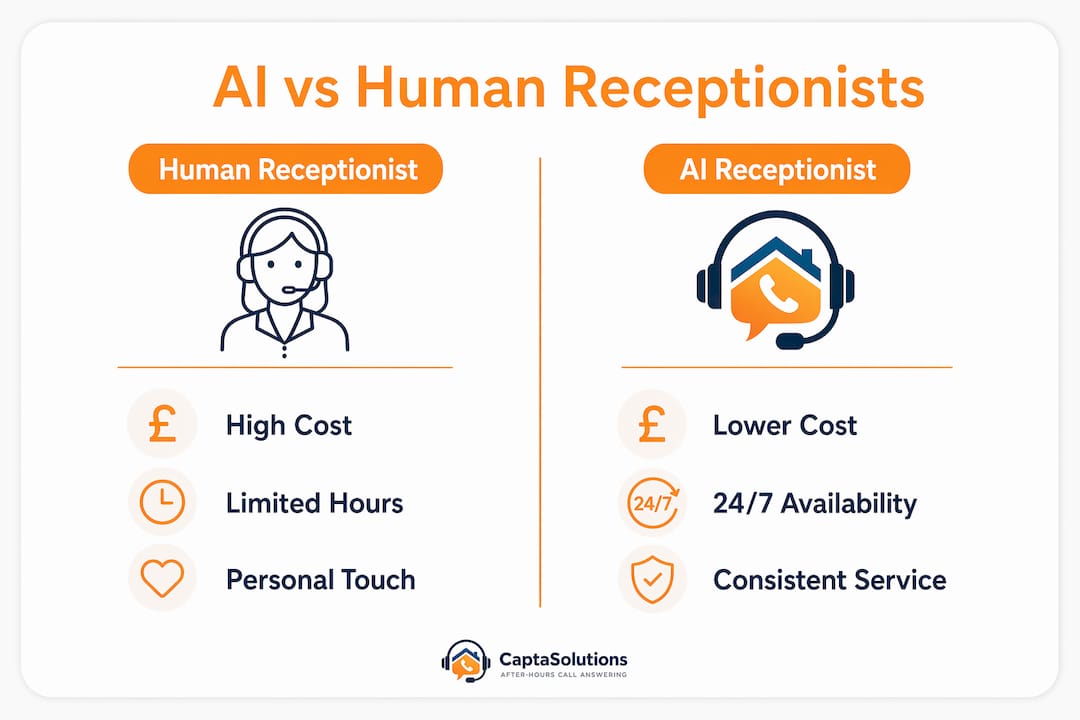
Cost and coverage are the two areas where AI holds the clearest advantage. A human receptionist brings genuine strengths in empathy, professional judgement, and the ability to read a caller's emotional state. Human receptionists remain preferable for walk-in traffic, escalations, and emotionally sensitive calls. AI cannot replicate that judgement in complex situations.
Where AI excels is in volume, consistency, and availability. It handles FAQs, appointment booking, call routing, and after-hours enquiries without fatigue or variation. A human receptionist has a good day and a bad day. An AI receptionist performs identically on both.
| Category | Human receptionist | AI receptionist |
|---|---|---|
| Annual employer cost | £36,000–£45,600 | £2,400–£9,600 |
| Availability | Business hours only | 24/7, 365 days |
| Consistency | Variable | Uniform |
| Empathy and judgement | High | Limited |
| Scalability | One call at a time | Unlimited simultaneous calls |
| Setup time | Weeks to recruit and train | Days to configure |
The hybrid model is the approach most UK businesses find most effective. AI handles routine calls, FAQs, scheduling, and out-of-hours enquiries. Human staff manage sensitive interactions, complaints, and relationship-critical conversations. This split gives businesses the cost efficiency of AI without sacrificing the quality that complex calls demand.
Pro Tip: Before committing to a fully AI-managed reception, audit your last three months of call logs. Categorise calls by type: routine enquiries, bookings, complaints, and escalations. If routine calls account for more than 60% of your volume, an AI receptionist will handle the majority of your workload without any drop in caller experience.
What kinds of UK businesses benefit most from AI receptionists?
Call volume is the primary factor in determining whether an AI receptionist makes financial sense. Businesses receiving 100 to 200 or more calls daily gain the clearest scalability and cost benefits from AI deployment. At that volume, a single human receptionist cannot keep pace, and the cost of additional staff grows quickly.
Smaller businesses with lower call volumes still benefit, particularly in specific scenarios:
- After-hours coverage. Trades businesses, clinics, and service firms regularly receive enquiries outside working hours. An AI receptionist captures those leads rather than losing them to voicemail.
- Overflow handling. During peak periods, calls that would otherwise go unanswered are picked up automatically. This is particularly valuable for restaurants, salons, and busy professional offices.
- Appointment booking. Businesses where scheduling is a core function, such as dental practices, beauty clinics, and consultancies, benefit from AI that books appointments directly into their calendar systems.
- Multi-site operations. Businesses operating across several locations can centralise call handling through a single AI system, reducing staffing costs and maintaining consistent caller experience across all sites.
- 24/7 service businesses. Any business that operates outside standard hours, or that serves customers who call outside those hours, gains immediate value from round-the-clock AI coverage.
AI adoption scales with call volume, and the economics tip decisively in favour of AI for mid-market UK businesses. For smaller operations, the value comes less from volume savings and more from never missing a lead.
Pro Tip: Map your call flow before selecting an AI receptionist. If your calls follow predictable patterns, such as booking requests, price enquiries, or directions, AI will handle them well. If your calls regularly involve negotiation, complaints, or nuanced client management, plan for a hybrid setup from the start.
What are the steps and timelines for deploying an AI receptionist?
Deployment is not instant, and businesses that treat it as a plug-and-play solution tend to get poor results. A fully integrated AI receptionist typically takes four to six weeks to deploy for a mid-market UK business. That timeline covers CRM integration, call flow configuration, GDPR compliance checks, and testing.
A well-structured deployment follows these stages:
- Discovery and scoping. Define which call types the AI will handle, which it will escalate, and what information it needs to capture. This stage shapes everything that follows.
- System integration. Connect the AI to your CRM, booking platform, or call management system. Without this step, the AI captures data that sits in isolation rather than feeding into your existing workflow.
- Knowledge base configuration. Build the AI's understanding of your business: your services, pricing, opening hours, FAQs, and escalation rules. The quality of this stage determines the quality of every call the AI handles.
- GDPR compliance review. UK businesses must confirm that call recording, data storage, and caller consent processes meet ICO guidelines. This is not optional. Skipping it creates legal exposure.
- Testing and refinement. Run the AI against real call scenarios before going live. Identify gaps in its knowledge base and adjust call routing rules based on test results.
- Go-live and monitoring. Launch with active monitoring during the first two to four weeks. Review call transcripts, check escalation rates, and refine the system based on real caller behaviour.
Enterprise-grade AI receptionist deployment requires thorough integration with CRM and call systems, GDPR compliance, and a multi-week configuration period to ensure reliable operations. Businesses that rush this process typically find their AI misroutes calls, fails to capture key information, or frustrates callers with irrelevant responses.
Pro Tip: Choose a provider that includes structured onboarding as part of the service, not as an optional extra. The configuration and testing phases are where the real value is built. A provider that skips them is selling you a product, not a solution.
How do AI receptionists improve customer experience and efficiency?
The customer experience benefits of AI call answering go well beyond cost reduction. AI receptionists answer calls 24/7 with consistent quality, reducing missed calls and improving the overall caller experience. That consistency is the feature most business owners underestimate until they see it in practice.
The operational gains are specific and measurable:
- Zero missed calls. Every inbound call receives an answer, regardless of time, day, or how busy the business is. A caller who reaches a business at 10pm gets the same professional response as one who calls at 10am.
- Accurate call routing. The AI directs callers to the right person or department based on their enquiry, reducing transfer times and caller frustration.
- Automatic lead capture. Caller details, enquiry type, and contact preferences are recorded and stored automatically. This feeds directly into your lead capture workflow, removing the risk of leads being lost to a missed note or a forgotten callback.
- Consistent FAQ handling. Opening hours, pricing, directions, and service information are delivered accurately every time, without variation or error.
- Appointment booking. The AI books appointments in real time, reducing the administrative load on human staff and eliminating double bookings caused by manual scheduling.
The benefits of automated call answering compound over time. Businesses that capture more leads, book more appointments, and miss fewer calls grow faster than those that rely on staff availability alone. AI receptionist technology makes that outcome repeatable and consistent.
Key takeaways
UK businesses trial AI receptionists primarily because the technology reduces employer costs by over £26,000 annually from the second year, while delivering 24/7 call coverage that human staff cannot match.
| Point | Details |
|---|---|
| Cost advantage is significant | AI receptionist costs £2,400–£9,600 per year versus £36,000–£45,600 for a human receptionist. |
| Hybrid model works best | Use AI for routine calls and human staff for sensitive or complex interactions. |
| Call volume drives ROI | Businesses handling 100 or more daily calls gain the strongest scalability and cost benefits. |
| Deployment takes four to six weeks | Full integration with CRM, GDPR compliance, and testing requires structured onboarding. |
| 24/7 coverage captures lost leads | AI answers every call out of hours, reducing the leads that go to competitors. |
What I've learned from watching UK businesses adopt AI receptionists
The businesses that get the most from AI receptionists are not the ones with the biggest budgets. They are the ones that go in with clear expectations. I have seen well-funded deployments fail because the business expected the AI to handle every call type without any configuration work. I have also seen small trades businesses get outstanding results within weeks because they defined their call flow clearly from day one.
The most common misconception is that AI replaces the need for human judgement entirely. It does not. What it does is free up human staff to focus on the calls that actually need them. A receptionist who spends 70% of their day answering the same five questions is not doing their best work. An AI that handles those five questions consistently gives that person back their time.
The second misconception is that a trial tells you nothing useful unless it runs perfectly. A trial is most valuable when it surfaces the edge cases: the call types the AI struggles with, the routing rules that need adjustment, the knowledge gaps that need filling. Those findings are what make the full deployment work.
My advice to any UK business owner considering a trial is to treat it as a diagnostic, not a demo. Run it for 30 days, review every call transcript, and measure the outcomes against your current missed call rate. The data will tell you exactly where AI adds value and where human judgement is still needed.
— Daniel
Captasolutions: AI call answering built for UK businesses
Captasolutions is an AI-powered call answering service designed specifically for UK businesses that cannot afford to miss a call. Whether you run a trades business, a salon, a clinic, or a professional office, Captasolutions answers every call in your business name, 24 hours a day, seven days a week.
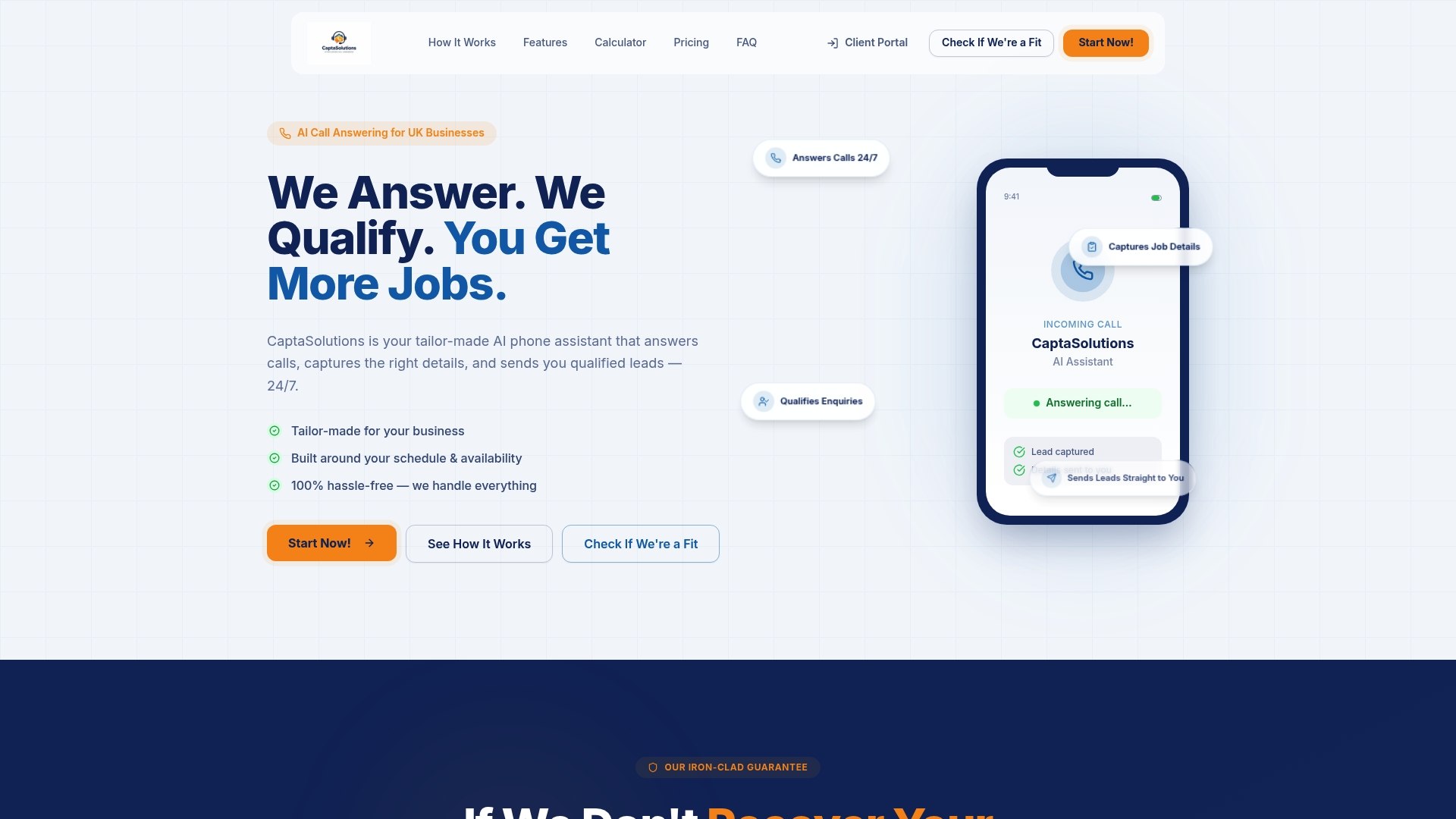
The service captures caller details, qualifies each enquiry, and organises everything into your client portal. You review every lead and decide what to take on. Setup takes less than an hour, there is no contract, and no card is required to start. Captasolutions offers a free 30-day trial so you can measure the impact on your own call volume before making any commitment. Visit captasolutions.co.uk or call 07346 811329 to get started today.
FAQ
What is an AI receptionist?
An AI receptionist is an automated system that answers inbound business calls using artificial intelligence. It handles enquiries, captures caller details, routes calls, and books appointments without human involvement.
How much does an AI receptionist cost in the UK?
AI receptionists typically cost between £200 and £800 per month, totalling £2,400 to £9,600 annually. That compares to £36,000 to £45,600 per year for a full-time human receptionist including employer costs.
How long does it take to set up an AI receptionist?
A fully integrated AI receptionist deployment takes four to six weeks for most mid-market UK businesses. That timeline covers CRM integration, GDPR compliance, knowledge base configuration, and testing.
Do AI receptionists work for small businesses?
AI receptionists work well for small businesses, particularly for after-hours coverage, overflow call handling, and appointment booking. The cost savings are proportionally significant even at lower call volumes.
Can an AI receptionist replace a human receptionist entirely?
AI receptionists handle routine calls, FAQs, and scheduling effectively, but human receptionists remain better suited to emotionally sensitive calls, complaints, and complex escalations. Most UK businesses use a hybrid model for best results.