

An automated receptionist is an AI-powered system that answers calls, qualifies enquiries, and captures lead data without any human input. For UK business owners, this technology solves a problem that costs real money every day: missed calls that turn into lost customers. Whether you run a plumbing firm, a restaurant, or a hair salon, understanding how automated receptionists capture leads is the difference between a full diary and a quiet one. The primary reason businesses adopt AI receptionists is to prevent operational loss from missed calls, turning those lost moments into structured CRM data within seconds.
How do automated receptionists capture and qualify leads?
Automated receptionists use natural conversational AI to engage callers in real time, asking pre-programmed questions that mirror what a trained human receptionist would say. The system collects the caller's name, contact details, and the nature of their enquiry. It then assesses intent and filters out spam or low-value calls before any human staff member gets involved.

The qualification process is where the real value sits. The AI works through a structured script, asking about budget, timeline, location, and service type. These answers are scored against pre-set criteria. AI receptionists autonomously complete approximately 60–70% of standard business enquiries, covering everything from greeting and intent qualification to data collection and appointment scheduling.
Once a lead is qualified, the data syncs directly to your CRM in real time. Platforms like Salesforce, HubSpot, and Zoho receive the lead record automatically, with no manual entry required. If a call requires human attention, the system transfers it to the right team member along with full call context, so your staff never start a conversation blind.
- Spam filtering: The AI identifies and dismisses robocalls and low-intent enquiries before they reach your team.
- Lead qualification questions: Budget, location, service type, and urgency are captured through natural conversation.
- Real-time CRM sync: Lead data is pushed to your CRM the moment the call ends.
- Warm transfer: Complex calls are handed to a human agent with a full summary attached.
- Multi-channel coverage: Modern AI receptionists engage through phone, SMS, web chat, and smart forms for complete coverage.
Pro Tip: Set your qualification script to ask at least one disqualifying question early, such as service area or budget range. This saves your team from chasing leads that will never convert.
What are the benefits compared to traditional phone answering?
Traditional phone answering relies on office hours, staff availability, and human consistency. All three fail at some point. A receptionist calls in sick. The phone rings during a busy period. A caller rings at 9pm and hits voicemail. Each of these moments is a lead that walks straight to a competitor.
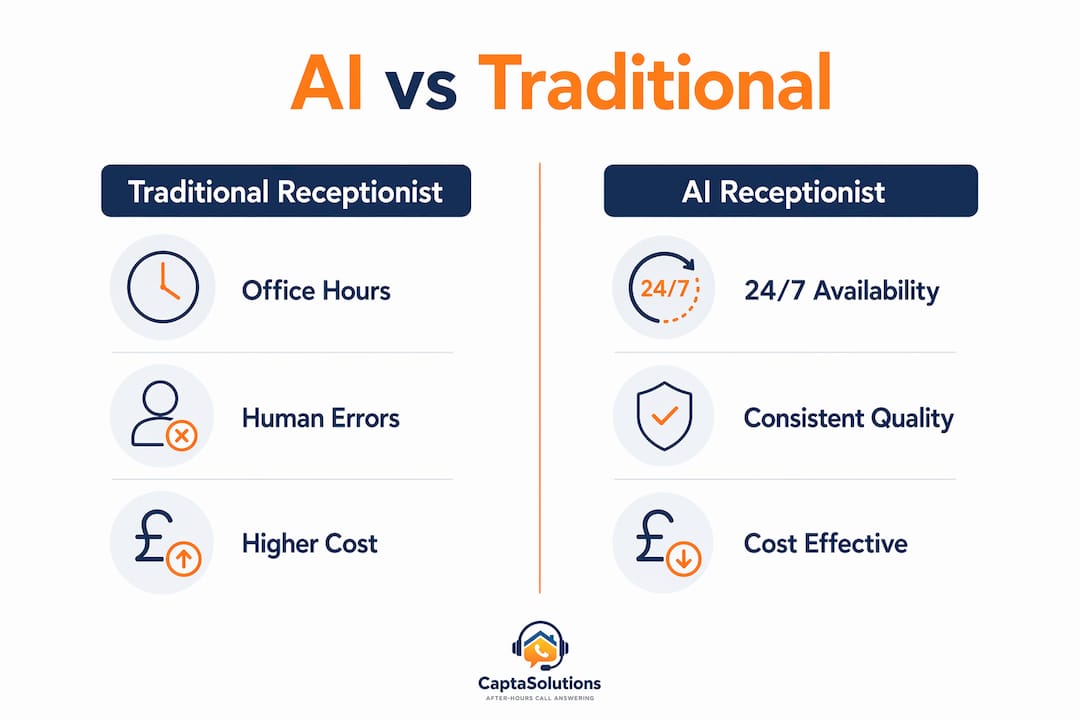
AI-powered call answering removes those failure points entirely. 24/7 call answering and lead capturing eliminates missed opportunities outside standard business hours. A caller at midnight gets the same quality response as one at 10am. That consistency is something no human team can match at scale.
The operational gains are significant. Businesses integrating AI receptionists report over 40 administrative hours saved weekly. One property team generated over £800,000 in new revenue in a single month through AI lead capture alone. These are not marginal improvements. They represent a structural shift in how businesses handle inbound demand.
| Feature | Traditional receptionist | AI receptionist |
|---|---|---|
| Availability | Office hours only | 24 hours a day, 7 days a week |
| Simultaneous calls | One at a time | Unlimited concurrent calls |
| Lead data capture | Manual, inconsistent | Automatic, real-time CRM sync |
| Cost | Full-time salary plus benefits | Fixed monthly subscription |
| Consistency | Varies by individual | Identical every call |
| Spam filtering | None | Built-in AI filtering |
The cost comparison alone makes the case for most small and medium-sized UK businesses. A full-time receptionist carries salary, National Insurance, holiday pay, and sick leave. An AI service carries a fixed monthly fee and no absence risk.
Which features should UK business owners prioritise?
Not all automated receptionist solutions are built equally. UK business owners need to assess features against their specific operational needs before committing to a platform.
The most critical feature is voice quality. A human-like voice builds caller trust. If the AI sounds robotic or stilted, callers hang up. Look for solutions that use natural language processing with UK English accents and phrasing. Multilingual support is worth considering if your customer base includes non-English speakers.
CRM integration is non-negotiable. Integration with CRM platforms like Salesforce, HubSpot, or Zoho enables automatic syncing of lead data and real-time updates. Without this, your AI receptionist captures data that sits in a silo. With it, every qualified lead feeds directly into your sales pipeline.
- Customisable scripts: Your AI should sound like your business, not a generic call centre. Tailor greetings, qualification questions, and sign-off language to match your brand.
- Calendar scheduling: Native appointment booking removes the need for a follow-up call to confirm a slot.
- Automatic follow-ups: SMS or email confirmations sent immediately after a call keep leads warm.
- Multi-channel support: Phone, SMS, web chat, and smart forms should all feed into the same lead management system.
- Data security: UK businesses must comply with GDPR. Choose a provider that stores data on UK or EU servers and offers clear data processing agreements.
- Reporting and analytics: Call volume, qualification rates, and conversion data should be visible in a dashboard so you can improve your scripts over time.
An AI answering service that handles calls, SMS, and web chat from a single platform gives you a complete picture of every inbound lead, regardless of how that customer chose to contact you.
How does integrating AI receptionists maximise lead conversion?
Capturing a lead is only the first step. Converting it requires speed, accuracy, and the right follow-up at the right time. Automated receptionists feed directly into this process by removing the delay between a call and a sales action.
When a qualified lead lands in your CRM, it can trigger an automated workflow immediately. A plumber's enquiry about a boiler replacement can fire off a quote request email, assign the lead to the nearest engineer, and schedule a callback, all within 60 seconds of the call ending. That speed is what separates businesses that win work from those that lose it to a faster competitor.
At a restaurant group using AI call handling, 58% of inbound calls were managed entirely by AI. Out of 9,139 monthly calls, 5,300 were handled without any human involvement. The leads that would have gone to voicemail were captured, qualified, and routed automatically.
Lead scoring adds another layer of value. The AI assigns a priority rating based on caller responses. High-value enquiries reach your senior sales staff first. Lower-priority leads enter a nurture sequence. This routing logic means your team focuses their time on the calls most likely to convert.
Pro Tip: Review your AI's call transcripts weekly for the first month after launch. You will spot patterns in caller questions that your script does not yet handle well. Updating the script based on real call data is the fastest way to improve your qualification rate.
Reducing human error in lead handling is an underrated benefit. Manual data entry introduces mistakes. A misheard phone number or a missed callback note can cost you a sale. Automated capture removes that risk entirely. Every detail the caller provides is recorded accurately and stored in your CRM without relying on a staff member to type it correctly under pressure.
Key takeaways
Automated receptionists capture leads by combining AI-driven conversation, real-time CRM integration, and 24/7 availability to turn every inbound call into a structured, actionable sales opportunity.
| Point | Details |
|---|---|
| AI handles the majority of calls | Automated systems manage 60–70% of standard enquiries without human input. |
| CRM sync is the critical link | Lead data must flow directly into Salesforce, HubSpot, or Zoho to drive sales action. |
| 24/7 availability removes missed call risk | AI answering after hours captures leads that voicemail and office hours cannot. |
| Script customisation drives quality | Tailored qualification questions produce better lead data and higher conversion rates. |
| Speed of follow-up determines conversion | Automated workflows triggered by call data reduce response time to under 60 seconds. |
Why most UK businesses are still leaving money on the table
I have spoken with dozens of UK business owners who believe they have their call handling under control. They have a receptionist, or a voicemail, or a "we always call back" policy. What they rarely have is data on how many calls they are actually missing, or what those calls were worth.
The uncomfortable truth is that most businesses do not know their missed call rate. They assume it is low. The evidence suggests otherwise. A caller who hits voicemail does not wait. They ring the next number on Google. That is not a hypothetical. That is the default behaviour of a customer with options.
The businesses I see winning with AI receptionists are not the ones who treat it as a cost-saving exercise. They treat it as a lead generation tool that works alongside their sales team. They customise their scripts to reflect their brand voice. They review call data regularly. They use the CRM integration to trigger follow-ups that feel personal, even though they are automated.
The biggest implementation mistake I see is launching with a generic script and never revisiting it. Your AI receptionist is only as good as the questions it asks. If those questions do not match what your customers actually say when they call, you will qualify the wrong leads and miss the right ones. Treat the script as a living document. Update it monthly based on what your call transcripts are telling you.
AI receptionists are not a replacement for human relationships. They are the system that makes sure those relationships get a chance to start. Every call that gets answered is a conversation that might become a customer. Every call that goes to voicemail is one that probably will not.
— Daniel
Captasolutions: AI call answering built for UK businesses
Captasolutions answers every call in your business name, 24 hours a day, 7 days a week. It captures caller details, qualifies the enquiry, and organises every lead into your client portal so you can review and act on each one.
Built specifically for UK trades businesses, hospitality venues, salons, clinics, and service businesses, Captasolutions integrates with your existing CRM and delivers real-time lead data without any manual input from your team. Whether you are on a job, in the middle of service, or closed for the evening, no call goes unanswered. Visit Captasolutions to start your free 30-day trial. No card required. No contract. Live within the hour.
FAQ
What does an automated receptionist actually do?
An automated receptionist answers inbound calls, qualifies the caller's enquiry using pre-set questions, captures their contact details, and syncs the lead data to your CRM. It can also book appointments and send follow-up messages automatically.
How do AI receptionists qualify leads without human input?
The AI uses a structured script to ask callers about their budget, location, service type, and urgency. Responses are scored against your criteria, and the lead is routed or transferred based on that score.
Can an AI receptionist handle calls outside business hours?
Yes. AI-powered call answering operates 24 hours a day, 7 days a week, capturing leads that would otherwise go to voicemail or be lost entirely after hours.
How does an AI receptionist integrate with my CRM?
Most AI receptionist platforms connect directly with CRM tools like Salesforce, HubSpot, and Zoho. Lead data captured during the call is pushed to the CRM in real time, triggering workflows and follow-up sequences automatically.
Is an AI receptionist suitable for small UK businesses?
Yes. The fixed monthly cost of an AI answering service is significantly lower than a full-time receptionist salary. Small businesses benefit most from the 24/7 availability and consistent lead capture that a human team cannot provide at the same cost. You can learn more about how AI receptionists work for UK businesses before committing to a platform.