

Call answering without staff is defined as using virtual receptionists or automated call handling systems to manage inbound business calls on your behalf, without employing a dedicated receptionist. These solutions answer calls in your business name, capture caller details, and deliver messages to you in real time. Services like USAnswer and MetroMessage demonstrate how call management without staff has matured into a professional, reliable alternative to in-house reception. For UK business owners, the core benefit is straightforward: every call gets answered, every enquiry gets captured, and no opportunity walks out the door.
How call answering works without staff: the core mechanics
Virtual call answering services operate by routing your incoming calls to a third party, either a team of live receptionists or an AI-powered automated system, before delivering the outcome back to you. The industry term for this model is outsourced call handling, and it covers everything from basic message taking to full lead qualification and appointment booking.
Here is how the process works in practice:
-
Call forwarding is activated. You instruct your existing phone provider to forward calls to the service. Setup can take as little as 15 minutes or up to five business days, depending on how your current phone system is configured and whether CRM or calendar integration is required. No new hardware is needed.
-
The service answers in your name. The receptionist or automated system greets callers using your business name and follows a script you have approved. Virtual receptionists are trained to sound like an in-house employee, preserving your brand identity on every call.
-
Caller information is captured. The system collects the caller's name, contact number, reason for calling, and any other details you specify. This data is logged accurately and consistently, regardless of call volume.
-
Messages are delivered instantly. Notifications arrive via text, email, or a secure portal depending on your preference. You receive the information in real time and can respond on your own schedule.
-
Urgent calls are escalated. Where a call requires immediate attention, escalation protocols transfer the call directly to a designated contact, following instructions you have set in advance.
This process integrates with your existing phone lines, CRM software, and calendar tools without replacing any current system. For a tradesperson on a job or a salon owner with a client in the chair, the result is a professional front of house that operates without any input from you.
Pro Tip: When setting up call forwarding, test the full journey yourself before going live. Call your own number, listen to the greeting, and check that the message you receive matches what you expect. A five-minute test prevents weeks of poor first impressions.

Human virtual receptionists vs automated call answering: which is right for you?
The two main models for call management without staff are live virtual receptionists and automated systems, including AI-powered answering and interactive voice response (IVR). Each has distinct strengths.
What live receptionists do well
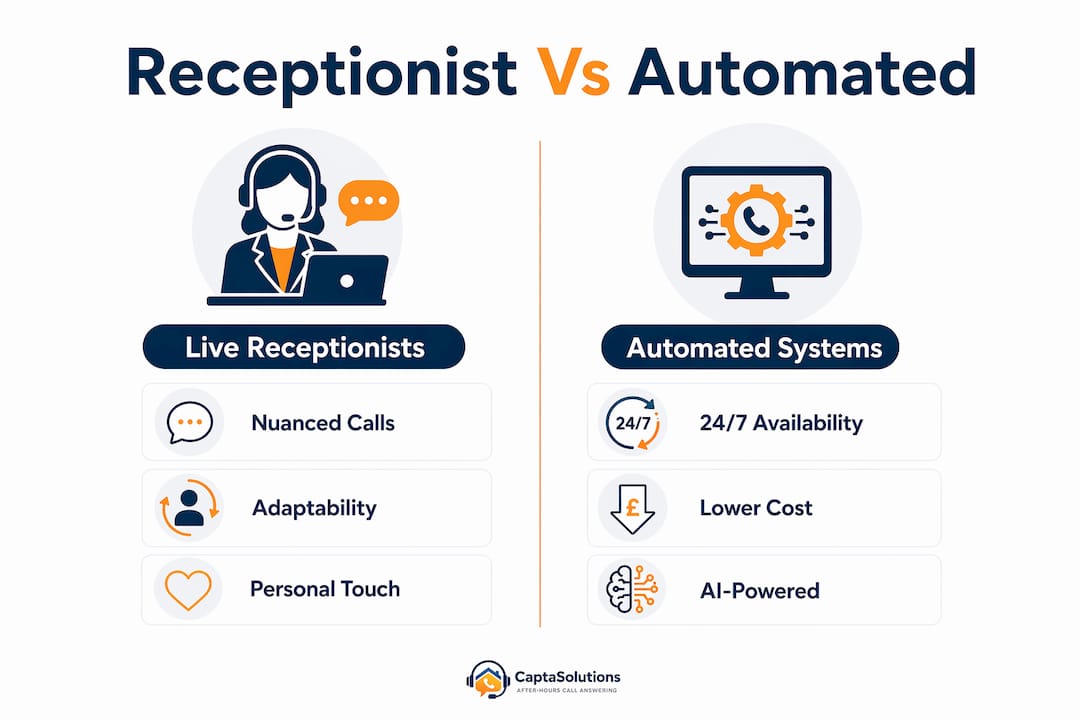
Live receptionists handle nuanced conversations. They can answer questions, manage objections, and adapt to unexpected caller requests. Callers frequently cannot tell they are speaking to an outsourced service. This matters most for professional services, clinics, and businesses where the first impression carries significant commercial weight.
What automated systems do well
Automated call answering provides 24/7 availability at a lower cost per call. AI-powered systems, such as those used by Captasolutions, capture caller details and qualify enquiries without any human involvement. They do not take breaks, do not have off days, and scale instantly during busy periods. The benefits of automated call answering for UK businesses are particularly strong for trades, hospitality, and service businesses that receive high volumes of routine enquiries.
Side-by-side comparison
| Factor | Live virtual receptionist | Automated AI system |
|---|---|---|
| Availability | Business hours or extended hours | 24 hours a day, 7 days a week |
| Cost | Higher per-call cost | Lower per-call cost |
| Personalisation | High, adapts to caller | Consistent, script-based |
| Scalability | Limited by staffing | Instant, no ceiling |
| Best suited for | Complex or sensitive enquiries | High-volume routine calls |
The most effective approach for many UK SMEs is a hybrid model: automated handling for out-of-hours and overflow calls, with live receptionists available during core business hours for higher-value interactions.
How to customise call handling protocols for your business
Effective virtual call management depends on the quality of the instructions you give the service. A generic script produces generic results. Tailored protocols produce professional, consistent customer experiences.
Key customisation options include:
- Greeting and brand voice. Your script should reflect how your business actually speaks. A law firm and a plumbing company require very different tones. Write the greeting you would want a new receptionist to use on day one.
- Time-based routing. Many businesses route calls differently during business hours versus after hours, directing urgent calls to a mobile number and routine enquiries to a message portal. This improves how you allocate your time without missing anything.
- Escalation rules. Define which call types require immediate transfer and which can wait for a callback. A boiler breakdown is urgent. A quote request is not.
- CRM and calendar integration. Link your call answering service to tools like HubSpot, Salesforce, or a booking calendar so that appointments are logged automatically and follow-ups are triggered without manual input.
- Caller qualification questions. Instruct the service to ask specific questions, such as location, job type, or budget, so you receive pre-qualified leads rather than raw enquiries.
For UK SMEs, the most commonly overlooked customisation is the after-hours script. Most businesses set a basic voicemail equivalent and leave it there. A well-written after-hours script that captures the caller's details, sets expectations for a callback, and confirms the business is open for their enquiry converts significantly more callers than a generic "we're closed" message.
Pro Tip: Review your call logs monthly. Patterns in caller questions reveal gaps in your website content, your pricing clarity, or your service descriptions. Fixing those gaps reduces call volume and improves the quality of the calls you do receive.
Practical steps to implement call answering without staffed reception
Getting a call answering service live in your UK business is straightforward. The process below applies whether you are choosing a live receptionist service or an AI-powered system.
-
Assess your call volume and call types. Count how many calls you receive per day and categorise them. Are most calls new enquiries, existing customer queries, or appointment requests? This determines which service model fits your needs.
-
Decide between live and automated handling. If your calls are mostly routine and predictable, an automated system is cost-effective and sufficient. If callers regularly ask complex questions or need reassurance, a live service adds value.
-
Ask providers the right questions. Before signing up, confirm: What are the setup timelines? How are messages delivered? Can scripts be updated in real time? What happens if call volume spikes? Is there a minimum contract?
-
Complete the setup process. Most providers complete setup within 15 minutes to one business day once you have shared your call preferences and approved your script. Captasolutions, for example, can have your service live within the hour.
-
Activate call forwarding. Contact your phone provider, whether BT, Sky Business, Vonage, or another UK carrier, and set up conditional or unconditional forwarding to the service number provided.
-
Monitor and refine. Review your call logs and message reports weekly for the first month. Adjust your script, escalation rules, and routing based on what you observe. A call answering service improves with iteration.
For practical guidance on handling calls during business hours alongside an outsourced service, the setup principles remain the same: clear instructions, defined escalation paths, and regular review.
Key takeaways
Call answering without staff works because virtual receptionists and automated systems handle every inbound call professionally, capturing leads and delivering messages in real time without any in-house resource.
| Point | Details |
|---|---|
| Setup is fast | Most services go live within 15 minutes to one business day with no new hardware required. |
| Two core models exist | Live virtual receptionists suit complex calls; automated AI systems suit high-volume routine enquiries. |
| Customisation drives results | Tailored scripts, time-based routing, and escalation rules determine the quality of every caller experience. |
| Integration is non-disruptive | Services connect to existing phone lines, CRM tools, and calendars without replacing current systems. |
| Iteration improves performance | Monthly review of call logs and script adjustments consistently improve lead capture and caller satisfaction. |
What I have learned from watching UK businesses get this wrong
The biggest mistake I see UK business owners make is treating a call answering service as a set-and-forget solution. They spend 20 minutes writing a script, activate the forwarding, and never look at it again. Six months later, they wonder why the service feels impersonal or why callers are dropping off before leaving a message.
The businesses that get the most from call management without staff are the ones that treat the service like a member of their team. They update the script when their services change. They review escalation rules when their priorities shift. They check the call logs not just for leads but for patterns.
There is also a tendency to over-automate too quickly. An AI system is excellent for capturing a caller's name and number at 11pm on a Sunday. It is less suited to handling a distressed customer who has had a poor experience and needs to feel heard. Knowing where to draw that line is the difference between a call answering service that protects your reputation and one that quietly damages it.
The future of call answering for UK SMEs is clearly moving toward AI-first with human escalation as the backstop. That is the right direction. But the businesses winning right now are the ones combining both, using automation for volume and availability, and reserving human judgement for the moments that matter.
— Daniel
How Captasolutions handles calls for UK businesses without staff
Captasolutions is an AI-powered call answering service built specifically for UK businesses that cannot afford to miss a call. Whether you run a trades business, a salon, a clinic, or a hospitality venue, Captasolutions answers every call in your business name, 24 hours a day, 7 days a week.
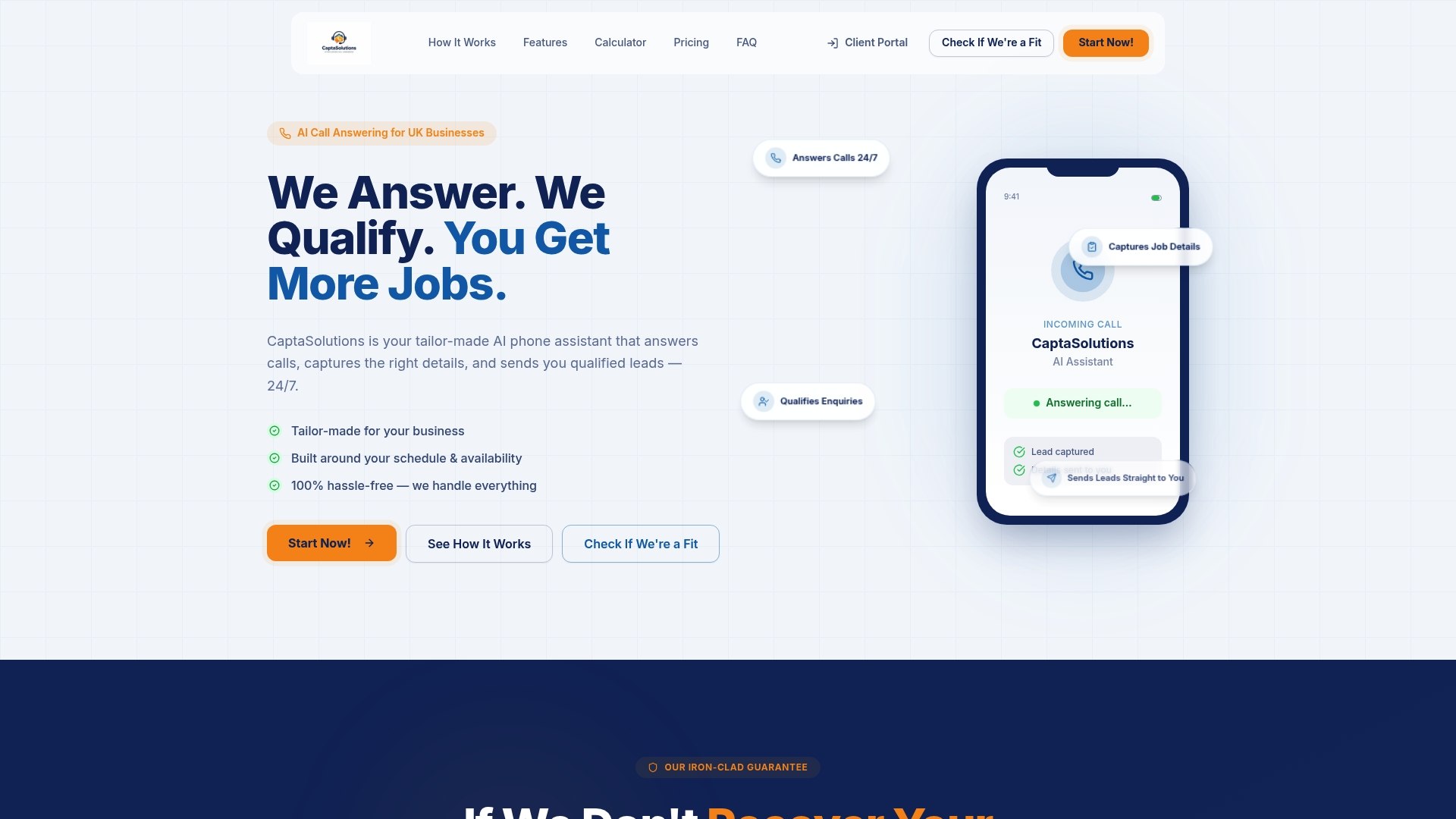
The service captures caller details, qualifies each enquiry, and organises everything into your client portal. You review every lead and decide what to take on. There is no contract, no card required for the trial, and the service goes live within the hour. For UK businesses looking to cover calls without staff, Captasolutions removes the complexity and delivers results from day one. Visit captasolutions.co.uk or call 07346 811329 to start your free 30-day trial today.
FAQ
How does call forwarding work with a virtual answering service?
Call forwarding redirects your incoming calls to the virtual service using a setting configured through your existing phone provider. Setup typically takes 15 minutes to five business days depending on your phone system and integration requirements.
Can automated call answering sound professional to callers?
Yes. AI-powered systems use natural language processing to greet callers in your business name and follow approved scripts. Live virtual receptionists are trained to sound indistinguishable from an in-house employee.
What happens to urgent calls when no staff are available?
Escalation protocols route urgent calls immediately to a designated contact, such as a mobile number, following rules you define in advance. This means time-sensitive enquiries are never left waiting in a message queue.
How quickly can a call answering service go live for a UK business?
Most providers complete the setup process within 15 minutes to one business day once scripts and preferences are confirmed. Services like Captasolutions are designed to go live within the hour for UK businesses.
Is call answering without staff suitable for small UK businesses?
Call answering without staff is well suited to small UK businesses, particularly those in trades, hospitality, and professional services where calls arrive unpredictably and covering business calls without staff is a practical necessity rather than a luxury.