

Call answering in UK SMEs is defined as the practice of ensuring every inbound customer call is received, handled, and acted upon by a real person or an intelligent automated system. UK SMEs lose an estimated £30 billion yearly from missed calls, with the average business losing around £5,500 annually. That figure represents not just lost revenue but lost relationships, lost trust, and customers who moved on to a competitor before you even knew they called. The role of call answering in UK SMEs has shifted from a basic administrative function to a direct driver of customer engagement, lead conversion, and operational resilience.
How does call answering improve customer engagement and sales for UK SMEs?
Prompt, professional call handling is one of the most direct levers a small business has over its conversion rate. Responding to a new lead within five minutes can increase conversion likelihood by up to 100 times compared to a delayed response. For a sole trader or a small team already stretched across multiple tasks, that window closes fast.

The comparison between voicemail and live answering is not close. Most callers will not leave a voicemail, which means a missed call is almost always a lost opportunity rather than a deferred one. A live person or AI-powered agent that answers in your business name, captures the caller's details, and qualifies the enquiry keeps that opportunity alive.
The industries where this matters most include:
- Legal and professional services, where a caller assessing multiple firms will choose the one that answers first
- Home services and trades, where a homeowner with an urgent plumbing or electrical issue will call the next number on the list within minutes
- Health and wellness clinics, where a patient who cannot get through will book elsewhere rather than wait
- Hospitality and restaurants, where reservation calls during service hours go unanswered without a dedicated system
Reaching a real person on first contact dramatically boosts trust and lead conversion, particularly in professional sectors where credibility is built before the first meeting. Personalised greetings, call screening, and detailed message delivery via SMS or email all contribute to a professional impression that a voicemail box simply cannot replicate.
Pro Tip: Integrate your call answering service with your CRM or calendar system. When a call is answered and the enquiry is logged automatically, your team spends less time on admin and more time on the work that generates revenue. Tools like Calendly, HubSpot CRM, and Google Calendar all support this kind of integration.
What types of call answering solutions are available to UK SMEs?
Understanding the types of UK call answering solutions available helps you choose the right fit for your budget, call volume, and customer expectations. The three main categories are live human answering, AI-powered automated answering, and hybrid solutions that combine both.
| Solution type | Key benefits | Limitations | Typical cost |
|---|---|---|---|
| Live human answering | Personal, nuanced, builds strong trust | Higher cost, limited to business hours unless 24/7 contract | £50–£300+ per month |
| AI-powered answering | 24/7 availability, instant response, scalable | Less suited to complex or sensitive calls | Under £250 per month |
| Hybrid (AI + human) | Balances cost with quality for varied call types | Requires setup and clear call routing rules | Variable |
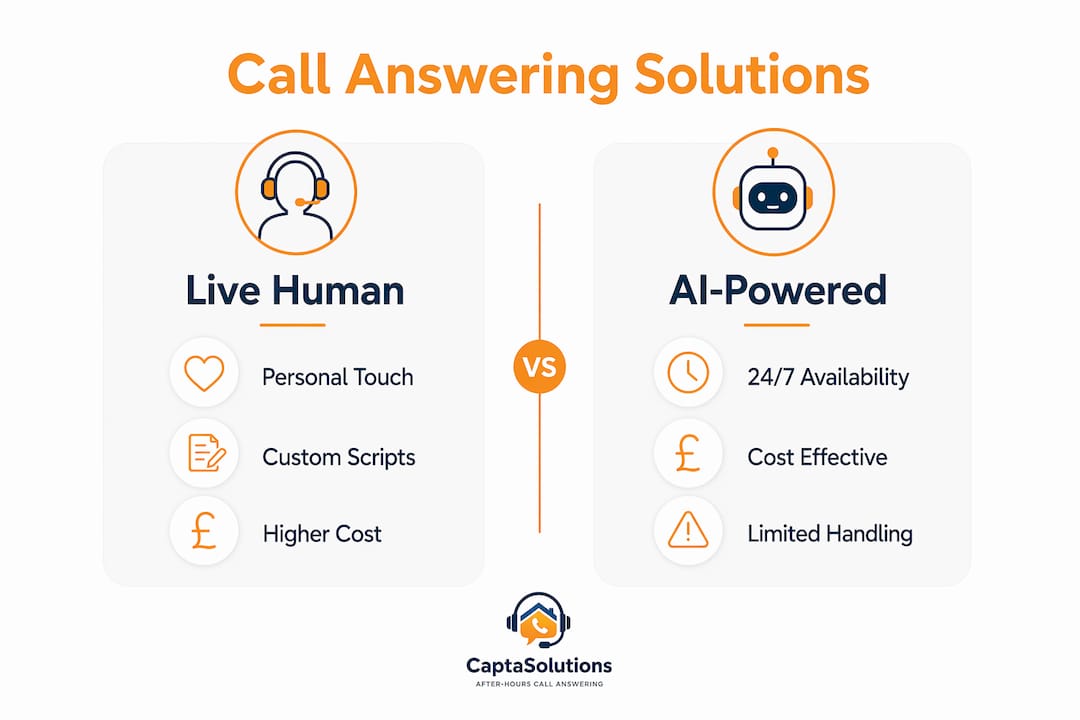
Live human answering services use trained receptionists who answer calls in your business name, follow your scripts, and relay messages. UK-based answering services offer better cultural alignment, accurate pronunciation of business and place names, and a tone that matches your brand. This matters more than many owners realise. An offshore receptionist mispronouncing your business name or struggling with a regional accent erodes the professional impression you are paying to create.
AI-powered answering has advanced considerably. Modern AI voice agents handle natural language, book appointments, qualify leads, and route calls without human involvement. AI voice agents can cost under £250 per month while saving significant administrative time compared to hiring a full-time receptionist. For SMEs that receive high volumes of routine enquiries, this is a cost-effective call answering approach that scales without adding headcount.
Hybrid solutions combine the two. Human agents handle complex, high-value calls while AI manages routine queries, reducing costs without sacrificing quality on the calls that matter most. This is the model that best suits UK SMEs with limited budgets but high customer service expectations.
Pro Tip: When you outsource call answering in the UK, choose a provider with UK-based staff or UK-trained AI. Cultural and linguistic alignment is not a luxury. It is a direct factor in whether callers trust your business from the first sentence.
How does call answering support UK SME business continuity?
Business continuity planning is often associated with IT systems and data backups, but reliable voice communication is equally critical for maintaining customer trust during disruptions. When your office is closed, your team is off-site, or an incident affects normal operations, your phone line is often the first thing customers reach for.
Incident-mode call routing is a specific capability worth building into any call answering plan. Routing priority calls to trained specialists while directing non-urgent callers to consistent prerecorded status messages reduces staff overhead during a crisis and prevents customers from receiving conflicting information. For a small business, this kind of structured response can be the difference between retaining a client and losing them permanently.
"Effective call answering can mitigate reputational damage during incidents by providing personalised updates and maintaining communication channels." — Business continuity planning: the importance of reliable voice communication
How call answering supports UK business continuity goes beyond crisis management. It covers everyday scenarios: a tradesperson on a job site who cannot take calls, a salon fully booked with clients, a restaurant in the middle of a busy service. In each case, an unanswered call is a continuity failure in miniature. A call answering service running in the background means the business never goes dark from a customer's perspective.
Regular live testing of call answering systems, including after-hours and remote-working scenarios, uncovers gaps before they become real problems. Quarterly drills that test call routing, message delivery, and escalation paths are a straightforward way to confirm your system works when it needs to. Most SMEs never test their call handling under pressure until an actual incident forces the issue.
What practical steps can UK SMEs take to implement effective call answering?
Choosing the right call answering service for your UK business starts with understanding your own call patterns. Before evaluating providers, work through these steps:
- Audit your current call volume. Review how many calls you receive per day, when peak times occur, and how many go unanswered. Most VoIP providers and mobile networks offer basic call logs that make this straightforward.
- Define what you need answered. Decide which call types require a human response and which can be handled by an AI or automated system. Appointment bookings and general enquiries are strong candidates for automation. Complaints and complex sales calls are not.
- Evaluate providers on four criteria. Look at UK-based staffing or UK-trained AI, pricing transparency, integration with your existing phone system or CRM, and the quality of their call scripts and onboarding support.
- Set up call scripts before you go live. A good provider will help you build scripts that reflect your brand voice, handle common questions, and escalate correctly. Poor scripts produce poor calls regardless of how good the technology is.
- Measure performance from week one. Track missed call rates, lead capture rates, and customer feedback. Integrating call answering with VoIP and calendar systems reduces missed opportunities and makes measurement straightforward.
The most common mistake UK SMEs make is treating call answering as a set-and-forget system. Call volumes change, business offerings evolve, and scripts go stale. A monthly review of call recordings and a quarterly update to your handling instructions keeps the service aligned with how your business actually operates. You can find practical examples of call answering ROI for UK businesses to benchmark what good performance looks like.
Pro Tip: Take advantage of free trial periods. Most reputable UK call answering providers offer a trial of 14 to 30 days. Use it to test real call scenarios, not just a demo. If the service cannot handle your actual enquiries convincingly in the trial, it will not improve after you sign a contract.
Key takeaways
Call answering is a direct revenue and retention tool for UK SMEs, not an administrative overhead. The businesses that treat it as a strategic function consistently outperform those that leave it to voicemail.
| Point | Details |
|---|---|
| Missed calls cost real money | UK SMEs lose an average of £5,500 per year from missed calls, making call answering a measurable investment. |
| Speed of response drives conversion | Responding to a lead within five minutes increases conversion likelihood by up to 100 times compared to delayed contact. |
| Solution type should match call complexity | Use AI for routine enquiries and live agents for high-value or sensitive calls to balance cost and quality. |
| UK-based services outperform offshore options | Cultural alignment and accurate pronunciation directly affect caller trust and brand perception. |
| Business continuity requires call planning | Structured call routing and regular system testing prevent communication failures during incidents and busy periods. |
Why I think most SMEs are still getting this wrong
Most small business owners I speak with treat call answering as a cost to minimise rather than a function to invest in. They set up a voicemail, assume customers will leave a message, and move on. The data says otherwise. The majority of callers hang up without leaving a voicemail, and a significant portion call a competitor within minutes.
What surprises me more is how few businesses think about call answering as part of their brand. The moment a customer calls, they are forming an opinion. A professional, knowledgeable response in your business name tells them you are organised, trustworthy, and worth their money. A voicemail or an unanswered ring tells them the opposite, regardless of how good your actual service is.
The shift I have seen in UK SMEs that get this right is that they stop thinking about call answering as a phone system feature and start thinking about it as a customer experience decision. Whether that means a live receptionist, an AI-powered agent like Captasolutions, or a hybrid of both, the underlying principle is the same. Every call is a customer choosing to engage with your business. The way you answer it sets the tone for everything that follows.
The future of call answering for UK SMEs is not a choice between human and AI. It is about deploying the right resource for the right call type, at the right time, without adding headcount. That is where the real efficiency gains are, and it is already achievable for businesses of any size.
— Daniel
Never miss another call with Captasolutions
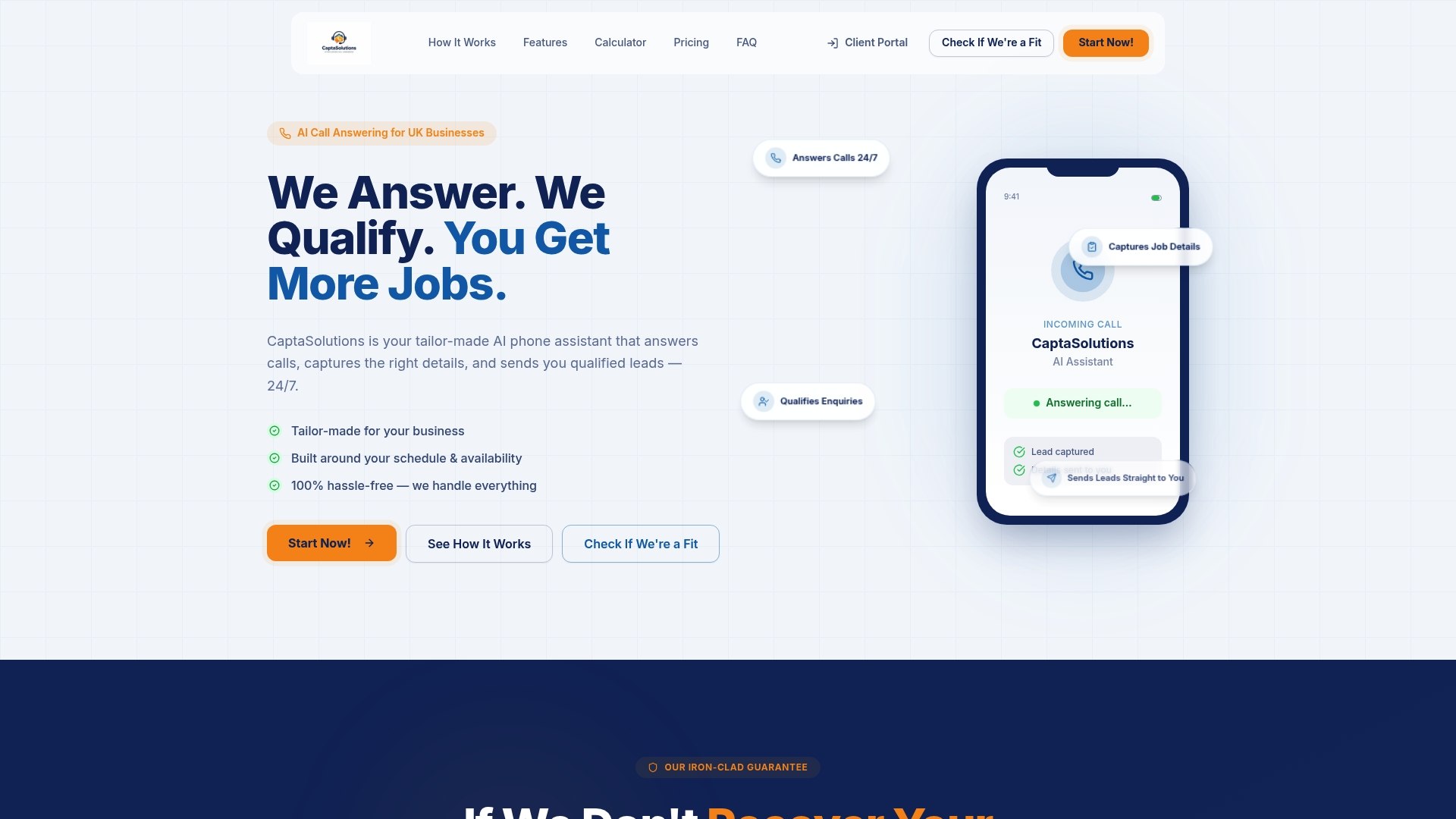
Captasolutions is an AI-powered call answering service built specifically for UK businesses that cannot afford to miss a call. Whether you run a trades business, a salon, a clinic, or a professional office, Captasolutions answers every call in your business name, 24 hours a day, 7 days a week. It captures caller details, qualifies the enquiry, and organises everything into your client portal so you stay in control without being tied to your phone.
There is no contract, no card required, and the service goes live within the hour. If you want to understand how phone answering drives growth for UK businesses like yours, Captasolutions offers a free 30-day trial. Visit captasolutions.co.uk or call 07346 811329 to get started today.
FAQ
What is the role of call answering in UK SMEs?
Call answering in UK SMEs ensures every inbound customer call is handled promptly by a real person or an AI-powered system, capturing leads, building trust, and preventing revenue loss from missed calls. UK SMEs lose an estimated £30 billion annually from unanswered calls, making reliable call handling a direct business priority.
How much do UK call answering services typically cost?
Live human answering services typically cost between £50 and £300 per month depending on call volume and hours covered. AI-powered answering solutions can cost under £250 per month and offer 24/7 coverage, making them a cost-effective option for SMEs with consistent call volumes.
Should I outsource call answering or handle it in-house?
Outsourcing call answering in the UK makes sense when your team cannot consistently cover incoming calls, particularly during peak hours, out-of-hours periods, or busy operational times. A dedicated service removes the burden from existing staff and ensures no call goes unanswered without requiring a full-time hire.
How does call answering support business continuity for UK SMEs?
Reliable call answering keeps communication open during disruptions by routing priority calls to the right people and providing consistent messaging to non-urgent callers. Regular testing of call routing and escalation paths confirms the system performs correctly when it is needed most.
What is the difference between live and AI-powered call answering?
Live answering uses trained human receptionists to handle calls in your business name, suited to complex or sensitive enquiries. AI-powered answering uses voice technology to manage routine calls, book appointments, and qualify leads at lower cost and with 24/7 availability. A hybrid approach combines both for the best balance of quality and efficiency.