
Most UK business owners suspect they are losing revenue to missed calls. Fewer can actually prove it. The gap between suspicion and certainty is where poor investment decisions get made. Looking at real call answering ROI examples UK businesses have generated makes that gap much smaller. This guide covers the criteria that make ROI measurement credible, concrete examples drawn from UK-relevant scenarios, a comparison of common service models, and practical advice on getting the most from whichever approach you choose.
Table of Contents
- Key takeaways
- 1. The right criteria for measuring call answering ROI
- 2. PPC campaign attribution: knowing which calls are worth most
- 3. AI call deflection: cutting operational costs at scale
- 4. Lead quality improvements: the 30% quote value example
- 5. Reduced handle time: turning minutes into money
- 6. 24/7 availability: capturing after-hours revenue
- 7. Staff wellbeing and retention: the indirect ROI
- 8. Comparing call answering approaches: what the ROI data shows
- 9. How to implement call answering to maximise ROI
- 10. Emerging trends affecting call answering ROI in 2026
- My honest view on the call answering ROI debate
- See how Captasolutions delivers measurable ROI for UK businesses
- FAQ
Key takeaways
| Point | Details |
|---|---|
| Measure outcomes, not just volume | Linking calls to revenue and bookings is the only way to build a credible ROI case. |
| Call tracking is non-negotiable | Dynamic call tracking connects calls to specific marketing sources, making ROI defensible. |
| AI deflection cuts real costs | Removing routine calls before they reach staff reduces labour cost at scale without harming service quality. |
| 24/7 availability lifts booking rates | Answering calls outside office hours captures leads that would otherwise be lost permanently. |
| Start with a trial | Testing a call answering service before committing lets you gather baseline data and measure improvement accurately. |
1. The right criteria for measuring call answering ROI
Before examining specific examples, you need a framework. Without one, you are comparing revenue guesses rather than real figures.
The most credible ROI assessments connect call outcomes directly to revenue data. That means tracking which calls were answered, which were missed, and what each call was worth. Dynamic call tracking assigns a unique phone number to each marketing source, so you can see whether calls from a Google Ads campaign, an organic search result, or a Facebook post actually converted into booked jobs or sales.
Key metrics to track include:
- Answered vs missed call rate and the estimated revenue value of each missed call
- Booking conversion rate before and after implementing a call answering service
- Average handle time and its direct relationship to staff labour costs
- Quote or sale value per call to distinguish high-value lead sources from low-value ones
- After-call work time reduced through automation or AI assistance
- Customer retention indicators such as repeat bookings and referrals
Pro Tip: Set a baseline before you change anything. Record your missed call rate, average handle time, and booking conversion rate for at least two weeks. Every improvement you make after that becomes measurable.
CRM integration is what turns these metrics into a proper ROI story. When your call answering data feeds directly into your sales pipeline, you can attribute revenue to specific calls and calculate return with confidence rather than intuition.
2. PPC campaign attribution: knowing which calls are worth most
One of the clearest call answering ROI examples UK businesses can replicate comes from pay-per-click advertising. A single PPC campaign can drive the majority of inbound call volume, yet without proper attribution, you would never know it.
One campaign drives 70% of all calls in some tracked scenarios. If that campaign is generating high-quality leads and your call answering service is converting them, the ROI calculation becomes straightforward: measure the cost of the service against the revenue generated from those calls. The arithmetic is rarely close. The service almost always pays for itself within the first month.
The practical implication is that call answering and call tracking should be purchased together, not separately. One without the other leaves half the data on the table.
3. AI call deflection: cutting operational costs at scale
Routine calls consume disproportionate staff time. Appointment confirmations, directions, opening hours, basic pricing queries. None of these require a senior member of staff, yet they clog up phone lines during peak periods.
AI voice agents deflect high-volume, low-complexity calls before they reach your team. The cost saving compounds quickly. Removing even two minutes from an agent's average handle time across hundreds of calls per week represents a significant reduction in payroll cost. At scale, this is one of the most financially measurable call answering benefits UK businesses can realise without reducing headcount.
The key distinction is between deflection and abandonment. Deflection routes the caller to a self-service answer or captures their details for follow-up. Abandonment simply loses the call. A well-configured AI answering service does the former every time.
4. Lead quality improvements: the 30% quote value example
Not all ROI comes from answering more calls. Sometimes it comes from answering the right ones better.
A roofing agency saw quote value spike 30% despite stable total call volume, simply because better call handling improved lead qualification. Callers were asked the right questions up front, irrelevant enquiries were filtered out, and the sales team spent their time on prospects who were actually ready to buy.
This type of improvement is often overlooked in ROI calculations. Businesses focus on volume when they should focus on quality. A call answering service that qualifies leads before passing them to your team can lift revenue per conversion significantly, even if total call numbers stay flat.
"The real ROI from call answering is rarely about answering more calls. It's about making sure the right calls get the right response, every time."
5. Reduced handle time: turning minutes into money
Shaving two minutes off average handle time has a measurable financial impact when multiplied across your total call volume. For a business handling 200 calls per week, that is more than six hours of staff time recovered every week. Over a year, that figure runs into weeks of recoverable capacity.
AI-powered agent assist tools support this by surfacing relevant information to staff in real time, so they spend less time searching for answers during a call. These tools reduce hold time and after-call work simultaneously, which makes the efficiency gain consistent rather than one-off.
For small and medium-sized UK businesses, handle time is often the single biggest hidden cost in call operations. Measuring it properly is the first step to reducing it.
6. 24/7 availability: capturing after-hours revenue
A tradesperson on a job cannot answer the phone. A salon with a client in the chair cannot answer the phone. A restaurant during dinner service cannot answer the phone. But the caller does not wait. They ring the next business on the list.
Answering calls outside office hours captures leads that would otherwise be permanently lost. For service businesses with average job values above £200, even recovering two or three of these calls per week represents thousands of pounds in additional annual revenue. The ROI from call answering services that operate around the clock is particularly strong for trades, hospitality, and healthcare businesses where demand does not follow a nine-to-five pattern.
7. Staff wellbeing and retention: the indirect ROI
This one rarely appears in ROI spreadsheets, but it belongs there. AI reduces staff overload and the operational stress that drives high turnover. Recruiting and training a replacement member of staff costs considerably more than a year's subscription to a call answering service.
When staff are not fielding repetitive, low-value calls, they focus on work that requires their skills. Job satisfaction improves. Turnover falls. The financial benefit is real, even if it takes longer to appear in a report.
8. Comparing call answering approaches: what the ROI data shows
Not all call answering service models deliver the same returns. Here is how the main options compare:
| Approach | Cost profile | ROI strengths | Limitations |
|---|---|---|---|
| Traditional staffed service | Higher fixed cost | Human tone, handles complexity | Limited hours, higher labour overhead |
| Outsourced call centre | Variable, per-call billing | Scalable volume handling | Less brand consistency, quality varies |
| AI-powered answering | Low fixed monthly cost | 24/7 coverage, instant lead capture | Less suited to highly complex enquiries |
| Dynamic tracking only | Low cost add-on | Precise attribution, no answering | Requires separate answering solution |
Splitting strategies between AI deflection for routine calls and human handling for complex ones consistently produces the best balance of cost reduction and service quality. Businesses that apply this split report measurable gains on both the cost and revenue side.
Key factors to weigh when comparing options:
- Whether the service integrates with your CRM and booking system
- Whether call tracking is included or needs to be purchased separately
- Whether the AI can handle your specific call types without caller frustration
- Whether you can run a call answering service trial before committing financially
9. How to implement call answering to maximise ROI
Choosing the right service model is only half the work. Implementation determines whether you actually capture the returns.
Start by auditing your current call data. If you do not know your missed call rate, you cannot measure improvement. Most phone systems or call tracking tools can produce this figure within days. Once you have a baseline, set a specific target: a 20% reduction in missed calls, or a 10% lift in booking conversion rate. Vague goals produce vague results.
Pro Tip: Integrate your call answering service with your CRM from day one. Every qualified lead captured by the answering service should appear in your pipeline automatically. Manual data entry creates gaps in your attribution and makes ROI harder to prove.
For UK home services businesses, call tracking for specific industries can link call outcomes directly to keyword and channel performance, giving you precise data to reallocate marketing budget toward the campaigns generating your highest-value calls.
Ongoing ROI tracking should be reviewed monthly at minimum. The patterns you see in month three will often differ from month one, as callers adjust to the new experience and your team settles into the workflow.
10. Emerging trends affecting call answering ROI in 2026
The technology underpinning call answering ROI measurement is advancing quickly. Here is where the most significant gains are appearing in the UK market right now:
| Trend | Impact on ROI measurement |
|---|---|
| Persistent AI memory | AI agents recall previous caller interactions, improving resolution rate and reducing repeat call volume |
| Conversation intelligence | Automatic call summaries cut after-call work from minutes to seconds |
| Multi-channel attribution | Calls linked to web sessions and ad clicks for full customer journey visibility |
| Real-time agent assist | Staff receive live prompts during calls, reducing handle time and escalations |
The businesses gaining the most from these developments are those that treat call answering data as a first-class input to their marketing and operations decisions, not an afterthought. Call handling improvements tied to keyword-level metrics are already helping UK home services companies shift budget toward campaigns that generate genuinely profitable calls.
My honest view on the call answering ROI debate
I've seen a lot of businesses invest in call answering services and then struggle to articulate what they got back. The reason is almost always the same. They measured call volume. Volume tells you how busy your phones are. It does not tell you whether you made money.
What I've learned from watching UK SMEs implement these solutions is that the businesses that demonstrate clear ROI are the ones that connected their call answering data to actual revenue outcomes. Not "we answered more calls." More like "we answered 43 more calls last month from our Google Ads campaign, converted 18 of them into bookings at an average value of £340, and paid £89 for the service." That is a conversation any manager can take to a board.
The underestimated piece is call tracking integration. Most businesses skip it because it feels like an added complexity. In my view, it is the most important part of the whole setup. Without it, you are left with anecdote. With it, you have a defensible financial case.
I'd also push back on the idea that AI call answering is purely a cost play. The businesses I find most compelling are using it to improve lead quality, not just reduce headcount. When an AI qualifies a caller before passing them on, your sales team converts at a higher rate. That is revenue growth, not just cost reduction. Both matter. Most ROI calculations only count one of them.
— Daniel
See how Captasolutions delivers measurable ROI for UK businesses
For UK businesses ready to move from guesswork to genuine measurement, Captasolutions provides an AI-powered call answering service built specifically to capture every lead, qualify every enquiry, and feed the data directly into your client portal.
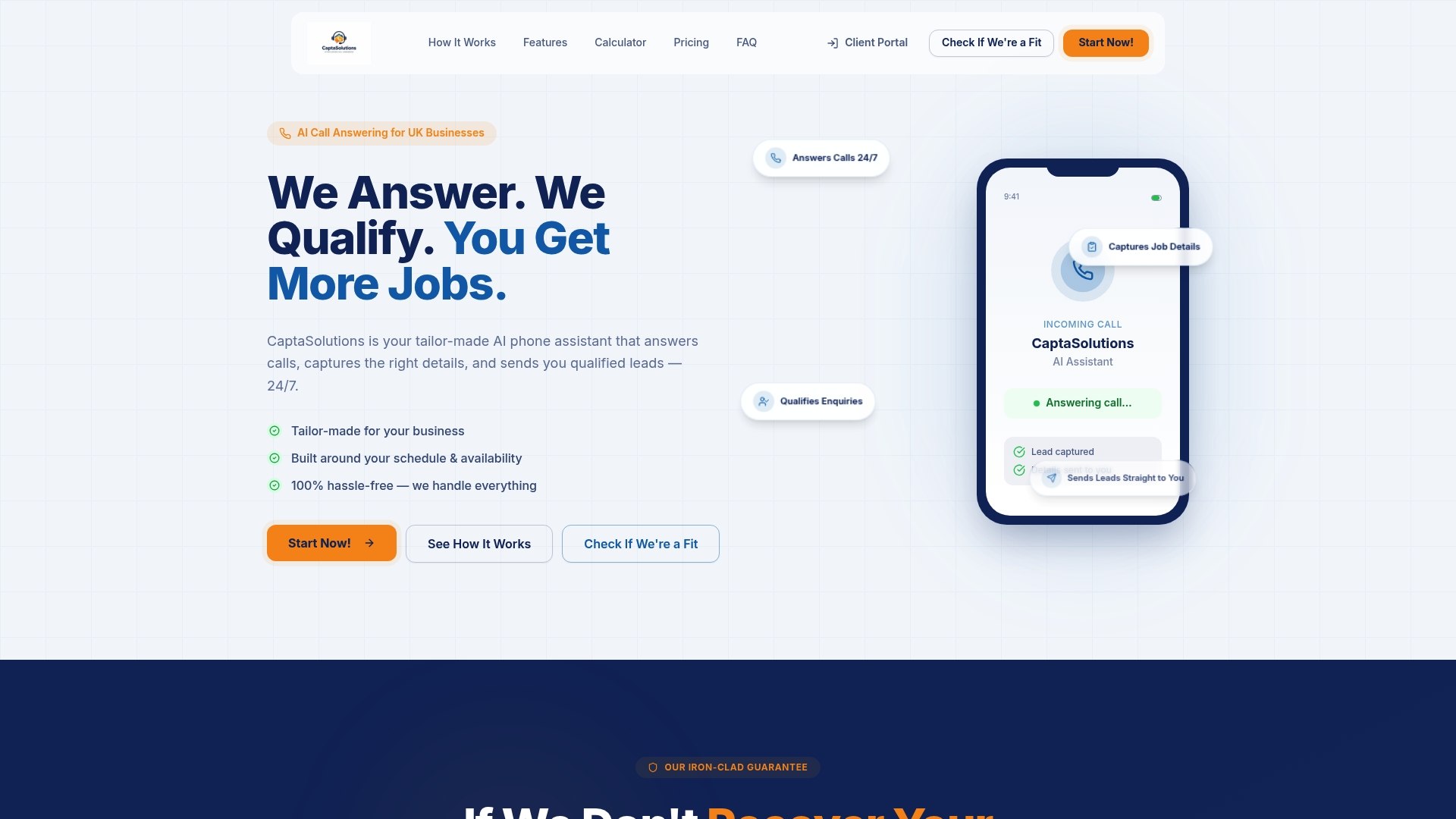
Whether you are a tradesperson, a clinic, a salon, or a service business, Captasolutions answers every call in your business name, 24 hours a day, 7 days a week. Every lead is captured and organised. Every missed call becomes a recovered opportunity. The call answering benefits for UK businesses are clear from the first week. Start your free 30-day trial at captasolutions.co.uk. No card required. No contract. Live within the hour.
FAQ
What is a realistic ROI from call answering services in the UK?
For service businesses with average job values above £150, recovering just two or three missed calls per week typically covers the cost of a call answering service many times over. ROI is highest when call tracking is used to attribute revenue to specific calls.
How does call tracking improve ROI measurement?
Dynamic call tracking assigns unique numbers to each marketing source, connecting calls to campaigns, keywords, and sales outcomes. This turns guesswork into data and makes ROI figures defensible.
Can AI call answering replace human staff?
AI call answering handles routine, high-volume enquiries effectively and is available 24/7. For complex or sensitive calls, human handling remains preferable. The strongest results come from combining both, using AI to deflect routine calls and staff to handle enquiries that require judgement.
How quickly can a UK business see ROI from call answering?
Most businesses see measurable improvement within the first 30 days, particularly in missed call rate and after-hours booking capture. Businesses running a free trial period before committing financially can measure the baseline shift before spending anything.
What metrics should I track to measure call answering ROI?
Track missed call rate, booking conversion rate, average call handle time, quote or sale value per call, and after-call work time. Connect these to your CRM and marketing attribution data for a complete and credible ROI picture.