

Automated call answering is defined as a technology system that receives, processes, and responds to inbound phone calls without human intervention, using AI-powered voice agents or interactive voice response. The benefits of automated call answering include 24/7 availability, instant lead capture, reduced staffing costs, and higher sales conversion rates. For UK business owners, whether you run a plumbing firm, a restaurant, or a salon, every unanswered call is a lost customer. Systems like those offered by Captasolutions and platforms analysed by OnceHub and KrispCall show that AI-powered call handling transforms how businesses manage inbound enquiries at scale.
1. benefits of automated call answering: faster lead conversion
Responding to a potential lead within the first 60 seconds increases conversion rates by up to 400%. That figure alone justifies the switch from a traditional answerphone to an AI-powered system. When a caller hangs up and hears voicemail, they do not wait. They call the next business on their list.
61% of mobile callers are ready to buy at the moment they dial. Automated answering captures that intent immediately, before it cools. A human receptionist working 9 to 5 cannot compete with a system that answers on the first ring at 11pm on a Sunday.
Automated systems also progress prospects through the sales funnel by capturing intent and booking appointments while caller motivation is at its peak. This removes the delay between initial enquiry and confirmed booking, which is where most small businesses lose revenue. The role of call answering in revenue for small businesses is directly tied to how quickly that first contact is made.
- Calls answered within 60 seconds convert at dramatically higher rates than those sent to voicemail
- AI systems qualify leads in real time, routing high-value prospects to the right person
- Appointment booking happens instantly, removing friction from the buying process
- No call goes unanswered during peak periods, lunch breaks, or out-of-hours
Pro Tip: Train your AI system with specific qualifying questions relevant to your trade or service. A plumber's AI should ask about the type of job, property access, and urgency. This produces better-qualified leads and saves you time when you call back.
2. how automated answering improves customer experience

24/7 availability and automated routine enquiries are the two features customers notice most. Modern consumers expect an immediate response regardless of the hour. A caller who reaches a helpful, responsive system at 8am on a Saturday forms a better first impression than one who hears three rings and a generic voicemail message.
Advanced AI systems use neural voice synthesis to deliver human-like voice interactions that are often indistinguishable from a real receptionist. This matters because the fear that AI sounds robotic is the most common objection from business owners considering automation. The technology has moved well beyond the stilted, menu-driven systems of a decade ago.
Automated systems handle FAQs instantly, with no hold time. A caller asking about opening hours, pricing, or availability gets an answer in seconds. Call routing then connects callers who need a specific person or department directly, without the caller having to repeat themselves. For businesses with multilingual customers, many systems support multiple languages, which broadens reach without adding headcount.
- Instant FAQ responses eliminate hold times for common queries
- Neural voice synthesis creates natural, professional interactions
- Intelligent call routing connects callers to the right person first time
- Multilingual support serves diverse customer bases without additional staff
3. cost savings from call automation
Automated call handling can reduce customer service costs by 50–85% depending on call volume and deployment model. That is not a marginal saving. For a small UK business paying a full-time receptionist £24,000 per year, even a 50% reduction in call-handling costs represents a significant shift in operating expenses.
Businesses that switch to automated phone agents reduce baseline customer service costs by up to 20% by paying only for software usage rather than fixed staff costs. Software costs scale with usage. Staff costs do not. A receptionist on a fixed salary costs the same whether she handles 10 calls or 100 in a day.
The cost comparison becomes even clearer when you factor in recruitment, training, sick leave, and holiday cover. An automated system requires none of these. It is available every day of the year, at a predictable monthly cost.
- Eliminate fixed staffing costs. Replace or supplement a full-time receptionist with a system that costs a fraction of a salary.
- Remove recruitment and training expenses. AI systems are configured once and updated as needed, with no onboarding time.
- Avoid temporary hire costs during busy periods. Automated systems scale instantly to handle call spikes without additional spend.
- Reduce missed-call revenue loss. Every unanswered call has a cost. Automation eliminates that loss entirely.
Pro Tip: Calculate your current missed-call cost before comparing solutions. Estimate how many calls you miss per week, multiply by your average job value, and you have a baseline figure. Most businesses find the number is far higher than expected.
4. scalability: handle any call volume without extra headcount
Modern AI answering systems handle unlimited simultaneous calls, eliminating queues and abandoned calls entirely. This is the scalability advantage that no human team can match. During a promotional campaign, a seasonal rush, or a sudden spike in demand, the system absorbs every call without degradation in quality or response time.
For a trades business running a local advertising campaign, call volume can triple overnight. A single receptionist cannot handle that. An automated system can, without any configuration change or additional cost. This makes automation particularly valuable for businesses that experience seasonal demand, such as heating engineers in winter or landscapers in spring.
The role of phone answering in growth for UK businesses is directly linked to this scalability. Growth means more calls. Automated systems grow with you.
5. comparing automated call answering solutions for UK businesses
Not all automated answering systems are equal. The three main types available to UK businesses are basic IVR (Interactive Voice Response), AI-based neural voice systems, and hybrid live/automated solutions. Each suits a different business size and call complexity.
| Solution Type | 24/7 Availability | AI Voice Quality | CRM Integration | Typical Monthly Cost | Best For |
|---|---|---|---|---|---|
| Basic IVR | Yes | Low (menu-driven) | Limited | £20–£60 | Simple call routing only |
| AI Neural Voice | Yes | High (human-like) | Full | £50–£200 | SMEs needing full coverage |
| Hybrid Live/AI | Yes | High | Full | £150–£400 | High-value or complex calls |
| Captasolutions AI | Yes | High | Full portal | Competitive | UK trades, hospitality, clinics |
Basic IVR systems are inexpensive but limited. They present callers with numbered menus and cannot handle open-ended questions. AI neural voice systems, such as those used by Captasolutions, understand natural speech and respond conversationally. Hybrid solutions combine AI with access to a live agent for escalations, which suits businesses where calls regularly involve complex or sensitive discussions.
For most UK small and medium businesses, an AI neural voice system delivers the best balance of cost and capability. The key features to prioritise are CRM integration, call analytics, and the ability to customise the AI's responses with your own business knowledge.
Trades businesses in particular benefit from AI answering set up for the trades sector, where job-specific qualification questions can be built directly into the call flow. This removes the need for a callback just to gather basic information.
6. best practices for implementing automated call answering
Successful implementation depends on how well you configure the system before it goes live. The technology works, but it works best when it knows your business.
- Train the AI with your specific context. Provide your services list, pricing structure, common customer questions, and the tone you want the system to use. Generic configurations produce generic results.
- Review call logs and analytics weekly. Identify calls where the AI struggled or where callers asked questions the system could not answer. Use this data to refine responses.
- Integrate with your CRM or scheduling tool. Automated appointment booking only delivers its full value when it connects directly to your calendar. Systems that capture leads into a separate portal, as Captasolutions does, keep everything organised without manual data entry.
- Brief your team on how the system works. Staff need to understand what the AI captures and how to follow up. Automation complements human judgement. It does not replace it entirely.
- Phase the rollout if you are cautious. Start with out-of-hours coverage only. Once you trust the system, extend it to peak periods and then to full-time coverage.
For restaurants and hospitality businesses, the call answering benefits for UK restaurants are particularly strong during service hours, when staff cannot leave the floor to answer the phone.
Key takeaways
Automated call answering delivers its greatest value when it combines instant response, AI-trained qualification, and full CRM integration to capture every lead at the moment of highest intent.
| Point | Details |
|---|---|
| Speed drives conversion | Responding within 60 seconds increases conversion rates by up to 400%. |
| Cost savings are substantial | Automation can reduce customer service costs by 50–85% versus full staffing. |
| Scalability is built in | AI systems handle unlimited simultaneous calls with no additional cost. |
| Configuration determines quality | Training the AI with business-specific context produces significantly better caller interactions. |
| 24/7 coverage captures missed revenue | Out-of-hours calls represent a large share of lost business for most UK SMEs. |
Why most businesses underestimate this technology
I have spoken with dozens of UK business owners who delayed adopting automated call answering because they assumed it would sound robotic, confuse their customers, or damage their reputation. That concern was valid five years ago. It is not valid now.
Modern neural voice synthesis, as used in systems like Captasolutions, produces speech that callers genuinely cannot distinguish from a human receptionist. The real barrier is not the technology. It is the configuration. Businesses that deploy a generic, out-of-the-box system and expect results are usually disappointed. Businesses that spend two hours training the AI with their services, their tone, and their most common caller questions see a very different outcome.
The strategic advantage that most people miss is speed of lead engagement. In competitive trades markets, the first business to respond wins the job. A caller who rings three plumbers and gets through to one immediately will book that one, regardless of price. Automated answering is not just a customer service tool. It is a competitive advantage in markets where response time determines who gets the work.
The businesses I have seen benefit most from automation are not the largest ones. They are the sole traders and small teams who were previously losing calls every single day, simply because they were busy doing the work they were already paid to do. Automation solves that problem completely, and it does so at a cost that pays for itself within weeks.
— Daniel
Never miss another call with Captasolutions
Captasolutions is an AI-powered call answering service built specifically for UK businesses that cannot afford to miss a call. Whether you are a tradesperson on a job, a salon with clients in the chair, or a restaurant in the middle of service, Captasolutions answers every call in your business name, 24 hours a day, 7 days a week.
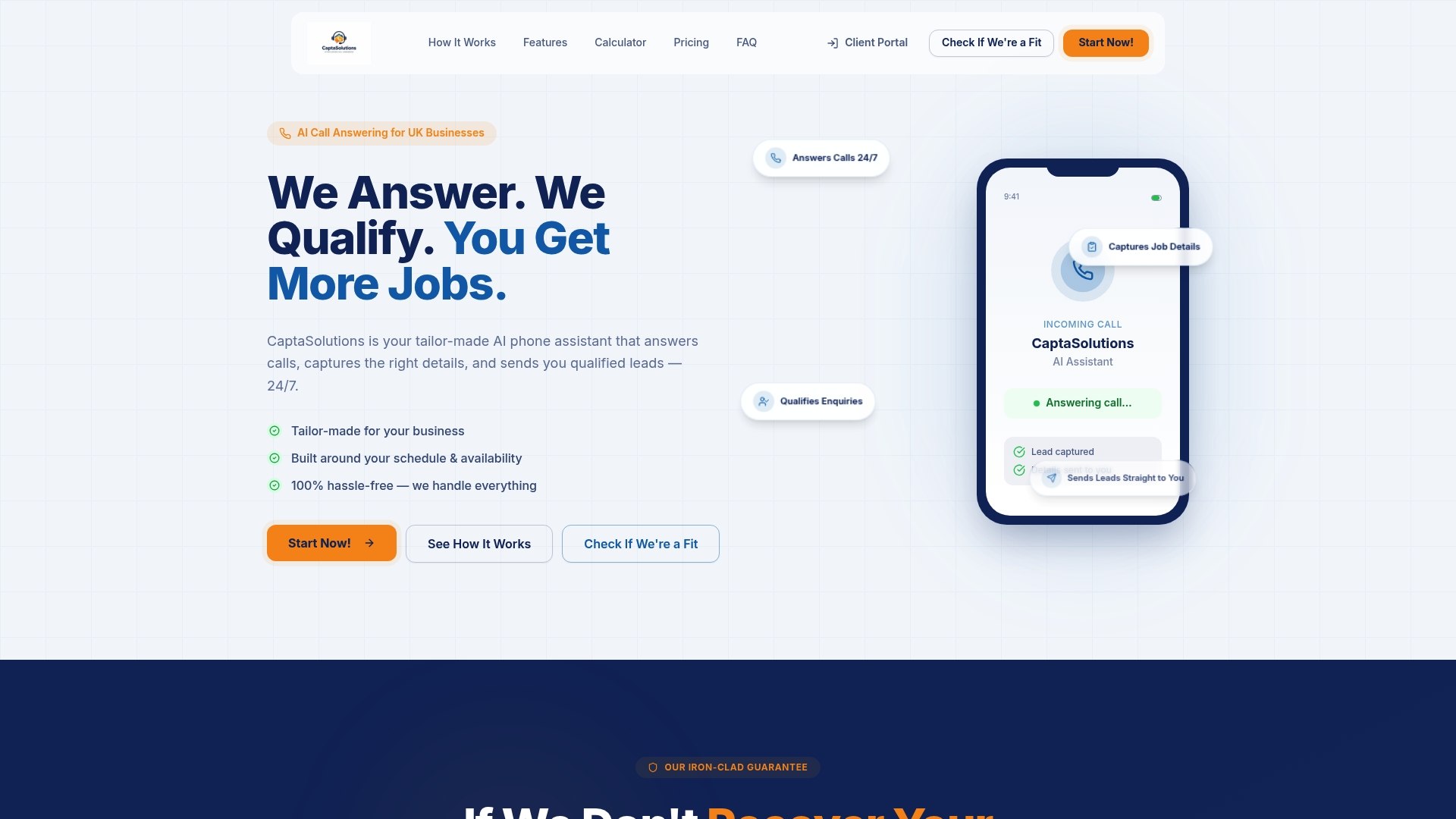
The system captures caller details, qualifies the enquiry, and organises every lead into your client portal. You stay in control of every decision. There is no contract, no card required, and you can be live within the hour. A free 30-day trial means you can see the results before you commit to anything.
Visit captasolutions.co.uk or call 07346 811329 to get started today.
FAQ
What is automated call answering?
Automated call answering is a technology system that uses AI or IVR to receive and respond to inbound calls without a human operator. Modern systems use neural voice synthesis to handle enquiries, qualify leads, and book appointments in real time.
How does automated answering improve sales conversion?
Engaging a caller within the first 60 seconds increases conversion rates by up to 400%. Automated systems answer immediately, capturing buyer intent before the caller moves on to a competitor.
What cost savings can UK businesses expect from call automation?
Businesses can reduce customer service costs by 50–85% by replacing or supplementing human receptionists with automated systems. Baseline savings of up to 20% are achievable simply by switching from fixed staff costs to software-based usage pricing.
Is automated call answering suitable for small UK businesses?
Automated call answering is particularly well suited to small UK businesses, including sole traders and SMEs, where missed calls directly translate to lost revenue. Systems like Captasolutions are priced and configured for businesses of this size.
How long does it take to set up an automated call answering system?
Most AI call answering services, including Captasolutions, can be configured and live within an hour. The setup process involves providing business details, services, and common caller questions to train the AI.