

AI call answering is defined as conversational AI that automates inbound telephone calls, handling tasks from appointment scheduling to emergency routing without human intervention. The most practical examples of AI call answering uses include lead qualification, live calendar booking, out-of-hours call handling, and real-time customer support. These applications matter because 74% of consumers expect 24/7 service availability, and AI systems now resolve a significant share of those contacts without a human ever picking up. For UK business owners, this is not a future technology. It is a working tool available today.
1. Examples of AI call answering uses: automated appointment scheduling
AI appointment scheduling is the most widely adopted AI call answering application across UK service businesses. The system checks live calendars in real time, confirms availability, and books the appointment during the call itself. No callback is needed. No manual diary entry is required.

AI booking systems negotiate time slots through natural conversation, integrating directly with CRM platforms such as Salesforce to update records automatically. A dental clinic, for example, can have its AI answer every call during surgery hours, offer the next available slot, and send a confirmation without any staff involvement. The caller experiences a fluid, professional interaction.
Key capabilities in AI scheduling:
- Cross-references multiple calendars simultaneously to avoid double bookings
- Sends automated confirmations and reminders via SMS or email
- Handles rescheduling and cancellations on the same call
- Logs all booking data directly into the CRM
Pro Tip: Connect your AI call answering system to your live calendar rather than a static booking page. This prevents the common problem of callers being offered slots that are already taken.
2. Lead capture and qualification
AI call answering systems trained on company-specific data outperform generic remote agents at lead qualification because they understand your services, pricing, and FAQs from the outset. The AI answers inbound enquiries around the clock, captures caller details, and scores the lead before any human reviews it. This means your team only speaks to prospects who are genuinely interested.
The qualification process works through structured conversation. The AI asks targeted questions, identifies the caller's intent, and routes the call accordingly. High-value leads go directly to a sales team member. Routine enquiries are logged for follow-up. Callers who are not a fit are handled politely without consuming staff time.
Benefits of AI-driven lead qualification:
- Captures name, contact details, and enquiry type on every call
- Filters out time-wasters before they reach your team
- Updates CRM records automatically with lead status
- Maintains consistent qualification criteria regardless of call volume
AI lead qualification removes the inconsistency that comes from staff handling calls differently depending on workload or time of day. Every caller receives the same thorough process.
3. Out-of-hours and emergency call handling
AI call answering systems enable emergency escalation protocols that respond to urgent situations outside business hours. This is one of the most valuable AI call answering applications for trades businesses, property managers, and healthcare providers. A burst pipe at 2am does not wait until 9am.
The AI assesses call urgency through keyword detection and caller tone. When an emergency is identified, the system triggers a pre-set escalation protocol. That might mean alerting an on-call engineer by SMS, transferring the call to an emergency line, or both. Routine after-hours enquiries are logged and queued for the next working day.
How AI handles out-of-hours calls:
- Answers every call in the business name, regardless of the hour
- Identifies urgency through natural language processing
- Triggers escalation for genuine emergencies, contacting on-call staff immediately
- Logs non-urgent enquiries with full caller details for morning follow-up
- Sends the caller a confirmation message so they know their request is recorded
Pro Tip: Set clear escalation thresholds in your AI system. Define which keywords or phrases trigger an emergency alert, and test them regularly. A plumber who gets called out unnecessarily at midnight will not thank you for a poorly configured system.
4. Personalised customer support and real-time problem resolution
Agentic AI goes well beyond answering questions. LG Uplus, working with OpenAI, built a contact centre AI that retains full conversation context, retrieves account information, and performs policy checks during a live call. This is the direction the entire industry is moving. Rule-based bots are being replaced by AI that understands what a caller actually needs and acts on it.
Real-time sentiment analysis adds another layer. AI detects caller frustration through tone and language cues, then initiates a warm handoff to a human agent. Crucially, it passes a pre-generated transcript so the caller does not have to repeat themselves. That single feature has a measurable impact on post-call satisfaction.
| Capability | Traditional call handling | AI call handling |
|---|---|---|
| Context retention | Lost on transfer | Carried through entire call |
| Frustration detection | Relies on agent judgement | Real-time sentiment analysis |
| Account retrieval | Manual lookup by agent | Automated during call |
| After-hours availability | Voicemail or no answer | Full resolution or escalation |
| CRM update | Manual entry post-call | Automatic, real-time |
Financial services firms deploy AI agents integrated with Salesforce and banking APIs to handle balance checks, appointment booking, and payment updates autonomously. The result is a significant reduction in calls that require human handling, without any drop in the quality of the customer experience.
5. Inbound call routing and triage
Call routing is one of the most straightforward AI call answering applications, and one of the most impactful. The AI identifies the purpose of a call within the first few seconds and directs it to the right destination. A caller asking about a booking goes to the scheduling system. A caller reporting a fault goes to the technical team. A caller with a billing query goes to accounts.
This removes the frustration of being passed between departments. It also removes the cost of a receptionist whose primary job is to transfer calls. AI receptionists for UK businesses handle this routing function continuously, with no hold times and no misrouting caused by human error.
Effective triage also means the AI collects relevant information before the transfer. The receiving team member knows who is calling and why before the call connects. That context saves time and improves the interaction from the first word.
6. Handling high call volumes during peak periods
Restaurants, salons, and hospitality venues face predictable surges in call volume. Friday evenings, bank holidays, and the run-up to Christmas generate more calls than any front-of-house team can handle. Missed calls during these periods are direct revenue losses.
AI call answering systems handle unlimited concurrent calls. There is no queue. Every caller is answered immediately. UK restaurants using AI call handling report that the system pays for itself during a single busy weekend by capturing bookings that would otherwise have been lost to voicemail.
The AI does not slow down under pressure. It answers the tenth call of the minute with the same accuracy and professionalism as the first. For businesses where the phone is a primary revenue channel, that consistency is the core benefit.
7. Post-call follow-up and feedback collection
AI call answering does not end when the caller hangs up. The system logs every interaction, categorises the enquiry, and triggers follow-up actions automatically. A caller who booked an appointment receives a confirmation. A caller who left a message receives an acknowledgement. A lead who was not ready to commit receives a scheduled callback.
Successful AI deployments focus on resolving customer intent end-to-end, not simply answering questions. Post-call automation is a direct expression of that principle. The AI keeps the customer informed and keeps the business organised without any manual effort from staff.
Some systems also collect caller feedback immediately after the call through a short automated survey. This gives businesses a continuous stream of customer satisfaction data tied directly to individual interactions.
Key takeaways
AI call answering delivers the most value when it is deployed across multiple use cases simultaneously, from scheduling and lead qualification to emergency routing and real-time resolution.
| Point | Details |
|---|---|
| Scheduling automation | AI books appointments live during the call, removing manual diary management entirely. |
| Lead qualification | AI trained on your business data captures and scores every inbound enquiry consistently. |
| Emergency handling | Escalation protocols route urgent calls to on-call staff immediately, around the clock. |
| Agentic resolution | Modern AI retains context, retrieves account data, and resolves issues without human handoff. |
| Peak volume coverage | AI answers unlimited concurrent calls, preventing revenue loss during busy periods. |
What I have learned from watching UK businesses adopt AI call answering
The businesses that get the most from AI call answering are not the ones with the most sophisticated setup. They are the ones that identified a single painful problem first and solved it completely before adding anything else.
A plumber who was losing three jobs a week to missed calls did not need a full agentic AI system on day one. He needed something that answered the phone when he was under a sink and captured the caller's details accurately. That alone changed his business. The scheduling integration and CRM sync came later, once he trusted the system.
The technology has moved faster than most business owners realise. Natural voice synthesis using tools like ElevenLabs means callers often cannot tell they are speaking to an AI. Low latency responses remove the awkward pauses that used to give systems away. The experience is now genuinely good, not just functional.
The area where I see businesses make mistakes is in treating AI call answering as a cost-cutting exercise rather than a customer experience investment. The businesses that frame it as "we will never miss a call again" outperform the ones that frame it as "we can reduce our receptionist hours." The mindset shapes the implementation, and the implementation shapes the result.
The competitive advantage is real. A business that answers every call, qualifies every lead, and follows up automatically is structurally better than one that does not. That gap will only widen as the technology improves.
— Daniel
How Captasolutions helps UK businesses answer every call
Captasolutions is an AI-powered call answering service built specifically for UK businesses that cannot afford to miss a call.
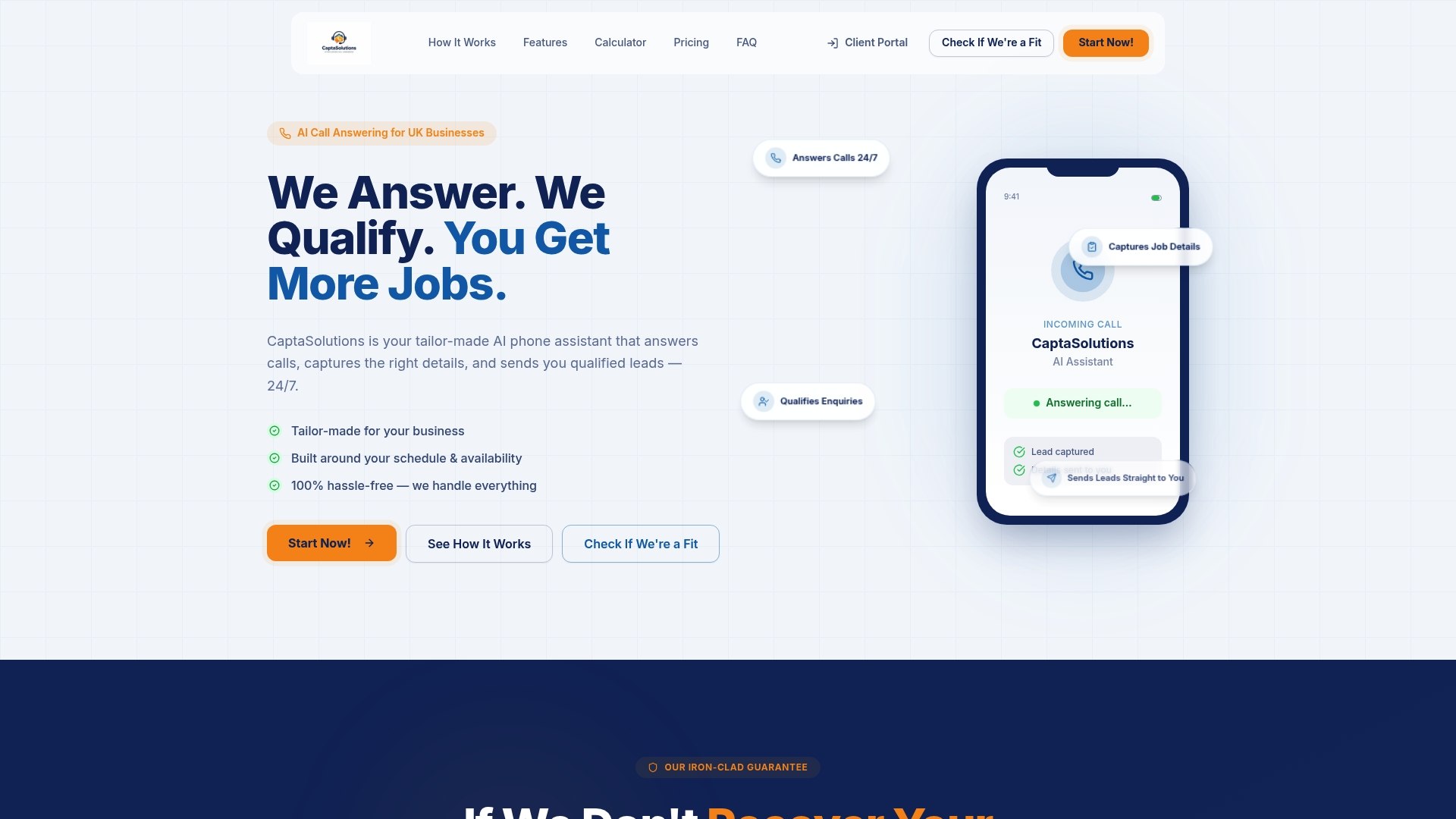
Whether you run a trades business, a restaurant, a salon, or a professional practice, Captasolutions answers every call in your business name, 24 hours a day, 7 days a week. The AI captures caller details, qualifies the enquiry, and organises everything into your client portal. You stay in control of every lead. The service goes live within the hour, with no contract and no card required for the free 30-day trial. Call 07346 811329 or visit captasolutions.co.uk to get started today.
FAQ
What are the main uses of AI call answering for UK businesses?
The main uses are appointment scheduling, lead qualification, emergency call routing, out-of-hours handling, and real-time customer support. AI call answering systems manage these tasks autonomously without human intervention.
Can AI call answering handle emergencies outside business hours?
Yes. AI systems detect urgency through keyword recognition and caller tone, then trigger escalation protocols that alert on-call staff immediately. Routine after-hours enquiries are logged for follow-up the next working day.
How does AI qualify leads on a phone call?
AI trained on your business data asks targeted questions, identifies caller intent, and scores the lead before any human reviews it. It updates your CRM automatically with the caller's details and enquiry type.
Is AI call answering suitable for small UK businesses?
AI call answering is particularly well-suited to small businesses because it removes the need for a dedicated receptionist while improving call handling for trades, hospitality, and service businesses across the UK.
Does AI call answering integrate with CRM systems?
Yes. Leading AI call answering platforms integrate with CRM systems such as Salesforce to update lead records, log call summaries, and trigger follow-up actions automatically during or immediately after each call.