

The fastest way to prioritise urgent booking calls is to apply a three-level triage at the point of entry, route High-priority callers to a reserved queue, and enforce a time-to-answer SLA of 60 seconds or fewer for that tier. Everything else follows from those three decisions.
To act on this within the hour, run through this checklist:
- Create a priority queue in your contact centre platform and assign at least one reserved agent slot to it at all times.
- Add a visible flag (audible alert plus a colour-coded screen indicator) so agents know instantly when a High-priority call lands.
- Enable a callback slot for overflow so urgent callers are never left on hold beyond your SLA threshold.
- Set your triage trigger: any caller with a departure, appointment, or payment deadline within 48 hours goes straight to High.
As a practical benchmark, dedicated priority queues with visible alerts and supervisor escalation are the proven baseline for faster urgent-query handling in UK contact centres. A real-world example: a travel agency caller whose flight departs in 18 hours and whose booking reference shows a payment failure needs a response within 60 seconds, not 5 minutes.
Table of Contents
- What counts as an urgent booking call in your contact centre?
- How does a three-level priority matrix work in practice?
- Which routing and technology options fast-track urgent bookings?
- What should agents and supervisors do when an urgent call arrives?
- What IVR mistakes slow down urgent callers?
- Which metrics tell you whether your urgent booking handling is working?
- Step-by-step implementation timeline
- Key takeaways
- The part most teams get wrong
- Try Captasolutions for urgent booking call handling
- Useful sources and further reading
What counts as an urgent booking call in your contact centre?
Consistent identification is the foundation of any priority system. Without a shared, operational definition, agents make different judgement calls and callers fall through the gaps.
An urgent booking call is one where a delay in response creates a material risk: financial loss, a missed event, a safety or health consequence, or a regulatory breach. The key signals to watch for are:
- Time-to-event threshold: the caller's appointment, departure, or service window is within 24–72 hours. Last-minute booking patterns cluster in this window, making it the most operationally significant triage criterion.
Typical UK scenarios include a traveller whose connecting flight has been cancelled and needs an immediate hotel booking, a homeowner with a burst pipe needing an emergency plumber, a patient requesting a same-day GP appointment, or a business owner whose card payment for a venue deposit is being declined hours before an event.
One compliance note: when a call involves regulated clinical advice, mental health triage, or financial guidance, the correct response is not simply to prioritise it within the standard queue. Route it to a specialist team. Prioritisation and specialist routing are separate decisions, and conflating them creates liability. For appointment call organisation at the business level, the same principle applies: speed matters, but routing to the right person matters more.
How does a three-level priority matrix work in practice?
A simple High / Medium / Low matrix, with clear examples attached to each tier, removes ambiguity at the point of triage. Prioritisation frameworks that sort items by impact and urgency consistently reduce disagreement and speed routing decisions when agents face simultaneous calls.
Statistic callout: Industry practice in UK contact centres targets most calls answered quickly for standard queues. For High-priority urgent bookings, leading operations compress response times substantially, with short maximum hold times before automatic callback offers.
| Priority tier | Caller signal examples | Time-to-answer SLA | Max hold before callback |
|---|---|---|---|
| High | Departure/appointment < 48 hrs; payment failing; safety risk; vulnerable caller | 60 seconds | 90 seconds |
| Medium | Event within 2–7 days; amendment needed; document query with a deadline | 3 minutes | 5 minutes |
| Low | New general enquiry; future booking; information request | 5 minutes | Standard queue |
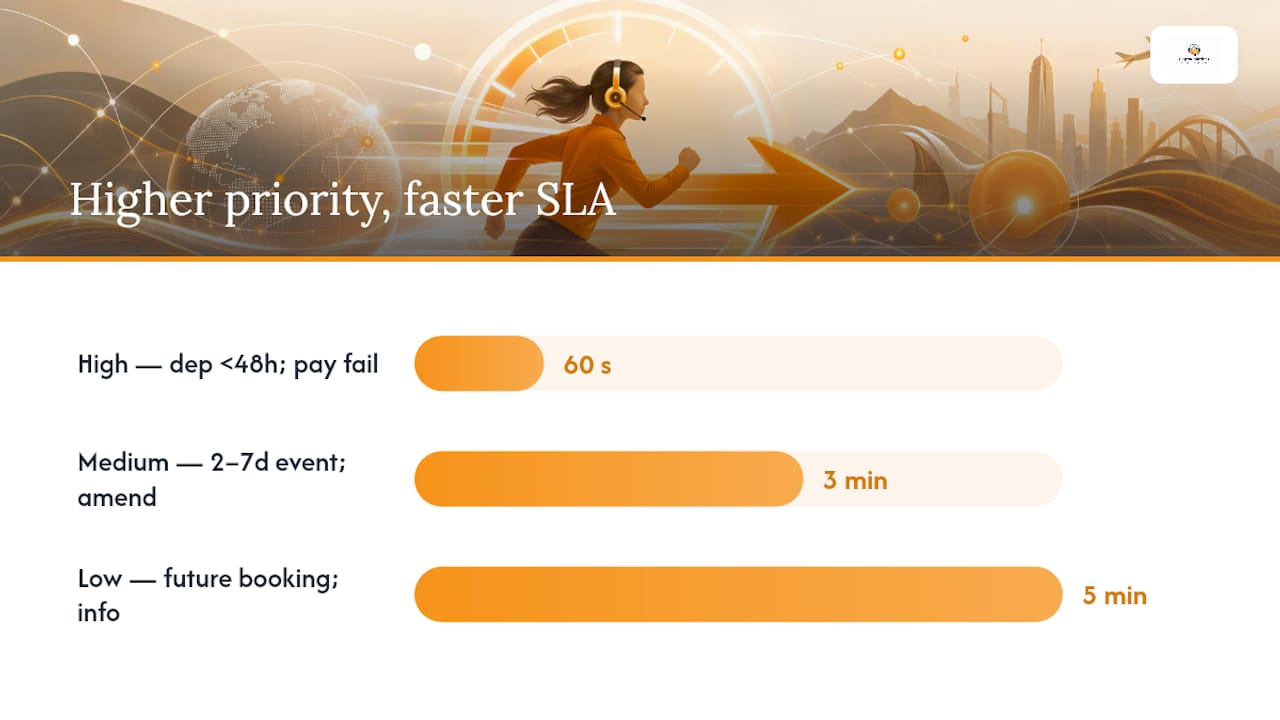
Map these tiers directly into your routing rules. A caller who says "my flight is tomorrow and my booking isn't confirmed" triggers High automatically. A caller asking about availability for next month is Low until a payment failure or deadline signal upgrades them. Separating urgent travellers into priority routing and offering callbacks for overflow reduces abandonment and produces measurably better outcomes in travel-sector operations.
Which routing and technology options fast-track urgent bookings?
The routing architecture you choose determines whether your triage matrix actually works or stays theoretical. These are the practical options, from simplest to most sophisticated:
- Cross-queue prioritisation: centralised, dynamic enforcement of service tiers using signals like customer value or sentiment. Platforms such as Microsoft Dynamics 365 Contact Centre support this natively, letting administrators define channel-level priorities and within-queue urgency controls.
- Channel-level priority — voice calls rank above chat and email by default for urgent bookings. Configure your ACD to reflect this.
- Reserved agent slots: blocking capacity for priority work is one of the most practical ways to protect urgent callers from being absorbed into a busy general queue.
For IVR versus automatic classification: use IVR prompts when your call volume is moderate and your caller base is predictable. Use keyword-based or sentiment-based automatic classification when volume is high enough that manual IVR selection creates bottlenecks. Automatic classification works by matching spoken keywords ("urgent", "today", "emergency") against a confidence threshold; calls above the threshold route directly to the priority queue.
When transferring an urgent call, pass the priority tag, a transcript snippet, and the booking reference to the receiving agent. This prevents the caller from repeating their situation and cuts average handle time on urgent calls.
Pro Tip: Require two signals before automatic escalation triggers, for example a keyword match plus a low-confidence sentiment score. A single signal produces too many false positives and degrades the priority queue for genuinely urgent callers.
For businesses that need AI-powered classification and routing without building it in-house, AI call answering services can apply these rules 24/7 from day one.
What should agents and supervisors do when an urgent call arrives?
Consistency at the agent level is where priority systems succeed or fail. A well-designed queue means nothing if the agent who answers does not know what to capture or when to escalate.
Agent triage script
When a High-priority call connects, agents should ask three questions in under 90 seconds:
- "Can I take your booking reference or name?"
- "When is your appointment or departure?"
- "What is the issue you need us to resolve today?"
These three fields, captured immediately, give the agent and any supervisor enough context to act. For a fuller qualification framework, the booking call qualification guide covers scoring and question sets in detail.
Escalation flow
Agents must warm-transfer to a supervisor when: the caller's issue cannot be resolved within the agent's authority, the call has already exceeded the SLA threshold, or the caller is distressed or vulnerable. A warm transfer means the agent briefs the supervisor before connecting, not a blind transfer. Supervisors receive an audible alert and a screen notification the moment a High-priority call enters the queue; they do not wait for an agent to flag it manually.
Supervisor interventions
Supervisors monitor the priority queue in real time. If a High-priority call has been waiting beyond 90 seconds, the supervisor either takes the call directly or reassigns an agent from a lower-priority queue. During peak periods, supervisors authorise temporary overflow to an after-hours service or a callback slot rather than letting the queue back up.
Training and coaching
New agents complete a role-play scenario covering at least two urgent booking call types before going live on the priority queue. Quick-reference cards (one page, laminated or pinned in the agent desktop) list the three triage questions, the escalation triggers, and the callback procedure. Monthly coaching sessions sample two to three urgent calls per agent and score them against the triage checklist. For handling multiple simultaneous booking calls, agents need a clear decision rule: the call with the earliest event deadline takes precedence.
What IVR mistakes slow down urgent callers?
IVR design is where most priority systems break down before a call even reaches an agent. The most common problems are:
- No single-key shortcut — urgent callers should reach their route with one keypress. "Press 1 for urgent or same-day bookings" at the top of the menu is the standard.
A lean urgent-route IVR looks like this:
Before (problematic): "Press 1 for new bookings. Press 2 for existing bookings. Press 3 for cancellations. Press 4 for urgent issues. Press 5 for billing. Press 6 to speak to an agent."
After (lean): "Press 1 if your booking is for today or tomorrow. Press 2 for all other enquiries."
That single change reduces the time an urgent caller spends in the IVR from an average of 25–30 seconds to under 8 seconds. Limit automated escalation attempts to two before offering a callback; more than two attempts frustrate callers and inflate abandonment. Combining proactive digital offers with phone prioritisation also reduces inbound urgent call volume, because some callers self-serve when a real-time digital option is visible.
Which metrics tell you whether your urgent booking handling is working?
Measurement turns a priority system from a policy into a performance loop. Track these KPIs by priority tier, not just overall:
- First-contact resolution (FCR) for urgent bookings — a call that requires a callback or transfer is not resolved. Track FCR separately from general FCR.
Weekly dashboard and monthly QA
The weekly dashboard should show: time-to-answer by tier, abandonment rate, FCR for urgent calls, and the number of escalations to supervisor. A one-page weekly status update includes these five figures, a brief note on any SLA breaches, and one root-cause observation.
Monthly QA: sample five to ten urgent calls per agent, score against the triage checklist, and identify the single most common failure point. Update routing rules or training materials based on that finding, then re-measure over the following four weeks. This measure-root cause-update-re-measure loop is what separates contact centres that improve from those that plateau.
Step-by-step implementation timeline
A phased rollout reduces the risk of disrupting live service while the new priority system beds in.
| Phase | Milestone | Timing | Owner |
|---|---|---|---|
| 1. Configure | Priority queue created, IVR updated, SLA rules set, reporting enabled | Week 1 | Operations / IT |
| 2. Train | All agents complete triage role-play; quick-reference cards distributed | Week 2 | Team leaders |
| 3. Pilot | Priority system live for one team or one call type; daily monitoring | Weeks 3–4 | Operations manager |
| 4. Review (30-day) | SLA compliance, abandonment rate, FCR reviewed; rules adjusted | Day 30 | Operations manager |
| 5. Full rollout | System extended to all queues and call types | Week 5–6 | Operations / IT |
| 6. Ongoing reviews | 60-day and 90-day reviews against baseline metrics | Days 60 and 90 | Management |
Configuration checklist: IVR menu updated with single-key urgent shortcut; priority queue created with reserved agent slots; SLA thresholds set per tier; audible and visual alerts configured; CRM or webhook mapped to pass booking reference and priority tag on transfer; reporting dashboard live; callback workflow tested end-to-end.
Staffing and cost: Reserve at least one agent slot for the priority queue during peak hours. Overtime risk is highest in weeks 3–4 of the pilot; budget for up to 10% additional agent hours during that period. If inbound urgent volume exceeds reserved capacity, route overflow to an after-hours answering service rather than letting the queue back up. For trades businesses and service providers, emergency after-hours handling is a practical model for what callers expect when they ring outside normal hours.
Fallback plan: during unexpected demand spikes, supervisors activate a pre-agreed overflow protocol: callbacks offered within 30 minutes, and a secondary agent pool pulled from lower-priority queues. Test this protocol in the pilot phase, not on go-live day.
Key takeaways
Prioritising urgent booking calls requires a three-level triage matrix, a reserved priority queue, short SLA thresholds, and a continuous-improvement measurement loop to sustain performance over time.
| Point | Details |
|---|---|
| Three-level triage | Classify every call as High, Medium, or Low at entry using time-to-event, payment risk, and safety signals. |
| SLA benchmarks | Target 60 seconds time-to-answer for High-priority calls; offer a callback after 90 seconds on hold. |
| Reserved agent capacity | Block at least one agent slot for the priority queue during peak hours to prevent urgent calls merging into general queues. |
| Measure by tier | Track time-to-answer, abandonment rate, and first-contact resolution separately for urgent calls, not just overall. |
| Captasolutions | Answers urgent booking calls 24/7 in your business's name, tags priority leads, and organises them in a client portal for immediate review. |
The part most teams get wrong
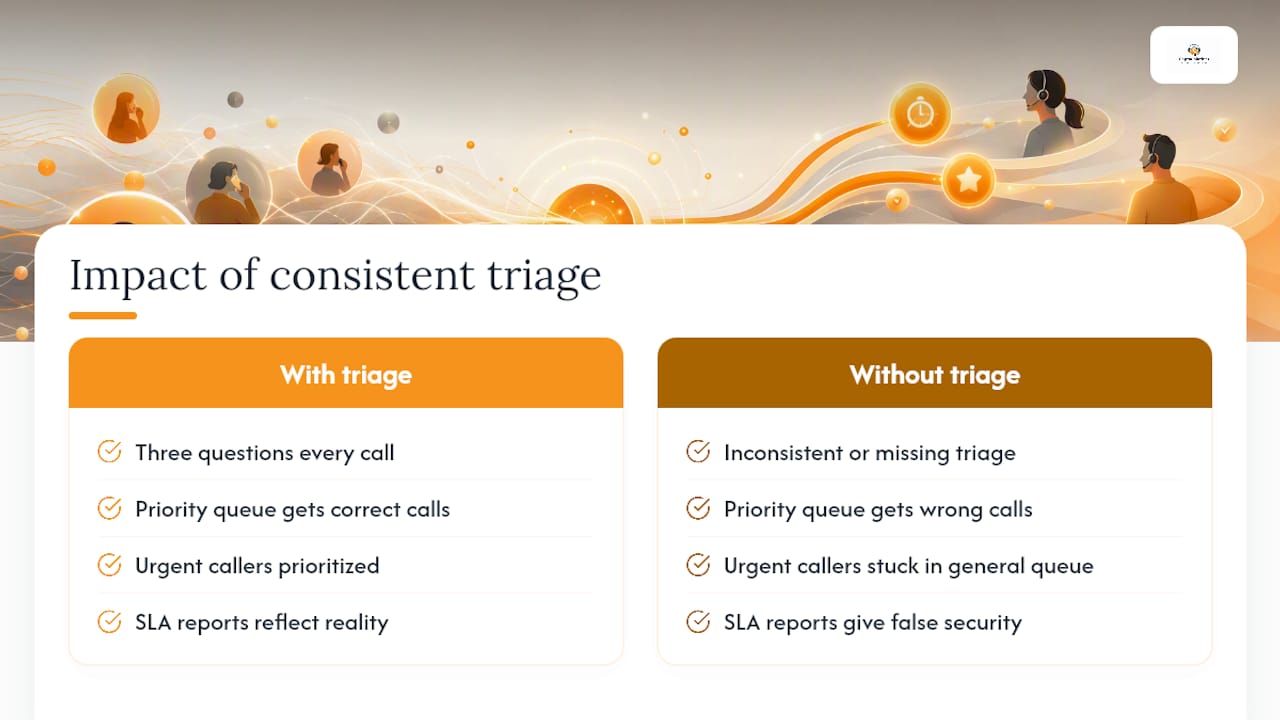
Most contact centre managers focus on the routing architecture and assume the hard work is done once the priority queue is live. The real failure point is almost always simpler: agents do not ask the triage questions consistently, so the system never gets the signal it needs to route correctly.
A priority queue that receives the wrong calls is worse than no priority queue at all. It degrades the experience for genuinely urgent callers and creates a false sense of security for managers reviewing SLA reports. The metric looks fine; the urgent caller who pressed the wrong IVR option is sitting in the general queue.
The operational habit that makes the biggest difference is not a technology change. It is a 90-second discipline: three questions, asked on every call, before the agent does anything else. When that habit is embedded through role-play, quick-reference cards, and monthly call sampling, the routing architecture works as designed. Without it, even the most sophisticated cross-queue prioritisation system produces unreliable results.
The same principle applies to after-hours and overflow scenarios. A business that has invested in a priority queue during office hours but routes urgent calls to voicemail at 6 PM has not solved the problem. It has moved it. For teams that cannot staff a priority queue around the clock, an AI-powered answering service that captures urgency signals and queues callbacks is a practical alternative to leaving those calls unanswered.
Try Captasolutions for urgent booking call handling
Every urgent booking call that goes unanswered is a customer who moves on. Captasolutions answers every call in your business's name, 24 hours a day, 7 days a week, captures the caller's details and urgency signals, and organises everything into your client portal so you act on the most time-sensitive leads first.
There is no card required, no contract, and the service can be live within the hour. A free 30-day trial gives you a full picture of how many urgent calls you are currently missing and what each one represents in lost revenue. All captured call details, transcripts, and priority tags appear in the Captasolutions client portal so you stay in control of every lead. Start your free trial at captasolutions.co.uk today.
Useful sources and further reading
The sources below underpin the guidance in this article. They are grouped by focus area to help you go deeper on the topics most relevant to your operation.
Industry benchmarks and prioritisation frameworks
- Enhance customer service with advanced prioritization - Microsoft Dynamics 365 Blog
- How to get last minute hotel deals
- How Travel Agencies Manage Customer Calls During Peak Season: Improve Peak Travel Support In 2026
- Prioritizing Tasks When Everything Feels Urgent - LinkedIn
Routing and contact centre technology
Travel and hospitality sector examples
- Last-minute hotel booking strategies — Onres Software: combining digital offers with phone prioritisation to reduce inbound urgent call volume.
Related Captasolutions guides
- How to handle multiple booking calls simultaneously
- How AI answers booking calls: a small business guide
- How to follow up missed booking calls effectively
- Call handling for busy professionals: 2026 guide
This article provides general operational guidance for UK contact centre managers. For regulated activities including clinical triage, financial advice, and data handling under UK GDPR, confirm current requirements with the relevant regulatory body or a qualified professional.