

A missed booking call is a lost lead with active intent. The caller already wanted to buy. They chose your number, picked up the phone, and dialled. When nobody answered, that intent did not disappear. It transferred to your nearest competitor. Following up missed booking calls is the single fastest way to recover that revenue without spending a penny on new advertising.
Missed call text back recovers 18–34% of missed calls into real conversations, with 5–18% converting to booked appointments or quotes. That is not a marginal gain. For a busy tradesperson, salon, or clinic missing ten calls a week, even a 10% recovery rate represents meaningful monthly revenue. The industry term for this process is missed call recovery, and the techniques that drive it, including automated SMS follow-up, CRM integration, and AI-powered call handling, are now accessible to businesses of every size across the UK.
How to follow up missed booking calls: tools you need first
Effective missed call recovery depends on having the right infrastructure in place before a single call goes unanswered. Three categories of tool matter most.
Automated SMS platforms send a text message to the caller within seconds of a missed call. Reply rates on the first SMS run at 35–55%, with the majority of those replies coming from genuine prospects. That speed is the entire point. A text sent within 60 seconds catches the caller while they are still thinking about your business.

CRM integration connects your follow-up workflow to your lead records. Every missed call becomes a tracked contact. You can see who called, when they replied, whether they booked, and what the outcome was. Without this, follow-up becomes guesswork and revenue leaks silently.
Scheduling and calendar tools close the loop. Once a prospect replies to your SMS, they need a frictionless path to booking. A direct link to your live calendar, or an AI agent that can confirm a slot in real time, removes the back-and-forth that kills conversions.
The cost of entry is low. Automation tools for missed call recovery typically cost between £15 and £80 per month, yet a single recovered booking in most service businesses covers that cost entirely. The ROI case is straightforward.
| Tool category | Primary function | Key benefit |
|---|---|---|
| Automated SMS platform | Sends instant text on missed call | Maintains caller intent at peak |
| CRM integration | Tracks leads and outcomes | Provides full visibility of recovery rate |
| Calendar or booking link | Enables direct appointment scheduling | Removes friction from the booking step |
| AI call handling | Answers calls and qualifies enquiries | Prevents missed calls from occurring |
Key features to look for in any missed call recovery setup:
- Instant trigger on missed call, with no manual step required
- Personalised message templates that include the caller's name where available
- Two-way SMS capability so the prospect can reply and continue a conversation
- CRM logging that records every interaction automatically
- Escalation rules that flag urgent or high-value leads for immediate human attention
Pro Tip: Set your SMS trigger to fire within 30 seconds of a missed call, not 60. The faster you respond, the less likely the caller has already dialled a competitor.
What is the best process to recover a missed booking call?
Speed is the defining variable in missed call recovery. Automated SMS within 60 seconds significantly increases the chance of converting a missed call into a booking by keeping the caller's intent alive. A manual callback attempted 20 minutes later faces a prospect who has already moved on.
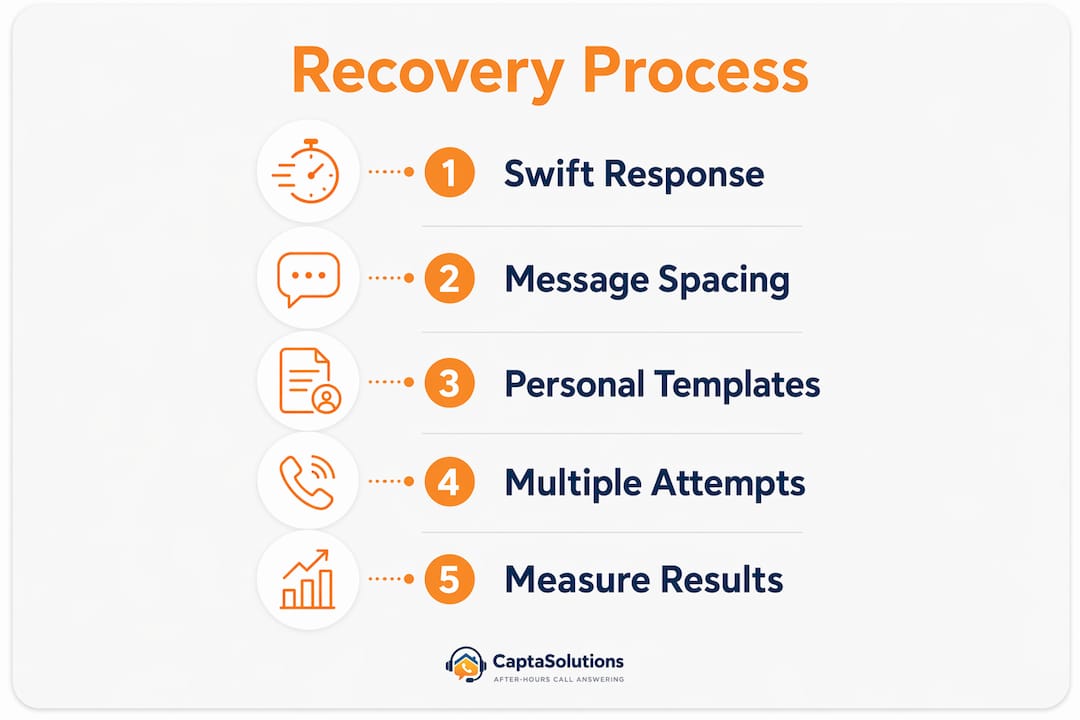
A structured recovery workflow looks like this:
- Trigger fires instantly. The moment a call goes unanswered, your system detects it and sends an automated SMS to the caller's number.
- Message is personalised and direct. The text uses the caller's name if available and asks one clear question. Effective follow-up messaging is concise, avoids robotic phrasing, and moves the caller toward booking with a single prompt.
- Reply routes into a managed inbox. Responses land in a central inbox monitored by an AI agent or a staff member. The conversation continues naturally from there.
- AI handles routine enquiries. For standard booking requests, an AI agent can confirm availability, answer common questions, and secure the appointment without human involvement.
- Complex or VIP leads escalate immediately. AI systems with escalation triggers route sensitive or high-value enquiries to a human team member straight away, preserving the client experience.
- Second follow-up sends if no reply. If the prospect does not respond within two to four hours, a second message goes out. Most replies arrive on the first or second contact.
- Multi-channel outreach activates if SMS fails. Multi-channel follow-up across calls, email, and SMS dramatically improves conversion for callers who do not respond to text alone.
The messaging cadence matters as much as the timing. Sending three texts within an hour feels aggressive. Spacing them at 60 minutes, then four hours, then the following morning respects the prospect's time while keeping your business visible.
Pro Tip: Write your SMS templates in the first person and keep them under 160 characters. "Hi, it's [Business Name]. Sorry we missed you. Are you still looking to book?" outperforms any formal autoresponse.
For businesses that want to go further, call handling for busy professionals covers how to structure inbound call workflows so fewer calls go unanswered in the first place.
What mistakes kill missed booking call recovery?
The most common mistake is delay. Typical independent venues miss 30–40% of inbound calls, and the callers who reach voicemail frequently ring a competitor before the original business calls back. Delay is not a minor inconvenience. It is a direct transfer of revenue to someone else.
Other mistakes that consistently reduce recovery rates:
- Generic, robotic messages. A text that reads "We missed your call. Please call back at your convenience" tells the prospect nothing and invites no action. Personalised, conversational messages outperform autoresponses every time.
- Relying on voicemail. Voicemail is ineffective and slow. Most callers do not leave a message, and those who do expect a callback within minutes, not hours.
- No CRM integration. Without a system tracking each missed call and its outcome, you cannot identify patterns, measure recovery rates, or improve over time.
- Too many follow-up attempts in too short a window. Three texts in 90 minutes reads as spam. It damages your brand and reduces the chance of a reply.
- Ignoring escalation for urgent leads. A caller enquiring about an emergency repair or a time-sensitive appointment needs a human response, not a chatbot loop.
- No reporting on outcomes. If you cannot see which follow-ups converted and which did not, you are operating blind. Manual callbacks have variable quality and speed, causing uneven recovery performance that automation corrects.
The role of follow-up after calls is often underestimated precisely because the losses are invisible. You never see the bookings you did not get.
How do you measure missed booking call follow-up results?
Measurement turns a follow-up process from a guess into a system. Three KPIs define performance: recovery rate, callback speed, and booking conversion rate.
Recovery rate is the percentage of missed calls that result in a reply or a callback. A well-configured SMS workflow typically achieves a 35–55% reply rate on the first message. If your rate sits below 20%, the trigger speed or message quality needs attention.
Callback speed measures how quickly your system responds after a missed call. The target is under 60 seconds for automated SMS. For manual callbacks, under five minutes is the benchmark worth aiming for.
Booking conversion rate tracks how many recovered conversations result in a confirmed appointment. This is the number that ties directly to revenue.
| KPI | What it measures | Target benchmark |
|---|---|---|
| Recovery rate | Percentage of missed calls that get a reply | 35–55% on first SMS |
| Callback speed | Time from missed call to first contact | Under 60 seconds (automated) |
| Booking conversion | Recovered conversations that become bookings | 5–18% of total missed calls |
| Follow-up attempts | Average contacts before reply or close | 2–3 per missed call |
Use your CRM's reporting dashboard to review these figures weekly. Look for patterns: which days generate the most missed calls, which message templates get the highest reply rates, and which lead types convert most reliably. Automated workflows integrate with CRM to track recovered bookings with clear reporting, removing the need for manual data entry.
Pro Tip: Review your recovery rate every Monday morning. A five-minute weekly check tells you whether your follow-up system is working or drifting. Adjust one variable at a time so you know what changed the result.
Refine your messaging templates every four to six weeks based on reply rate data. Small changes in wording, send timing, or message length can shift conversion meaningfully. The businesses that treat missed call recovery as an ongoing process, rather than a one-time setup, consistently outperform those that set it and forget it.
Key takeaways
Missed call recovery is the highest-ROI lead capture method available to UK service businesses, because it converts callers who already have buying intent rather than trying to generate new demand.
| Point | Details |
|---|---|
| Speed is everything | Send an automated SMS within 60 seconds of a missed call to keep caller intent alive. |
| Personalise every message | Concise, conversational texts outperform generic autoresponses and drive higher reply rates. |
| Integrate with your CRM | Track every missed call and outcome to measure recovery rate and identify patterns. |
| Avoid voicemail dependency | Callers who reach voicemail frequently ring a competitor before you call back. |
| Measure and refine weekly | Review recovery rate, callback speed, and booking conversion every week and adjust one variable at a time. |
Why most businesses are sitting on their best revenue opportunity
Working with UK service businesses on call handling has shown me one pattern more than any other. The owners who invest in paid advertising, SEO, and social media, yet leave their inbound calls unanswered, are pouring water into a bucket with a hole in it. Missed-call recovery converts callers with immediate intent more effectively than any top-of-funnel channel, because the work of persuasion is already done. The caller chose you.
What surprises most business owners is the cumulative damage. The greatest revenue losses are not individual missed calls but the lifetime value of repeat business that never starts, and the negative word of mouth from a caller who felt ignored. A single missed call from a new client could represent years of repeat bookings. That is the number worth thinking about.
The businesses I have seen recover fastest are not the ones with the most sophisticated tech stack. They are the ones who respond fastest and sound most human. Automation handles the speed. Personalised messaging handles the human part. The two work together, not in opposition.
Ongoing measurement is what separates a recovery system from a recovery habit. Checking your KPIs weekly and adjusting your templates monthly keeps the system sharp as your business grows and your caller mix changes. Set it, measure it, and refine it. That is the entire method.
— Daniel
Captasolutions: built for businesses that cannot afford to miss a call
Every missed call is a warm lead walking out of the door. Captasolutions answers every inbound call in your business name, 24 hours a day, 7 days a week, so that lead never gets the chance to ring someone else.
The AI-powered call answering service captures caller details, qualifies the enquiry, and organises everything into your client portal. You see every lead, decide what to take on, and stay in control. Captasolutions integrates with your existing booking workflow and delivers the reporting you need to track recovered revenue. Trusted by tradespeople, salons, clinics, restaurants, and professional services across the UK. Start your free 30-day trial at captasolutions.co.uk or call 07346 811329. No card required. No contract. Live within the hour.
FAQ
What is missed call text back?
Missed call text back is an automated process that sends an SMS to a caller within seconds of a missed call. Reply rates on the first text run at 35–55%, making it one of the fastest ways to re-engage a lost lead.
How quickly should you follow up a missed booking call?
Follow up within 60 seconds using an automated SMS. The faster the response, the higher the chance the caller is still considering your business rather than ringing a competitor.
Why do missed calls lose customers?
Callers who reach voicemail or no answer frequently contact a competitor before the original business calls back. The intent is immediate, and delay transfers it elsewhere.
How many follow-up attempts should you make?
Two to three attempts across different channels is the effective range. Most replies arrive on the first or second contact. Beyond three attempts in a short window, further messages risk being perceived as intrusive.
What KPIs should you track for missed call recovery?
Track recovery rate, callback speed, and booking conversion rate. A well-configured system achieves a 35–55% reply rate on the first SMS and converts 5–18% of total missed calls into confirmed bookings.