

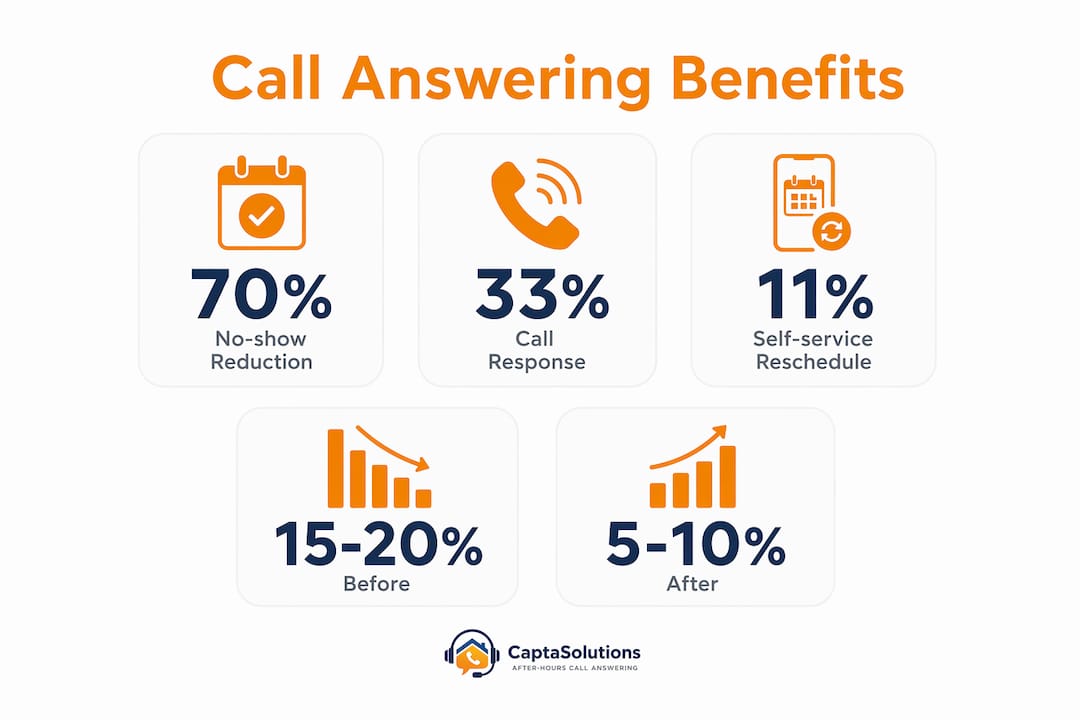
Call answering is defined as the practice of capturing, responding to, and acting on inbound calls in a way that confirms appointments, prevents cancellations, and keeps clients engaged. Understanding how call answering reduces no-shows is the single most valuable thing a UK service business can do to protect its revenue. Confirmation and reminder calls reduce no-shows by up to 70% compared to businesses that send no reminders at all. That figure represents real money: a salon losing two appointments a day, a clinic with a chronic 18% no-show rate, or a tradesperson driving to an empty address.
How call answering reduces no-shows: the core mechanisms
Call answering cuts no-shows through three direct actions: confirming the appointment exists, reminding the client before the day, and giving them an easy way to reschedule if plans change.
Appointment confirmation calls
Confirmation calls work because they close the gap between booking and attendance. A client who booked three weeks ago may have forgotten, moved house, or simply lost the details. A call the day before reactivates that commitment. Clinics that added interactive confirmation calls saw their no-show rate drop from 18.55% to 7.01%. That is not a marginal improvement. It is a near-halving of lost appointments through one additional touchpoint.
Reminder calls close to the appointment
Timing matters as much as the call itself. A reminder sent three days before a routine appointment performs differently from one sent the morning of a complex procedure. Tailoring reminder timing to appointment type and day consistently outperforms a standard one-size schedule. For UK service businesses, this means a Friday afternoon call for a Monday morning slot, or a same-day call for high-value bookings.
Two-way communication and rebooking
The most overlooked benefit of phone follow-ups is the two-way nature of the call. A text or email cannot negotiate. A call can. When a client says they cannot make it, a trained agent or AI phone agent can immediately offer two or three alternative slots. Offering alternative slots during cancellation calls increases same-day fill rates by 34%. That converts a lost appointment into a rebooked one, often within the same conversation.
Pro Tip: Record every cancellation reason during calls. After four weeks, patterns emerge. If Monday mornings produce the most cancellations, shift your confirmation call timing or adjust your scheduling policy for that slot.
The role of live versus AI-assisted answering is also worth separating. Live agents bring empathy and flexibility. AI phone agents bring consistency and availability. The strongest results come from combining both: AI handles volume, overflow, and out-of-hours calls, while live agents manage complex or sensitive rebooking conversations.
How does call answering compare with other reminder methods?
Voice calls produce higher engagement than text or email reminders. Phone call response rates reach 33% compared to lower rates for SMS and email. That gap exists because a ringing phone demands attention in a way that a notification does not.

The table below compares the main reminder methods on the metrics that matter most to UK service businesses.
| Reminder method | Response rate | Allows rebooking | No-show reduction |
|---|---|---|---|
| Phone call (live) | High | Yes, immediately | Up to 70% |
| AI phone agent | High | Yes, immediately | 35–40% |
| SMS reminder | Moderate | Limited | 20–30% |
| Email reminder | Low | No | Minimal |
| No reminder | None | No | None |
Automated call answering sits in a strong middle position. It delivers the engagement of a phone call without the staffing cost of a live agent. Phone call volume dropped by 88% in one large health system after automating call answering and reminders. That freed front-desk staff to handle the calls that genuinely needed a human.
Combining methods produces the best results. A confirmation call followed by an SMS the morning of the appointment covers clients who missed the first touchpoint. The call does the heavy lifting; the text acts as a safety net.
Best practices for integrating call answering into your no-show strategy
Deploying call answering without a clear plan produces inconsistent results. These steps give UK businesses a structured approach.
-
Audit your current no-show rate by appointment type. Separate routine bookings from high-value or complex ones. No-show rates vary significantly by slot, day, and client type. You cannot fix what you have not measured.
-
Set confirmation call timing based on appointment lead time. For appointments booked more than a week ahead, call 48 hours before. For same-week bookings, call the day before. Reducing lead time between booking and appointment reduces no-shows by 10–15% per week of reduction. Shorter lead times mean less time for clients to forget or change plans.
-
Script rebooking into every cancellation call. When a client cancels, the agent's next sentence should offer an alternative slot. This is not upselling. It is recovering a lost booking before the slot goes cold. Handling cancellations as rebooking opportunities during the call itself is the single most effective way to recover lost revenue.
-
Use AI phone agents to cover after-hours and overflow calls. After-hours answering generates 34% of total monthly leads for service businesses. Missing those calls means missing bookings that would have filled your diary the next morning. An AI agent answers in your business name, captures the details, and flags the lead for follow-up.
-
Follow up after a missed appointment. A call or message within two hours of a no-show increases rescheduling rates significantly. The client is often embarrassed or apologetic. That moment is the best time to rebook. Follow-up calls after missed appointments increase retention and rescheduling likelihood more than any other single action.
Pro Tip: Segment your client list by historical no-show behaviour. Clients who have missed before are statistically more likely to miss again. Give that group an additional call the morning of their appointment, not just the day before.
For businesses managing call handling for busy professionals, the key is removing friction at every stage. The harder it is to rebook, the more likely a client is to simply not show up.
What measurable benefits do businesses see from effective call answering?
The impact of call answering on no-show rates is well documented across service sectors. AI phone agents reduce no-shows by 35–40%, recovering up to £37,000 annually for service businesses. That figure assumes a modest number of missed appointments per week. For businesses with higher volumes, the recovery is proportionally larger.
The table below summarises the key performance shifts businesses typically see after implementing a structured call answering strategy.
| Metric | Before call answering | After call answering |
|---|---|---|
| No-show rate | 15–20% | 5–10% |
| Same-day fill rate | Low | Increased by up to 34% |
| Staff call volume | High | Reduced by up to 88% |
| Annual revenue recovered | £0 | Up to £37,000 |
| Client retention | Baseline | Improved through consistent contact |
Staff efficiency gains are often underestimated. When automated call answering handles confirmations and reminders, front-desk teams stop spending half their day chasing appointments. They focus on clients who are present, which improves the in-person experience and reduces stress.
Customer retention also improves. Clients who receive consistent, professional communication before and after appointments are more likely to rebook and more likely to refer others. The role of call answering in revenue extends well beyond the individual appointment. It shapes the client's overall perception of how the business operates.
Self-service rescheduling options reduce no-shows by nearly 11% on their own. When call answering includes an immediate rebooking offer, that figure compounds with the broader reduction from confirmation and reminder calls.
Key takeaways
Consistent, proactive call answering is the most direct method UK service businesses have for cutting no-shows, recovering revenue, and retaining clients.
| Point | Details |
|---|---|
| Confirmation calls work | No-show rates drop from around 18% to 7% when interactive confirmation calls are added. |
| Timing is critical | Match call timing to appointment lead time and day of week for the best attendance results. |
| Rebooking during cancellations | Offering alternative slots immediately during a cancellation call increases fill rates by 34%. |
| AI covers the gaps | AI phone agents handle after-hours and overflow calls, capturing leads and bookings around the clock. |
| Staff workload falls sharply | Automated call answering reduces inbound call volume by up to 88%, freeing staff for higher-value tasks. |
Why most businesses are solving the wrong problem
Most business owners I advise treat no-shows as a client behaviour problem. They blame forgetfulness, bad manners, or unreliable customers. That framing leads to the wrong solutions: stricter cancellation policies, deposits, and penalty fees. Those tools have their place, but they do not address the root cause.
The majority of no-shows are an administrative friction problem. The client forgot, could not get through to rebook, or did not know how to cancel without feeling awkward. A well-structured call answering system removes all three of those barriers before they become a missed appointment.
What I have seen work consistently is the combination of AI-powered answering for volume and availability, paired with a clear rebooking script for every cancellation. Businesses that treat every cancellation call as a recovery opportunity, not a loss, fill significantly more slots. The ones that simply log the cancellation and move on leave money on the table every single week.
The other pitfall I see regularly is ignoring after-hours calls. A client who rings at 7pm to cancel a tomorrow morning appointment reaches voicemail. They do not call back. The slot stays empty. An AI phone agent that answers that call, acknowledges the cancellation, and offers an alternative slot the following week turns a no-show into a rebooked appointment. That is not a complex system. It is a consistent one.
If you are a UK service business owner looking at your no-show rate and feeling stuck, the answer is rarely a harsher policy. It is better communication, delivered at the right moment, through the right channel. How call answering supports UK clinic growth covers this in more depth for appointment-based businesses specifically.
— Daniel
Captasolutions: built to keep your appointments filled
Missed calls and missed appointments cost UK service businesses thousands of pounds every year. Captasolutions answers every call in your business name, 24 hours a day, 7 days a week, so no booking request, cancellation, or rebooking opportunity goes unanswered.
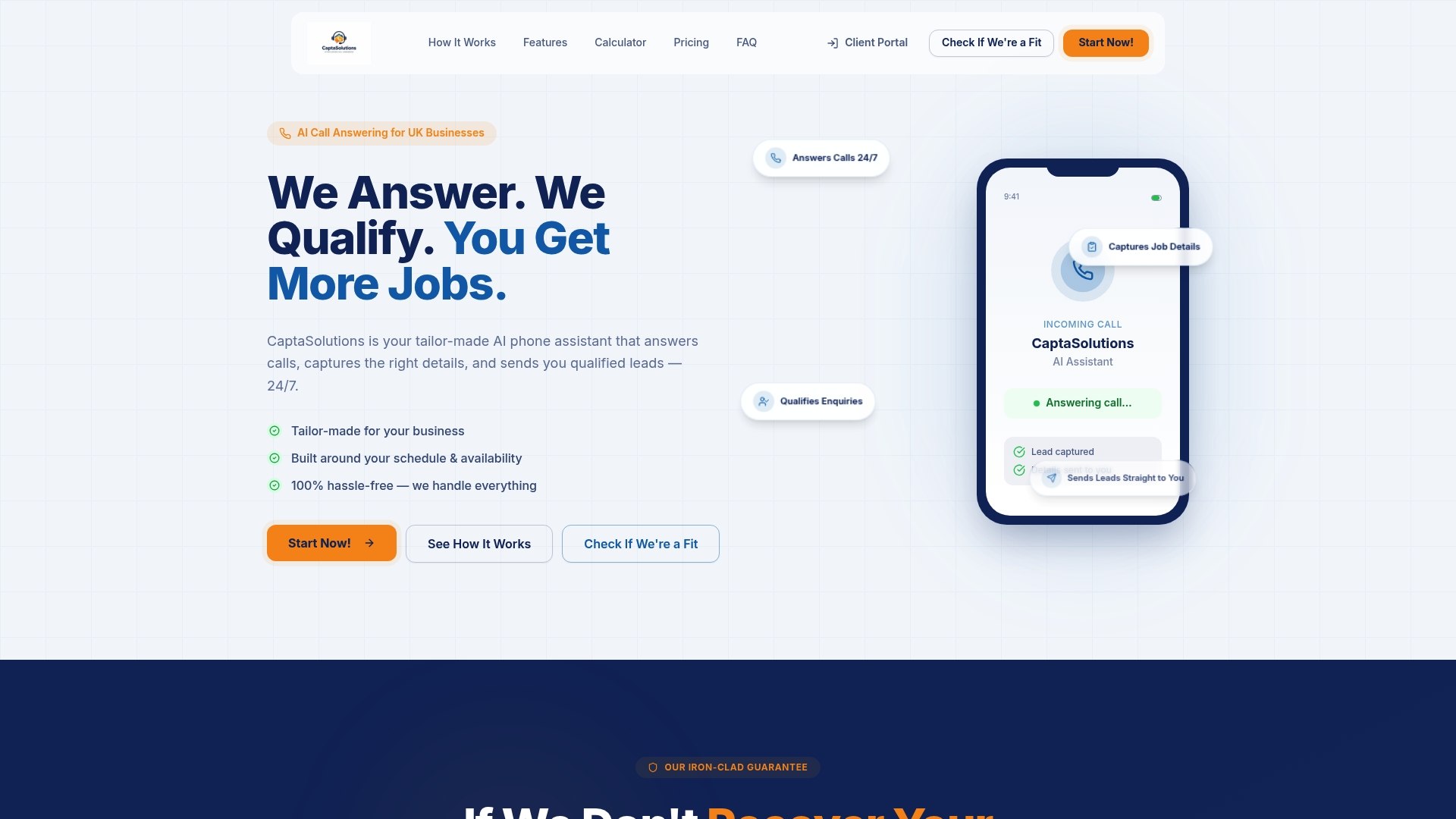
Captasolutions captures caller details, qualifies the enquiry, and organises everything into your client portal. You stay in control of every lead and every appointment. Whether you run a salon, a clinic, a trades business, or a professional practice, the system is live within the hour. There is no contract and no card required for the free 30-day trial. Visit Captasolutions to get started today, or call 07346 811329.
FAQ
How much can call answering reduce no-shows?
Confirmation and reminder calls reduce no-shows by up to 70% compared to no reminders. AI phone agents alone produce reductions of 35–40%.
What is the best time to send an appointment reminder call?
Call 48 hours before for appointments booked more than a week ahead, and the day before for same-week bookings. Tailoring timing to appointment type consistently outperforms a fixed schedule.
Are AI phone agents as effective as live agents for reducing no-shows?
AI phone agents match live agents on availability and consistency, particularly for after-hours and overflow calls. The strongest results come from combining both, with AI handling volume and live agents managing complex rebooking conversations.
What should a cancellation call include to recover the booking?
Every cancellation call should immediately offer two or three alternative appointment slots. Offering alternatives during the call increases same-day fill rates by 34% and converts potential no-shows into confirmed bookings.
Does call answering improve client retention beyond reducing no-shows?
Yes. Consistent, professional communication before and after appointments improves client retention and referral rates. Follow-up calls after missed appointments also increase rescheduling likelihood more than any other single action.