
Effective call answering is the single most direct lever UK clinic owners have for converting patient interest into booked appointments. Every time a call goes unanswered, a potential patient moves on, often to a competitor who picks up. Understanding how call answering supports UK clinic growth means recognising that the telephone is not an administrative inconvenience. It is the front door of your practice. Modern solutions including AI-powered receptionists, cloud VoIP systems, and professional call answering services UK-wide are reshaping how clinics capture demand and build lasting patient relationships.
How missed calls are costing your clinic more than you think
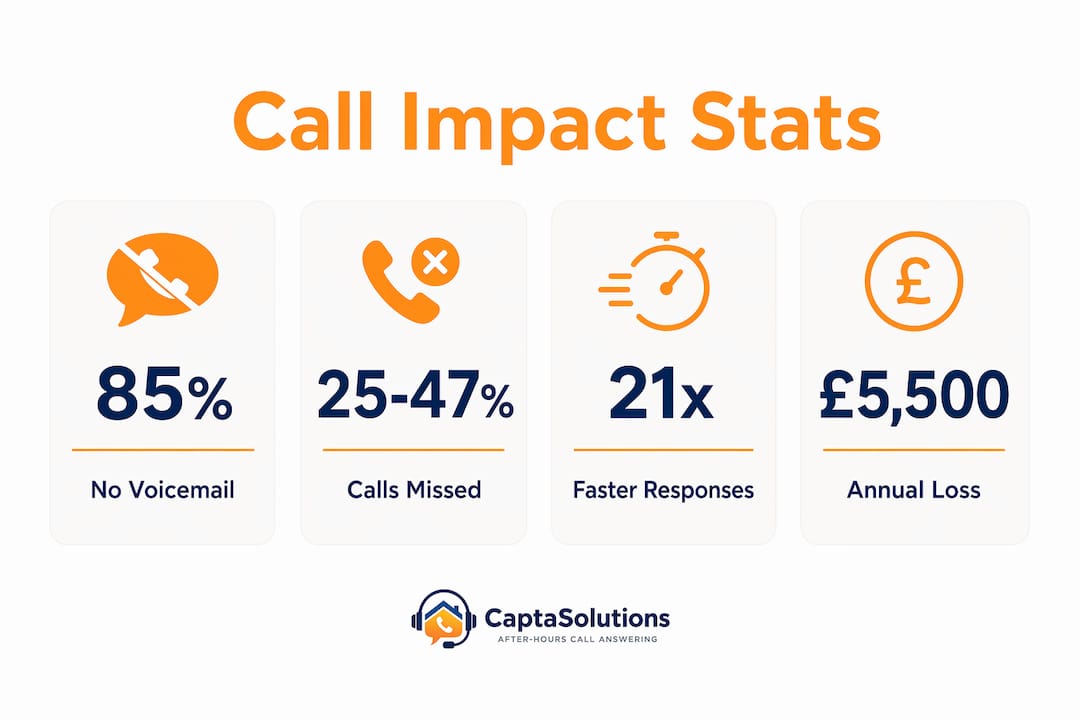
UK businesses miss 25 to 47% of incoming calls, and clinics are no exception. That figure means nearly half of every patient who picks up the phone to book with you never gets through. The financial consequence is substantial: industry research estimates UK businesses collectively lose £30 billion annually from missed calls, roughly £5,500 per business per year.
The damage does not stop at the missed booking itself. 85% of callers who reach voicemail do not leave a message. They simply hang up and search for the next available clinic. This means your CRM and booking system show no record of the lost opportunity, making the problem invisible in your weekly reports.
The table below illustrates the contrast between answered and unanswered calls across key outcome metrics.
| Outcome | Answered call | Missed call |
|---|---|---|
| Appointment booked | High probability | Near zero |
| Patient retained | Likely | Lost to competitor |
| Referral generated | Possible | Eliminated |
| Revenue captured | Immediate | Permanently lost |
| CRM record created | Yes | No |
Missed calls also compound over time. Retaining an existing patient costs five to seven times less than acquiring a new one, so each unanswered call erodes not just today's revenue but the referral network and repeat bookings that fuel organic clinic growth. Clinics that consistently miss calls become increasingly dependent on paid advertising to replace what they are quietly losing through the phone.
What poor call handling does to patient trust
Call handling quality is a frontline patient experience factor, not merely an administrative function. When a patient cannot get through to your clinic, the emotional response is frustration followed by doubt about whether the practice is well-run. That doubt translates directly into lost trust, cancelled appointments, and negative word-of-mouth.

The consequences of poor phone access in UK healthcare are well-documented. The BBC reported that an 84-year-old patient spent over 16 hours across three days attempting to cancel an NHS appointment because the phone system was unresponsive. While that is an extreme case, it illustrates the patient frustration that builds when call handling is treated as a low priority. Private clinics face the same reputational risk on a smaller scale every day.
The practical consequences for a growing clinic include:
- Increased no-show rates, because patients who struggled to book feel less committed
- Lost referrals from patients who would otherwise recommend the practice to family and friends
- Reduced trust in the clinic's ability to deliver reliable care
- Higher patient acquisition costs as organic growth stalls
Queue callback features and call routing tools address much of this frustration directly. When a patient cannot get through immediately, an automated callback option allows them to hold their place in the queue and receive an outbound call when a receptionist is free. This single feature reduces hold time frustration and measurably improves patient satisfaction during peak clinic hours.
Pro Tip: Treat call answering quality as a core patient experience metric alongside appointment wait times and consultation satisfaction scores. Review it monthly with the same rigour you apply to clinical outcomes.
Which technologies actually improve clinic call handling?
Cloud-based VoIP systems are the most practical upgrade available to UK clinics replacing legacy landline infrastructure. Unlike traditional phone lines, VoIP handles multiple concurrent calls, routes them intelligently, and integrates with clinical record systems. Dynamic routing and hunt groups distribute incoming calls across available staff during peak periods, preventing the bottleneck that causes most missed calls in the first place.
Screen pop integration is one of the most underrated efficiency gains available. When a patient calls, their record appears automatically on the receptionist's screen before the call is answered. This reduces average call handling time by 30 to 40 seconds per call. Across a busy morning of 100 calls, that recovers between 50 and 67 minutes of receptionist time, capacity that can be redirected to patient care or booking conversion.
AI-powered receptionists extend coverage beyond contracted hours without adding headcount. They answer calls in the clinic's name, capture caller details, qualify the enquiry, and log everything to a client portal for review. For clinics that receive enquiries during evenings and weekends, this technology captures additional demand that would otherwise be permanently lost.
| Technology | Key feature | Primary benefit |
|---|---|---|
| Cloud VoIP | Dynamic routing, hunt groups | Handles peak call volumes without missed calls |
| Queue callback | Automated outbound call return | Reduces patient frustration and hold times |
| Screen pop integration | Instant patient record display | Cuts handling time by 30 to 40 seconds per call |
| AI receptionist | 24/7 call capture and qualification | Captures out-of-hours enquiries automatically |
Pro Tip: Before procuring any new telephony system, test your current broadband upload speed. VoIP call quality degrades below 1 Mbps per concurrent call. Most UK clinic broadband connections support this easily, but it is worth confirming before switching.
How to implement and measure call answering for clinic growth
Improving call answering in a clinic follows a clear sequence. Start with an audit of your current performance before spending anything on new technology.
- Audit your call data. Pull reports from your existing phone system or ask your provider for missed call logs. Identify peak missed-call windows, typically Monday mornings and post-weekend periods.
- Test your broadband capacity. Confirm your connection supports VoIP if you plan to switch. A stable connection with at least 10 Mbps download and 2 Mbps upload handles most clinic call volumes comfortably.
- Procure and pilot a VoIP or AI answering solution. Run a 30-day trial before committing. Measure answer rate, abandonment rate, and booking conversion weekly during the trial period.
- Train front desk staff on call conversion. A call answered poorly converts no better than a missed call. Staff should be trained to confirm availability, offer alternatives when slots are full, and capture contact details for follow-up. You can find practical guidance on effective call handling to support this training.
- Set KPIs and review them monthly. The four metrics that matter most are answer rate, average response time, call abandonment rate, and booking conversion rate. Tracking these KPIs enables evidence-based improvements rather than guesswork.
- Integrate telephony with your CRM. When call data feeds directly into your patient management system, you gain a complete picture of patient acquisition cost and can attribute bookings accurately to their source.
Medical practices that respond within five minutes to new enquiries are 21 times more likely to convert them. Speed of response is not a nice-to-have. It is the single biggest conversion variable in patient acquisition.
Pro Tip: Use call recordings for monthly coaching sessions with reception staff. Identify the calls where bookings were lost and work backwards to find the exact moment the conversation went wrong. This is faster and more effective than generic customer service training.
In-house answering vs outsourced call answering services: which suits your clinic?
The choice between managing calls internally and using a professional call answering service depends on three factors: call volume, operating hours, and staff capacity. Neither approach is universally superior, but the trade-offs are clear.
In-house call answering: strengths and limitations
- Full control over tone, scripts, and patient interaction
- Staff have direct access to the booking system and clinical records
- Works well during core hours when reception is fully staffed
- Breaks down during peak periods, staff absences, and outside contracted hours
- Adds to receptionist workload, increasing risk of errors and burnout during busy periods
Outsourced call answering services: strengths and limitations
- Provides 24/7 coverage including evenings, weekends, and bank holidays
- Reduces pressure on in-house staff during peak demand
- Professional services offer trained agents and AI-powered call qualification
- Concerns about data privacy and GDPR compliance are legitimate but addressable. Reputable UK providers operate under strict data processing agreements
- Some loss of direct control over patient interaction tone, mitigated by detailed briefing documents and call scripts
For most growing UK clinics, a hybrid model works best. In-house staff handle calls during core hours, and an outsourced service covers the gaps. Professional call answering services reduce lost enquiries during evenings and weekends when clinics are otherwise closed, capturing demand that in-house teams structurally cannot reach. The return on investment from call answering services is well-documented across UK service businesses, and clinics consistently rank among the highest-benefit sectors.
Key takeaways
Effective call answering is the most direct and measurable driver of patient acquisition and revenue growth available to UK clinic owners.
| Point | Details |
|---|---|
| Missed calls destroy revenue | UK businesses lose approximately £5,500 per year from missed calls; clinics face the same structural loss. |
| Patient trust depends on phone access | Poor call handling increases no-shows, reduces referrals, and damages long-term clinic reputation. |
| VoIP and AI receptionists close the gap | Screen pop integration saves 30 to 40 seconds per call; AI answering captures out-of-hours demand automatically. |
| Speed of response is the top conversion variable | Practices responding within five minutes are 21 times more likely to convert a new enquiry into a booking. |
| Measure what matters | Track answer rate, abandonment rate, and booking conversion monthly to drive evidence-based improvements. |
The call answering mistake most clinics make before they realise it
I have spoken with clinic owners who have invested heavily in Google Ads, social media, and SEO, only to find their new patient numbers barely moving. When we look at their call data, the pattern is almost always the same. A significant share of the calls generated by that marketing spend went unanswered. The clinic was paying to attract patients it then failed to receive.
The uncomfortable truth is that call answering is treated as an operational afterthought in most clinics. It sits below website design, pricing strategy, and clinical equipment in the priority queue. Yet it is the one touchpoint that sits between every other growth investment and the actual booking. You can have the best-designed website and the most competitive pricing in your area. If the phone goes unanswered, none of that matters.
What I have found works in practice is treating the phone channel with the same rigour applied to clinical quality. That means monthly KPI reviews, call recording analysis, and a clear escalation process for periods when in-house capacity is stretched. It also means being honest about the limits of in-house coverage. No reception team can answer every call during a busy Monday morning and simultaneously manage a waiting room. The clinics that grow consistently are the ones that answer calls reliably rather than the ones that occasionally answer calls brilliantly.
Prioritise call answering before you increase your marketing budget. Fix the leak before you turn up the tap.
— Daniel
How Captasolutions helps UK clinics capture every patient enquiry
Captasolutions is an AI-powered call answering service built specifically for UK businesses that cannot afford to miss a call. For clinic owners, that means every patient enquiry is answered in your clinic's name, 24 hours a day, seven days a week, including evenings, weekends, and bank holidays.
The Captasolutions AI captures caller details, qualifies the enquiry, and organises everything into your client portal. You review every lead and decide how to follow up. There is no contract, no card required to start, and the service goes live within the hour. For clinics looking to convert more of their existing patient demand without adding headcount, Captasolutions offers a free 30-day trial. Visit captasolutions.co.uk or call 07346 811329 to get started today.
FAQ
How many calls do UK clinics typically miss?
UK small businesses, including clinics, miss between 25 and 47% of incoming calls. The majority of those callers do not leave a voicemail or call back.
What is the financial impact of missed calls on a clinic?
Industry research estimates UK businesses lose approximately £5,500 per year from missed calls. For clinics with high appointment values, the figure is often considerably higher.
How quickly should a clinic respond to a new patient enquiry?
Medical practices that respond within five minutes are 21 times more likely to convert a new enquiry. Response speed is the single largest variable in patient acquisition conversion rates.
What is the difference between VoIP and an AI receptionist for clinics?
VoIP is a telephony infrastructure upgrade that improves call routing, concurrency, and integration with clinical systems. An AI receptionist is a software layer that answers calls autonomously, captures information, and qualifies enquiries without human involvement. Many clinics use both together.
Is outsourced call answering GDPR-compliant for UK clinics?
Reputable UK call answering providers operate under data processing agreements that comply with UK GDPR. Clinics should confirm that any provider they use stores data within the UK or EEA and can supply a signed data processing agreement before going live.