

Call qualification is the process of evaluating an inbound enquiry against defined criteria to confirm whether a prospect is a genuine fit before committing sales time to a full meeting. 30% of booked meetings fail to convert because of poor qualification. That figure represents wasted time, wasted resource, and missed revenue that most businesses cannot afford. Understanding how booking calls are qualified, and applying that understanding consistently, is the single most reliable way to improve your conversion rate without increasing your marketing spend.
How booking calls are qualified: the core criteria
Qualification is a binary test. A prospect either fits your criteria or they do not. Fit and urgency together determine sales readiness. A prospect who matches your ideal customer profile but has no urgency to act is unqualified, regardless of their budget or seniority.
The most widely used framework for qualifying booking calls is BANT, which stands for Budget, Authority, Need, and Timing. Each element serves a specific purpose.
- Budget: Does the prospect have the financial capacity to proceed? A caller who cannot afford your service will not convert, no matter how well the call goes.
- Authority: Is the person on the call the decision-maker, or do they need to consult someone else? Booking a meeting with the wrong person wastes everyone's time.
- Need: Does the prospect have a genuine problem that your service solves? Vague interest is not the same as a real requirement.
- Timing: Is the prospect ready to act within a reasonable timeframe? A prospect planning to buy in 18 months is a nurture lead, not a booking.
Alternative frameworks include MEDDIC (Metrics, Economic Buyer, Decision Criteria, Decision Process, Identify Pain, Champion) and CHAMP (Challenges, Authority, Money, Prioritisation). These are more detailed and suit complex B2B sales cycles. For most service businesses, BANT covers the ground efficiently.
Structured frameworks like BANT or MEDDIC increase deal closure rates by 40–50% compared to unqualified or poorly qualified leads. That improvement comes from filtering out poor fits before they consume sales capacity.

One common error is over-weighting intent signals. A prospect who fills in a contact form, downloads a brochure, and replies to an email looks highly engaged. Companies that prioritise intent over fit build pipelines full of interested but unsuitable prospects. High intent does not compensate for a poor fit. Weigh both equally.
Pro Tip: Lead scoring and lead qualification are not the same thing. Lead scoring ranks prospects by engagement level. Qualification confirms whether they meet your minimum criteria. Use scoring to prioritise who to call, and qualification to decide who to book.
How does AI improve the call qualifying process?
AI-powered tools have changed the speed and consistency of lead qualification. AI voice agents qualify inbound leads within 60 seconds of a form submission, capturing structured data on ideal customer profile fit, pain points, and decision-maker status in real time. That speed matters because the probability of qualifying a lead drops sharply the longer you wait to make contact.
The practical benefits of AI-assisted qualification include:
- Immediate response: An AI voice agent answers every call, at any hour, without delay. No lead waits in a queue or reaches voicemail.
- Consistent questioning: AI applies the same qualification criteria to every call. Human agents vary in how they phrase questions and how they interpret answers.
- Automatic routing: Qualified leads are routed directly to a sales representative or booking system. Unqualified leads enter a nurture sequence without consuming sales time.
- Structured data capture: Every call produces a written record of the prospect's answers, making handoff to a human representative straightforward.
Evaluation tools for AI voice agents reveal why leads drop off during calls and allow businesses to improve their qualification scripts through data-driven iteration. This is a significant advantage over human-only qualification, where call quality is difficult to audit at scale.
Captasolutions uses AI to answer every inbound call in your business name, qualify the enquiry, and organise the results into a client portal. You review each lead and decide which ones to pursue. The system works 24 hours a day, 7 days a week, which means no call goes unanswered and no lead is lost to a missed ring.
Pro Tip: When reviewing AI qualification data, look at the point in the call where prospects disengage. If most drop off after the budget question, your framing of that question needs adjustment. The data tells you exactly where to fix the script.
Best practices for conducting qualification calls
A highly effective qualification call lasts approximately 5 minutes and focuses on four questions that confirm budget, authority, need, and timing. Longer calls do not produce better qualification. They produce fatigue and, often, a booked meeting that should not have been booked.
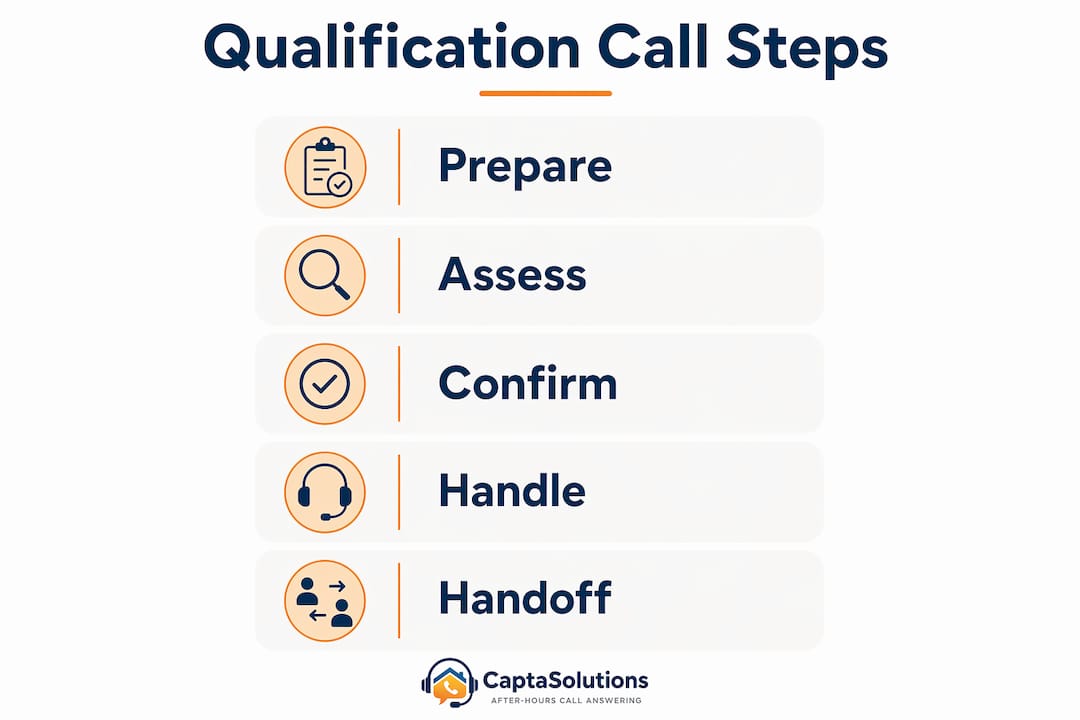
The most important discipline on a qualification call is to act as a gatekeeper, not a salesperson. Selling during a qualification call is one of the most common causes of unproductive meetings. When you start pitching, you create artificial enthusiasm in prospects who are not a genuine fit. They agree to a meeting to be polite, and then they do not convert.
Common pitfalls to avoid:
- Asking leading questions: "You'd want to reduce your costs, wouldn't you?" invites agreement rather than honest answers. Ask open questions instead.
- Skipping the authority check: Booking a meeting with someone who cannot make the decision is a guaranteed waste of time.
- Over-qualifying on the first call: Trying to complete a full discovery session in a 5-minute qualification call burns the prospect's patience and interest.
- Failing to set clear next steps: Every qualification call should end with a defined outcome. Either a meeting is booked, or the prospect is moved to a nurture sequence with a specific follow-up date.
A two-gate approach is the most effective structure. The first gate is a 5-minute fit and pain screen. The second gate is a 20–30 minute discovery call for prospects who pass the initial screen. This protects both your time and the prospect's, and it prevents the common mistake of trying to do too much in a single conversation.
Handling objections on a qualification call requires restraint. If a prospect raises a concern about price, your job is not to overcome it. Your job is to assess whether the concern disqualifies them. If it does, move on. If it does not, note it and pass it to the account executive as part of the handoff.
What role does pre-qualification and handoff play?
Pre-qualification begins before the call itself. A short confirmation message or intake form sent after a booking request filters out low-intent enquiries before they reach your calendar. Prospects who do not complete a basic form are unlikely to show up to a meeting.
The handoff between the person who qualifies the call and the person who conducts the sales meeting is where most pipelines leak. Poor handoff between SDR and account executive leads to wasted appointments because the sales representative enters the meeting without context. An appointment handover sheet solves this directly.
A well-structured handover sheet covers:
- The prospect's confirmed budget range and any stated constraints
- The name and role of the decision-maker on the call
- The specific pain point or problem they described
- Any objections raised during qualification
- The agreed next step and what the prospect expects from the meeting
| Handoff element | Why it matters |
|---|---|
| Pain point summary | Allows the account executive to open with relevance |
| Objections raised | Prevents the sales rep being caught off guard |
| Decision-maker confirmed | Confirms the right person will attend the meeting |
| Budget range noted | Sets realistic expectations before the meeting starts |
| Agreed next step | Aligns both parties on the purpose of the meeting |
The two-gate qualification model reinforces the handoff process. The first call produces the handover sheet. The second call, the discovery session, uses that sheet as its foundation. Sharing detailed handover sheets consistently produces better sales meetings because the account executive arrives prepared rather than starting from scratch.
Pre-call qualification also includes confirming the appointment 24 hours in advance. A simple confirmation message reduces no-shows and gives you early warning if a prospect has gone cold. For UK service businesses handling phone enquiry qualification, this step alone can recover a meaningful percentage of booked meetings that would otherwise be lost.
Key takeaways
Qualifying booking calls effectively requires applying consistent criteria, using the right tools, and maintaining a clean handoff process at every stage.
| Point | Details |
|---|---|
| Use a structured framework | BANT or MEDDIC applied consistently increases deal closure rates by 40–50%. |
| Keep qualification calls short | A 5-minute call focused on four questions is more effective than a long, unfocused conversation. |
| Act as a gatekeeper, not a salesperson | Pitching during qualification creates false positives and wastes sales capacity. |
| Use AI to qualify at speed | AI voice agents capture structured data instantly and route leads without delay. |
| Document and hand off properly | A detailed handover sheet prevents pipeline leakage between qualification and sales. |
Why I think most businesses are qualifying calls the wrong way
Most businesses I speak with treat qualification as a formality. They book the meeting first and ask the hard questions later, usually during the discovery call when it is too late to recover the time already spent. That approach is backwards.
The real purpose of a qualification call is to protect your most valuable resource, which is your sales team's time. Every unqualified meeting that makes it onto the calendar is a qualified meeting that did not. The opportunity cost is invisible, which is why it gets ignored.
AI has made this problem easier to solve and harder to excuse. AI-powered qualification removes the inconsistency that comes from human agents having good days and bad days. It applies the same criteria to every call, at any hour, without variation. The data it produces is auditable. You can see exactly where your qualification process is working and where it is not.
The mistake I see most often is treating AI as a replacement for judgement. It is not. AI handles the data capture and the initial screen. Human judgement decides what to do with the output. The businesses that get this right use AI to qualify faster and humans to qualify better. Those two things are not in conflict.
The other mistake is confusing a busy calendar with a productive pipeline. Lots of meetings is not the goal. Lots of the right meetings is. If your conversion rate from booked meeting to closed deal is low, the problem is almost certainly in your qualification process, not your sales technique.
— Daniel
Captasolutions: AI-powered call qualification for UK businesses
Every missed call is a missed opportunity. Captasolutions answers every inbound call in your business name, qualifies the enquiry using defined criteria, and organises the results into a clear client portal for you to review.
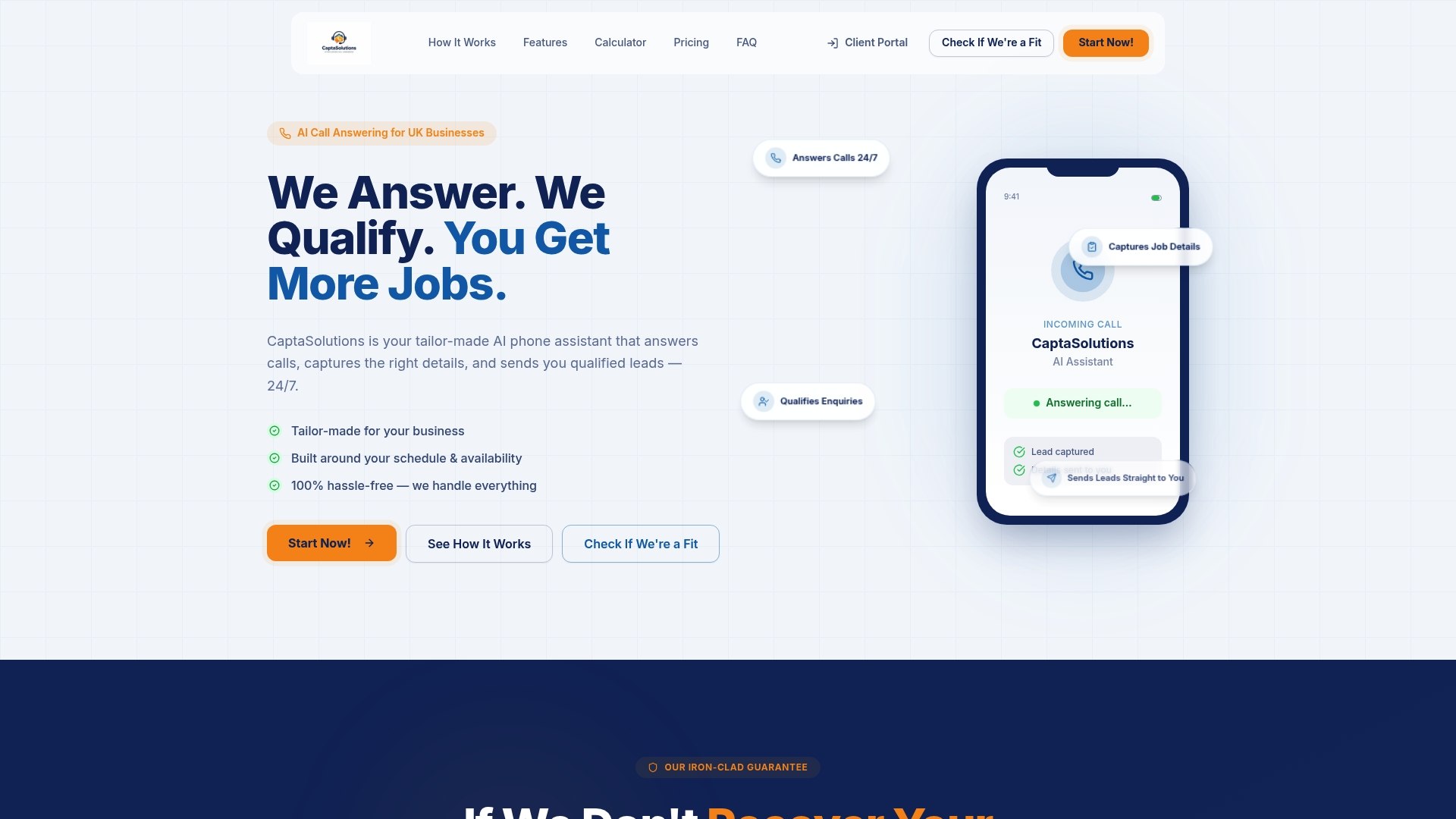
Whether you run a trades business, a clinic, a salon, or a professional office, Captasolutions captures the details that matter: the caller's need, their budget, their timeline, and their contact information. You decide which leads to pursue. The system runs 24 hours a day, 7 days a week, with no contract and no card required to start. Visit Captasolutions to begin your free 30-day trial and start qualifying every booking call from day one.
FAQ
What is the standard method for qualifying a booking call?
The most widely used method is the BANT framework, which assesses budget, authority, need, and timing. A well-run qualification call applies all four criteria in approximately 5 minutes.
How long should a qualification call last?
An effective qualification call lasts around 5 minutes. Longer calls risk over-qualification and reduce the prospect's willingness to engage in a follow-up discovery session.
What is the difference between lead scoring and lead qualification?
Lead scoring ranks prospects by engagement level. Lead qualification confirms whether a prospect meets the minimum criteria to proceed. Both are useful, but only qualification determines whether a meeting should be booked.
How does AI help with qualifying booking calls?
AI voice agents respond to inbound enquiries immediately, apply consistent qualification criteria, and capture structured data on fit and intent. This removes delays and human inconsistency from the call qualifying process.
Why do booked meetings fail to convert?
30% of booked meetings fail to convert because of poor qualification. The most common causes are booking prospects who lack authority, urgency, or genuine fit with the product or service on offer.