

Professional call handling is defined as the complete workflow from the moment a phone rings to the point where the caller's need is resolved, logged, and followed up. It goes well beyond simply picking up the phone. For service businesses across the UK, mastering how professional services handle calls is the difference between a booked client and a lost one. 80% of callers who reach voicemail do not leave a message and call a competitor instead. That single statistic defines the stakes.
How professional services handle calls: the core components
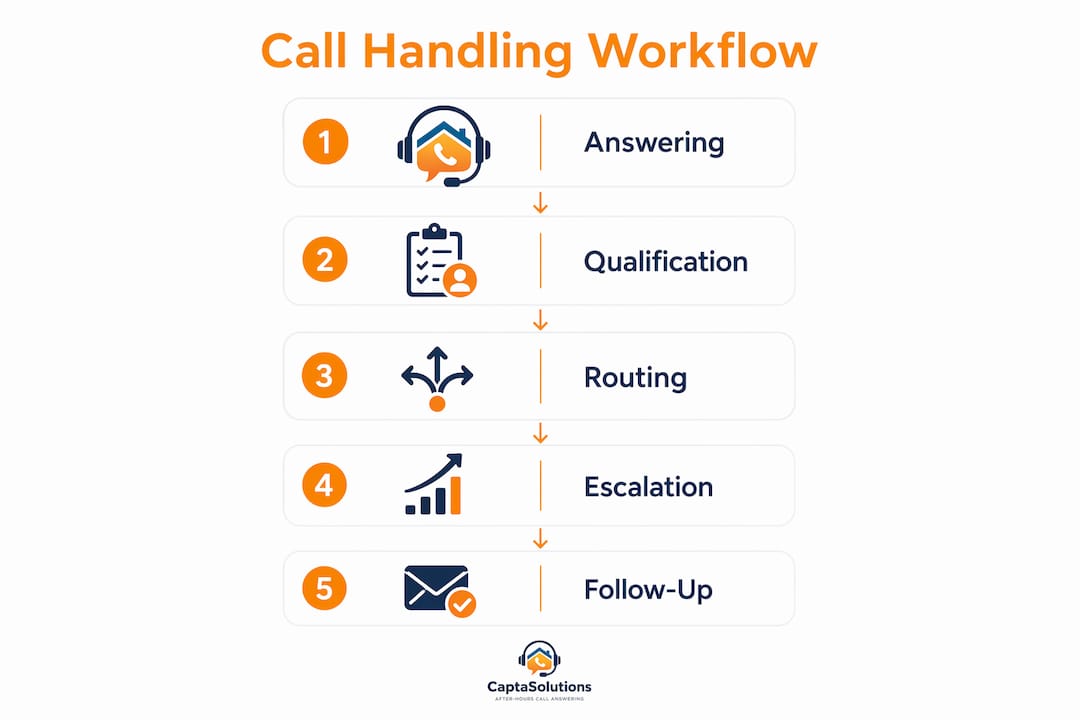
Call handling is the complete management of a call from the initial ring through to resolution, avoiding long holds or callbacks. The industry term for this end-to-end process is call flow management, and it covers intake, qualification, routing, escalation, and follow-up as a single connected sequence.
The core components of an effective call handling system are:
- Answer speed. Calls should be answered within 2–3 rings. Every additional ring increases the likelihood of abandonment.
- Needs identification. A structured opening question such as "How can I help you today?" combined with active listening allows the handler to qualify the enquiry within the first 30 seconds.
- Accurate routing. The caller reaches the right person or department on the first attempt. Misrouting is one of the leading causes of caller frustration in professional services.
- CRM logging. Every call outcome, including the caller's name, contact details, and the nature of the enquiry, is recorded automatically in a customer relationship management system such as Salesforce, HubSpot, or a sector-specific platform.
- Resolution or scheduling. The call ends with a clear next step: a booked appointment, a confirmed callback, or a resolved query. No caller should hang up without knowing what happens next.
Pro Tip: Map your call flow on paper before you configure any technology. Define who answers, who qualifies, who routes, and who follows up. Firms that define clear call flows before implementing technology report fewer integration problems and better CRM data quality.

How do AI and automation improve call handling workflows?
AI has changed professional call management more than any other technology in the past decade. An AI voice agent answers instantly, 24 hours a day, 7 days a week, with no hold time and no variability in tone or accuracy. For consultancies, legal practices, and financial services firms, this means no enquiry goes unanswered outside office hours.
The practical benefits break down into four areas:
- Instant response. AI answers on the first ring and begins qualifying the caller immediately, capturing name, contact number, and the nature of the enquiry without human intervention.
- Real-time appointment booking. The AI connects directly to a scheduling system such as Calendly or a practice management platform, confirming appointments without requiring a callback.
- Multi-touch confirmation sequences. Automated confirmations sent 48 hours, 24 hours, and 2 hours before an appointment reduce no-show rates by 30–50%. Recovering even a fraction of missed appointments has a direct impact on monthly revenue.
- Concurrent call handling. During peak periods, AI handles multiple calls simultaneously, completing intake, qualification, booking, and CRM logging faster than a human receptionist can manage a single call.
"Successful firms don't treat call handling as an administrative task. They treat it as a revenue workflow. AI is the engine that makes that workflow run at scale." — CoreiBytes Blog
This frees human staff to focus on complex, high-value interactions: the client who needs reassurance, the escalated complaint, the nuanced consultation. AI handles volume. People handle judgement.
For a closer look at how this works in practice, the guide on AI answering booking calls covers the mechanics in detail.
What best practices do professional call handlers follow?
Quality call handling is not about following a rigid script. Flexible branching logic structured guides outperform rigid, robot-like scripts because they allow the handler to adapt to the caller's tone, pace, and specific need while maintaining a consistent professional standard.
The best practices that consistently separate high-performing call handlers from average ones are:
- Tone and pacing control. Voice communication relies heavily on tone and timing. Handlers should slow their pacing by 10% during escalated calls. This single adjustment reduces caller tension and improves the perception of competence.
- Searchable knowledge bases. Documenting common FAQs in a searchable internal knowledge base reduces hold times and allows junior staff or AI systems to resolve enquiries without escalation. It cuts the frequency of "let me just check on that" moments, which erode caller confidence.
- Documented escalation paths. Every call flow needs a defined escalation route. If the handler cannot resolve the issue, the caller should be transferred once, to the right person, with context already communicated.
- Post-call follow-up procedures. A call is not complete until the outcome is logged and any promised action is taken. This includes sending a confirmation email, updating the CRM record, or scheduling a callback. The guide on post-call follow-up outlines how to build this into daily operations.
Pro Tip: Train staff and AI systems on your top 20 most frequently asked questions before going live. Resolving these without a transfer or hold is the fastest way to improve caller satisfaction scores.
The call handling workflow includes intake, routing, qualification, escalation, and follow-up, supported by decision logic and scripts that maintain consistency under high call loads. Consistency is what makes a call handling system scalable.
How can professional services measure call handling effectiveness?
Measurement turns call handling from a gut-feel operation into a managed process. The metrics that matter most for professional services firms are:
| Metric | What it measures | Why it matters |
|---|---|---|
| Answer time | Seconds from first ring to pickup | Directly linked to caller abandonment rates |
| First-contact resolution rate | % of calls resolved without a callback | Indicates handler competence and knowledge base quality |
| Appointment booking rate | % of enquiry calls that result in a booking | Measures commercial conversion from inbound calls |
| No-show rate | % of booked appointments not attended | Reflects confirmation sequence effectiveness |
| Caller satisfaction score | Post-call survey rating | Tracks perceived quality of the interaction |
Call recording and transcription tools such as Gong, Chorus, or built-in AI call logging provide the raw material for quality assurance reviews. Listening back to calls reveals patterns that no dashboard can surface: the moment a handler loses control of a difficult conversation, the FAQ that keeps recurring, the routing error that happens every Friday afternoon.
CRM analytics add a second layer. When call data feeds into a platform such as HubSpot or Salesforce, you can identify which call sources convert to paying clients, which enquiry types take longest to resolve, and where bottlenecks sit in the workflow. That data drives targeted training and process improvement.
How do professional services handle calls out of hours?
Out-of-hours call handling is where most professional services firms lose the most revenue. A potential client calls at 7pm, reaches voicemail, and books with a competitor by 7:15pm. The solution is not to ask staff to work longer hours. It is to build a system that never stops.
The strategies that work in practice are:
- AI answering services. An AI voice agent answers every call in the business name, qualifies the enquiry, and logs the details to a client portal. The business owner reviews leads the next morning and decides which to pursue.
- On-call routing rules. For urgent matters, calls can be routed to a designated on-call member of staff via a mobile number. This is common in legal, medical, and facilities management sectors.
- Automated alerts for urgent enquiries. When an AI system identifies a high-priority caller, it sends an immediate SMS or email alert to the relevant staff member. The staff member decides whether to call back immediately or the following morning.
- Voicemail with guaranteed callback windows. If live answering is not possible, a professional voicemail message that commits to a specific callback window (for example, "within two business hours") retains more callers than a generic message.
For UK businesses that operate across extended hours, the guide on answering calls during business hours covers scheduling and routing in detail. The same principles apply to out-of-hours coverage with an AI layer added.
Key takeaways
Effective call handling in professional services is a structured workflow combining prompt answering, AI qualification, CRM integration, and consistent follow-up to convert every inbound call into a resolved outcome.
| Point | Details |
|---|---|
| Answer speed is non-negotiable | Calls answered within 2–3 rings prevent abandonment and competitor loss. |
| AI handles volume at scale | AI voice agents answer concurrently, book appointments, and log outcomes faster than human staff. |
| Flexible scripts outperform rigid ones | Branching logic guides allow natural conversations while maintaining professional consistency. |
| Measurement drives improvement | Tracking answer time, first-contact resolution, and no-show rates identifies where the workflow breaks down. |
| Out-of-hours coverage protects revenue | AI answering services and on-call routing prevent missed opportunities beyond normal office hours. |
What I have learned from watching firms get this wrong
The most common mistake I see professional services firms make is treating call handling as a staffing problem rather than a systems problem. They hire another receptionist, the volume increases, and the same issues reappear at a higher cost. The firms that get it right build the workflow first and staff it second.
The second mistake is underestimating tone. Technology can handle volume, but it cannot fully replace the moment when a caller is frustrated and needs to feel heard. Slowing your pace, using the caller's name, and acknowledging the problem before offering a solution are not soft skills. They are measurable techniques that change call outcomes. The research on de-escalation in calls is clear on this point.
What I find genuinely interesting about 2026 is the convergence of AI and human judgement in call handling. The best systems I have seen do not replace human handlers. They remove the low-value, high-volume work so that human handlers can do what they are actually good at: building trust with a client who is uncertain, managing a complaint with real empathy, and making a judgement call that no script can anticipate.
The firms that will handle calls best in the next three years are the ones that invest in both sides of that equation. Build the AI infrastructure. Train the humans. Measure everything.
— Daniel
How Captasolutions supports professional call management
Captasolutions is an AI-powered call answering service built specifically for UK businesses that cannot afford to miss a call. Whether your team is on-site, in service, or simply closed for the evening, Captasolutions answers every call in your business name, qualifies the enquiry, and organises every lead into a clean client portal.
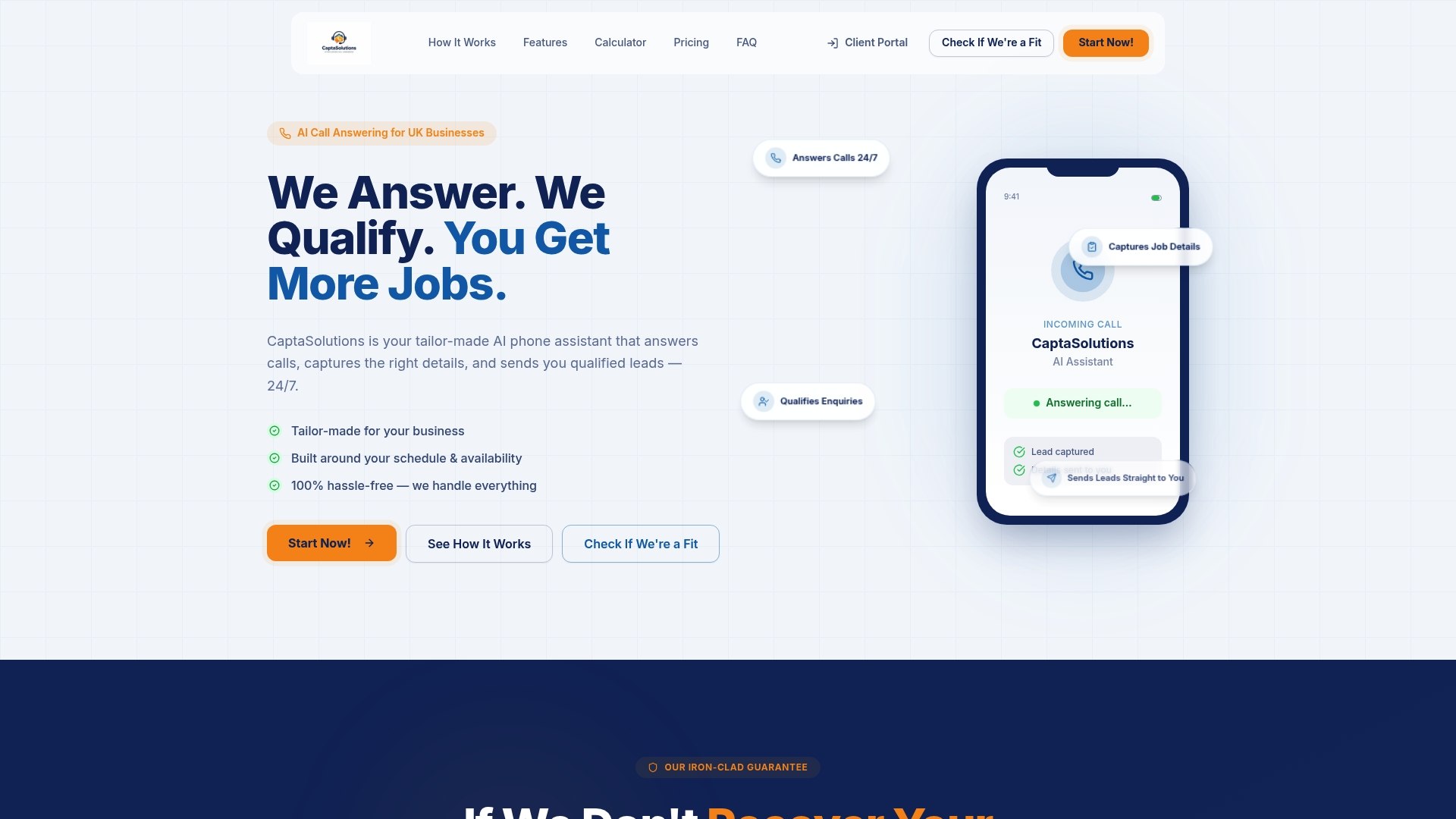
The service covers 24/7 call answering, real-time lead qualification, and CRM-ready call logging with no contract and no setup complexity. You can be live within the hour and start your free 30-day trial today, with no card required. For businesses that want to put the best practices in this article to work immediately, Captasolutions provides the infrastructure to do exactly that.
FAQ
What is call handling in professional services?
Call handling in professional services is the end-to-end management of an inbound call, covering answering, needs qualification, routing, resolution, and CRM logging. Effective call handling resolves the caller's need within 90 seconds of pickup.
How does AI improve call handling for service businesses?
AI answers calls instantly, qualifies enquiries, books appointments in real time, and logs outcomes to a CRM without human intervention. Multi-touch confirmation sequences delivered by AI reduce no-show rates by 30–50%.
What is the most important metric for call handling performance?
First-contact resolution rate is the single most telling metric. It measures the percentage of calls resolved without a callback or transfer, reflecting both handler competence and the quality of the supporting knowledge base.
How should professional services handle difficult or escalated calls?
Handlers should slow their speech pace, acknowledge the caller's concern directly, and follow a documented escalation path. Slowing pacing by 10% during tense calls measurably reduces caller frustration and improves resolution outcomes.
How can small professional firms cover calls out of hours?
An AI answering service covers out-of-hours calls by answering in the business name, capturing caller details, and alerting the relevant staff member for urgent matters. This prevents missed opportunities without requiring staff to work extended hours.