

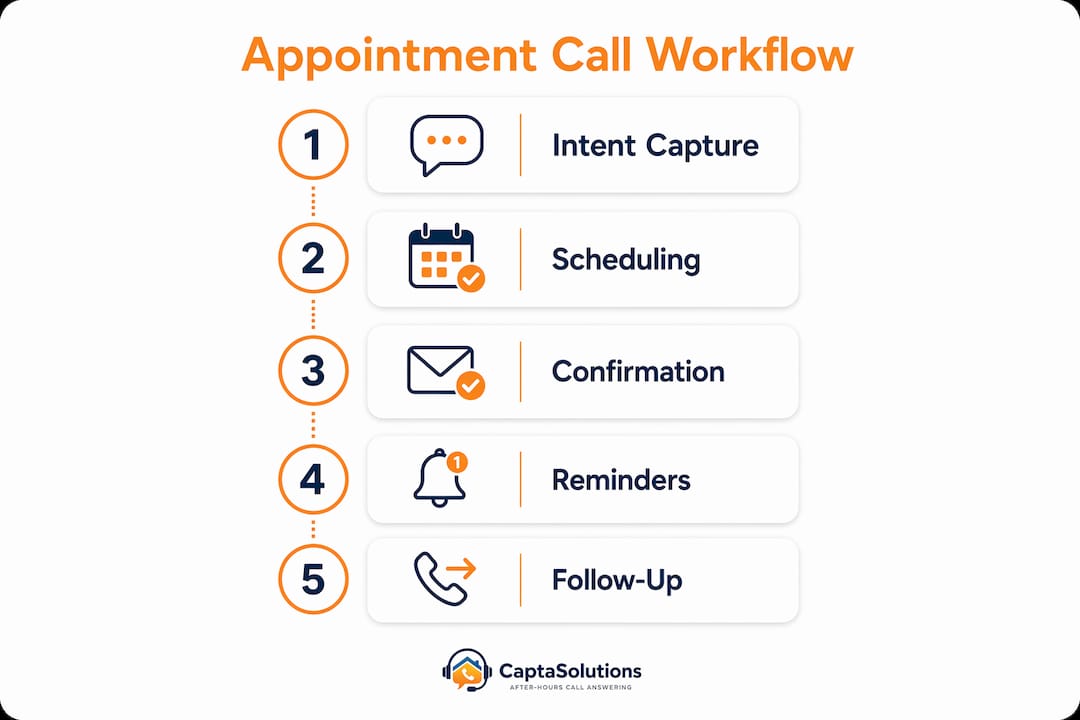
Appointment call organisation is defined as the structured process of managing incoming client calls from first contact through to confirmed booking, all within a single interaction. For UK business owners, getting this process right is the difference between a full diary and a string of missed opportunities. The appointment scheduling process follows five core stages: intent capture, scheduling, confirmation, reminders, and rescheduling. Each stage reduces manual coordination, prevents errors, and keeps clients moving towards a confirmed appointment. When these stages work together, businesses spend less time chasing bookings and more time delivering their service.
How appointment calls are organised: the core workflow
Effective call organisation follows a clear sequence. Each step builds on the last, and skipping any one of them creates gaps that lead to lost bookings or frustrated clients.
-
Greeting and intent capture. The call opens with a professional greeting that immediately identifies the business. The caller's name, contact number, and reason for calling are captured within the first 15 seconds. This sets the tone and gives the handler everything needed to move forward.
-
Caller qualification. This is where most businesses underinvest. Qualification frameworks like BANT (Budget, Authority, Need, Timeline) help identify decision-ready prospects before a slot is offered. A caller who needs a quote for next week is a different conversation from one who is browsing options for six months' time.
-
Real-time slot offering. Once the caller's needs are clear, available slots are offered from a live calendar. The handler never guesses at availability. Real-time access prevents the back-and-forth that frustrates callers and wastes staff time.
-
Booking confirmation. The appointment is confirmed verbally and a written confirmation is sent immediately by SMS or email. The caller leaves the call with certainty, not a vague promise.
-
Reminders and follow-up. Automated reminders sent before the appointment reduce no-shows significantly. A follow-up after the appointment builds the relationship and opens the door to repeat bookings.
Efficient workflows complete this entire sequence, from greeting to confirmation, in 60–90 seconds. That speed is only possible when each step is scripted, practised, and supported by the right tools.
Pro Tip: Write a call script for each service you offer. A script does not make calls robotic. It removes hesitation, keeps the call on track, and means any member of your team can handle bookings confidently.

How does technology improve the appointment scheduling process?
Automation does not replace good call handling. It removes the parts of the process that are repetitive, error-prone, and time-consuming, so your team can focus on the conversation.
- 24/7 AI voice agents. An AI-powered call answering service handles calls outside business hours, at weekends, and during busy periods when staff cannot pick up. Every call is answered in your business name, every enquiry is captured, and no caller is left waiting.
- Two-way calendar synchronisation. Modern scheduling tools connect directly with Google Calendar, Outlook, and most CRM platforms. Two-way calendar sync means availability updates in real time across every channel, preventing double-bookings automatically.
- Automated SMS and email reminders. Reminder systems sent before appointments reduce no-shows by up to 90%. That figure represents a significant recovery of revenue that would otherwise be lost to empty slots.
- Easy rescheduling pathways. When a client needs to change their appointment, a simple link in the reminder message lets them reschedule without calling back. This reduces inbound call volume and keeps your diary accurate.
- Quick setup. Basic calendar connection and availability rules for most scheduling systems take under 30 minutes to configure. There is no reason to delay implementation waiting for a complex IT project.
"Conversational booking remains the best approach for clients with questions or complex needs. Booking links suit low-intent self-schedulers, but a phone conversation with a qualified handler produces higher-quality appointments and better lead qualification."
The key is maintaining a natural, conversational tone even when automation handles the call. Callers should feel they are speaking with a knowledgeable representative of your business, not navigating a phone tree.
What are the common challenges in organising appointment calls?
Every business that handles bookings by phone faces the same set of problems. Recognising them is the first step to fixing them.
- Double-bookings. These happen when two channels offer the same slot simultaneously. A soft hold mechanism locks a proposed time slot during a live conversation for 30–90 seconds, preventing another booking from taking it before the call ends. Without this, race conditions between your website booking form and your phone line create conflicts.
- Complex client needs. Some callers cannot self-serve. They have questions, specific requirements, or need reassurance before committing. Conversational booking systems handle these callers far better than a static booking link, because they can qualify needs and adapt the conversation in real time.
- No-shows. A confirmed booking is not a guaranteed attendance. Double-confirmation protocols, where the client confirms both at booking and again 24 hours before, produce show rates of 70–80%. Personalised follow-ups that verify the client's needs and commitment add another layer of reliability.
- Inconsistent call handling. When different staff members handle calls differently, the quality of bookings varies. Standardised call scripts and qualification frameworks remove this inconsistency. Every caller gets the same professional experience regardless of who answers.
Pro Tip: Record a sample of your booking calls each month and review them as a team. You will quickly identify where callers are dropping off, where the script needs adjusting, and where staff need additional support.
Best practices for UK businesses managing appointment calls
The businesses that handle appointment calls most effectively share a set of common habits. These are not complicated. They are consistent.
- Use standardised call scripts. A script adapted to each service you offer keeps calls focused and ensures qualification happens on every call. Scripts also reduce training time for new staff.
- Send multi-channel notifications. SMS open rates are significantly higher than email. Send both. A client who misses the email will likely see the text. Redundancy in reminders is not excessive; it is good practice.
- Adopt scheduling tools with easy integration. The best tools connect to your existing calendar and CRM without requiring technical expertise. If setup takes more than an afternoon, the tool is too complex for most small businesses.
- Monitor your booking data. Track call volume by time of day, booking conversion rate, and no-show rate. These three numbers tell you where your process is working and where it is not.
- Prioritise call quality over call speed. A call that qualifies the client properly and confirms the booking clearly is worth more than a fast call that leaves the client uncertain.
The table below shows how different approaches to effective call organisation compare across key performance areas.
| Approach | Qualification | No-show risk | Setup complexity |
|---|---|---|---|
| Manual phone handling only | Variable | High | Low |
| Online booking link only | Low | Medium | Low |
| Automated AI call answering | Consistent | Low | Low |
| Combined phone and automation | High | Very low | Medium |
The combined approach consistently outperforms single-channel methods. It captures callers who prefer to speak with someone while also handling out-of-hours enquiries automatically.
Key takeaways
Organised appointment calls follow a five-stage workflow that, when supported by automation and consistent call scripts, reduces no-shows, prevents double-bookings, and converts more enquiries into confirmed appointments.
| Point | Details |
|---|---|
| Five-stage workflow | Every call should move through intent capture, scheduling, confirmation, reminders, and follow-up. |
| Qualification matters | Use a framework like BANT to ensure you book only decision-ready clients. |
| Soft hold prevents double-bookings | Lock proposed slots for 30–90 seconds during live calls to stop race conditions across channels. |
| Reminders cut no-shows | Automated SMS and email reminders can reduce no-shows by up to 90%. |
| Automation and conversation work together | AI call answering handles volume; conversational qualification handles quality. |
Why most businesses get appointment call organisation wrong
The most common mistake I see UK businesses make is treating appointment call organisation as a phone manner problem. They invest in training staff to sound friendly, but they never fix the underlying process. A warm greeting does not prevent a double-booking. A polite tone does not reduce no-shows.
The businesses that genuinely improve their booking rates do two things differently. First, they treat every call as a qualification opportunity, not just a scheduling task. Second, they use automation to handle the parts of the process that do not require human judgement, freeing their team for the conversations that do.
The other pitfall I see regularly is the assumption that a booking link replaces a phone call. It does not. Booking links work well for clients who already know what they want. For everyone else, a phone conversation with a knowledgeable handler produces a better outcome. The businesses that offer both, and route callers appropriately, consistently outperform those that rely on one channel alone.
The future of appointment scheduling sits firmly in AI-assisted call handling. Not because AI replaces the human element, but because it makes consistent, professional call handling available at any hour, for any volume of calls. The businesses adopting this now are building a structural advantage over those still relying entirely on staff availability.
— Daniel
How Captasolutions supports UK businesses with appointment calls
Captasolutions is built for UK businesses that cannot afford to let calls go unanswered.
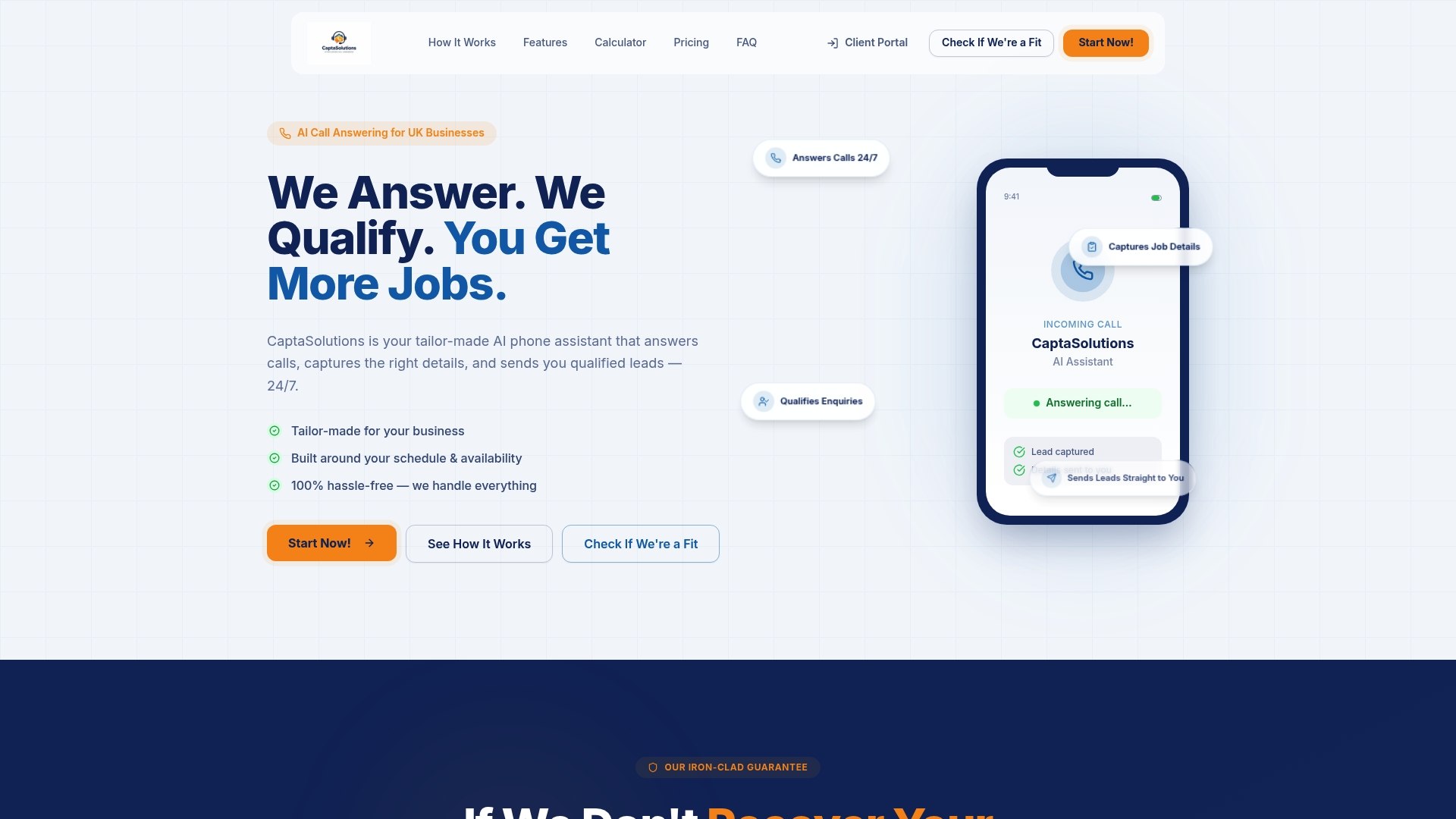
The Captasolutions AI answers every call in your business name, 24 hours a day, seven days a week. It captures caller details, qualifies the enquiry, and organises everything into your client portal so you can review every lead and decide what to take on. Calendar integration means bookings are confirmed in real time, and automated reminders reduce no-shows without any manual effort from your team. Setup takes under an hour, with no contract and no card required for the free 30-day trial. Whether you run a trades business, a salon, a clinic, or a professional office, Captasolutions handles the calls so your team can focus on the work.
FAQ
How are appointment calls typically organised?
Appointment calls follow a five-stage process: intent capture, scheduling, confirmation, reminders, and follow-up. Efficient workflows complete this sequence from greeting to confirmation in 60–90 seconds.
What is a soft hold in appointment scheduling?
A soft hold locks a proposed time slot during a live call for 30–90 seconds, preventing another booking from taking the same slot before the conversation ends. This stops double-bookings across multiple channels.
How can UK businesses reduce appointment no-shows?
Automated SMS and email reminders sent before appointments reduce no-shows by up to 90%. Double-confirmation protocols, where clients confirm at booking and again 24 hours before, produce show rates of 70–80%.
When should a business use a booking link versus a phone call?
Booking links suit clients who know exactly what they want and are ready to self-schedule. Phone calls with a qualified handler are better for clients with questions, complex needs, or who require reassurance before committing.
How quickly can appointment scheduling automation be set up?
Basic calendar connection and availability rules for most scheduling systems take under 30 minutes to configure. AI-powered call answering services like Captasolutions can be live within the hour.