

A business call management workflow is the system that organises how incoming calls are received, routed, handled, and recorded to improve customer outcomes and business results. Without a defined workflow, calls fall through the cracks, leads go cold, and customers move on to a competitor who picks up. Effective call management orchestrates people, processes, and technology into one aligned system rather than leaving each call to chance. For small UK businesses, this is not a luxury. It is the difference between a full diary and a missed opportunity.
What components make up an effective business call management workflow?
A call management system encompasses call initiation, routing, handling with CRM integration, resolution, and logging. Each stage serves a specific purpose, and a gap in any one of them costs you leads. The industry term for the full process is inbound call workflow, though "business call management workflow" describes the same concept from a business owner's perspective.

The seven core stages
Every effective workflow moves through these stages:
- Entry: The call arrives via your main business number or a tracked campaign line.
- Qualification: An automated greeting or IVR (interactive voice response) identifies the caller's need.
- Routing: The call goes to the right person, team, or voicemail based on rules you set.
- Escalation: Unanswered or complex calls move to a fallback option, such as a callback queue.
- Resolution: The caller gets what they need, whether that is a booking, a quote, or an answer.
- Data capture: Call details, caller information, and outcome are logged automatically.
- Post-interaction automation: Follow-up messages, CRM updates, or task assignments trigger without manual input.
Tools that support each stage
The table below maps key feature categories to their function in a small business call workflow.
| Feature category | Function in the workflow |
|---|---|
| Skill-based routing | Sends calls to the most qualified available person |
| IVR / auto-attendant | Qualifies callers and reduces misdirected calls |
| Callback queue management | Holds caller intent without keeping them on hold |
| CRM integration | Logs call data and links it to the customer record |
| SMS follow-up automation | Recovers missed leads within seconds of a missed call |
| Call recording and transcription | Supports quality review and staff coaching |
| Call tracking numbers | Measures which marketing channels drive inbound calls |
Pro Tip: Align every tool you add to a specific stage in your workflow. If you cannot name which stage a tool serves, you do not need it yet.
How do you design a call management workflow step by step?
Building a call workflow is a structured process. Skipping steps creates the same gaps you were trying to close.
Step-by-step implementation
-
Map your current call flow. Write down what actually happens when a call arrives today. Note where calls are missed, transferred incorrectly, or left unresolved.
-
Define your routing rules. Set logic based on skill, language, time of day, and caller priority. A plumber taking a call mid-job needs a different rule set than a clinic receptionist.
-
Set up callback options and queue management. Offering callback options when queues are full reduces call abandonment by approximately 33%. That is one in three callers you would otherwise lose permanently.
-
Automate SMS follow-ups for missed calls. Automated SMS follow-ups recover 30–40% of lost leads within 60 seconds of a missed call. For a busy tradesperson or salon, this single step can reclaim a significant portion of weekly revenue.
-
Integrate with your CRM. Every call outcome should write automatically to your customer record. Manual logging is slow and error-prone.
-
Monitor metrics and fix bottlenecks. Track abandonment rate, average handle time, first-call resolution, and missed call rate. Fix the worst bottleneck first, then move to the next.
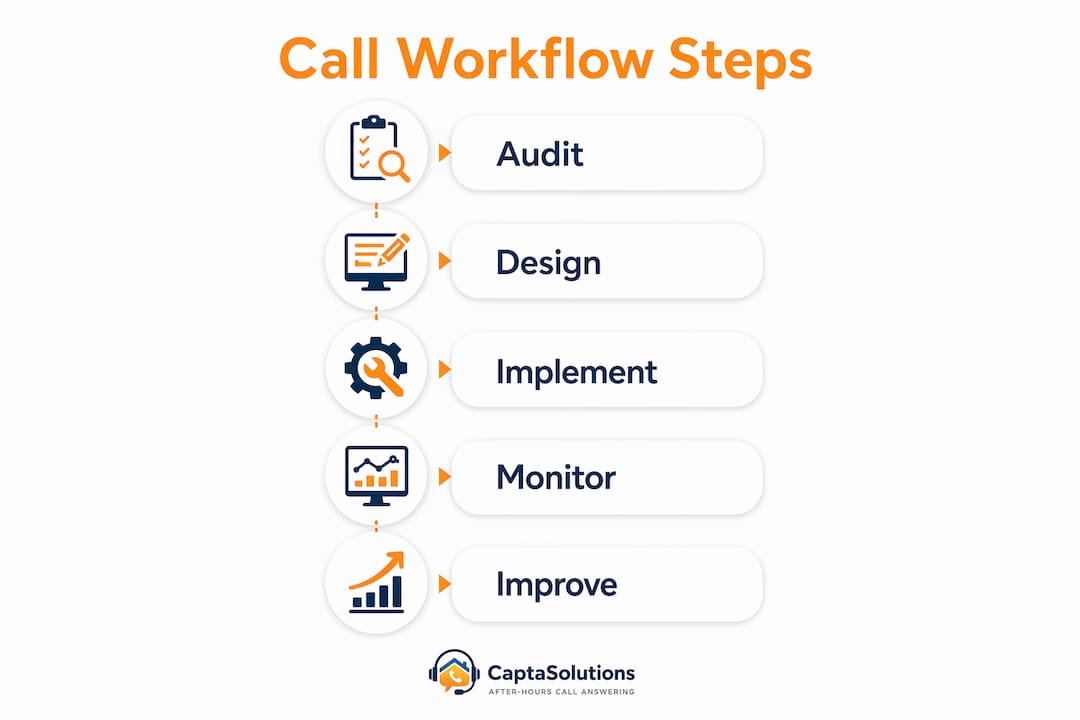
The table below summarises each phase and what you should expect from it.
| Phase | Action | Expected outcome |
|---|---|---|
| Audit | Map existing call flow | Identify gaps and missed call patterns |
| Design | Set routing and IVR rules | Fewer misdirected and unanswered calls |
| Automation | Add callbacks and SMS follow-ups | Reduced abandonment and lead recovery |
| Integration | Connect CRM and logging | Accurate data and faster post-call tasks |
| Optimisation | Review metrics and adjust | Continuous improvement in call efficiency |
Pro Tip: Start with a paper map of your call flow before touching any software. Business owners who skip this step build automation on top of a broken process.
For a deeper look at how professional service businesses handle this in practice, the call handling guide for professionals covers real-world routing decisions in detail.
What mistakes should small businesses avoid in call management?
Poor call workflow design costs money quietly. The errors are rarely dramatic. They accumulate as missed calls, frustrated callers, and lost bookings.
-
Static IVR menus that never change. An IVR set up once and forgotten does not reflect seasonal demand, new services, or changed opening hours. Callers hit dead ends and hang up.
-
Ignoring skill-based routing. Sending every call to the same person or number ignores the fact that different callers need different responses. A high-value client calling about a large contract should not wait behind a general enquiry.
-
Replacing your main business number with a tracking number. Changing your main number on your Google Business Profile harms local SEO. Tracking numbers belong on paid ads and dynamically swapped website content only. Your NAP (name, address, phone) must stay consistent across all directories.
-
Delayed or absent follow-up. A missed call with no follow-up is a lost lead. Most callers will not ring back. The window to recover them closes within minutes.
-
Manual post-call processing. Asking staff to log calls, update records, and send follow-ups by hand creates delays and mistakes. Automation handles this faster and more accurately.
Pro Tip: Keep your primary business number fixed on Google Business Profile, Yell, and Checkatrade. Use dynamic number insertion only on your website and paid ad landing pages to protect your local search ranking.
How can small businesses continuously improve their call workflow?
A call workflow is not a one-time setup. Treating it as a living map and adjusting routing based on real-time data keeps it performing as your business grows.
Use data to find what is breaking
Real-time analytics show you where calls are dropping, which agents are overloaded, and which times of day generate the most missed calls. Historical data reveals patterns, such as a spike in calls every monday morning or a drop in resolution rates on friday afternoons. Both tell you where to act.
Build a coaching cycle from recorded calls
Call recording and transcriptions allow managers to review performance and improve coaching. A 15-minute weekly review of three recorded calls gives a small team more useful feedback than a quarterly appraisal. The goal is not surveillance. It is identifying the specific moments where calls go wrong and fixing them.
Adjust for seasonal and campaign demand
A roofing company in october handles a different call volume than in march. A restaurant running a Valentine's Day promotion needs different routing than on a standard tuesday. Build seasonal adjustments into your routing rules before demand peaks, not after.
Automate repetitive tasks to free up your team
Every task your team does manually after a call is a task that could trigger automatically. CRM updates, appointment confirmations, quote request acknowledgements, and review requests all fit into post-call automation. The result is faster customer call handling and a team that spends time on work that actually requires human judgement.
Key takeaways
A well-designed business call management workflow is revenue architecture. It determines how many leads you capture, how fast you respond, and how many callers become paying customers.
| Point | Details |
|---|---|
| Define all seven stages | Map entry through post-interaction automation before choosing any tools. |
| Use callback and SMS automation | Callbacks cut abandonment by 33%; SMS follow-ups recover 30–40% of missed leads. |
| Protect your local SEO | Keep your main number consistent on Google Business Profile; use tracking numbers only on ads. |
| Treat the workflow as a living system | Adjust routing rules using real-time data and seasonal demand shifts. |
| Build a coaching cycle | Weekly review of recorded calls improves team performance faster than annual appraisals. |
Why call workflow is revenue architecture, not a tech project
I have worked with enough small UK businesses to know that most call management problems are not technology problems. They are process problems wearing a technology costume. A business owner buys a phone system with IVR, sets it up once, and assumes the work is done. Six months later, callers are still hanging up, leads are still going cold, and the owner blames the software.
The real issue is that the workflow was never designed around the customer's journey. It was designed around what was easy to configure. Those are very different things.
The businesses that get this right treat their call workflow the same way they treat their pricing or their service delivery. They review it regularly. They ask why calls are being missed. They test different routing rules. They look at the data. A call answering strategy tied to revenue is not about having the most features. It is about having the right process for your specific business and your specific callers.
Small teams also face a constraint that large call centres do not: you cannot staff for every scenario. That is where AI-powered answering fills the gap. Not as a replacement for human judgement, but as a first line that captures every call, qualifies the enquiry, and makes sure nothing is lost while you are on a job, with a client, or closed for the evening.
The businesses I see struggle most are the ones waiting for the perfect setup before they start. The ones that improve fastest start with a basic map, automate one thing, measure it, and move on to the next. Iteration beats perfection every time.
— Daniel
How Captasolutions supports your call management workflow
Managing every inbound call consistently is difficult when you are running a small business. Captasolutions is an AI-powered call answering service built for UK businesses that cannot afford to miss a call.
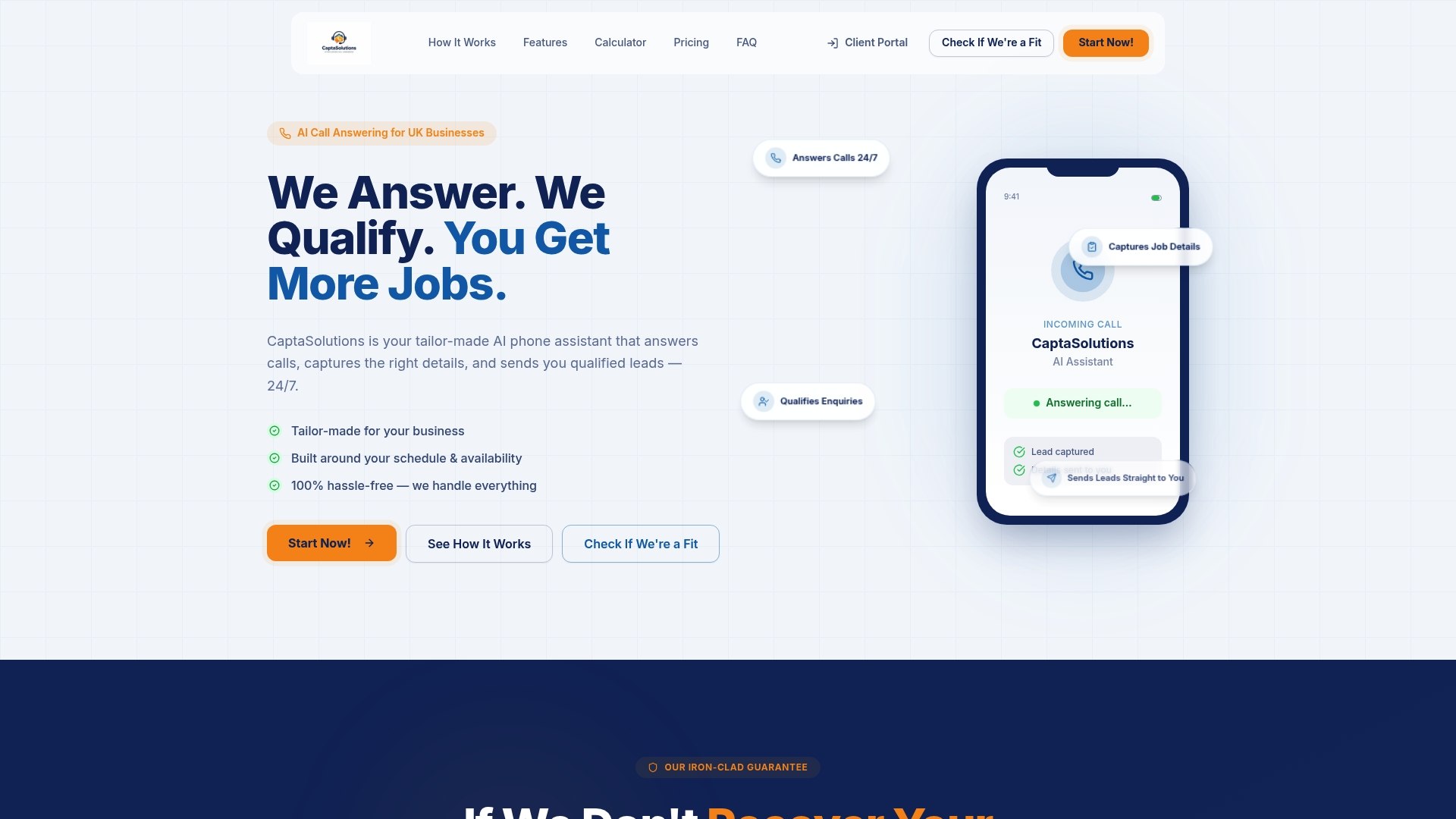
Captasolutions answers every call in your business name, 24 hours a day, 7 days a week. It captures caller details, qualifies the enquiry, and organises everything into your client portal so you can review and act on every lead. Whether you are a tradesperson mid-job, a salon with a client in the chair, or a clinic after hours, every call is handled professionally. There is no contract, no card required, and you can be live within the hour. Start your free 30-day trial at captasolutions.co.uk or call 07346 811329 today.
FAQ
What is a business call management workflow?
A business call management workflow is the defined process that governs how incoming calls are received, routed, handled, logged, and followed up. It covers every stage from the first ring to the post-call action.
How does call routing improve customer experience?
Skill-based routing sends callers to the most qualified person available, reducing transfer rates and resolution time. Callers reach the right person faster, which directly improves satisfaction.
Can SMS automation really recover missed leads?
Automated SMS follow-ups recover 30–40% of lost leads within 60 seconds of a missed call. For small businesses, this is one of the highest-return actions available in any call workflow.
Will using call tracking numbers hurt my Google ranking?
Using a tracking number as your primary listed number on Google Business Profile can harm local SEO. Keep your main number consistent across all directories and use tracking numbers only on paid ads and dynamically swapped website pages.
How often should I review my call management workflow?
Review your workflow at least once per quarter, and after any significant change in call volume, staffing, or marketing activity. Real-time analytics make it possible to spot problems and adjust routing without waiting for a scheduled review.