

UK professional office calls are defined as the various categories of business telephone communications used to manage client enquiries, sales, support, and internal coordination. Understanding the types of UK professional office calls your business relies on is the first step to building a phone system that actually works. Whether you run a legal practice, a financial advisory firm, or a busy trade office, the wrong call setup costs you clients. Modern telephony, including AI-powered call answering, GDPR-compliant recording, and cloud-based distribution, has made it possible for businesses of any size to handle every call professionally and efficiently.
1. What are the types of UK professional office calls?
Professional office calls fall into four broad categories: inbound, outbound, automated, and distributed. Each category serves a distinct function. Inbound calls come from clients or prospects contacting your business. Outbound calls are initiated by your team. Automated calls use AI or pre-recorded systems to handle volume. Distributed calls are routed across teams using ring groups, hunt groups, or call queues.
Most UK offices rely on a mix of all four. A solicitor's office, for example, receives inbound enquiries, makes outbound follow-up calls, uses call queues during busy periods, and increasingly deploys AI receptionists to handle out-of-hours contact. Knowing which call type fits which scenario is the foundation of effective office communication.

2. Inbound calls: how UK businesses manage incoming contact
Inbound calls are calls received from clients, prospects, or suppliers. They are the most common type of professional phone call in UK offices and cover general enquiries, appointment bookings, complaints, and support requests.
UK businesses manage inbound calls through several methods:
- Live receptionists answer and route calls manually, providing a personal touch suited to high-value client relationships.
- Automated attendants use pre-recorded menus to direct callers to the right department.
- AI receptionists handle FAQs, capture caller details, and qualify leads without human intervention.
- Call queues hold callers in a waiting line with music and position announcements during peak periods.
Compliance is a critical factor for inbound call handling. UK law firms must retain call recordings for 6 months for general enquiries, 6 years for client matter updates, and up to 15 years for conveyancing files under 2026 SRA guidance. Voicemail-to-email transcriptions must be encrypted in transit and at rest. That level of data handling requires a phone system built for compliance, not a basic consumer VoIP account.
Financial and legal offices face a specific risk: standard PBX reporting often omits ring group transfers and parked call logs, which means billable client phone time goes unrecorded. Verifying that your system captures and exports all billable minutes before purchase is not optional for professional firms.
Pro Tip: Before signing a VoIP contract, ask the provider to demonstrate how ring group calls, transferred calls, and parked calls appear in the call log. If they cannot show you a complete record, the system will cost you billable time.
3. Outbound calls: purposes and compliance in UK offices
Outbound calls are initiated by your business and serve a wide range of professional purposes. The most common outbound call types in UK offices include:
- Lead follow-up calls to prospects who have submitted an enquiry or requested a callback.
- Appointment reminders to reduce no-shows in medical, legal, and service businesses.
- Payment chasing calls to recover outstanding invoices from clients.
- Client satisfaction surveys to gather feedback after a service has been delivered.
- Account management calls to maintain relationships with existing clients.
Outbound calling in the UK carries specific compliance obligations. Businesses must check numbers against the Telephone Preference Service (TPS) register before making unsolicited calls. GDPR also requires a lawful basis for processing the personal data used to make the call. Failing either check exposes your business to ICO enforcement action.
AI voice agents are changing how UK businesses handle outbound volume. AI voice agents provide both inbound and proactive outbound calling capabilities, unlike AI receptionists which handle inbound calls only. That distinction matters when you are deciding which technology to invest in. An AI voice agent can chase payment reminders or confirm appointments at scale, freeing your team for higher-value work.
4. Call distribution models used in UK professional offices
Call distribution determines how incoming calls reach the right person. Three models dominate UK professional offices: ring groups, hunt groups, and call queues. Each suits different team sizes and call volumes.
Ring groups cause all phones to ring simultaneously, making them well suited to small sales teams where any available person can answer. The downside is office noise and confusion when multiple staff reach for the phone at the same time. Hunt groups ring phones sequentially or in a round-robin pattern, distributing calls more evenly and reducing that confusion. They do increase caller wait time slightly, but the trade-off is usually worth it for teams of four or more.
Call queues are the most sophisticated option. They hold callers with waiting music and queue position announcements, which significantly improves the caller experience during busy periods. Most UK hosted VoIP systems include ring groups and hunt groups on basic licences, but require a Pro licence for true call queue features including music and position announcements. Budget for that upgrade if your office regularly handles more than five concurrent calls.
| Distribution model | Best suited to | Key advantage | Key limitation |
|---|---|---|---|
| Ring group | Small teams (2–4 staff) | Fastest answer time | Office noise, confusion |
| Hunt group | Medium teams (4–10 staff) | Even call distribution | Slightly longer wait |
| Call queue | Busy offices, support teams | Caller experience, monitoring | Requires Pro VoIP licence |
Pro Tip: Monitor your call queue abandonment rate weekly. If more than 10% of callers hang up before being answered, your queue configuration or staffing needs adjusting.
5. How AI-powered calls are changing UK office communication
AI-powered calls represent the fastest-growing category of professional office communication in the UK. Two distinct products serve this space: AI receptionists and AI voice agents.
An AI receptionist handles inbound calls only. It answers in your business name, responds to FAQs, books appointments, captures caller details, and qualifies leads. An AI voice agent does all of that and also makes outbound calls proactively. AI voice agents enable payment reminders, lead follow-ups, and surveys at scale. The cost difference reflects that added capability: AI receptionist setups cost typically £1,500–£5,000 in the UK, while full AI voice agents cost £3,500–£12,000.
Script quality determines whether an AI call builds or damages caller trust. Effective AI voice agent scripts must clearly identify the AI, be concise, and maintain a formal tone matching the brand voice. The standard structure follows an identification, name, purpose, and invitation sequence of under 20 words. Avoid Americanised sales phrases, which sound out of place to UK callers and immediately undermine credibility.
"Identifying AI clearly and maintaining a formal tone in scripts is critical for UK business AI telephony. Caller trust and project success depend on getting this right from the first sentence."
You can read more about how an AI receptionist works for UK businesses if you are weighing up which option fits your office. The practical examples of AI call answering across different UK sectors also help clarify where each technology adds the most value.
6. Which call types should UK professional offices prioritise?
The right mix of call types depends on three factors: call volume, complexity of enquiries, and compliance requirements. A small accountancy practice with low call volume needs a different setup from a busy legal firm handling dozens of concurrent client calls.
- Assess your call volume first. Count how many calls you receive and miss per day. Missed calls are lost revenue. Professional firms using outdated phone systems risk missed client instructions and compliance failures, not just poor service.
- Match distribution to team size. Use ring groups for teams under four, hunt groups for four to ten staff, and call queues for larger or busier offices.
- Add CRM integration. Modern systems with CRM integration enable automatic contact and note logging for better client management and auditability. Without it, your call records and client records live in separate silos.
- Layer in AI for out-of-hours and overflow. An AI receptionist covers calls when your team is unavailable, capturing every lead without the cost of a full-time receptionist.
- Review your compliance obligations. GDPR, TPS, and sector-specific rules like SRA recording schedules all affect which call types you can use and how you must manage the data they generate.
Pro Tip: Start with a call handling guide built for your sector before configuring your phone system. The right framework prevents costly reconfigurations later.
Key takeaways
The most effective approach to UK professional office calls combines inbound management, compliant outbound practices, the right distribution model, and AI-powered answering to cover every scenario.
| Point | Details |
|---|---|
| Know your call categories | Inbound, outbound, automated, and distributed calls each serve distinct professional purposes. |
| Compliance is non-negotiable | GDPR, TPS, and sector rules like SRA recording schedules apply to every call type. |
| Match distribution to team size | Ring groups suit small teams; call queues require a Pro VoIP licence for full functionality. |
| AI receptionists vs voice agents | AI receptionists handle inbound only; AI voice agents also make outbound calls proactively. |
| CRM integration prevents revenue loss | Systems without CRM logging cause missed instructions, billing gaps, and compliance risks. |
Why most UK offices are still getting their call setup wrong
The uncomfortable truth about professional office calls in the UK is that most firms invest in the wrong order. They buy a phone system first, then try to fit their communication needs around it. That approach almost always produces gaps: missed calls, unlogged client instructions, and compliance risks that only surface during an audit.
The shift to cloud-based telephony and AI has made it easier than ever to build a call setup that fits the business rather than the other way around. But the firms benefiting most are not necessarily the largest. They are the ones that took the time to map their call types before choosing their tools. A sole-practitioner solicitor using an AI receptionist and a simple hunt group for two staff can outperform a 20-person firm running an outdated PBX with no CRM link.
The other mistake I see repeatedly is treating AI calls as a cost-cutting exercise rather than a client experience investment. The businesses that script their AI calls carefully, identify the AI clearly, and match the tone to their brand voice consistently report better caller satisfaction than those that deploy a generic off-the-shelf bot. The technology is only as good as the thought put into it.
The future of UK office calls is not about choosing between human and AI. It is about knowing which call type serves which moment, and having the right system in place to handle each one without dropping the ball.
— Daniel
Captasolutions: AI call answering built for UK professional offices
Every missed call is a missed opportunity. Captasolutions answers every call in your business name, 24 hours a day, 7 days a week, so no enquiry goes unanswered regardless of when it arrives.
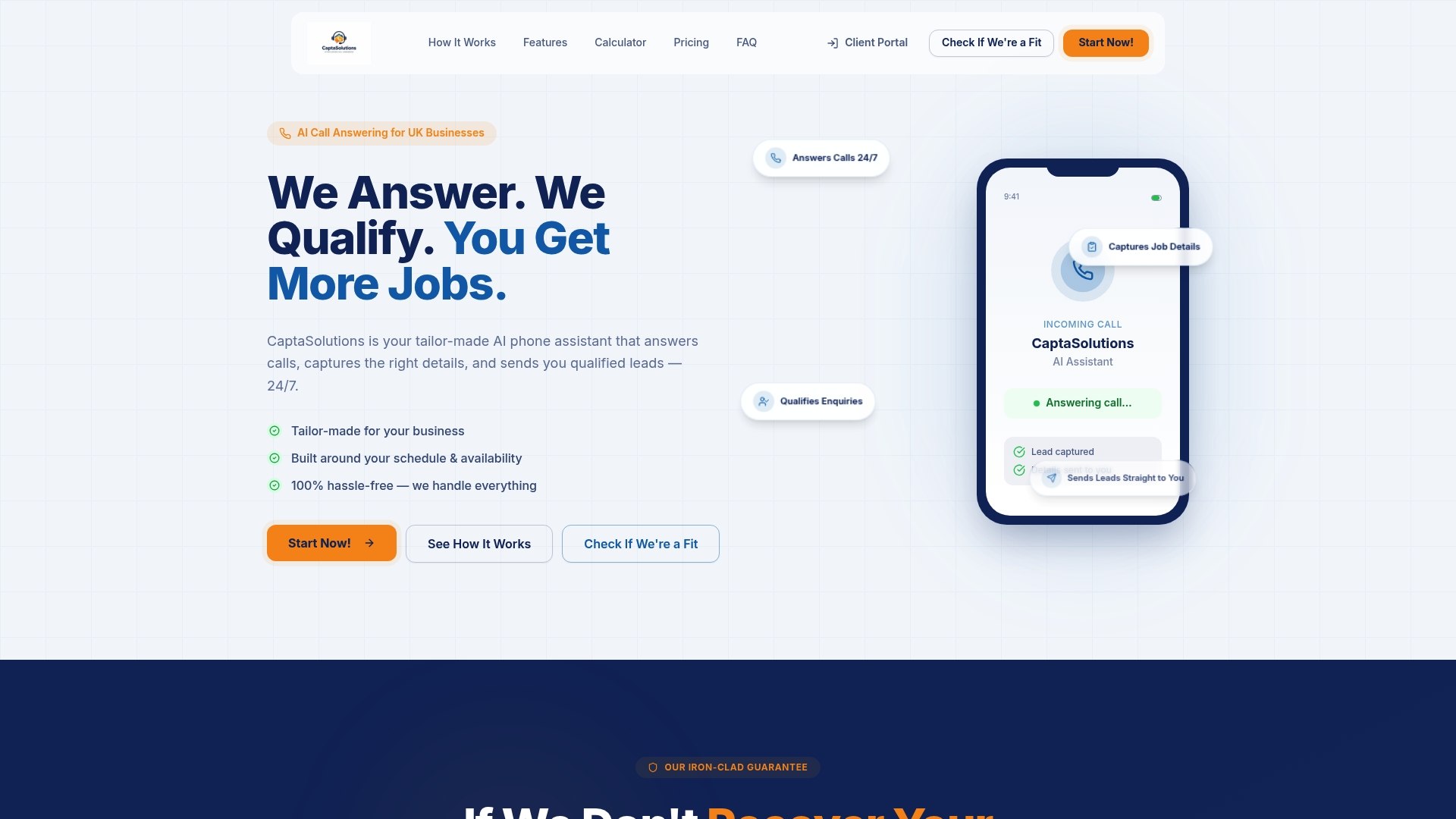
Captasolutions captures caller details, qualifies the enquiry, and organises everything into your client portal. Your team reviews every lead and decides what to take on. The service covers inbound call answering, lead qualification, and out-of-hours coverage, all with no contract and no card required to start. Visit Captasolutions to begin your free 30-day trial and go live within the hour. Call 07346 811329 to speak to the team directly.
FAQ
What are the main types of professional office calls in the UK?
The main types are inbound calls, outbound calls, automated calls, and distributed calls. Each serves a distinct function in managing client enquiries, sales, support, and internal coordination.
Do UK businesses need to check TPS before making outbound calls?
Yes. UK businesses must check numbers against the Telephone Preference Service register before making unsolicited outbound calls, and must also have a lawful basis under GDPR for processing the caller's personal data.
What is the difference between a ring group and a hunt group?
A ring group causes all phones to ring simultaneously, while a hunt group rings phones sequentially or in a round-robin pattern. Hunt groups distribute calls more evenly and reduce office noise in teams of four or more.
How much does an AI receptionist cost for a UK business?
AI receptionist setups typically cost £1,500–£5,000 in the UK. Full AI voice agents, which also handle outbound calls, cost £3,500–£12,000 depending on capability and configuration.
What call recording rules apply to UK law firms?
UK law firms must retain call recordings for 6 months for general enquiries, 6 years for client matter updates, and up to 15 years for conveyancing files under 2026 SRA guidance. All voicemail transcriptions must be encrypted in transit and at rest.