

Converting phone enquiries into confirmed bookings comes down to three things: speed of response, confident qualification, and timely follow-up. Get all three right, and your phone becomes one of the most reliable booking channels you have. Miss any one of them, and callers move on to the next business on their list.
The core tactics that work:
- Answer every call, every time. A missed call is a lost lead. Most callers do not book on their first attempt, so even answered calls need a follow-up plan.
- Qualify the enquiry during the call. Ask open questions to understand what the caller actually needs, then connect your service directly to that need.
- Ask for the booking explicitly. Research shows agents skip this step far more often than they realise. A direct, confident ask closes more calls than any other single technique.
- Follow up the same day. Callers who do not commit immediately are not lost. A prompt call, text, or email within a few hours keeps the conversation warm.
- Train staff with a sales mindset. Phone calls are revenue opportunities, not admin tasks. Staff who understand that distinction handle calls differently.
- Use a CRM or call-tracking tool. Recording caller details, preferences, and follow-up tasks prevents leads from slipping through when staff change over.
- Make outbound calls part of your process. Proactive outreach to undecided callers consistently outperforms waiting for them to ring back.
Pro Tip: Set a same-day outbound call target for every enquiry that does not convert on the first contact. Pair it with an SMS that includes your booking link. Multi-step engagement reliably outperforms single-call attempts.

How do you handle phone enquiries to maximise bookings?
The difference between a call that converts and one that does not usually comes down to how the conversation is structured, not how persuasive the person answering happens to be.
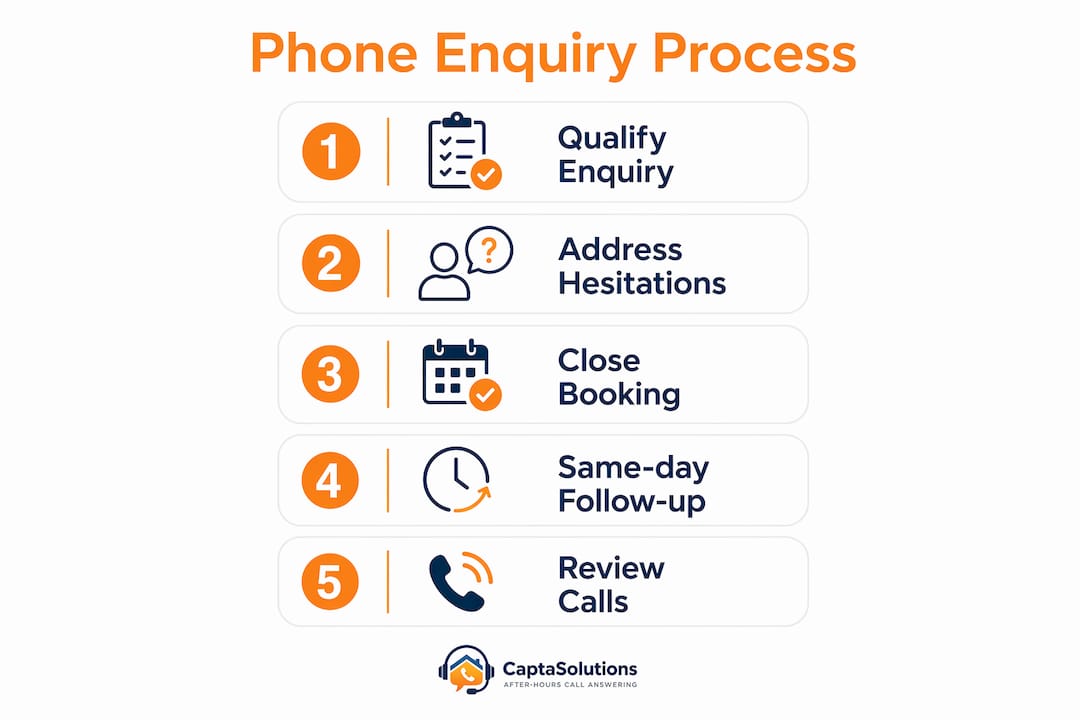
Start with a clear call-handling flow. Every call should move through three stages: qualify the enquiry, address any hesitation, and secure a commitment. Agents who skip straight to pricing without understanding the caller's situation lose bookings that a more structured approach would have closed.
Active listening and open-ended questions are the most effective tools available during a booking call. Rather than reciting a list of services, ask the caller what they are looking for and listen carefully. When you connect your offering directly to what they have described, the conversation feels personal rather than transactional.
Objection handling is where many calls stall. When a caller hesitates on price or timing, the instinct is often to back off. The better move is to acknowledge the concern, then emphasise availability or offer a flexible option. Urgency, used honestly, works well: "We have availability this week, but it tends to fill quickly" is both truthful and motivating.
- Design a call flow that covers qualification, objection handling, and closing in that order.
- Use open questions: "What are you hoping to get sorted?" works better than "Can I help you?"
- Confirm booking details verbally before ending the call: date, time, service, and any payment arrangement.
- Take payment details securely over the phone using a PCI-compliant process, and confirm the amount clearly.
- Keep call scripts flexible. A framework that guides without constraining produces better results than a rigid script.
- Encourage warmth alongside professionalism. Callers book with people they feel comfortable with.
Pro Tip: Record a sample of your calls each week and review them as a team. Identify the moment callers disengage and adjust your call flow accordingly. This single habit improves conversion faster than any script rewrite.
What systems prevent missed or mishandled phone enquiries?
A well-trained team cannot convert calls they never receive. The operational side of phone enquiry management matters as much as the conversation itself.
70% of customers expect a click-to-call button when browsing on a mobile device. If your phone number is buried in a footer or missing from your Google Business profile, you are losing enquiries before they start. Display your number prominently in your website header, footer, and contact page, and check that it is consistent across every platform where your business appears.
24/7 availability directly correlates with higher booking rates. Most small businesses cannot staff phones around the clock, which is where AI-powered call answering services fill the gap. An AI receptionist answers in your business name, captures the caller's details, qualifies the enquiry, and logs everything for your review. No call goes unanswered, even at 10pm on a Sunday.
- Display your phone number in the header, footer, and contact page of your website.
- Enable click-to-call on your mobile site and verify your number on Google Business and social profiles.
- Use an AI answering service or call answering cover for evenings, weekends, and peak periods.
- Implement CRM or call-tracking software to log caller details, enquiry type, and follow-up tasks automatically.
- Standardise note-taking during calls so handovers between staff are clean and no detail is lost.
- Schedule staff coverage around your peak enquiry windows, using call volume data to guide rota decisions.
- Filter junk and spam calls using call screening features to protect agent time for genuine leads.
Tracking call conversion metrics reveals where bookings are being lost. Volume, answer rate, conversion rate, and average call length each tell a different part of the story. Review them monthly and adjust staffing or call flow accordingly.
How UK businesses successfully turn phone enquiries into bookings
The strategies above are not theoretical. UK service businesses across trades, hospitality, and health and beauty are applying them with measurable results.
A plumbing and heating business using Captasolutions' AI-powered call answering service found that a significant share of their bookings were coming in outside business hours, calls that previously went to voicemail and were rarely returned. With every call answered, caller details captured, and enquiries organised in a client portal, the business could follow up each lead the next morning with full context. Missed calls dropped sharply, and the team spent less time chasing cold leads.
A hospitality venue trained its front-of-house staff in conversational sales techniques, moving away from a purely informational call style. Staff began asking open questions, confirming availability with light urgency, and following up undecided callers with a personal call the same evening. Booking rates from phone enquiries improved noticeably within the first month.
A beauty salon combined a tailored call script with CRM integration, logging every enquiry against a client record. When a caller did not book immediately, the system flagged a follow-up task for the next day. Staff could see the caller's previous visit history and preferences, making the follow-up feel personal rather than generic.
Transferable tactics from these UK examples:
- Log every enquiry in a CRM, even if the caller does not book.
- Use follow-up call guides to structure outbound contact the same day.
- Pair outbound calls with an SMS booking link for callers who prefer digital confirmation.
- Brief all staff on the call flow, not just the person who usually answers the phone.
- Review your answer rate weekly. If it drops, identify the cause before leads are lost.
How do you choose the right phone enquiry approach for your business?
The right approach depends on your call volume, your hours of operation, and how much of your revenue comes through the phone. A sole trader taking five calls a day has different needs from a clinic handling fifty.
Start by assessing your current answer rate and your peak enquiry windows. If you are missing calls during evenings or weekends, that gap costs you bookings directly. For businesses in this position, an AI-powered answering service like Captasolutions provides 24/7 lead capture without the overhead of additional staff. It answers in your business name, qualifies the caller, and organises the lead for your review.
For businesses with an existing team, the priority is CRM integration and call-tracking software that fits your current workflow. A system that requires staff to log into a separate platform they were not trained on will not be used consistently. Look for tools that integrate with your booking or scheduling software and automate follow-up task creation.
Weigh live agents against automated answering honestly. Live agents build rapport faster and handle complex enquiries better. AI answering services cover volume and off-hours reliably and at lower cost. Many UK service businesses use both: a live team during core hours and an AI service for overflow and out-of-hours calls.
Checklist of features to evaluate when choosing a provider or system:
- 24/7 call answering or overflow cover
- Lead qualification and caller detail capture
- CRM or scheduling software integration
- Call recording and conversion reporting
- Follow-up automation or task creation
- UK-based support and compliance with data protection requirements
- Call script or call flow configuration options
Questions to ask before committing:
- What happens to a call that comes in at 11pm on a Friday?
- How are caller details passed to my team, and how quickly?
- Can the system be configured to qualify enquiries specific to my services?
- What does the home services industry experience suggest about response time and conversion?
- Is there a trial period with no long-term contract?
Captasolutions offers a free 30-day trial with no card required and no contract, and goes live within the hour. For UK small businesses that cannot afford to miss a call, that combination of speed and flexibility makes it a practical starting point.
Key takeaways
Speed, qualification, and follow-up are the three factors that determine whether a phone enquiry becomes a confirmed booking for UK small businesses.
| Point | Details |
|---|---|
| Answer rate is the foundation | A missed call is a lost lead. Prioritise 24/7 cover before refining your call script. |
| Ask for the booking directly | Agents skip the direct ask far more often than they realise. A confident, clear request closes more calls. |
| Follow up the same day | Most callers do not book on first contact. A same-day call or SMS keeps the lead warm. |
| Log every enquiry in a CRM | Standardised notes and CRM records prevent lead loss during staff handovers and enable personalised follow-up. |
| Use AI answering for off-hours cover | AI call answering services capture leads and qualify enquiries when live staff are unavailable, at a fraction of the cost of additional headcount. |