

For most UK salons, a managed, domain-trained AI call answering service delivers faster results and fewer missed bookings than any DIY platform. The single best option to trial first is Captasolutions: it goes live within the hour, requires no card, and handles 24/7 answering with built-in salon integrations out of the box.
TL;DR shortlist:
- Captasolutions — Best for salons that want a fully managed, UK-ready deployment with no setup headache. Answers every call in your salon's name, captures leads, syncs with your booking system, and organises everything into a client portal. Free 30-day trial, no card required.
- CloudTalk — Best for multi-site salon groups or chains that need a cloud telephony platform with call routing, IVR, and analytics. Requires more owner time to configure and integrate.
- Zenoti — Best for enterprise spas and salon groups already running Zenoti's POS and booking platform, where phone features are an extension of an existing system rather than a standalone tool.
Cancellations and no-shows cost UK salons a measurable share of revenue, and the pressure falls hardest on solo stylists and small teams who cannot staff a phone line during busy hours. An AI answering service that books appointments, sends reminders, and captures every caller's details addresses that gap directly. For salons that want to act now: trial Captasolutions first. It is the only option on this list built specifically for UK businesses, live within the hour, and with no contract.
Table of Contents
- How we evaluated these phone answering tools for beauty salons
- At-a-glance comparison: which tool fits your salon?
- Mini-reviews: Captasolutions, CloudTalk, and Zenoti
- How to choose the right AI phone answering tool for your salon
- What features does your salon actually need from a call answering tool?
- Pricing explained: what does a salon phone answering tool actually cost?
- Integrations with Phorest, Mindbody, Treatwell, and Fresha
- Why managed, domain-trained AI tends to win for UK salons
- Key takeaways
- What UK salons are actually choosing in 2026
- Captasolutions: the managed UK option worth trialling first
- Useful sources and further reading
How we evaluated these phone answering tools for beauty salons
Every tool on this list was assessed against criteria that reflect what actually matters to a working salon, not a contact centre.
Evaluation criteria:
- Call accuracy and natural language handling — does the AI understand UK accents, service names, and pricing queries without repeated clarification?
- Booking workflow — can a caller book, reschedule, or cancel an appointment end-to-end within the call, without a human stepping in?
- Integrations — does the tool connect natively with Phorest, Mindbody, Treatwell, or Fresha, and does that connection go both ways (read availability, write bookings)?
- GDPR and data residency — are call recordings and transcripts stored in the UK or EEA, and does the vendor provide a DPIA-ready evidence pack?
- Setup time and owner effort — how long from sign-up to first live call, and how much configuration does the owner need to do personally?
- Cost to serve — total monthly cost including setup fees, per-call charges, and any integration add-ons.
- Support and SLA — is there a named UK support contact, and what is the response time commitment?
Testing involved live call simulations using a sample salon script, checking whether bookings created by calls appeared correctly in connected booking systems, and verifying trial availability and pricing transparency directly from vendor pages. For call quality, professional phone handling guidance recommends answering within three rings with a professional greeting — that standard was used as the baseline when scoring AI response speed and script naturalness. Vendor claims about integrations were cross-checked against published API documentation and user reviews on G2 where available.
At-a-glance comparison: which tool fits your salon?
The table below covers the dimensions that matter most at shortlisting stage. Full mini-reviews follow.
| Tool | Best for | Price band | Key features | Phorest / Mindbody integration | Setup time | Managed vs DIY |
|---|---|---|---|---|---|---|
| Captasolutions | Solo stylists, small salons, multi-site groups wanting a hands-off UK deployment | Setup fee + monthly subscription; free 30-day trial, no card | 24/7 answering, in-call booking, lead capture, call recording, client portal, CRM sync | Yes — salon-specific onboarding includes integration setup | Under 1 hour to go live | Fully managed |
| CloudTalk | Multi-site chains and groups needing cloud telephony with routing and analytics | Monthly subscription; tiered by users and features | IVR, call routing, analytics, CRM integrations, call recording | Via CRM integrations; not salon-native | Days to weeks depending on configuration | DIY / no-code configuration |
| Zenoti | Enterprise spas and groups already on Zenoti POS | Enterprise pricing; custom quotes | POS-native phone features, booking, CRM, loyalty, marketing | Native to Zenoti ecosystem only | Weeks; full platform onboarding | Platform-managed within Zenoti |
Bottom-line notes:
- Captasolutions is the only option here built as a managed service for UK SMEs, with salon-specific onboarding and a trial that costs nothing to start.
- CloudTalk suits operations that already have IT resource to configure and maintain a telephony platform; it is not salon-native and requires integration work.
- Zenoti's phone capabilities are powerful but only relevant if you are already committed to the Zenoti platform; standalone adoption for call answering alone is not cost-effective for most salons.
Mini-reviews: Captasolutions, CloudTalk, and Zenoti

Captasolutions
Captasolutions is a fully managed AI call answering service built for UK businesses. For salons specifically, it answers every inbound call in your salon's name, 24 hours a day, captures the caller's details, qualifies the enquiry, and organises leads into a client portal for review. Call recording and transcription are included, and the service supports schedule-based call handling so after-hours calls are handled differently from in-hours ones.

Setup is the clearest differentiator. Most salon owners are live within the hour. There is no coding, no telephony configuration, and no integration project to manage yourself — onboarding includes connecting your booking system and configuring the AI voice to match your salon's tone. The free 30-day trial requires no card and no contract, which removes the usual risk of committing to a new platform before you have seen it work.
For UK GDPR purposes, Captasolutions processes data within the UK, and call recordings and transcripts are accessible through the client portal. Salon owners retain control over what data is captured and how long it is held.
Pros: Rapid deployment, fully managed, UK data focus, salon-specific onboarding, no-contract trial. Cons: As a managed service, customisation options are set within the platform's configuration rather than being fully open-ended. Bottom line: The strongest fit for solo stylists and small-to-medium salons that want results quickly without a DIY build. Also viable for multi-site groups that want consistent, managed call handling across locations.
CloudTalk
CloudTalk is a cloud telephony platform used across multiple industries, including retail and hospitality. Its strengths are call routing, IVR menus, analytics dashboards, and a broad range of CRM integrations. G2 reviews highlight call quality and the analytics suite as genuine positives.
The limitation for salons is that CloudTalk is a general-purpose telephony tool, not a salon-specific one. Connecting it to Phorest or Mindbody requires either a native CRM integration (where available) or a middleware layer such as Zapier. There is no out-of-the-box in-call booking flow designed around salon appointment logic — service duration matching, stylist availability, deposit collection. A salon owner setting this up independently should budget days to weeks for configuration, not hours.
Pros: Strong analytics, reliable call quality, flexible routing, broad CRM support. Cons: Not salon-native; integration with booking platforms requires owner or developer time; no managed onboarding for salons. Bottom line: Worth evaluating for multi-site salon groups with an in-house operations or IT function. Not the right starting point for a solo stylist or a small salon without technical resource.
Zenoti
Zenoti is an enterprise spa and salon management platform. Its phone and communication features are built into a broader POS, CRM, marketing, and loyalty system. For large salon groups or day spas already running Zenoti, the phone capabilities are a natural extension of an existing workflow.
For anyone not already on Zenoti, adopting it purely for call answering is not practical. Onboarding takes weeks, pricing is enterprise-level and quoted individually, and the value proposition is the integrated platform, not the phone feature in isolation. UK availability is confirmed, but the platform is designed for multi-site enterprise operations rather than independent salons.
Pros: Deep integration across POS, booking, CRM, and marketing within one platform; strong for large groups. Cons: Enterprise pricing and onboarding timeline; not suitable as a standalone call answering solution; overkill for single-site salons. Bottom line: Relevant only if you are already evaluating Zenoti as a full platform replacement. For call answering alone, it is not the right tool.
How to choose the right AI phone answering tool for your salon
The right choice depends on three things: your salon's size, how much time you can spend on setup, and which booking software you already use.
Decision checklist by salon profile:
- Solo stylist or single-site salon with no IT support — prioritise a fully managed service with out-of-the-box integrations and a short trial. Setup time should be measured in hours, not days. Captasolutions fits this profile directly.
- Small salon group (2–5 sites) — look for multi-location support, consistent call handling across sites, and a client portal that gives you visibility across all locations. Ask whether pricing scales per site or per call volume.
- Multi-site chain with in-house operations resource — a cloud telephony platform like CloudTalk may be viable if you have the team to configure and maintain it. Weigh the integration cost honestly against a managed alternative.
Questions to ask during a demo or trial:
- What is your call-to-booking success rate for salons specifically?
- How does the system handle a caller who wants to book with a specific stylist who has no availability that day?
- What happens when the AI cannot answer a question — does it fall back to a human, take a message, or end the call?
- Where is call audio and transcript data stored, and can you provide a DPIA-ready evidence pack?
- How do you handle a DSAR (Data Subject Access Request) for a caller's recording?
Red flags to watch for:
- No trial period or a trial that requires a card and a minimum commitment.
- Pricing that is not published and only available after a sales call.
- No direct integration with your booking platform — only a generic "we support Zapier" answer.
- No DPIA documentation or data residency information available on request.
- No fallback to human or message-taking when the AI reaches its limits.
Trust signals to prioritise: published case studies from salons, a testable free trial, transparent pricing, confirmed UK data residency, and a named support contact with a response time commitment.
What features does your salon actually need from a call answering tool?
Not every feature on a vendor's marketing page translates into a booking. These are the capabilities that materially affect daily operations.
Feature checklist:
- In-call booking — the AI books the appointment during the call, not via a follow-up link.
- Two-way calendar sync — availability is read in real time from your booking system; new bookings write back immediately.
- CRM and POS sync — client records are updated automatically; no manual data entry after the call.
- Service and duration matching — the AI knows your service menu, durations, and which stylists offer which services.
- Deposit and pre-payment flows — the system can collect or prompt for a deposit at booking, which reduces no-show rates significantly.
- Automated reminders — SMS or email reminders sent automatically before appointments. UK hair and beauty salons using automated SMS reminders plus deposit requirements achieve no-show rates of 2–5%, compared to a baseline of 10–20%.
- Waitlist handling — when a cancellation comes in, the system offers the slot to the next client on the waitlist.
- Call recording and transcription — every call is logged and searchable; useful for training and dispute resolution.
A typical end-to-end booking call looks like this: a client calls after hours, the AI answers in the salon's name within seconds, asks for the service and preferred stylist, checks live availability, confirms a slot, takes the client's name and number, writes the booking to the calendar, and sends a confirmation SMS. The salon owner sees the new booking in the portal the next morning with a full call transcript attached.
Pro Tip: During any vendor trial, call the system yourself using a regional UK accent — Scottish, Geordie, or West Midlands — and ask for a service by its colloquial name rather than its formal menu title. If the AI misunderstands or asks for repeated clarification, that is a reliable signal of how it will perform with your real clients.
For handling multiple simultaneous booking calls, a managed AI service has a clear operational advantage over a single human receptionist: it handles concurrent calls without a queue or a missed call.
Pricing explained: what does a salon phone answering tool actually cost?
The honest answer is that cost depends heavily on which category of solution you choose.
Basic AI receptionist setup in the UK typically involves a configured deployment and monthly running costs that vary by call volume. Human telephone answering services and part-time receptionists generally incur higher monthly costs, including additional employment-related expenses.
| Solution type | Typical setup cost | Monthly running cost |
|---|---|---|
| Managed AI call answering (UK) | From £1,500 | £100–£250 |
| Telephone answering service (human) | Low or none | £200–£400 |
| Part-time receptionist | Recruitment cost | £1,200–£1,800 |
The cost picture shifts further over time. A specialised AI receptionist that updates CRM records and books appointments automatically typically costs less than a human answering service from Year 2 onwards, because it removes ongoing per-call processing and admin overhead. For appointment-based businesses, the ROI window is typically 60–90 days, with 30–60 minutes of admin saved per day once the system is running.
Pricing questions to ask every vendor:
- What is included in the monthly fee — call minutes, integrations, portal access, support?
- Is there a one-off setup or onboarding fee, and what does it cover?
- What are the cancellation terms — is there a minimum contract period?
- Does the trial have any call volume or feature limits?
For a simple ROI estimate: take your average booking value, multiply by the number of calls you currently miss per week, and compare that against the monthly subscription cost for home service companies. Most salons recover the monthly fee from two or three recovered bookings.
For a detailed AI call service versus human receptionist cost breakdown, the numbers consistently favour managed AI for salons handling more than 20–30 inbound calls per week.
Integrations with Phorest, Mindbody, Treatwell, and Fresha
A call answering tool that does not write bookings back to your existing system creates more admin, not less. Integration depth is the single most important technical question to resolve before committing to any platform.
Integration checklist:
- Two-way calendar sync — the AI reads live availability from your booking platform and writes new bookings back in real time.
- Client record linkage — returning clients are matched to existing records; new clients are created automatically.
- Booking reconciliation — bookings made by phone appear identically in your system to bookings made online, with no duplicate or orphaned entries.
- Confirmation and reminder triggers — a booking created by a call fires the same confirmation SMS and reminder sequence as an online booking.
Demo test script to verify integration depth:
- Call the AI and book a specific service with a named stylist for a date two days ahead.
- Immediately open your Phorest, Mindbody, Fresha, or Treatwell dashboard and confirm the booking appears with the correct service, duration, stylist, and client details.
- Check that a confirmation message was sent to the test phone number.
- Cancel the booking via the AI and confirm the slot is released in the dashboard.
- Ask the AI to book a service that does not exist in your menu and verify it handles the request gracefully rather than creating a malformed booking.
When a direct native integration is not available, fallback options include Zapier or Make automations that bridge the call answering platform to your booking system via webhooks. These work but introduce a dependency on a third-party automation layer, which adds a point of failure and requires maintenance. A practical guide to switching to AI phone answering covers the integration setup steps in detail for UK salons.
Why managed, domain-trained AI tends to win for UK salons
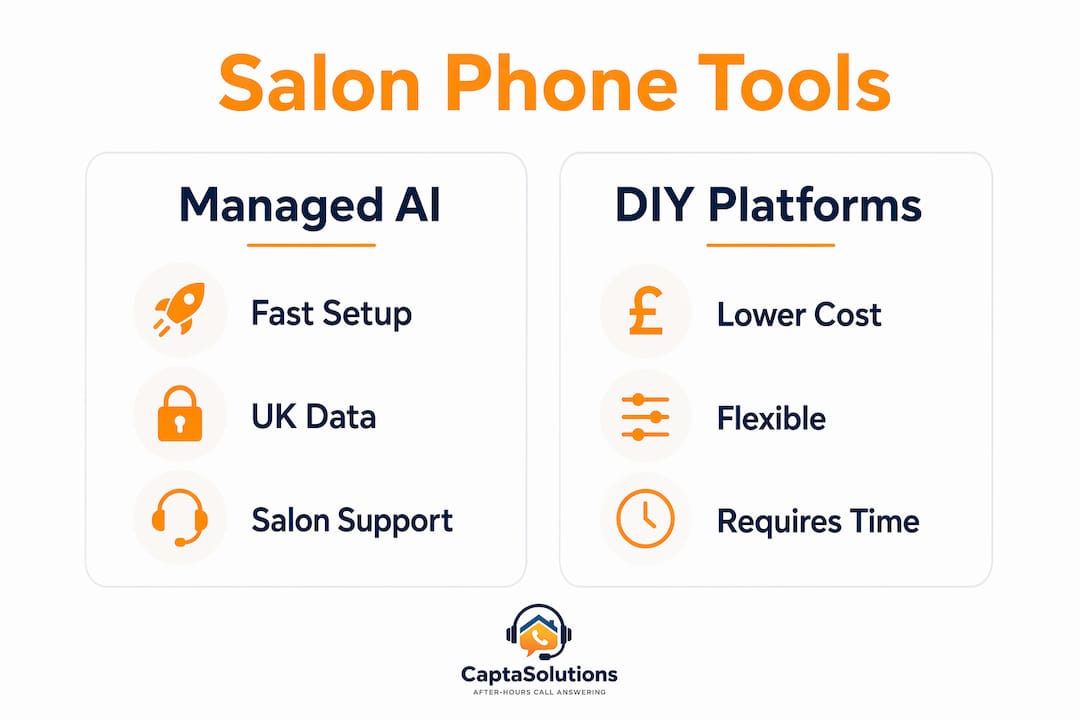
The choice between a DIY no-code platform and a fully managed service comes down to one question: how much is your time worth?
Industry analysts observe that while DIY platforms carry lower recurring fees, the real cost includes the owner's time to build, test, and maintain integrations. Managed services typically deliver faster time to value and deeper out-of-the-box connections with platforms like Phorest or Mindbody. For a salon owner who is also cutting hair, managing staff, and ordering supplies, that time cost is not abstract.
The financial case is clear. Setup costs for a managed AI receptionist in the UK start from around £1,500, with monthly costs of £100–£250. Against a part-time receptionist at £1,200–£1,800 per month, the break-even arrives quickly. For appointment-based businesses, the typical ROI window is 60–90 days once the system is handling calls and writing bookings automatically.
On compliance, UK GDPR applies to any voice AI system that processes caller personal data. The ICO's guidance on voice AI identifies six evidence categories salons should expect their vendor to support: an AI system inventory, a completed DPIA, transparency documentation (callers must be told they are speaking with an AI), decision logs, human oversight records, and a DSAR response process. For a beauty salon handling standard booking calls, the compliance burden is lower than for financial services or healthcare, but the basics — DPIA, data residency, caller disclosure — still apply. Ask your vendor for these documents before you go live.
What a realistic 60–90 day ROI path looks like for a small salon:
- Week 1: System live, calls answered 24/7, first after-hours bookings captured.
- Weeks 2–4: Admin time saved on call-backs and manual diary entries; no-show rate begins to fall as automated reminders activate.
- Days 30–60: Monthly subscription cost recovered from recovered bookings and reduced no-shows.
- Day 90: Net positive on time and revenue; owner reviews portal data to refine call scripts and service menu accuracy.
For examples of how AI call answering performs across UK businesses, including salons, the pattern is consistent: the fastest ROI comes from salons that were previously missing after-hours calls entirely.
Key takeaways
For most UK salons, a managed AI call answering service delivers faster ROI, lower owner time cost, and better salon-software integration than any DIY telephony platform.
| Point | Details |
|---|---|
| Managed beats DIY for most salons | Owner time to configure and maintain a DIY platform erodes the cost saving; managed services go live in hours. |
| Integrations are non-negotiable | Two-way sync with Phorest, Mindbody, Fresha, or Treatwell must be verified in a live demo before committing. |
| No-shows cost real money | UK salons using automated reminders and deposits achieve no-show rates of 2–5% versus a baseline of 10–20%. |
| GDPR basics apply to all voice AI | Ask every vendor for a DPIA, data residency confirmation, and a caller disclosure script before go-live. |
| Captasolutions | The only option on this list built as a fully managed, UK-first service with a free 30-day trial and no card required. |
What UK salons are actually choosing in 2026
The conversation I hear most often from salon owners is not "which platform has the best features?" It is "I do not have time to set this up." That is the real selection criterion for most independent salons, and it is the one that vendor comparison tables consistently underweight.
DIY platforms look attractive on a features spreadsheet. Lower monthly fees, flexible configuration, open API access. But the owner who spends a weekend building Zapier automations between a telephony tool and Phorest is not saving money — they are spending their most expensive resource, their own time, on a task that a managed service would have handled in an hour. The salons that get the fastest results are the ones that accept a slightly higher monthly fee in exchange for not becoming their own IT department.
There is also a subtler point about call quality. A general-purpose telephony platform configured by a non-technical salon owner will handle calls less naturally than a domain-trained AI that has been set up specifically for salon booking conversations. The difference shows up in the first week: callers who get confused, repeat themselves, or hang up before booking are a direct revenue cost.
My practical advice: if you have fewer than five sites and no dedicated operations resource, start with a managed service and trial it against your real call volume. If you are running a larger group with IT support and existing telephony infrastructure, CloudTalk or a similar platform may be worth the configuration investment. But do not let the lower headline price of a DIY tool obscure the full cost of your own time.
A useful profile: a two-chair salon in a busy high street, owner-operated, currently missing roughly 30% of calls during appointment hours. The right answer is a managed AI service, live within the hour, with no contract. The owner gets their evenings back, the missed calls get answered, and the ROI arrives before the first month is out.
Captasolutions: the managed UK option worth trialling first
Every call your salon misses during a busy appointment slot is a booking that goes to the salon down the road. Captasolutions answers every inbound call in your salon's name, 24 hours a day, captures the caller's details, qualifies the enquiry, and organises everything into a client portal you review at your convenience.
The setup takes under an hour. There is no card required, no contract, and no configuration project to manage. Salon-specific onboarding includes connecting your booking system, configuring the AI voice, and setting your availability schedule. Call recording and transcription are included as standard, so you have a full record of every conversation. For salons that want to see real booking results from AI call answering before committing, the 30-day trial gives you a full month of live data at no cost.
Start your free trial at captasolutions.co.uk or call 07346 811329 today.
Useful sources and further reading
- Professional Beauty — cancellations cost survey: UK industry survey on the revenue impact of cancellations and no-shows on salons.
- Fresha — cancellations cost study: Research on how reminders, deposits, and flexible cancellation settings reduce lost income for salons.
- Session.care — no-show statistics 2025: Sector-by-sector no-show rate data including UK hair and beauty benchmarks and the impact of SMS reminders and deposits.
- Softomatesolutions — AI receptionist pricing UK: UK market pricing data for managed AI receptionists versus human answering services; useful for cost comparisons.
- Softomatesolutions — AI receptionist for small business UK: Setup cost ranges, monthly running costs, and ROI timelines for appointment-based businesses.
- ICO voice AI audit guidance via DILR.ai: Practical breakdown of the six evidence categories UK businesses need for voice AI compliance, including DPIA requirements and caller disclosure obligations.
- ClientWave — salon phone etiquette: Practical call handling standards for salons; useful as a baseline when testing AI call quality during vendor trials.
- Captasolutions blog — why UK salons need automated answering: Cost comparisons and owner time analysis specific to UK beauty salons.
Note: case study data and client testimonials from UK salons will be added to this article as they become available. Vendor pricing figures should be verified directly with each provider, as subscription tiers change regularly.