

For most UK hair salons, an AI-powered virtual receptionist is the right starting point. It answers every call 24/7, captures booking details, and integrates with salon management software without the cost of a full-time front desk. Captasolutions is the recommended UK option for independent salons and small chains, with GDPR-compliant call handling and same-day setup. For high-touch events such as bridal parties, a hybrid approach (AI plus human escalation) can add an extra layer of care.
Quick shortlist:
- Solo stylist or chair renter: An AI-first service such as Captasolutions handles all inbound calls, qualifies enquiries, and logs bookings without requiring a dedicated receptionist.
- Independent salon (2–10 chairs): A hybrid model that automates routine bookings and escalates complex consultations to a live agent covers most scenarios.
- Multi-site chain or franchise: An enterprise-grade platform with multi-location routing, stylist-level calendars, and centralised reporting is worth the higher monthly cost.
- Bridal and group bookings: Human-backed answering remains the gold standard for coordinating six-person parties, but it carries higher per-minute fees and longer contracts.
Look for these signals in any provider: real-time integration with Booksy, Fresha, Timely, or Zenoti; stylist-level scheduling; 24/7 call coverage; and a clear ICO-aligned data-handling policy.
Table of Contents
- How do the leading virtual receptionist options compare for salons?
- Profiles: Captasolutions and the main alternative approaches
- How do you choose the right virtual receptionist for your salon?
- How do virtual receptionists handle salon booking complexity?
- What does virtual receptionist pricing look like for UK salons?
- How we evaluated and shortlisted these options
- What UK salon owners say about virtual receptionist services
- Key takeaways
- The gap between what AI receptionists promise and what salons actually need
- Captasolutions: the recommended UK option for salon call answering
- Further reading and sources for UK salons
How do the leading virtual receptionist options compare for salons?
The table below maps the most relevant decision dimensions for UK salon owners. Pricing is indicative; always confirm current tiers directly with vendors.
| Option | Best for | Pricing shape | AI vs human | Booking integrations | 24/7 availability | Setup time | UK support / GDPR |
|---|---|---|---|---|---|---|---|
| Captasolutions | Solo stylists, independent salons, small chains | Monthly subscription + one-time setup fee; free 30-day trial, no card | Fully AI-powered with client portal review | Configurable to Booksy, Fresha, Timely, Zenoti | Yes, 24/7 | Live within the hour | UK-based; ICO-aligned call recording and data handling |
| AI-first platform (e.g. Zenoti, Booksy built-in tools) | Salons already on those platforms | Bundled with platform licence; varies by tier | Fully automated | Native to the platform | Yes, within platform | 1–2 days for configuration | Depends on platform; GDPR policies vary |
| Hybrid answering service | Mid-size salons needing human escalation | Per-minute or per-call; typically higher monthly spend | AI triage + live agent handover | Via API or manual relay | Usually yes | 3–7 days | Varies; confirm data-hosting location |
| Human-backed answering service | Bridal, high-touch, complex colour corrections | Per-minute or monthly retainer; longer contracts common | Live agents only | Manual relay to salon software | Yes, with shift cover | 1–2 weeks | Varies widely; must request GDPR clauses |
| CloudTalk (VoIP + AI features) | Multi-site chains needing call analytics | Per-seat monthly; enterprise tiers | AI-assisted routing + human agents | CRM integrations; salon software via Zapier | Yes | 1–3 days | EU data centres; GDPR documentation available |
Pricing callout: Entry-level AI answering services for UK salons are available with basic call-capture tiers at starting monthly costs. Hybrid and human-backed services with live agents generally run higher, often involving per-minute billing that can amount to substantial monthly expenses for a busy independent salon. Transparent pricing and flexible month-to-month billing are the clearest trust signals for small salons evaluating providers. Captasolutions offers a free 30-day trial with no card required, which is the lowest-risk entry point currently available in the UK market.
Profiles: Captasolutions and the main alternative approaches
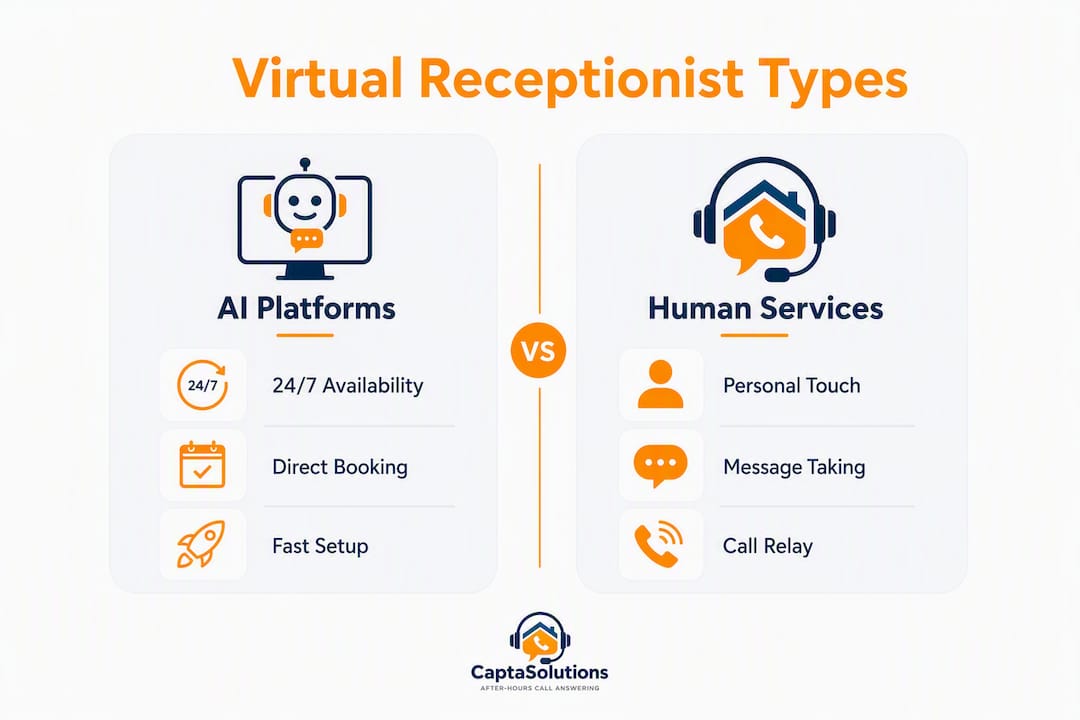
Captasolutions
Captasolutions answers every inbound call in the salon's name, 24 hours a day, seven days a week. The AI captures caller details, qualifies the enquiry against custom criteria (service type, preferred stylist, date and time), and organises everything into a client portal for the salon owner to review. Call recordings and transcriptions are stored in the portal; schedule-based handling means the system knows when the salon is open, when it is closed, and how to route calls accordingly.

Salon-specific strengths: The system can be configured to handle appointment calls with service-duration logic, so a caller requesting a balayage is not booked into a 45-minute root touch-up slot. Stylist matching by speciality is configurable, and the portal gives the owner a clear lead list to action rather than a voicemail backlog.
Pros:
- Live within the hour; no lengthy onboarding
- Free 30-day trial, no card required, no contract
- UK-based with ICO-aligned call recording consent and data handling
- Custom AI voice configuration keeps the salon's brand voice consistent
Cons:
- Fully AI-powered, so very high-touch bridal coordination may still benefit from a human follow-up call
- Integration depth with specific salon platforms depends on configuration at setup
Integrations: Configurable to work alongside Booksy, Fresha, Timely, and Zenoti via the client portal workflow.
Onboarding timeline: Same-day activation is standard. Full integration with a salon's booking system typically takes a few hours to one business day.
AI-first platform category (built-in booking tools)
Platforms such as Zenoti, Booksy, and Fresha include native booking automation that handles inbound digital requests and, in some cases, phone-to-booking flows. Booksy's virtual receptionist features are designed specifically for beauty businesses, with client messaging and appointment management built into the same system the salon already uses.
Best for: Salons already paying for one of these platforms who want to consolidate tools rather than add a separate service.
Pros:
- Native integration means no data relay or API configuration
- Service-duration rules and stylist calendars are already mapped in the platform
Cons:
- Coverage is typically limited to the platform's own booking channel; phone calls from clients who prefer to ring may still be missed
- GDPR policies and data-hosting locations vary by platform and require individual verification
Human-backed answering service category
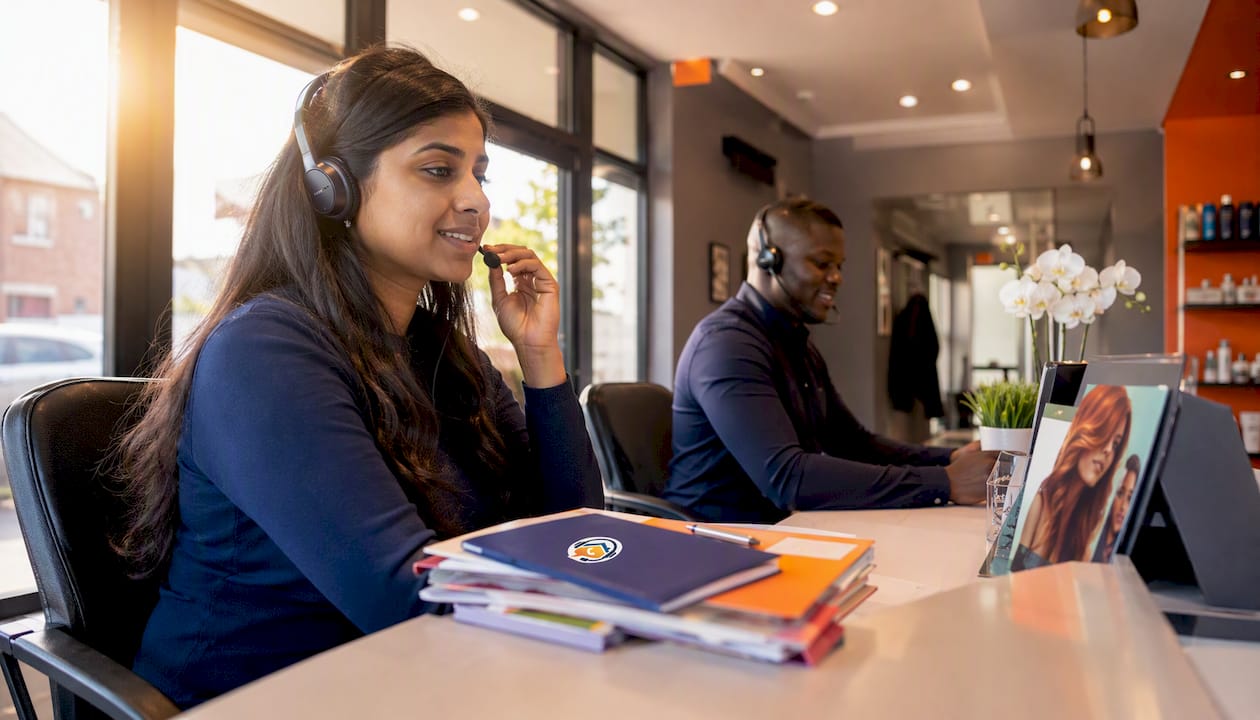
Established answering services offer live agents who answer in the salon's name, take messages, and relay booking requests. They suit high-touch scenarios: a six-person bridal party, a complex colour correction that needs a consultation call, or a VIP client who expects a human voice.
Best for: Salons with a significant volume of high-value, complex bookings where the cost of a mishandled call outweighs the premium pricing.
Pros:
- Human judgement for nuanced conversations
- Can handle emotional or sensitive enquiries (e.g. hair-loss consultations)
Cons:
- Per-minute billing adds up quickly for busy salons
- Longer contracts are common; month-to-month options are rarer
- Agents may not have salon-specific knowledge without extensive briefing
Integration note: Most human-backed services relay bookings manually or via email, which introduces a lag between the call and the calendar update. Real-time sync with Fresha or Timely is rarely native.
How do you choose the right virtual receptionist for your salon?
Work through this checklist before committing to any provider:
- Stylist-level scheduling: Can the system book a specific stylist, not just any available slot? Without this, clients who ask for a named stylist will be frustrated or misboooked.
- Real-time calendar sync: Does the system read live availability from your booking platform, or does it relay a message and hope someone updates the diary?
- Multi-service timing: Can it handle a booking that combines a cut, colour, and blow-dry with correct gap and processing time?
- Bridal and group booking support: Does it collect individual service choices for each party member and flag the booking for human review?
- Rebook automation: Does it prompt clients to rebook at the end of a call, and can it send a six-week colour reminder?
- 24/7 call coverage: Does it answer at 11 PM on a Sunday, or does it divert to voicemail after hours?
- GDPR-compliant call handling: Does the vendor provide a data processing agreement, state where call recordings are hosted, and explain how long data is retained?
Questions to ask during a demo:
- "Book a three-hour balayage with [stylist name] on a Saturday morning." Does the system find the right slot, assign the right stylist, and block the correct duration?
- "Coordinate a six-person bridal party for a Saturday in August." Does it collect each person's services, flag the complexity, and produce a summary?
- "A client cancels two hours before their appointment." How does the system handle the slot, and does it trigger a waitlist or rebook prompt?
Red flags to watch for: no live integration with your booking software; no UK data-hosting or ICO-aligned GDPR documentation; onboarding quoted in weeks rather than hours; pricing that is not published or requires a sales call to obtain.
Pro Tip: Before signing anything, run a real booking scenario through the vendor's demo environment using your actual service menu and a stylist name. A system that cannot handle your most complex service type in a demo will not handle it in production.
How do virtual receptionists handle salon booking complexity?
Salon scheduling is more demanding than most local service bookings. Service durations vary dramatically, colour work often requires a pre-consultation, and a single bridal party can occupy every chair for half a day. Any receptionist, AI or human, must be configured to reflect that reality.
| Service type | Typical duration | Scheduling rule | Receptionist behaviour required |
|---|---|---|---|
| Root touch-up | 60–75 min | Single stylist, no gap | Book directly; confirm stylist availability |
| Full balayage | — | Processing time + stylist check-in | Block extended slot; flag for stylist confirmation |
| Consultation only | 20–30 min | No colour or cut | Separate slot type; capture hair history and photos |
| Cut and blow-dry | 45–60 min | Stylist-specific | Match to stylist speciality; confirm duration |
| Bridal party (6 persons) | 4 hours | Multiple stylists, staggered start times | Collect individual services; produce run sheet; flag for manager review |
| Colour correction | — | Consultation required first | Do not book without prior consultation; escalate to human or manager |
An AI receptionist can map service type to correct duration and match callers to stylists by speciality, which reduces double-bookings and rushed services. That mapping must be configured at setup; a generic call-answering service with no salon-specific logic will not do this automatically.
Pre-consultation data capture is where AI receptionists add particular value. A caller requesting a colour correction can be prompted to describe their current colour, upload a photo via a follow-up message, and confirm their hair history before the appointment. That information reaches the stylist before the client sits in the chair, cutting the chair-side consultation from 20 minutes to five.
- Automated rebooking prompts tied to service type (for example, a six-week colour reminder) increase repeat visit rates without any manual effort from the salon team.
- For bridal bookings, collecting each party member's services individually and producing a single run sheet reduces day-of pressure and late finishes significantly.
- Colour corrections should never be booked without a prior consultation; a well-configured AI system flags these calls for human review rather than auto-booking.
What does virtual receptionist pricing look like for UK salons?
Typical pricing bands:
- Entry-level AI answering: £30–£60 per month for call capture, basic qualification, and portal access. Usually month-to-month with a free trial.
- Mid-tier hybrid services: £80–£150 per month, combining AI triage with live agent escalation. Often per-minute billing above a call allowance.
- Human-backed services: £100–£250 per month depending on call volume, with per-minute rates typically ranging from 75p to £1.50. Longer contracts (3–12 months) are common.
- Enterprise platforms (Zenoti, CloudTalk): Per-seat or per-location pricing; publicly listed tiers vary widely. Usually require a demo call for a quote.
Setup and onboarding timeline:
- AI-first services: same-day activation is achievable. Same-day setup depends on how quickly the salon's booking system can be connected and whether stylist-level calendars need manual mapping.
- Hybrid services: 3–7 days to brief agents and configure routing.
- Human-backed services: 1–2 weeks for agent training and script approval.
GDPR and ICO considerations for UK salons:
- Call recording requires explicit consent from the caller; the system must play a compliant consent notice before recording begins.
- Data retention policies must be documented; the ICO recommends retaining personal data only as long as necessary for the stated purpose.
- Ask vendors where call recordings and transcriptions are hosted. UK or EU data centres are preferable; US-hosted data introduces additional transfer compliance steps under UK GDPR.
- Request a Data Processing Agreement (DPA) from any vendor before going live. A vendor that cannot produce one promptly should be deprioritised.
- Subject Access Requests (SARs): your vendor must be able to retrieve, export, or delete a specific caller's data within the statutory 30-day window.
For a detailed view of why UK salons need automated answering and the specific ICO controls to verify, the Captasolutions blog covers the compliance checklist in full.
How we evaluated and shortlisted these options
The shortlist was built against criteria that reflect what UK salon owners actually need, not generic call-centre benchmarks.
Evaluation criteria (in priority order):
- Stylist-level scheduling support: — can the system book a named stylist and respect their skill set and availability?
Evidence gathered: product documentation, vendor demo sessions, published pricing pages, UK-specific blog content from Captasolutions, and the Booksy UK support centre. Where vendor pricing was not publicly listed, the option was noted as requiring a direct quote.
Rating logic: criteria were classified as must-have (stylist scheduling, GDPR controls, 24/7 coverage), differentiator (pre-consultation capture, rebook automation, bridal workflow), or nice-to-have (custom AI voice, multi-language support). Options that failed a must-have criterion were excluded from the shortlist regardless of other strengths.
What UK salon owners say about virtual receptionist services
Salon owners across the UK consistently report the same two pain points: calls missed during busy chair time, and bookings lost after hours when the salon is closed. Both are well-documented patterns in the beauty industry.
Booksy's research into the future of salon receptionists found that clients increasingly expect to book at any hour, and that salons without after-hours answering lose a measurable share of new client enquiries to competitors who do respond. The same research notes that younger clients in particular will not leave a voicemail; they move on immediately.
Salons using AI-powered call answering report that the client portal approach, where every call is logged with caller details and a qualification summary, gives the owner a clear picture of demand without requiring them to listen to every recording. That visibility is particularly useful for tracking which services are most requested and which stylist names come up most often in calls.
For salons that have trialled human-backed services before switching to AI, the most common feedback is that per-minute billing became unpredictable during busy periods, and that agents without salon-specific training occasionally booked services into incorrect slot lengths. Configuring an AI system with the salon's own service menu and duration rules removes that risk at the source.
CloudTalk's published reviews on G2 reflect a similar pattern for multi-site operations: call routing and analytics are valued, but the setup complexity is higher than single-site salons typically want to manage.
Key takeaways
For UK hair salons, an AI-powered virtual receptionist with stylist-level scheduling and GDPR-compliant call handling is the most cost-effective and practical solution available in 2026.
| Point | Details |
|---|---|
| AI-first is the default for most salons | Solo stylists and independent salons get 24/7 coverage and booking capture without the cost of a live agent. |
| Stylist-level scheduling is non-negotiable | Without it, clients who request a named stylist will be misboooked or lost to a competitor. |
| GDPR compliance must be verified before go-live | Request a Data Processing Agreement and confirm data-hosting location before signing with any vendor. |
| Free trials reduce commitment risk | Captasolutions offers a 30-day free trial with no card required, making it the lowest-risk starting point for UK salons. |
| Captasolutions is the recommended UK option | It covers 24/7 AI answering, client portal management, and same-day setup, with ICO-aligned data handling. |
The gap between what AI receptionists promise and what salons actually need
The marketing around AI receptionists tends to focus on availability: "never miss a call again." That is true, and it matters. But availability alone is not what separates a good salon receptionist from a poor one.
The real differentiator is configuration depth. A generic AI answering service that picks up every call but books a colour correction into a 45-minute slot, or assigns a client to a stylist who does not do extensions, creates a different kind of problem. The call was answered. The booking was made. And the client will arrive to a situation the salon cannot deliver.
Salon scheduling is unusually complex compared with most local services. Service durations vary dramatically, high-value colour work needs pre-consultation, and stylist matching is personal. A client who has been with the same colourist for three years is not interchangeable with any available chair. Any receptionist system that does not reflect that reality will generate bookings that cost the salon more than a missed call would have.
The practical implication: spend more time on configuration than on the demo. The demo will show you the best-case scenario. Configuration is where you find out whether the system can actually handle your service menu, your stylists' individual schedules, and your most complex booking type. That is the test that matters.
Captasolutions: the recommended UK option for salon call answering
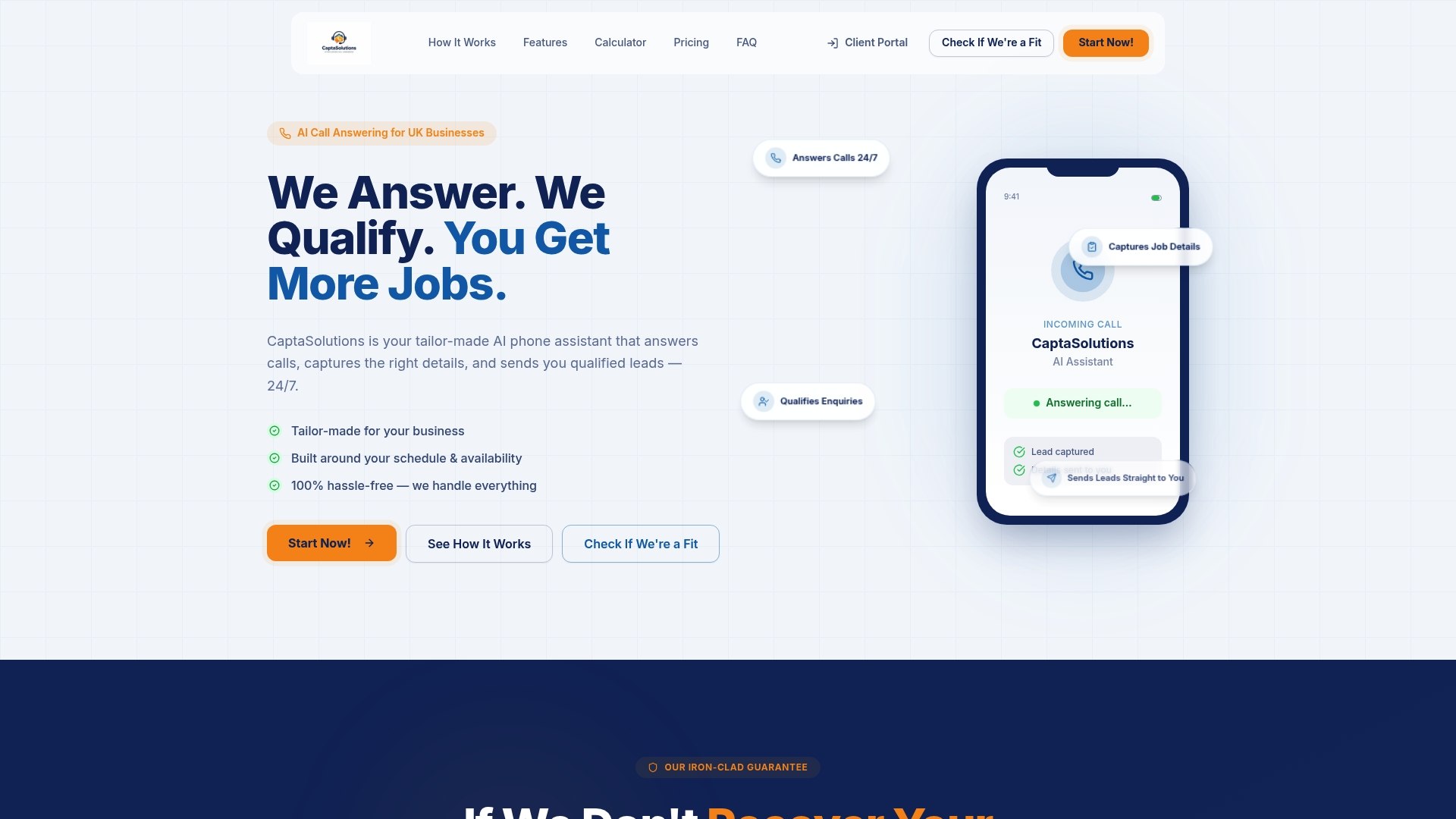
Every call a salon misses during a busy Saturday is a booking that goes to the next result on Google. Captasolutions answers those calls in the salon's name, 24 hours a day, captures the caller's details, qualifies the enquiry, and delivers a clean lead list to the client portal. There is no voicemail backlog, no missed Saturday evening enquiry, and no need for a dedicated front desk.
For salons that want to connect their online presence with their call answering, Wexla Websites provides web design for local service businesses and can help align the booking journey from first click to confirmed appointment.
Setup takes less than an hour. The free 30-day trial requires no card and no contract. If the system does not work for the salon, there is nothing to cancel. Visit captasolutions.co.uk or call 07346 811329 to get started today.
Further reading and sources for UK salons
The sources below are the most useful references for salons researching virtual receptionist services, GDPR compliance, and booking integration.
Captasolutions-owned resources:
- How salons handle appointment calls: a practical guide — implementation examples and call scripts
- Why UK salons need automated answering in 2026 — UK market context and ICO compliance checklist
- How call answering reduces no-shows for UK businesses — rebooking automation and reminder tactics
- Role of call answering in revenue: a small business guide — ROI framework for salon owners
Independent and industry sources:
- Booksy UK: the future of salon receptionists — industry research on client booking behaviour
- Forbes Advisor: best answering services — broad comparison of human-backed and AI answering services
- SchedulingKit: AI receptionist for hair salons — technical detail on service-duration mapping and stylist matching
- Booksy UK support centre — platform-specific help for salons using Booksy