

What are the main types of inbound service calls?
Inbound calls fall into four primary outcome categories: completed (answered), voicemail, missed, and abandoned. Each represents a distinct point in the customer journey and carries different implications for lead capture and service quality.
Modern call tracking systems classify these outcomes to identify where customer friction occurs. Beyond outcomes, calls are also classified by intent:
- Enquiry calls — product questions, availability checks, pricing requests
- Technical support calls — fault reporting, troubleshooting, account issues
- Sales and booking calls — new business, appointment scheduling, service quotes
- Billing and payments calls — invoices, refunds, account queries
- Complaint calls — service failures, escalations, dissatisfied customers
- Emergency calls — urgent situations requiring immediate human response
Inbound call centre operations cover all of these, each demanding a different response approach. Complaint and emergency calls require priority routing and human empathy. Routine enquiries and booking calls are well-suited to AI handling.
Call categorisation directly affects routing and prioritisation, which determines whether a lead is captured or lost. For UK small businesses, getting this right is the difference between a new customer and a missed opportunity.

Captasolutions identifies each call type on arrival, qualifies the enquiry, and routes or records it accordingly, 24 hours a day.
Table of Contents
- How call abandonment points affect your lead capture
- Never miss another inbound call with Captasolutions
- Key takeaways
How call abandonment points affect your lead capture
Abandoned calls are not a single event. They occur at distinct stages: during IVR menus, within the call queue, during ringing, or at the voicemail prompt. Each stage signals a different level of customer intent and frustration.
- IVR abandonment — the caller drops out during an automated menu, often due to complexity or length
- Queue abandonment — the caller hangs up while waiting, indicating high demand or slow response
- Ringing abandonment — the call goes unanswered entirely, the most common scenario for sole traders and small teams
- Voicemail abandonment — the caller reaches voicemail but does not leave a message
Ringing abandonment is where most small UK businesses lose leads. A tradesperson on a job, a salon mid-appointment, a restaurant during service — the phone rings and nobody answers. That caller rarely tries again.
Voice remains the preferred channel for complex or urgent calls, while AI handles high-volume, low-complexity interactions such as scheduling and availability checks. The key is matching the response mechanism to the call type. Complaint calls and emergencies need warm handoffs to a human; routine enquiries do not.
Captasolutions integrates caller identification and call history to distinguish a first-time enquiry from a returning customer, adjusting its response accordingly. This is how AI call answering moves beyond simple voicemail replacement.
Inbound call handling works best when responsiveness and empathy are built into the system, not bolted on after the fact. For home services businesses, categorising service calls by urgency and type is a practical starting point.
Pro Tip: Set up your AI answering service to flag calls from repeat numbers as priority leads. A caller who has tried twice is significantly more likely to convert than a cold first contact.
Never miss another inbound call with Captasolutions
Every missed call is a missed lead. Captasolutions answers every inbound call in your business name, captures the caller's details, qualifies the enquiry, and organises it in your client portal — whether you are on a job, with a client, or closed for the evening.
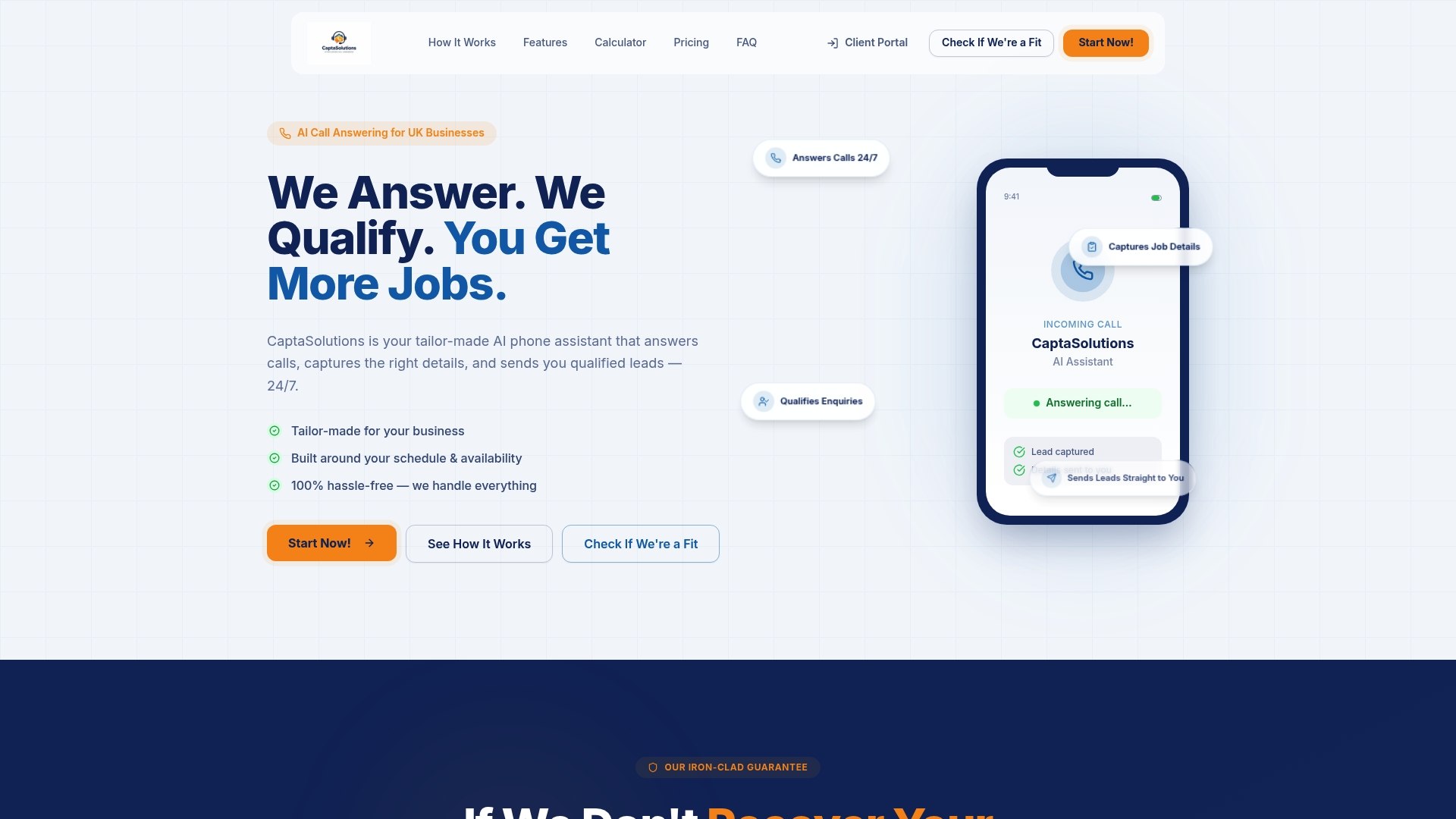
No contract. No card required. Live within the hour. Start your free 30-day trial at captasolutions.co.uk or call 07346 811329 today.
Key takeaways
Effective inbound call management starts with knowing which call type you are dealing with — because the right response to a complaint is never the same as the right response to a booking enquiry.
| Point | Details |
|---|---|
| Four core call outcomes | Completed, voicemail, missed, and abandoned calls each signal a different customer experience stage. |
| Six intent categories | Enquiry, support, sales, billing, complaint, and emergency calls each require distinct handling and routing. |
| Abandonment has four stages | IVR, queue, ringing, and voicemail abandonment each represent a separate lost-lead risk point. |
| AI suits routine calls | High-volume, low-complexity calls such as scheduling and availability checks are well-matched to AI handling. |
| Captasolutions covers all types | Captasolutions answers, qualifies, and records every inbound call, so no lead goes uncaptured. |