

UK service business enquiries fall into five distinct categories: pre-purchase questions, billing issues, technical support requests, complaints, and regulatory or tax enquiries. Each category carries a different urgency level and requires a different response approach. Understanding these common business inquiry types is the single most important step towards handling customer contacts efficiently and converting more of them into paying work.
Most service business owners treat all incoming contacts the same way. That is the core mistake. A prospect asking about your availability needs a different response to a client disputing an invoice. Getting the categories right means you respond faster, sound more professional, and lose fewer leads to slower competitors.
1. Types of UK service business enquiries: an overview
Service business enquiries are defined as any contact from a prospect or client that requires a response before, during, or after a transaction. The term "enquiry management" specifically covers the pre-sale phase: capturing interest, qualifying the contact, and responding with context. This is distinct from post-sale customer service, and most businesses confuse the two. Mixing them up creates slower responses and a worse experience for the customer.

The five core categories used across the UK service sector are pre-purchase, billing, technical support, complaints, and specialised regulatory enquiries. Each one has its own urgency benchmark, tone requirement, and routing logic. The sections below cover each in detail.
2. Pre-purchase enquiries
Pre-purchase enquiries are questions from prospects who have not yet committed to buying. They are the highest-volume category for most UK service businesses and the most time-sensitive for conversion.
Common pre-purchase contacts include:
- Pricing and quote requests
- Questions about service availability or lead times
- Comparisons of service options or packages
- Requests for references or case studies
- Questions about your qualifications, accreditations, or insurance
Speed is the defining factor here. Responding within 5 minutes versus 30 minutes can multiply conversion rates by several times when the response references the customer's specific context. That gap is significant. A prospect who calls a plumber and gets no answer will call the next one on the list within minutes.
Professional service businesses win clients by promptly acknowledging enquiries, showing they understand the need, and clarifying the next step. The reply does not need to be long. It needs to be fast, relevant, and reassuring.
Pro Tip: Set a P4 response target of 24 hours as your absolute maximum for pre-purchase contacts, but aim for under one hour during business hours. A same-day reply that references the prospect's specific question converts far better than a next-day generic response.
3. Billing and payment enquiries
Billing enquiries are contacts from existing clients about invoices, payments, refunds, or charges. They carry higher emotional weight than pre-purchase questions because money has already changed hands.
Typical billing contacts include:
- Disputes over invoice amounts or line items
- Requests for refunds or partial credits
- Questions about payment methods or terms
- Notifications of failed or delayed payments
- Requests for revised or duplicate invoices
The urgency benchmark for billing enquiries sits at P2: respond within one hour. Delays on billing contacts signal disorganisation and erode trust quickly. A client who cannot get a clear answer about a charge will escalate to a chargeback or a negative review before they escalate to your manager.
Accuracy and empathy are both required here. Acknowledge the concern first, then verify the details before responding with a resolution. Clients contacting you about billing are testing whether you are easy to work with and trustworthy. A calm, clear, and correct reply builds loyalty. A defensive or delayed one loses the client.
Pro Tip: Keep a billing enquiry log separate from your general inbox. Tag each contact by type (dispute, refund, query) and track resolution time. Patterns in the data will show you where your invoicing process creates confusion.
4. Technical support and complaints
Technical support requests and complaints are the most operationally demanding category of service sector enquiries in the UK. Both require empathy, speed, and a clear escalation path.
Technical support requests
Technical support contacts arise when a client cannot use or access a service they have paid for. Examples include a broadband fault reported to a telecoms provider, a booking system error flagged by a hospitality client, or a heating system failure reported to a maintenance contractor. These contacts are urgent because the client is currently unable to operate normally.
Complaint enquiries
Complaints differ from technical support in one key way: the client believes something went wrong due to your business's fault. That distinction matters for tone. Technical support requires competence. Complaints require empathy first, then competence.
Complaint handling is not about winning the argument. It is about making the client feel heard before you solve the problem. A client who feels dismissed will escalate publicly. A client who feels heard will often accept a reasonable resolution.
The industry standard for enquiry urgency categories classifies critical failures as P1 (respond within 15 minutes), serious issues as P2 (within one hour), and standard complaints as P3 (within four hours). Use a ticketing or CRM system to log every complaint with a timestamp. This protects you legally and shows the client their issue is being tracked.
5. HMRC and regulatory enquiries
HMRC enquiries are a distinct category of UK service business contacts that many owners are unprepared for. They are not customer contacts. They are formal communications from a regulatory body that carry legal weight and strict timelines.
HMRC investigates businesses using three main enquiry types:
| Enquiry type | Typical duration | Scope |
|---|---|---|
| Aspect enquiry | 3–6 months | Specific line items or figures in a return |
| Full enquiry | 12–18 months or more | Complete review of business records |
| Discovery assessment | Variable, up to 20 years | Undisclosed income or errors found later |
Common triggers for service businesses include inconsistent income reporting, high cash transactions, large unexplained expense claims, and significant year-on-year profit fluctuations. An Aspect enquiry is the most common and the least disruptive. A Full enquiry requires full access to your records and can run for well over a year.
The practical advice is straightforward. Keep clean, dated records of all income and expenses. Respond to HMRC correspondence within the stated deadline. Appoint a qualified accountant or tax adviser to handle all written communication. Do not ignore letters. A non-response escalates an Aspect enquiry into a Full one.
Pro Tip: If you receive an HMRC enquiry letter, do not reply directly until a qualified tax adviser has reviewed it. The scope of an enquiry can be widened by an ill-considered reply. Advisers know how to respond in a way that limits the investigation's reach.
6. How to improve enquiry management across all types
Effective enquiry management is a pre-sale process, not a customer service function. Getting it right reduces confusion, speeds up response times, and improves the customer experience before a contract is even signed.
The following practices apply across all UK service industry inquiry types:
- Use progressive capture forms. Start with contact details only, then ask optional qualifying questions. Progressive capture improves data completeness without reducing form completion rates.
- Route by intent and urgency. A billing dispute should not sit in the same inbox as a new quote request. Separate routing means faster responses and fewer dropped contacts.
- Respond fast with context. Reference the specific detail the client mentioned. A generic acknowledgement is better than silence, but a contextual reply converts and retains far better.
- Use a polite "not a fit" template. Pre-written decline responses help you turn away unsuitable enquiries without damaging your reputation. Include a referral where possible.
- Maintain a unified enquiry record. Every contact, regardless of channel, should be logged in one place. This prevents repeated explanations and gives you a full picture of each client relationship.
Pro Tip: Review your enquiry log monthly. Look for the most common question types and build templated responses for each. You will spend less time writing replies and more time on the work itself.
Key takeaways
Effective handling of UK service business enquiries depends on categorising each contact by purpose and urgency before you respond.
| Point | Details |
|---|---|
| Five core enquiry types | Pre-purchase, billing, technical support, complaints, and regulatory enquiries each need a different response approach. |
| Urgency benchmarks matter | P1 requires a 15-minute response; P4 allows up to 24 hours. Matching speed to urgency protects both conversion and client trust. |
| Pre-sale vs post-sale | Enquiry management covers pre-sale contacts only. Confusing it with customer service slows down responses and frustrates clients. |
| HMRC enquiries need specialist handling | Aspect, Full, and Discovery enquiries carry legal weight. Always involve a qualified adviser before replying. |
| Progressive capture improves routing | Collecting contact details first, then qualifying questions, speeds up routing and improves response quality. |
Why most service businesses handle enquiries badly
Most service business owners I speak with treat their inbox as a single queue. Everything goes in, everything gets answered in the order it arrived, and urgency is judged by gut feel rather than any consistent standard. That approach works when you are small and quiet. It breaks down the moment volume picks up.
The businesses that handle enquiries well do one thing differently. They decide in advance what each enquiry type looks like and what it requires. A new lead gets a fast, contextual reply. A billing dispute gets empathy and accuracy within the hour. A complaint gets acknowledgement before resolution. These are not complicated rules. They are just rules that most owners have never written down.
The other pattern I see consistently is businesses that are brilliant at the work but slow to respond to contacts. A tradesperson who does excellent work but takes two days to reply to a quote request will lose that job to someone less skilled who replied in 20 minutes. Speed does not replace quality. But in the pre-purchase phase, speed is what gets you to the quality conversation in the first place.
If you want to audit your own process, start by looking at your last 20 enquiries. How many were pre-purchase? How many were billing? How many were complaints? If you cannot answer that question, you do not have an enquiry management process. You have an inbox.
— Daniel
Captasolutions: built for UK service businesses that can't miss a contact
Every missed call is a missed enquiry. For a tradesperson mid-job, a salon with a client in the chair, or a clinic running back-to-back appointments, the phone goes unanswered and the lead moves on.
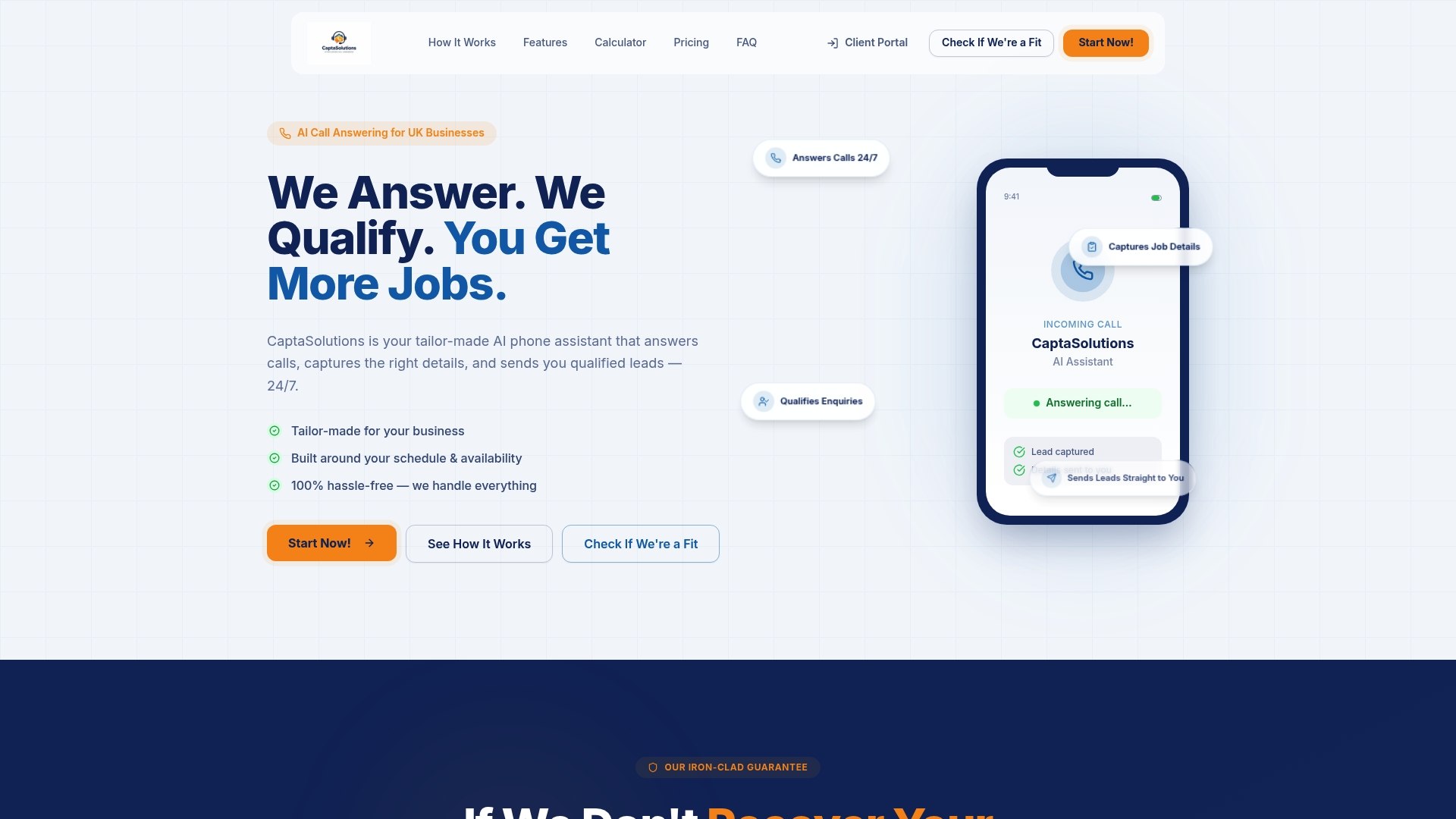
Captasolutions answers every call in your business name, 24 hours a day, 7 days a week. The AI captures the caller's details, qualifies the enquiry type, and organises everything into your client portal. You review each lead and decide what to take on. Pre-purchase, billing, or support contact, every type is captured and logged without you lifting a finger. Visit captasolutions.co.uk to start a free 30-day trial. No card required, no contract, and live within the hour.
FAQ
What are the main types of UK service business enquiries?
The five main types are pre-purchase questions, billing and payment contacts, technical support requests, complaints, and regulatory enquiries such as those from HMRC. Each requires a different response speed and tone.
How quickly should a UK service business respond to enquiries?
Response time benchmarks classify urgency from P1 (15 minutes) to P4 (24 hours). Pre-purchase enquiries should be answered within one hour during business hours to protect conversion rates.
What is the difference between enquiry management and customer service?
Enquiry management covers pre-sale contacts: capturing interest, qualifying the lead, and responding before a contract is signed. Customer service covers post-sale support. Treating them as the same process slows down both.
What triggers an HMRC enquiry for a service business?
Common triggers include inconsistent income figures, high cash transactions, and large unexplained expense claims. HMRC uses Aspect, Full, and Discovery enquiry types, with durations ranging from three months to over 20 years.
How can I handle enquiries I cannot take on without damaging my reputation?
Use a pre-written decline template that politely explains you are not the right fit and, where possible, refers the prospect to someone who is. This preserves goodwill and keeps your reputation intact.