

UK service business lead capture is the process of converting website visitors and enquiries into qualified leads using strategic assets, compliant consent mechanisms, and timely follow-up to maximise sales opportunities. The industry term for this process is lead generation, and the two concepts work together: lead generation drives traffic, while lead capture converts that traffic into contact records you can act on. For UK service businesses, tools like Google Local Services Ads, CRM platforms such as HelloGrowthCRM, and marketing platforms like Cloudswitched each play a distinct role in building a capture system that works. Get the system right, and every enquiry becomes an opportunity. Get it wrong, and you are paying for traffic that disappears.
Which lead magnets work best for UK service businesses?
A lead magnet is any free resource you offer in exchange for a prospect's contact details. The format you choose directly affects how many people sign up and how qualified those leads are.
Checklist and cheat sheet lead magnets achieve 5–10% conversion rates, while free consultations convert at 2–5% for UK service businesses. Checklists win on volume because they deliver instant value with minimal commitment from the reader. Free consultations attract fewer sign-ups but tend to produce warmer, more sales-ready leads.

| Lead Magnet Type | Typical Conversion Rate | Pros | Cons |
|---|---|---|---|
| Checklist / Cheat Sheet | 5–10% | High volume, quick to consume | Lower lead quality |
| PDF Guide / Whitepaper | 3–7% | Builds authority | Slower to produce |
| Free Consultation / Audit | 2–5% | High-intent leads | Lower volume |
| Email Mini-Course | 3–6% | Strong nurture built in | Requires ongoing content |
Matching your lead magnet to your audience's buying stage is the deciding factor. A homeowner searching for a boiler replacement needs a "What to Ask Your Heating Engineer" checklist, not a 40-page whitepaper. A business owner evaluating an accountancy firm responds better to a free tax review offer. The closer your magnet is to the actual buying decision, the higher your conversion rate will be.
Pro Tip: Focus your lead magnet on solving one specific buying decision quickly. A single-page checklist titled "5 Questions to Ask Before Hiring a Plumber" outperforms a generic "Home Maintenance Guide" every time.
For more on lead generation tactics that work specifically for service businesses, the principles of specificity and immediacy apply across every trade and profession.
How to ensure GDPR and PECR compliance in lead capture
Compliance is not optional for UK service businesses collecting contact details. The Privacy and Electronic Communications Regulations (PECR) and UK GDPR set out exactly what you can and cannot do with the data you capture.
PECR requires prior consent for email and SMS marketing to individuals, except under a strict soft opt-in exemption for existing customers. Opt-out tickboxes are not sufficient. You need a positive, affirmative action from the prospect before you send any marketing message.
The soft opt-in exemption applies only when all three conditions are met:
- You collected the contact details during a sale or negotiation of a sale
- You are marketing similar products or services only
- You gave the person a clear opportunity to opt out at the time of collection and in every subsequent message
ICO compliance audits focus on actual consent wording, the timestamp of consent, and channel-specific consent capture. Having an unsubscribe link in your emails is not enough evidence of lawful consent. You need to record the exact wording shown to the prospect, the date and time they consented, and which channel (email, SMS, phone) they consented to.
In practice, this means your CRM must store consent status, timestamp, source, and the specific marketing channel for every lead. UK GDPR-compliant CRMs capture consent status, timestamp, and lead-source attribution as standard fields in automated routing processes. If your current system does not record this data, you are exposed.
Pro Tip: Separate your transactional emails (booking confirmations, invoices) from your marketing emails in your CRM. Transactional messages do not require marketing consent, so mixing them risks triggering PECR obligations unnecessarily.
What does an effective lead capture funnel look like?
A lead capture funnel for a UK service business follows a clear sequence: attract, capture, deliver, nurture, convert. Each stage has a measurable outcome, and each failure point has a known fix.
Here is the standard funnel structure that produces consistent results:
- Landing page collects the lead's name and email in exchange for the lead magnet. Keep the page focused on one offer with no navigation links to distract the visitor.
- Immediate delivery sends the lead magnet by email. A welcome email sent within five minutes of sign-up sets the tone and prevents the lead from going cold.
- Follow-up sequence delivers 2–3 value-first emails over the following seven days. Each email should address a specific concern or question the prospect is likely to have at that stage.
- Conversion offer appears in the third or fourth email, once trust has been established. This is where you invite the prospect to book a call, request a quote, or claim a limited offer.
The metrics that matter at each stage are: landing page visit-to-sign-up rate (aim for 20–40% for a targeted audience), email open rate (35–50% is achievable for a warm list), and sign-up-to-booking rate (5–15% depending on service value and price point).
Common funnel failures include sending the lead magnet from a no-reply address, which kills reply engagement. Another frequent mistake is waiting 24 hours before sending the welcome email. By then, the prospect has moved on or forgotten they signed up.
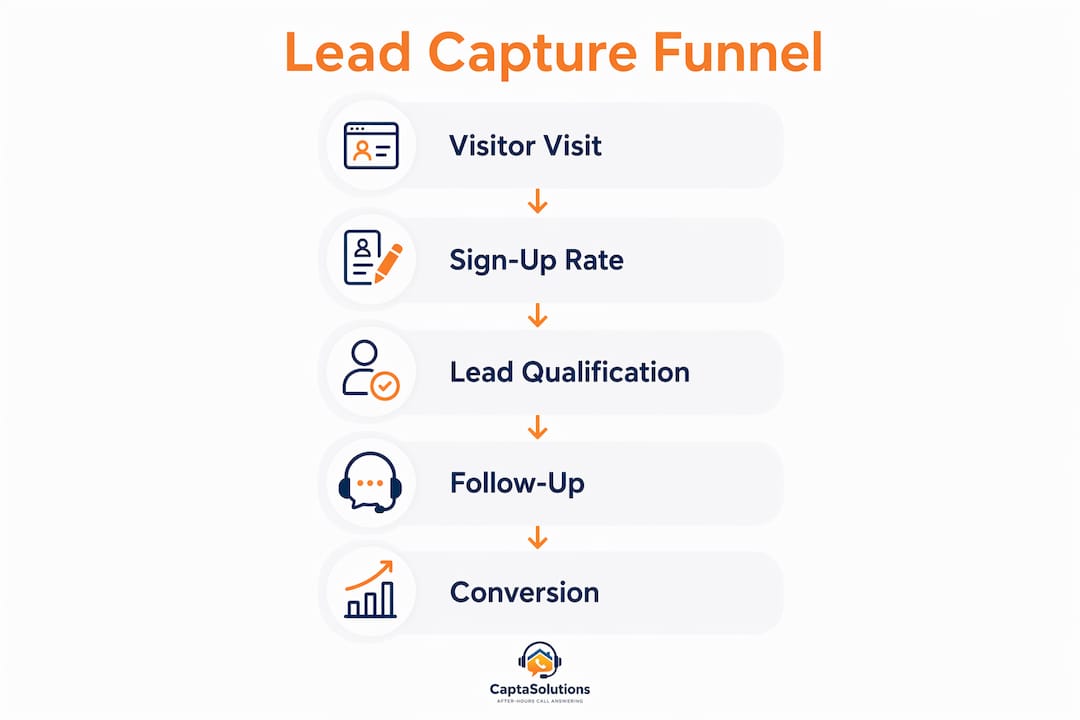
Pro Tip: Use a local business sales funnel framework to map your funnel stages before building anything. Knowing your conversion targets at each stage tells you exactly where to focus your improvement effort.
A practical follow-up guide for UK service businesses covers the recommended timeline and structure for email sequences after a prospect first makes contact.
How to integrate CRM and data management for compliant lead capture
A CRM is the backbone of any UK business lead capture strategy. Without it, leads from different channels pile up in separate inboxes, spreadsheets, and voicemail boxes, and most of them are never followed up.
Lead capture setups break at the handoff step when leads from calls, web forms, and live chats are not unified under a single record with defined response rules. This is the single most common cause of lost leads in service businesses. A call comes in while you are on a job, a web form arrives overnight, and a chat enquiry sits unread. None of them are connected, and none trigger a follow-up.
A well-structured CRM setup for UK service businesses should include:
- A single lead record for every inbound contact, regardless of channel
- Consent status, timestamp, and channel recorded as mandatory fields
- Lead source attribution so you know which marketing activity produced each lead
- Automated first-response triggers that fire within minutes of a new lead arriving
- An audit trail of every interaction for ICO compliance purposes
HelloGrowthCRM is one platform built specifically for UK B2B lead capture with these fields as standard. For trades and service businesses handling high call volumes, AI-driven scoring and routing can prioritise the most valuable enquiries automatically.
Speed-to-lead is the critical conversion lever: delivering acknowledgements within minutes and automating next steps after missed calls maximises conversion. A prospect who receives a response within five minutes is significantly more likely to book than one who waits an hour.
Pro Tip: Set up an automated acknowledgement email or SMS that fires the moment a new lead enters your CRM. Even a simple "Thanks for getting in touch, we'll call you within the hour" message keeps the lead warm and sets a professional first impression.
For more on phone enquiry qualification and how to handle inbound calls as part of your lead capture workflow, the principles of speed and consistency apply equally to digital and phone channels.
What local lead generation strategies complement online lead capture?
Online lead magnets and funnels work best when paired with local lead generation channels that put your business in front of people who are actively searching for your service right now.
Google Local Services Ads offer pay-per-lead costing around £15–£60, with typical delivery of 20–60 leads per month when combined with local landing page optimisation. That cost-per-lead compares favourably to most paid search campaigns, and the leads are pre-qualified by Google's verification process.
Local lead sources worth prioritising for UK service businesses include:
- Google Local Services Ads: Pay per verified lead, not per click. Ideal for trades, clinics, and professional services with a defined service area.
- Google Business Profile: Free to maintain and directly affects local search rankings. Reviews, photos, and service descriptions all influence click-through rates.
- Local landing pages: A dedicated page for each town or borough you serve improves organic search visibility and gives paid traffic a relevant destination.
- Checkatrade and Rated People: High-intent directories where prospects are actively comparing quotes. Useful for trades businesses building volume.
- Referral programmes: Existing clients referring new ones cost nothing per lead and convert at higher rates than any paid channel.
The key to making local lead generation work alongside your online capture system is consistency. Every lead from every source must enter the same CRM workflow. A Google Local Services Ad lead who calls your number should receive the same prompt follow-up as a web form sign-up. Understanding why tradespeople lose jobs to competitors often comes down to this exact gap: the lead arrived, but the follow-up never happened.
Track cost-per-lead and lead-to-booking rate for each source monthly. This tells you where to increase spend and where to cut it.
Key takeaways
Effective UK service business lead capture requires compliant consent collection, a unified CRM, and a fast follow-up sequence working together as a single system.
| Point | Details |
|---|---|
| Choose the right lead magnet | Checklists convert at 5–10%; match the format to the prospect's buying stage. |
| Record consent correctly | Store consent wording, timestamp, and channel in your CRM to satisfy ICO requirements. |
| Follow up within five minutes | Send the welcome email immediately after sign-up to prevent leads going cold. |
| Unify all lead sources | Route calls, web forms, and chat enquiries into one CRM record with automated next steps. |
| Track local lead ROI | Monitor cost-per-lead and booking rate by source monthly to allocate budget effectively. |
Speed is the variable most service businesses ignore
Most articles on lead capture focus on the mechanics: which lead magnet to use, how to write a landing page, which CRM to buy. Those things matter. But in my experience working with UK service businesses, the variable that separates businesses that convert well from those that do not is almost always speed.
A prospect searching for a plumber, a physio, or a cleaning service is not browsing. They have a problem and they want it solved. The first business that responds gets the job. The second business gets a polite "we've already sorted it, thanks."
The compliance side of this is also underestimated. I have seen businesses invest heavily in lead magnets and paid ads, then receive an ICO complaint because their consent wording was vague or their CRM had no timestamp records. The fine is the least of it. The reputational damage with existing clients is worse.
The practical answer is to automate the first response and the consent record simultaneously. When a lead signs up, the CRM should fire an acknowledgement, log the consent, and assign a follow-up task, all within seconds. That is not a luxury for large businesses. It is the minimum standard for any service business that takes lead capture seriously.
The businesses I have seen grow fastest are not the ones with the cleverest lead magnets. They are the ones who respond first, follow up consistently, and measure everything. The role of phone answering in business growth is a direct extension of this principle: every unanswered call is a lead that never entered your funnel.
— Daniel
Never miss a lead with Captasolutions
Every lead capture system has one weak point: the moment a prospect calls and nobody answers. That is where Captasolutions comes in.
Captasolutions is an AI-powered call answering service built for UK service businesses. It answers every call in your business name, 24 hours a day, 7 days a week. It captures the caller's details, qualifies the enquiry, and organises everything into your client portal. Whether you are a tradesperson on a job, a salon with clients in the chair, or a clinic after hours, no call goes unanswered. Every lead is captured, logged, and ready for you to act on. Start your free 30-day trial today. No card required, no contract, and live within the hour.
FAQ
What is lead capture for a UK service business?
Lead capture is the process of collecting a prospect's contact details through a form, call, or landing page so you can follow up and convert them into a paying client. For UK service businesses, this typically involves a lead magnet, a consent mechanism, and a CRM to manage follow-up.
Which lead magnet converts best for UK service businesses?
Checklists and cheat sheets convert at 5–10% for UK service businesses, making them the highest-volume option. Free consultations convert at 2–5% but attract higher-intent prospects.
Do i need GDPR consent to email leads i have captured?
Yes. Under PECR, you need prior consent or a valid soft opt-in before sending marketing emails or SMS to individuals. Opt-out checkboxes are not sufficient consent under UK law.
How quickly should i respond to a new lead?
Send a welcome email within five minutes of a new lead signing up. Leads contacted within minutes convert at significantly higher rates than those contacted hours later.
What should my CRM record for each lead?
Your CRM should record consent status, the timestamp of consent, the channel consented to, and the lead source. These fields are required to demonstrate compliance during an ICO audit.