

Automation is the single most significant lever UK businesses have for accelerating productivity and sustainable growth right now. The role of automation in UK business growth has moved well beyond theory: 75% of UK businesses using or planning AI reported productivity improvements alongside new or improved processes, according to the DSIT AI Adoption Research report published in January 2026. Whether you run a five-person trades firm or a multi-site hospitality group, the fundamentals of business automation apply equally. Ignore them and you cede ground to competitors who are already acting.
How does automation improve productivity and operational efficiency in UK businesses?
Automation, in its broadest industry sense referred to as intelligent process automation or IPA, removes repetitive, error-prone tasks from human workflows and replaces them with software-driven execution. The productivity gains are not marginal. Research from the Bank for International Settlements found that AI adoption raises labour productivity by 4% on average in the short term, without negative employment effects across European firms. For a business turning over £2 million, a 4% productivity lift translates directly into capacity for growth without adding headcount.
The impact of automation on business operations is most visible in administrative and support functions. 47% of organisations cited automation as a key AI use case, with 70% of those applications concentrated in back-office and support roles. Tasks such as invoice processing, appointment scheduling, call handling, and data entry are prime candidates because they consume significant staff time yet require no creative judgement.
Key areas where UK businesses are achieving fast efficiency wins through automation:
- Call handling and lead capture: AI-powered call answering tools qualify enquiries and log caller details without staff intervention, ensuring no lead is lost during busy periods.
- Invoice and payment processing: Automated accounts payable tools reduce manual data entry errors and accelerate payment cycles.
- Customer communications: Automated email sequences and chatbots handle routine queries, freeing staff for higher-value interactions.
- Scheduling and diary management: Booking automation removes the back-and-forth of manual appointment setting, particularly valuable in salons, clinics, and trades businesses.
- Reporting and analytics: Automated dashboards pull data from multiple sources, giving leaders accurate performance snapshots without manual compilation.
Pro Tip: Target your single biggest workflow bottleneck first. Automating one high-volume, repetitive process delivers a measurable win quickly and builds internal confidence for broader adoption.
What are the different types and use cases of automation in UK companies?
Not all automation is the same, and choosing the wrong type for your context is one of the most common and costly mistakes UK business leaders make. The three principal categories are process automation, AI-driven automation, and human augmentation tools, each suited to different operational contexts.

| Type of automation | Description | Common UK business applications |
|---|---|---|
| Robotic process automation (RPA) | Software bots that replicate rule-based human actions on digital systems | Invoice processing, data migration, compliance reporting |
| AI-driven automation | Machine learning models that handle unstructured data and make predictions | Call handling, demand forecasting, fraud detection |
| Augmentation tools | AI that assists human decision-making rather than replacing it | Legal document review, medical diagnostics support, content drafting |
| Workflow automation platforms | No-code or low-code tools connecting apps and automating multi-step processes | CRM updates, email triggers, project task assignment |
Larger firms, including Lloyds Banking Group, tend to build bespoke AI models for specific use cases such as commercial real estate risk assessment, where proprietary data and regulatory requirements demand custom solutions. SMEs, by contrast, favour off-the-shelf tools from providers such as Zapier, HubSpot, and Microsoft Power Automate, which require minimal technical expertise and deliver results within days rather than months.
Sector patterns matter here. Hospitality businesses prioritise booking and reservation automation. Information and communications firms focus on content generation and data analytics. Retail operations lean heavily on inventory management and demand forecasting tools. Understanding which category of automation fits your sector prevents wasted investment and accelerates time to value.
What are the financial impacts and profitability benefits of automation?
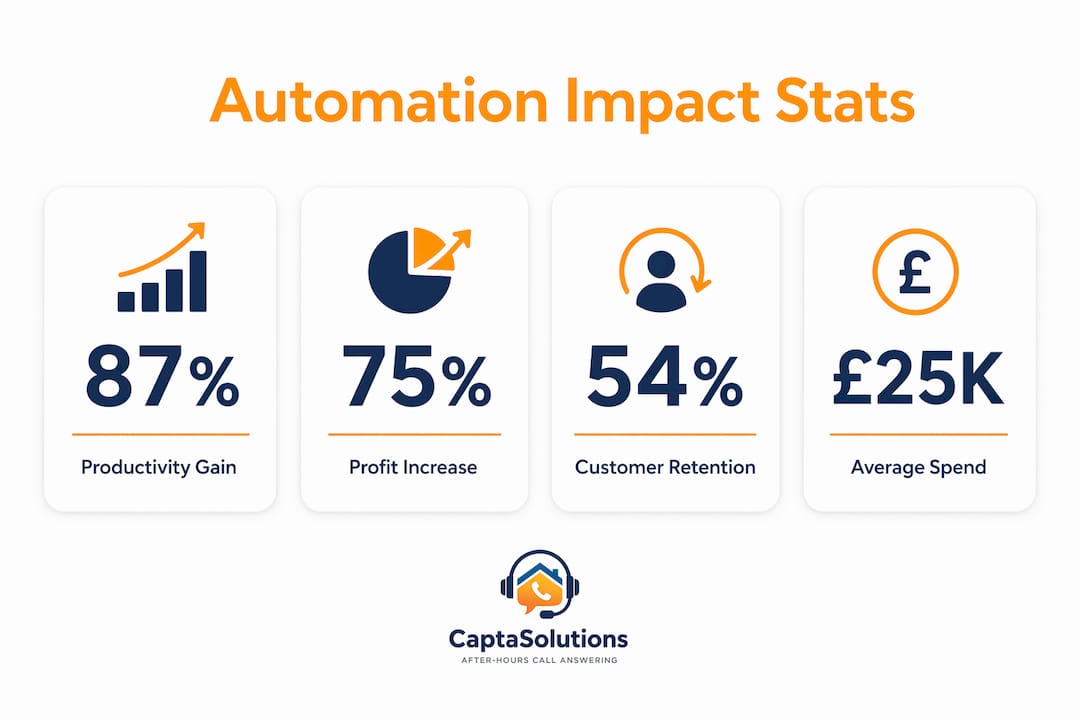
The financial case for automation in UK businesses is now well-evidenced. 87% of UK firms integrating AI report productivity gains, and 48% saw profit increases, with nearly half of those experiencing uplifts of 11% or more, according to the Lloyds Banking Group Business Barometer published in March 2026. These are not marginal improvements. An 11% profit increase for a business generating £500,000 annually represents £55,000 in additional profit, often from tools costing a fraction of that.
The accessibility of automation investment is a critical point for SMEs. Most businesses spend under £25,000 on AI and automation tools, placing meaningful capability within reach of even small operators. The barrier is rarely financial. It is more often a lack of clarity about where to start and how to measure success.
| Financial metric | Observed outcome | Implication for UK businesses |
|---|---|---|
| Productivity gain | 87% of AI-adopting firms report improvement | Capacity grows without proportional headcount increase |
| Profit uplift | 48% report increase; nearly half by 11% or more | Strong ROI case even at modest automation investment levels |
| Labour productivity | 4% average short-term increase | Measurable output gain per employee from day one |
| Typical investment | Under £25,000 for most businesses | Automation is accessible to SMEs, not just large enterprises |
Pro Tip: Measure automation ROI beyond hours saved. Track commercial metrics such as lead conversion rate, customer retention, and revenue per employee. Process metrics like cycle time and error rates give a fuller picture of where automation is genuinely driving growth.
What are the challenges and best practices for implementing automation successfully?
Automation benefits for UK companies are real, but they are not automatic. The most common barriers to successful implementation are predictable and avoidable with the right preparation.
The principal challenges UK business leaders report include:
- Skills gaps: Many teams lack the technical literacy to configure, maintain, or troubleshoot automation tools. This is not a reason to delay adoption; it is a reason to invest in training alongside deployment.
- Unclear ROI expectations: Businesses that cannot define what success looks like before they start rarely achieve it. Set specific, measurable targets tied to commercial outcomes before selecting any tool.
- Ethical and governance concerns: Automated systems that make decisions affecting customers or employees require oversight. The UK government's Data and AI Ethics Framework stresses continuous governance and accountability in AI deployment, not a one-time ethics checklist.
- Change management resistance: Staff who fear automation will eliminate their roles are less likely to adopt new tools effectively. Transparent communication about how automation redesigns roles rather than removes them is non-negotiable.
- Governance in regulated sectors: Human oversight and fallback mechanisms are mandatory for automation in customer-facing or regulated contexts. Testing, continuous monitoring, and fallback design are not optional extras.
The DSIT AI Management Essentials Tool provides a self-assessment framework for UK businesses evaluating their readiness for responsible AI deployment. Using it before committing to a specific tool or vendor reduces the risk of costly missteps. Research from the University of Essex confirms that 54% of UK firms actively using AI see limited workforce size impact, which is a useful data point for internal communications when managing staff concerns.
How can UK business leaders integrate automation into their growth strategies effectively?
Treating automation as a one-off technology project is the single most reliable way to underdeliver on its potential. The businesses seeing the strongest returns treat it as an ongoing operational model, continuously updated and governed as the business evolves. Here is a practical integration framework for UK leaders:
- Audit your current workflows. Map every recurring process that consumes more than two hours of staff time per week. Rank them by volume, error rate, and commercial impact. This becomes your automation priority list.
- Define success criteria before selecting tools. Decide whether you are targeting faster response times, lower error rates, higher lead conversion, or reduced cost per transaction. Tools chosen without defined goals rarely deliver measurable outcomes.
- Start with one high-impact process. Deploy automation in a single area, measure the results over 60 to 90 days, and use that evidence to build internal confidence and refine your approach before scaling.
- Pair automation with reskilling. Labour market research consistently shows that growth plans aligned with reskilling and job redesign outperform those focused solely on cost reduction. Redesign roles around what automation cannot do: relationship management, creative problem-solving, and complex judgement.
- Adopt augmentation over pure replacement. Augmentation strategies yield stronger long-term performance than automation approaches focused purely on cost-cutting, which risk eroding staff engagement and institutional knowledge.
- Review and iterate quarterly. Automation tools require maintenance, updates, and reconfiguration as your business changes. Build a quarterly review into your operational calendar to assess what is working and where new opportunities exist.
The future of automation in UK business belongs to leaders who treat it as a capability to be developed, not a product to be purchased. Businesses that link automation to commercial workflow metrics rather than measuring ROI narrowly make better scale-up decisions and sustain growth over time.
Key takeaways
Automation drives measurable UK business growth when it is embedded into operational workflows, tied to commercial KPIs, and supported by continuous governance and staff development.
| Point | Details |
|---|---|
| Productivity gains are proven | 75% of UK AI-adopting businesses report productivity improvements, with a 4% average labour productivity increase. |
| Financial returns are accessible | 48% of AI-adopting UK firms report profit increases, with most spending under £25,000 on tools. |
| Start with bottlenecks | Targeting high-volume, repetitive tasks first delivers fast wins and builds momentum for broader adoption. |
| Governance is non-negotiable | The UK government's Data and AI Ethics Framework requires continuous oversight, not a one-time compliance check. |
| Augmentation outperforms replacement | Pairing automation with reskilling and role redesign produces stronger long-term performance than cost-cutting alone. |
Why most UK businesses are still getting automation wrong
Having worked closely with UK businesses across trades, hospitality, and professional services, the pattern I see most often is not a failure of technology. It is a failure of expectation-setting. Leaders buy a tool, deploy it without defined success criteria, and then declare automation a disappointment when the results are ambiguous.
The second most common mistake is treating governance as a compliance exercise rather than an operational discipline. The businesses I have seen extract the most value from automation are the ones that review their automated processes quarterly, update them when workflows change, and maintain clear records of what each system does and why. That discipline is what separates a business that grows with automation from one that simply has more software.
There is also a cultural dimension that rarely gets enough attention. Automation-first approaches focused on headcount reduction create internal resistance that undermines adoption. The businesses winning with automation in 2026 are the ones framing it as a way to reduce staff overload and free people for higher-value work. That framing is not just more ethical. It is more effective.
My honest view: the future of automation in UK business is not about replacing people. It is about giving good people better tools and more time to do what they are actually good at.
— Daniel
How Captasolutions helps UK businesses automate for growth
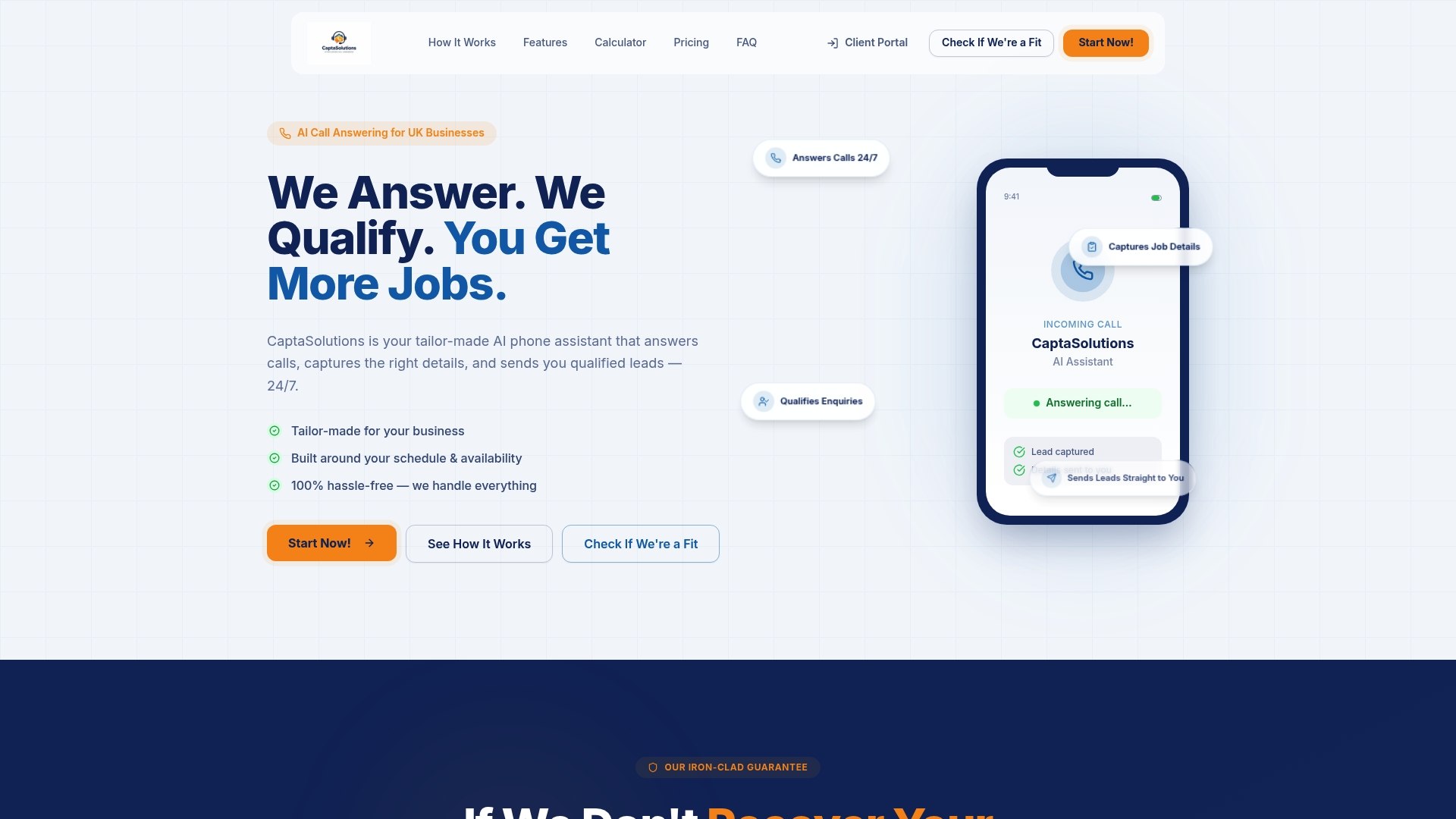
Captasolutions is an AI-powered call answering service built specifically for UK businesses that cannot afford to miss a call. Whether you are a tradesperson on a job, a salon with clients in the chair, or a professional office after hours, every unanswered call is a lost opportunity. Captasolutions answers every call in your business name, 24 hours a day, seven days a week, captures caller details, qualifies the enquiry, and organises everything into your client portal. You stay in control of every lead without being tied to your phone. For UK businesses looking to put automation to work for growth, Captasolutions offers a free 30-day trial with no card required and no contract. You can be live within the hour.
FAQ
What is the role of automation in UK business growth?
Automation drives UK business growth by removing repetitive tasks from human workflows, reducing costs, and freeing capacity for higher-value activity. Research shows 87% of UK firms integrating AI report productivity gains, with 48% seeing profit increases.
Does automation reduce jobs in UK small businesses?
The evidence suggests limited immediate impact on workforce size. Research from the University of Essex found that 54% of UK firms actively using AI report roles largely unchanged, particularly in SMEs, with automation redesigning rather than eliminating positions.
How much do UK businesses typically spend on automation tools?
Most UK businesses spend under £25,000 on AI and automation tools, making adoption accessible to SMEs as well as larger organisations. The primary barrier is not cost but clarity about where to start and how to measure results.
What are the biggest challenges of automation adoption in the UK?
The main barriers are skills gaps, unclear ROI expectations, change management resistance, and governance requirements. The UK government's Data and AI Ethics Framework and the DSIT AI Management Essentials Tool both provide structured guidance for responsible deployment.
How should UK businesses measure the ROI of automation?
Measure automation ROI using commercial metrics such as lead conversion rate, revenue per employee, and customer retention, alongside process metrics like cycle time and error rates. Tracking hours saved alone understates the true impact of automation on business performance.