

Scalable answering is defined as the ability to handle increasing call volumes and customer enquiries as your business grows, without a proportional rise in costs or headcount. For UK businesses targeting sustainable growth, this is the operational concept that separates businesses that scale confidently from those that buckle under demand. Frameworks from Shopify UK, Lock & Ledger, and K3 Advisory Group all point to the same conclusion: growth without proper systems leads to chaos. Scalable answering is the system that prevents that chaos at the customer-facing front line.
What is scalable answering for UK growth?
Scalable answering, known in operational terms as scalable call handling, means your business can absorb a doubling of inbound calls without doubling your wage bill. The standard industry term for this is operational scalability applied to customer communications. For UK business owners, it translates directly to one thing: more leads handled, more customers retained, and margins that hold as you grow.
Scalable answering lets businesses increase call volume handling without proportional costs or headcount rise, preserving margins. That matters because most UK SMEs hit a growth ceiling not from lack of demand, but from operational infrastructure that cannot keep pace. A plumbing firm winning three new contracts simultaneously, a salon expanding to a second site, or a restaurant launching a delivery service all face the same problem: the phone rings more, and the current setup cannot cope.
The role of phone answering in growth for UK businesses is well documented. Missed calls are missed revenue. Scalable answering closes that gap by building a system that grows with you, not against you.

What operational challenges does scalable answering solve?
Growing UK businesses face a predictable set of call handling problems. They are not unique to any sector. They appear in trades, hospitality, healthcare, and professional services alike.
The most common challenges include:
- Unmanaged call volumes: Calls go unanswered during busy periods, on-site work, or out-of-hours, and callers move on to a competitor.
- Rising costs without rising output: Hiring a full-time receptionist to handle more calls increases fixed costs, but call volume is rarely consistent enough to justify it.
- Customer dissatisfaction: Slow response times and missed calls damage trust. Retention suffers before growth even begins.
- Founder dependency: When the business owner is the only person answering calls, every missed call is a personal failure and a bottleneck.
- No lead qualification: Calls are answered reactively with no system to capture caller details, assess enquiry quality, or prioritise follow-up.
Each of these problems has a scalable answering solution. Automation handles volume. AI-powered systems work around the clock. Structured lead qualification replaces ad hoc conversations. UK SMEs should diagnose their operational constraints and prioritise systems before hiring. That sequence matters because premature hiring without optimised systems drains cash flow and rarely solves the underlying problem.
Pro Tip: Before investing in additional staff to handle call volume, map every stage of your current call handling process. Identify where calls are lost, delayed, or mishandled. Fix the process first, then consider headcount.
The call answering for UK SMEs challenge is fundamentally a systems challenge. Businesses that treat it as a staffing challenge consistently overspend and underperform.
How do technology and automation enable scalable answering?
Automation and technology such as AI receptionists and integrated CRM systems are the primary enablers of scalable answering. They remove manual workload, capture every interaction, and allow a business to handle significantly more customer contact without adding headcount.
The shift from traditional to scalable answering technology is significant. Here is how the two approaches compare:
| Feature | Traditional Answering | Scalable Answering Technology |
|---|---|---|
| Availability | Business hours only | 24 hours a day, 7 days a week |
| Cost model | Fixed staff salary | Usage-based or subscription |
| Call capacity | Limited by staff numbers | Unlimited concurrent calls |
| Lead capture | Manual, inconsistent | Automated, structured |
| CRM integration | Rarely included | Standard feature |
| Out-of-hours cover | Answerphone or none | AI receptionist, live response |
| Scalability | Requires new hires | Scales with demand automatically |
AI-powered call answering services answer in your business name, qualify the enquiry, capture caller details, and log everything to a client portal. The business owner reviews leads and decides what to act on. That is a fundamentally different operating model from a receptionist who takes a message on a notepad.
Cloud-native platforms integrate directly with sales pipelines and customer management tools. That means a call from a new lead at 9pm on a Friday does not disappear into a voicemail. It enters your system, gets categorised, and waits for your review. How an AI receptionist replaces UK answerphone systems is a practical shift that most UK SMEs can implement within hours, not weeks.
Pro Tip: When evaluating call answering technology, prioritise CRM integration and lead qualification capability over call volume capacity alone. A system that captures and categorises every enquiry is worth more than one that simply answers and records.
Home service automation demonstrates this clearly. Trades businesses that automate customer contact points report faster response times and higher conversion rates from initial enquiry to booked job.
What kpis should you track for scalable answering?
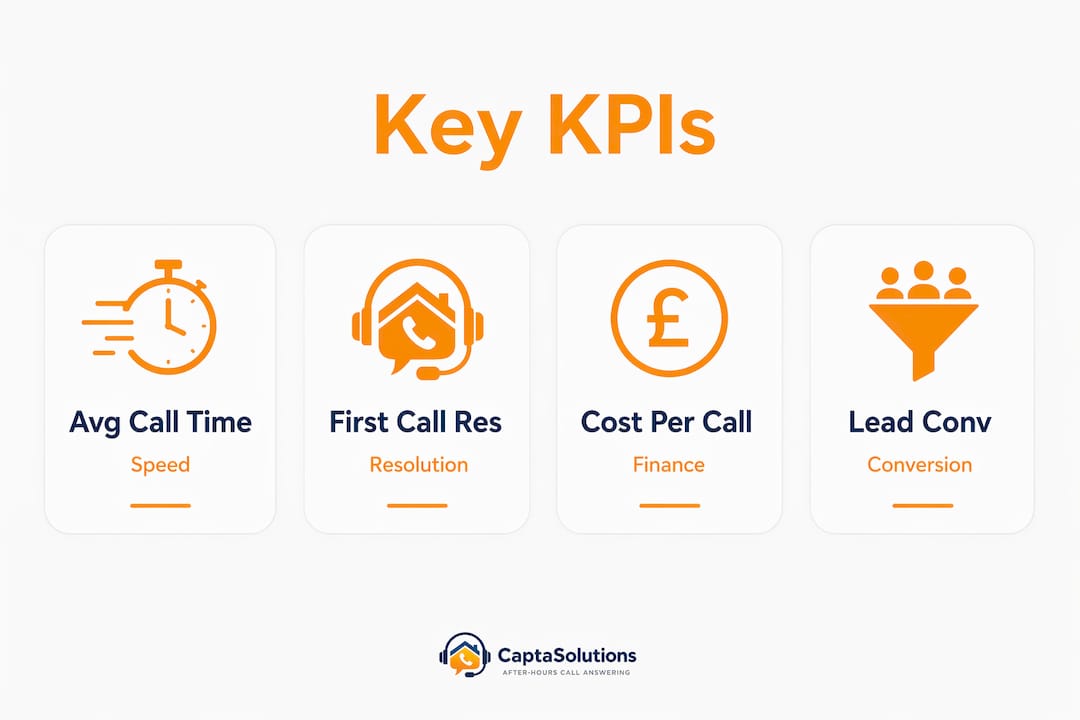
Tracking the right metrics confirms whether your scalable answering system is working. Key KPIs for scalable answering include call response time, resolution rates, cost per call, and revenue impact metrics. Without these, you are operating on assumption rather than evidence.
The following table sets out the KPI categories, what to measure, and why each one matters:
| KPI Category | Metric | Why It Matters |
|---|---|---|
| Speed | Average call response time | Slow response loses leads before conversation begins |
| Quality | First-call resolution rate | Unresolved calls require costly follow-up and damage trust |
| Efficiency | Cost per call handled | Reveals whether your answering model is financially sustainable |
| Volume | Calls handled per staff member | Shows whether automation is reducing manual workload |
| Revenue | Conversion rate from call to booking | Connects call handling directly to business income |
| Retention | Repeat caller rate | Indicates whether customers are returning after first contact |
Effective business scaling in the UK requires a 12–36 month timeline with clear resource planning and benchmarks. Apply the same discipline to your call handling KPIs. Set a baseline in month one, review monthly, and assess against your growth targets at the 90-day mark.
A 90-day execution rhythm limiting focus to up to three priorities prevents overextension. Apply that to your call handling improvement plan. Choose three metrics to improve in the first quarter. Master those before adding complexity.
Execution discipline including monthly financial reviews is critical for successful growth. Cost per call is a financial metric as much as an operational one. If your answering costs are rising faster than your revenue from calls, the model needs adjusting.
How to implement scalable answering in your UK growth strategy
Implementation follows a clear sequence. Skipping steps is the most common reason UK businesses fail to achieve the benefits of scalable answering.
- Audit your current call handling. Record how many calls you receive daily, how many go unanswered, and what happens to enquiries after the call ends. This baseline is non-negotiable.
- Identify your biggest constraint. Is it out-of-hours coverage? Unqualified leads consuming your time? Calls missed during on-site work? Prioritise the single biggest failure point first.
- Document your call handling process. Scalable businesses document workflows to avoid growing operational chaos. Write down exactly how a call should be handled, what information should be captured, and what happens next.
- Select and implement the right technology. Choose an AI-powered call answering service that integrates with your existing tools. Captasolutions, for example, goes live within the hour with no contract required.
- Set your 90-day KPI targets. Pick three metrics from the KPI table above. Set realistic targets and review them monthly.
- Review and adjust at 90 days. Assess what has improved, what has not, and what the data tells you about the next quarter's priorities.
Many UK business failures in scaling occur due to premature hiring and lack of automation before expanding the workforce. Step four in this sequence is where most businesses go wrong. They hire before they automate, and the new hire inherits a broken process.
Automation drives business growth in service businesses by removing the human bottleneck from repeatable tasks. Call answering is a repeatable task. Qualifying a lead, capturing a name and number, and logging an enquiry does not require a person. It requires a system.
Financial visibility matters here too. If customer acquisition cost exceeds customer lifetime value, scaling accelerates failure rather than growth. Track what each new customer costs you to acquire through your call channel, and compare it to what they spend over time. That ratio tells you whether your answering investment is paying off.
Key takeaways
Scalable answering works because it separates call volume growth from cost growth, giving UK businesses a way to handle more enquiries without hiring more people.
| Point | Details |
|---|---|
| Define scalable answering clearly | It means handling more calls without proportional cost or headcount increases. |
| Fix systems before hiring | Automating call handling before expanding staff preserves margins and cash flow. |
| Track the right KPIs | Measure response time, cost per call, and conversion rate to confirm the system is working. |
| Use a 90-day rhythm | Limit focus to three priorities per quarter to maintain execution discipline. |
| Technology is the enabler | AI-powered call answering and CRM integration are the core tools for scalable call handling. |
Why most UK businesses get this wrong
I have seen the same pattern repeat across UK service businesses of every size. The phone starts ringing more, which is a good sign. The owner starts missing calls, which is a bad sign. The instinct is to hire someone to answer the phone. That hire costs £22,000 to £28,000 a year, works fixed hours, takes holidays, and still cannot answer two calls simultaneously.
The businesses that scale well do the opposite. They treat call handling as a system problem, not a staffing problem. They automate the repeatable parts, document the process, and use technology to cover the hours and volume that no single person can manage. The after-hours answering piece alone is where I have seen businesses recover significant lost revenue. Callers do not wait until morning. They call the next number on the list.
The other mistake I see consistently is treating scalable answering as a cost rather than an investment. A missed call from a new customer is not a neutral event. It is lost revenue. When you calculate the average value of a new customer and multiply it by the number of calls you miss each week, the case for a scalable answering system becomes obvious. Investors prefer businesses with predictable, recurring revenue streams. A business that captures every enquiry and converts consistently is a business worth investing in.
Adopt scalable answering early. The businesses that wait until they are overwhelmed spend twice as much fixing the problem as those that build the system before they need it.
— Daniel
How Captasolutions supports scalable call handling for UK businesses
Captasolutions is an AI-powered call answering service built specifically for UK businesses that cannot afford to miss a call. Whether you run a trades business, a restaurant, a salon, or a professional office, Captasolutions answers every call in your business name, 24 hours a day, 7 days a week.
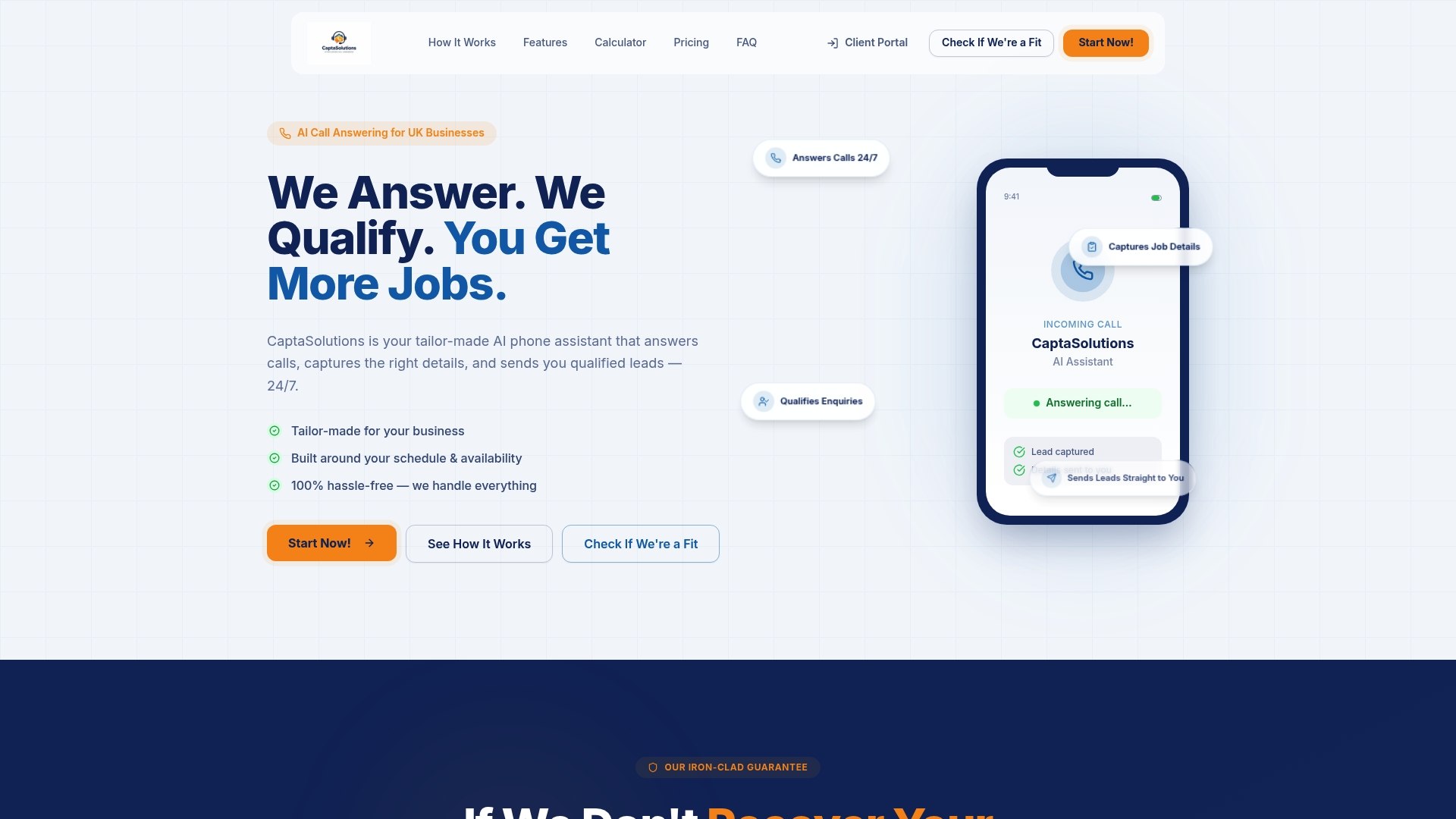
The service captures caller details, qualifies the enquiry, and organises everything into your client portal. You stay in control of every lead without being tied to the phone. There is no contract, no card required for the free 30-day trial, and the system goes live within the hour. For UK businesses serious about growth, Captasolutions is the scalable answering solution that removes the bottleneck and keeps every opportunity in play.
FAQ
What is scalable answering for UK business growth?
Scalable answering is a call handling approach that allows UK businesses to manage increasing inbound call volumes without a proportional rise in costs or staff numbers. It relies on automation, AI-powered tools, and documented processes to maintain service quality during growth.
How does ai-powered call answering support UK growth strategies?
AI call answering services handle inbound calls around the clock, capture lead details, and qualify enquiries automatically. This removes the manual bottleneck from customer contact and allows businesses to convert more enquiries without increasing headcount.
What kpis should UK businesses track for call handling?
The most important KPIs are call response time, first-call resolution rate, cost per call, and conversion rate from call to booking. Tracking these monthly against a 90-day target cycle confirms whether your answering system is supporting growth.
When should a UK business implement scalable answering?
The right time is before demand outpaces your current capacity. Businesses that automate call handling early preserve margins and avoid the cost of premature hiring. A 90-day implementation plan with clear KPI targets is the recommended starting point.
Is scalable answering only relevant for large UK businesses?
Scalable answering is most valuable for small and medium-sized UK businesses. SMEs face the sharpest trade-off between call volume and staffing costs, making automation and AI-powered call handling the most cost-effective path to growth.