
After hours answering is defined as a service that handles inbound customer calls outside standard business hours, ensuring no enquiry goes unanswered. The role of after hours answering goes well beyond simple message-taking. It is the mechanism by which UK businesses maintain continuous customer engagement, capture revenue-generating leads, and protect their reputation when the office is closed. According to Regus, telephone answering services deliver 24/7 support alongside measurable business efficiency gains. For a plumber on a job, a salon mid-appointment, or a clinic after closing time, that capability is not a luxury. It is a competitive necessity.
How does after hours answering enhance customer service and business growth?
The most direct benefit of after hours answering is that it converts calls that would otherwise be lost into qualified leads. A customer who rings at 7pm and reaches voicemail does not wait until morning. They call the next business on their list. That is revenue your competitor collects.
Zendesk Benchmark data shows that nearly half of all customers consider 24/7 support a crucial element of good customer service. That figure reflects a shift in expectation, not preference. Customers now treat round-the-clock availability as a baseline standard, and businesses that fall short are penalised in satisfaction scores and repeat custom.
The sectors that benefit most in the UK are trades, hospitality, healthcare, and professional services. A plumbing business that captures after-hours calls from homeowners facing an emergency is not just winning one job. It is building a reputation for reliability that generates referrals. A dental clinic that answers an out-of-hours query about an appointment books the slot before the patient considers a competitor.
After hours answering also supports business growth by freeing up daytime staff. When overnight and weekend enquiries are handled automatically, your team arrives in the morning with a structured list of leads to follow up rather than a backlog of missed calls to decode.
- Captures leads from customers who will not call back
- Improves customer satisfaction by meeting 24/7 availability expectations
- Reduces pressure on daytime reception staff
- Builds brand trust through consistent, professional call handling
- Generates structured lead data for follow-up
Pro Tip: Set up your after hours answering service to qualify callers by urgency and job type. A well-designed call script means your morning follow-up list is already prioritised before you start the day.
What are the common methods used for after hours call handling?
Three primary approaches exist for handling calls outside business hours: live human answering, AI-powered voice agents, and voicemail. Each carries different cost profiles, capabilities, and caller experiences.
Live answering uses a human receptionist, either in-house or outsourced to a virtual receptionist provider. The caller experience is warm and flexible, but costs are significant. A full-time UK receptionist costs upwards of £25,000 per year in salary alone, before National Insurance and benefits. Outsourced live answering services reduce that cost but still carry per-minute or per-call charges that accumulate quickly for high-volume businesses.
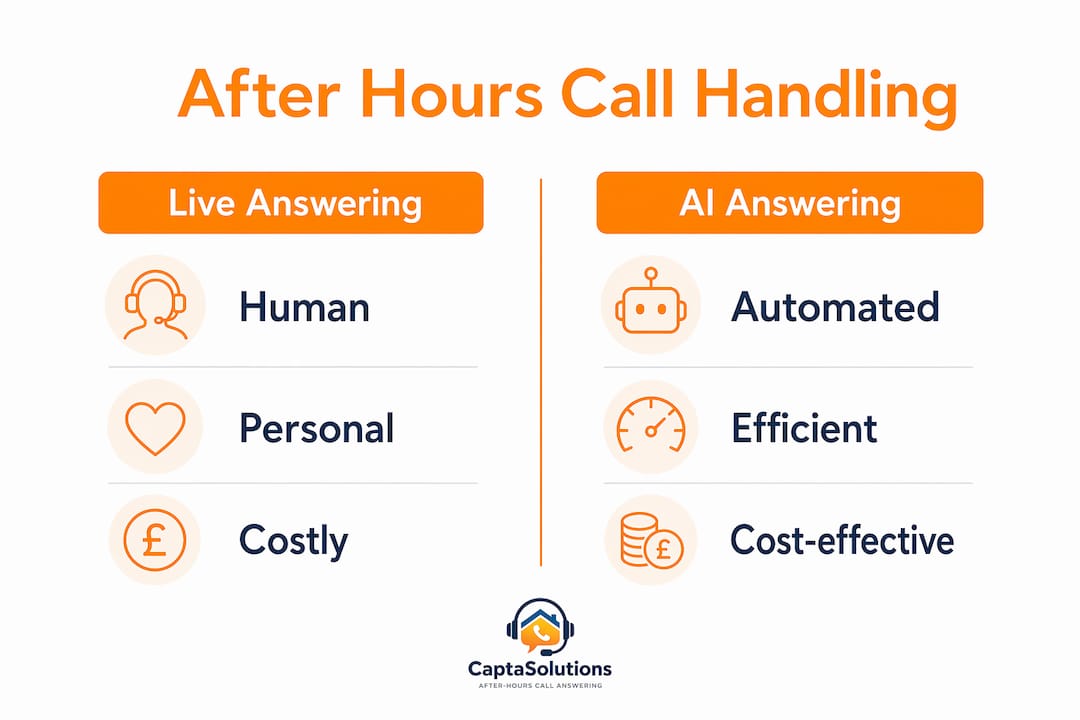
AI-powered voice agents are the fastest-growing category in the UK market. These systems answer calls within 2 seconds in 92% of cases and improve after-hours call capture by 40 to 65% compared to voicemail. That improvement in capture rate translates directly to revenue. AI agents can qualify callers, collect contact details, categorise enquiry type, and route urgent calls to an on-call number. Captasolutions operates on this model, answering every call in your business name and organising all captured data into a client portal.
Voicemail remains the default for many small businesses, but it is the weakest option. Most callers hang up before leaving a message, and those who do leave one rarely receive a timely response.
| Service type | Cost profile | Call capture | Caller experience | Compliance readiness |
|---|---|---|---|---|
| Live human answering | High (£25k+ per year) | High | Warm, flexible | Moderate |
| AI voice agent | Low to moderate | Very high (40-65% uplift) | Consistent, professional | High (with correct setup) |
| Voicemail | Very low | Low | Impersonal | Minimal |
Remote support technology also removes geographical constraints, meaning a UK business can access expert call handling at any hour without needing local staff on standby.
Pro Tip: If you are moving from voicemail to an AI answering service, run both in parallel for two weeks. Compare call capture rates and caller feedback before switching fully. The data will confirm the decision.
How does after hours answering comply with UK regulations?
UK businesses using automated or AI-powered call answering must meet specific legal requirements under Ofcom rules, GDPR, and the Privacy and Electronic Communications Regulations (PECR). Non-compliance carries financial penalties and reputational risk.
The compliance requirements for after hours answering services in 2026 are as follows:
- Disclose automation within 5 seconds. Ofcom requires that AI or automated calls disclose their nature at the very start of the interaction. The AI must not impersonate a named human individual.
- Obtain lawful basis for data processing. Under GDPR, any caller data collected during an after hours call must be processed under a documented lawful basis, typically legitimate interest or contractual necessity.
- Notify callers of call recording. PECR requires that callers are informed if the call is being recorded, and that they have a reasonable opportunity to object.
- Design compliant call scripts. Call scripts must include the required disclosures without burying them in lengthy introductions. The script structure directly affects both compliance and caller experience.
- Establish escalation protocols. Calls involving sensitive data, complaints, or urgent safety matters must have a defined escalation path to a human agent. Automated handling alone is insufficient for these categories.
Transparency in AI call handling improves customer trust rather than undermining it. Callers who are told clearly that they are speaking with an AI and that their details will be passed to the business team respond positively when the interaction is efficient and professional.
How can you measure the ROI of after hours answering?
The financial case for after hours answering is measurable, not theoretical. The metrics that matter most are call capture rate, lead conversion, appointment attendance, and staff time saved.
AI receptionists improve after-hours call capture by 40 to 65% over voicemail. For a business receiving 20 after-hours calls per week, that improvement represents 8 to 13 additional captured enquiries every week. At even a modest conversion rate, the revenue impact is substantial within the first month.
Appointment-based businesses see a further benefit. Businesses using AI receptionists with automated SMS reminders report a 28% reduction in no-shows. For a dental practice, beauty salon, or physiotherapy clinic, that figure directly affects daily revenue and scheduling efficiency.
| Metric | Typical improvement |
|---|---|
| After-hours call capture rate | 40-65% increase over voicemail |
| No-show reduction | 28% with automated SMS reminders |
| Call answer speed | 92% answered within 2 seconds |
| Staff time saved | Significant reduction in morning call backlog |
You can review call answering ROI examples from UK businesses to benchmark your own potential gains. The internal efficiency argument is equally strong. When after hours calls are handled and logged automatically, your team spends less time chasing missed calls and more time on billable work.
What should UK business owners consider when choosing a solution?
Choosing the right after hours answering solution requires matching the service to your call volume, customer expectations, and operational structure. Not every business needs the same approach.
- Call volume and urgency. A trades business receiving emergency calls at night needs a different setup to a professional services firm that handles enquiries during evenings. Clarifying service scope and emergency criteria before you sign up prevents mismatched expectations.
- Budget and cost-effectiveness. AI-powered services cost a fraction of live answering. For most small and medium UK businesses, AI is the practical choice. Live answering may suit businesses where caller relationships are highly personal.
- Technology integration. The service should feed captured data directly into your existing CRM or client management system. Manual data transfer defeats the efficiency purpose.
- Compliance support. Your provider should offer compliant call scripts and documented data handling processes. Do not assume compliance is built in. Ask for evidence.
- Scalability. A solution that works for 10 calls per week should also handle 100 without degrading caller experience. Confirm how the service scales before committing.
After hours communication strategies that segment calls by urgency and type produce better outcomes than a single-script approach. A well-structured service routes emergency calls to an on-call number, logs routine enquiries for morning follow-up, and handles appointment requests automatically.
Key takeaways
After hours answering is the single most effective way for UK businesses to capture missed revenue and maintain customer satisfaction outside standard operating hours.
| Point | Details |
|---|---|
| Core role | After hours answering captures leads and maintains customer engagement when the office is closed. |
| AI outperforms voicemail | AI voice agents improve call capture by 40-65% and answer 92% of calls within 2 seconds. |
| Compliance is non-negotiable | Ofcom requires AI calls to disclose automation within 5 seconds; GDPR governs all caller data. |
| ROI is measurable | Businesses see 28% fewer no-shows and significant reductions in missed leads within weeks. |
| Choosing the right fit | Match the solution to your call volume, urgency profile, budget, and integration requirements. |
After hours answering: what I have learned from UK businesses getting it right
I have worked with enough UK business owners to know that the biggest objection to after hours answering is not cost. It is the belief that customers will wait. They will not. The data is unambiguous on this point, and the businesses I have seen thrive are the ones that stopped hoping customers would call back and started making sure every call was answered the first time.
What surprises most owners is how quickly the ROI becomes visible. Within the first fortnight of switching from voicemail to an AI answering service, the morning call log changes character entirely. Instead of a list of missed calls with no context, you have a structured set of qualified enquiries with caller details, job type, and urgency level already recorded. That shift alone changes how a business starts its day.
The compliance piece is where I see the most avoidable mistakes. Business owners assume their provider has handled it. Some have. Many have not. The Ofcom disclosure requirement is specific and non-negotiable. If your AI answering service does not identify itself as automated within the first five seconds of a call, you are exposed. Ask your provider directly and get a written confirmation.
The businesses that get the most from after hours answering are those that treat it as part of their customer service strategy, not a bolt-on. They design their call scripts with care, review their captured leads daily, and use the data to improve their follow-up process. The technology does the heavy lifting. The strategy determines the outcome.
— Daniel
How Captasolutions supports your after hours answering
Captasolutions is an AI-powered call answering service built specifically for UK businesses that cannot afford to miss a call.
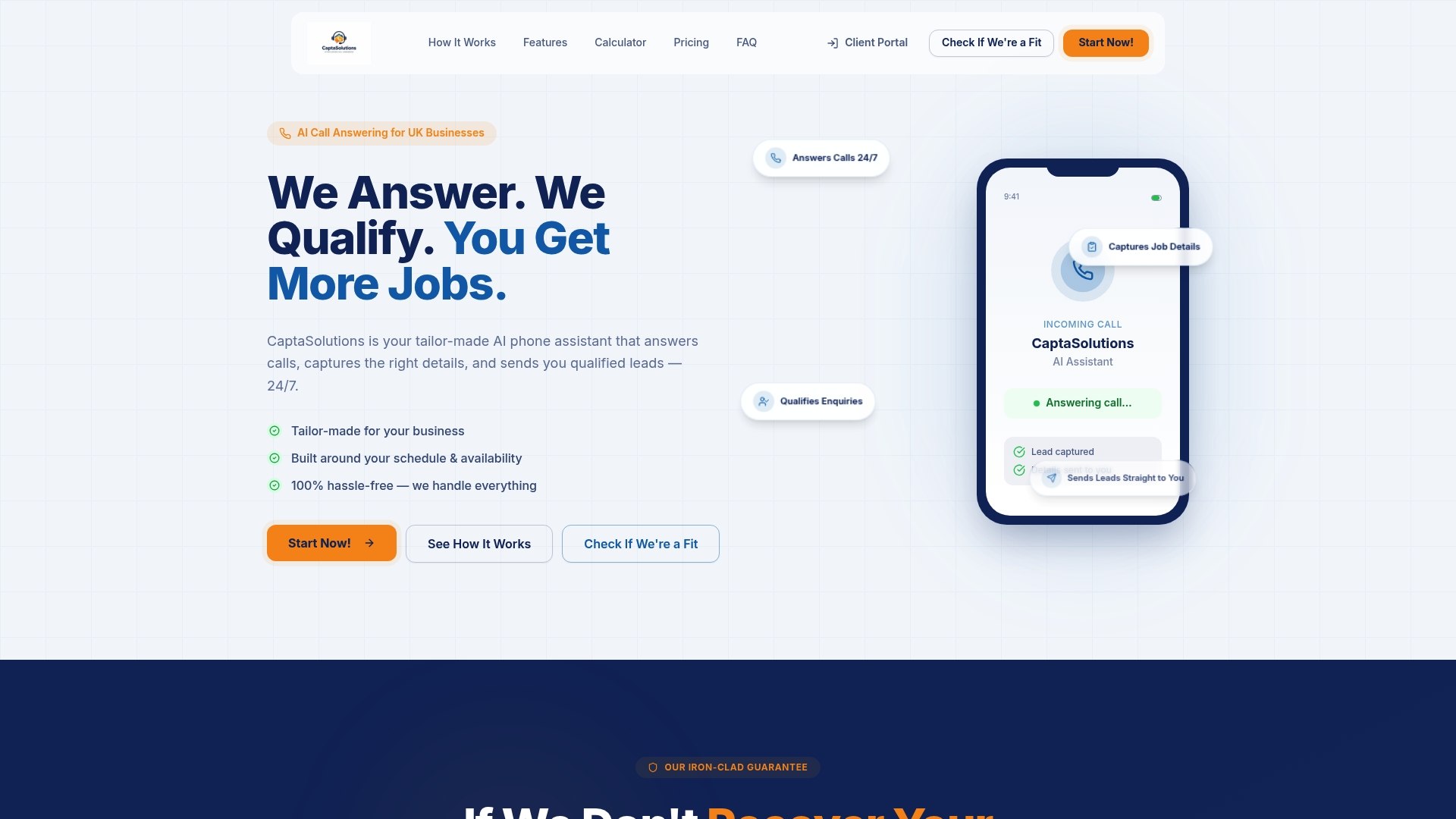
Whether you run a trades business, a clinic, a salon, or a professional office, Captasolutions answers every call in your business name, 24 hours a day, seven days a week. The AI captures caller details, qualifies the enquiry, and organises everything into your client portal. You stay in control of every lead. The service is fully compliant with Ofcom and GDPR requirements, with disclosure-ready call scripts built in. Visit Captasolutions to start your free 30-day trial. No card required, no contract, and live within the hour.
FAQ
What is the role of after hours answering for a small UK business?
The role of after hours answering is to capture inbound calls and enquiries outside standard business hours, preventing missed leads and maintaining customer satisfaction. For small UK businesses, it replaces voicemail with a professional, responsive service that qualifies callers and logs their details automatically.
How are after hours calls handled by AI answering services?
AI answering services answer calls within seconds, follow a pre-designed script to collect caller information and categorise the enquiry, and route urgent calls to an on-call number if required. All captured data is stored in a client portal for the business owner to review.
Is after hours answering compliant with UK law?
Yes, provided the service meets Ofcom and GDPR requirements. Ofcom requires AI or automated calls to disclose their automated nature within the first 5 seconds, and all caller data must be processed under a documented lawful basis.
What is the cost difference between AI and live after hours answering?
AI-powered after hours answering costs significantly less than live human answering. A full-time UK receptionist costs upwards of £25,000 per year, while AI services typically operate on a low monthly subscription, making them accessible to businesses of all sizes.
How quickly can a business see results from after hours answering?
Most businesses see measurable improvements within the first two weeks. Call capture rates improve by 40 to 65% over voicemail, and appointment-based businesses typically see a reduction in no-shows of around 28% when automated SMS reminders are included.