

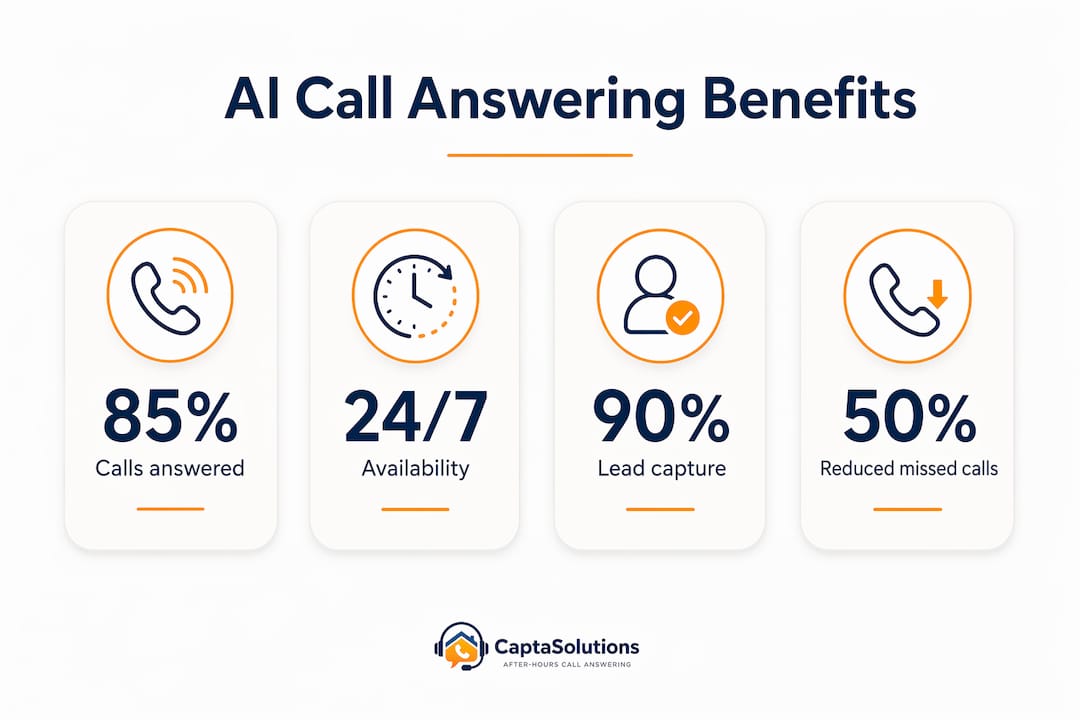
Yes, AI call answering gives UK small businesses a measurable competitive advantage. UK business AI adoption has risen from 12% to 35% since late 2023, yet most implementations remain shallow. The businesses that go deeper, specifically by deploying AI at the point of first contact, capture leads their competitors miss entirely.
The core advantages come from three directions:
- Availability: AI answers every call, 24 hours a day, 7 days a week, including evenings, weekends, and mid-job.
- Lead capture and qualification: Every caller's details are captured and the enquiry is assessed before it reaches you.
- Speed to response: Callers get an immediate, professional answer in your business name, not a voicemail they will not leave.
Table of Contents
- How does AI call answering create a competitive advantage for UK businesses?
- When should AI hand over to a person?
- What does UK regulation mean for AI call answering?
- How do you adopt AI call answering as a small UK business?
- How do you measure ROI from AI call answering?
- Which sectors benefit most from AI call answering?
- Key takeaways
- Why culture matters more than the technology
- Try Captasolutions with no commitment
- Sources and further reading
How does AI call answering create a competitive advantage for UK businesses?
The role of AI answering in UK competitive advantage is most visible at the moment a potential customer calls and nobody picks up. That caller does not wait. DSIT's AI Adoption Research found that a majority of UK businesses cite efficiency and productivity as their primary reason for adopting AI, but the conversion argument is equally compelling: a missed call is a missed booking, and a missed booking is revenue that goes to whoever answered.
AI call answering addresses four benefit categories directly.
- Availability and speed: Calls answered outside business hours are no longer lost. Trades businesses on a job, restaurants mid-service, and salons with clients in the chair all face the same problem. AI removes it.
- Lead qualification: The AI captures name, number, enquiry type, and urgency, so you review a structured lead rather than a vague voicemail.
- Conversion uplift: Qualified leads that arrive with full caller details convert at a higher rate than cold callbacks from missed calls.
- Staff redeployment: Reception and call-handling time shifts to higher-value work. The ONS notes that AI for operational improvements is the most reported use across all business sizes, with a majority of businesses citing it.
There is a second layer of competitive advantage that most small businesses overlook entirely. AI Overviews now appear in over 40% of all Google searches and exceed 60% for informational or research-intent queries. Businesses that structure their service pages for Answer Engine Optimisation (AEO) are cited in those AI answers. Those that do not are invisible to a growing share of buyers before a call is ever made.
Pro Tip: Trades businesses gain most from after-hours availability; hospitality and clinics gain most from qualification and routing. Identify your highest-loss point first and configure the AI script around it.
When should AI hand over to a person?
UKRI recommends human-in-the-loop designs that use AI to support service pathways from first enquiry to delivery, rather than replacing human judgement at critical points. The practical split is straightforward.
AI handles safely:
- Answering every inbound call in your business name.
- Capturing caller name, number, and enquiry details.
- Running a basic qualification script (job type, location, urgency, budget range).
- Routing to the right team member or booking a callback slot.
- Logging the interaction and sending a summary to your client portal.
Human handover is required when:
- The caller raises a complaint or dispute.
- Payment authorisation or contract terms are discussed.
- Sensitive personal data is involved (medical history, legal matters).
- The caller explicitly requests a person.
- The enquiry falls outside the AI's configured scope.
Designing the handoff well matters as much as the technology. Your escalation rules should include a clear privacy notice at the start of each call, a defined SLA for staff callback after an AI interaction, and a logged record of every handover trigger. Read more on how AI handles after-hours calls and the specific handover points that protect caller trust.
Pro Tip: Script the AI's opening line to match your brand tone exactly. Callers who hear a confident, professional greeting in your business name rarely object to speaking with an AI first, provided the handover to a person is fast and warm when it occurs.

What does UK regulation mean for AI call answering?
The UK's post-Brexit regulatory position gives businesses more flexibility than their EU counterparts, but industry analysts warn this is an opportunity with an expiry date. Act now, but design for tighter rules ahead.
For call answering specifically, the practical ICO and UK GDPR considerations are:
- Consent and notification: Callers must be informed their call is being handled by an AI system and that their data is being recorded or processed.
- Data retention: Define and document how long caller data is held and who can access it.
- International data transfers: If your vendor processes data outside the UK, confirm the transfer mechanism is lawful under UK GDPR.
- Deletion policy: You must be able to delete a caller's data on request.
Before signing with any vendor, ask these questions directly:
- Where is caller data stored, and is it within the UK or EEA?
- What encryption standards apply to data in transit and at rest?
- Who has access to call recordings and transcripts?
- What is the data deletion process and turnaround time?
- Are audit logs available for ICO compliance purposes?
On market signals: around 85% of UK SMEs currently have no measurable AI visibility, and fewer than 5% have taken deliberate steps to improve it. That gap is the opportunity. First-mover citation authority compounds through 2027, making early action commercially sensible.
How do you adopt AI call answering as a small UK business?
The practical path from decision to live service is shorter than most owners expect.
- Audit your missed calls. Pull the last 30 days of call data. Identify how many calls went unanswered and at what times. This is your baseline.
- Fix your digital foundations. Add FAQ schema and answer-first content to your key service pages. AEO implementations can earn AI Overview citations within 6–12 weeks.
- Check your Google Business Profile. Confirm your hours, services, and phone number are accurate. AI search pulls from structured local signals.
- Select a vendor and ask the security questions listed in the regulatory section above.
- Configure your call script. Define qualification questions, routing rules, and escalation triggers before go-live.
- Go live. Captasolutions, for example, is live within the hour. No technical integration is required to start.
- Train your team. Staff need to know how to read portal summaries, respond to escalation notifications, and handle warm handovers.
- Measure at 30 and 90 days. Compare missed-call rate, lead capture volume, and conversion against your baseline.
For a detailed walkthrough, the practical UK guide to switching covers vendor selection and go-live steps in full.
Vendor questions to confirm before committing: custom script options, CRM or booking system integration, trial terms with no card required, and the handover SLA for escalated calls.
How do you measure ROI from AI call answering?
| KPI | What to measure | How to calculate |
|---|---|---|
| Missed-call rate | Calls unanswered as % of total | Missed ÷ total × 100 |
| Lead capture rate | Leads logged ÷ calls answered | Portal entries ÷ answered calls × 100 |
| Lead-to-booking conversion | Bookings from AI-captured leads | Bookings ÷ leads × 100 |
| Cost per handled call | Monthly service cost ÷ calls handled | Fixed fee ÷ call volume |
| Staff hours saved | Hours previously spent on call handling | Pre-AI hours minus post-AI hours |
For trades businesses, the clearest ROI signal is the number of after-hours enquiries that convert to booked jobs. For clinics and salons, track appointment bookings sourced from AI-handled calls versus the previous missed-call baseline. Hospitality venues typically see the sharpest gains in reservation capture during peak service hours.
Pro Tip: Tag AI-handled calls in your CRM from day one. Use a dedicated call-tracking number or UTM parameter on your booking confirmation to link closed revenue back to AI-captured leads. Without this, you are measuring activity, not income.
Which sectors benefit most from AI call answering?
The sector use-cases follow a consistent pattern: the businesses that gain most are those where the owner or staff are physically unavailable to answer during peak demand.
- Trades: A plumber on a job cannot answer a new enquiry. AI captures the caller's details, qualifies the job type and location, and sends a structured lead to the portal. The tradesperson reviews it between jobs and calls back with full context.
- Hospitality: A restaurant during Saturday service cannot staff the phone. AI takes reservation enquiries, captures party size and preferred time, and routes urgent calls to a manager. No reservation is lost to a busy signal.
- Clinics and salons: Appointment enquiries arrive outside opening hours. AI answers, captures the treatment requested and preferred dates, and logs the lead for the front desk to confirm in the morning.
Captasolutions answers every call in your business name, captures caller details, qualifies the enquiry, and organises everything into your client portal. The free 30-day trial requires no card and no contract, and the service is live within the hour. For a full feature overview, see how an AI receptionist works for UK businesses.
Key takeaways
AI call answering delivers competitive advantage for UK small businesses by eliminating missed calls, capturing qualified leads 24/7, and freeing staff for higher-value work.
| Point | Details |
|---|---|
| Missed calls are lost revenue | Every unanswered call is a lead that moves to a competitor; AI removes that gap entirely. |
| Qualification matters as much as availability | Capturing caller details and enquiry type converts more leads than a simple voicemail ever will. |
| Regulatory compliance is non-negotiable | Confirm data residency, deletion policy, and ICO-compliant consent notices with any vendor before going live. |
| Measure from day one | Track missed-call rate, lead capture rate, and lead-to-booking conversion against your pre-AI baseline. |
| Captasolutions trial | Free 30-day trial, no card required, no contract, live within the hour — start with the audit in Section 5. |
Why culture matters more than the technology
Most UK businesses that adopt AI call answering treat it as a cost-saving pilot. They set it up, leave the default script in place, and check the portal occasionally. The ONS data is unambiguous on this point: UK AI adoption has widened significantly, but the average adopter uses only 1.6 AI tools and rarely deepens the implementation. Scott Pope frames this as a culture problem, not a technology one.
The businesses that extract genuine competitive advantage treat AI answering as an operational change. They configure the qualification script around their actual sales process. They train staff to act on portal summaries within a defined SLA. They review the data monthly and adjust. The technology is the easy part. The discipline of using it consistently is what separates a business that captures 30% more leads from one that captures the same number it always did, slightly more tidily.
Try Captasolutions with no commitment
Every missed call costs you a lead. Captasolutions answers every inbound call in your business name, 24 hours a day, 7 days a week. The AI captures caller details, qualifies the enquiry, and organises everything into your client portal. You stay in control of every decision.
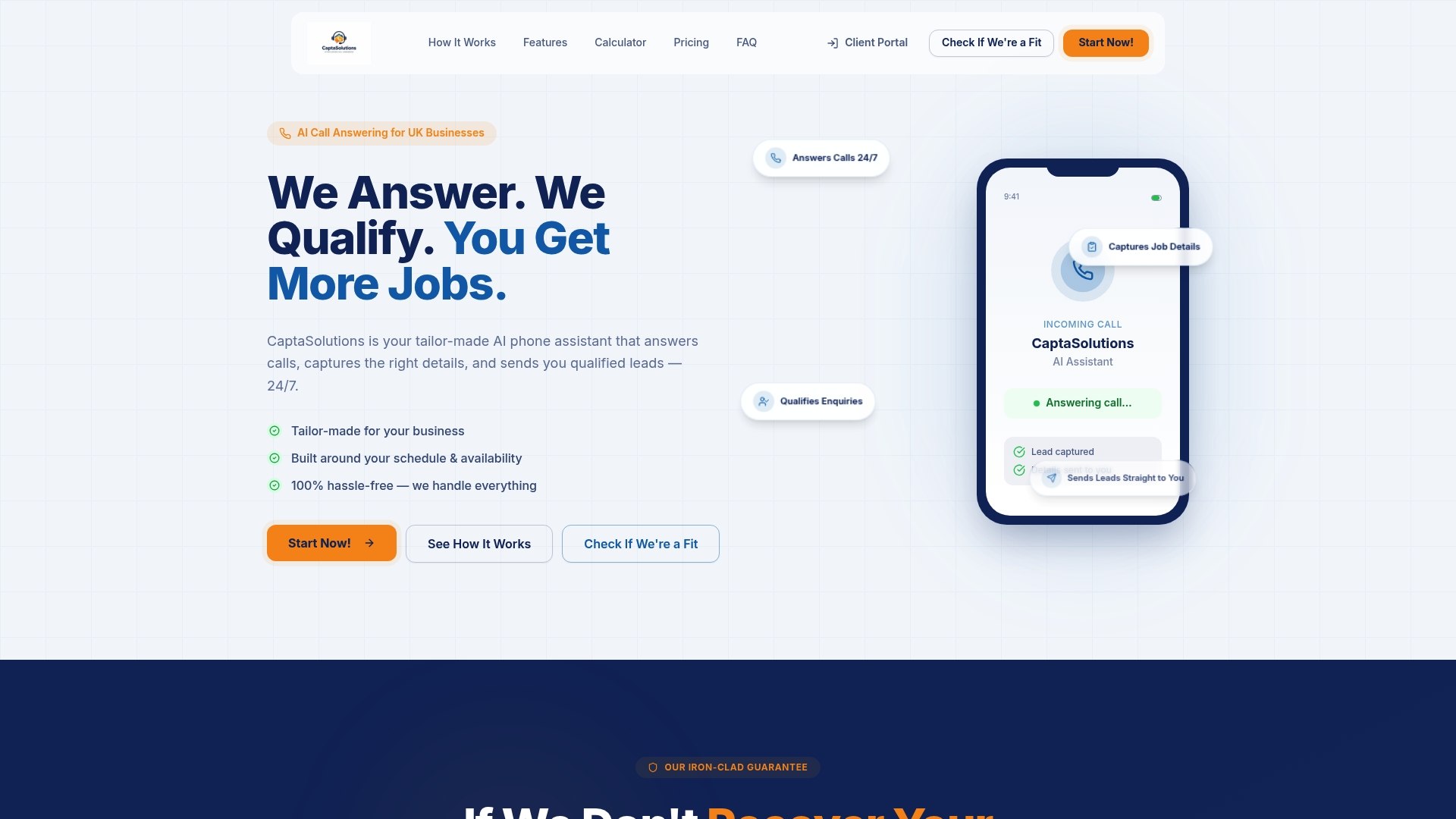
The free 30-day trial requires no card and no contract. The service is live within the hour. Before you start, run through the vendor security questions in the regulatory section above — Captasolutions is built to answer all of them. Visit captasolutions.co.uk to begin your trial today, or call 07346 811329.
Sources and further reading
- ONS: AI in UK businesses (2023–2026) — primary data on UK AI adoption rates and business use patterns.
- DSIT: AI Adoption Research — motivations, barriers, and efficiency findings from UK businesses.
- UKRI AI Research and Innovation Strategic Framework — guidance on human-in-the-loop design and trust-preserving AI service models.
- MarGen: AI Search in the UK — 2026 State of the Market — AI Overview prevalence, first-mover advantage, and buyer behaviour shifts.
- Redeagle: Answer Engine Optimisation — Complete 2026 UK Guide — AEO tactics, structured data, and citation probability.
- Klarai: Answer Engine Optimisation — 2026 UK AEO Guide — implementation timing and FAQ schema guidance.
- DBS Digital: AI Search Visibility — 7 Steps for UK SMEs — baseline visibility data and quick-win priorities for small businesses.
- ResultSense: EU regulation and the UK AI race — regulatory flexibility as a time-limited opportunity for UK firms.