

AI call handling after hours is defined as an automated voice agent that answers every inbound call outside business hours, qualifies the caller's needs, and routes or records the outcome without human involvement. For UK businesses, this is no longer a luxury. 80% of callers complete their interaction with an AI agent without needing a human, and businesses using AI for out-of-hours calls see booking rates rise by 17% compared to traditional overflow methods. The industry term for this technology is an AI voice agent, though you will also hear it called an automated call answering service or virtual receptionist. Understanding how AI manages out-of-hours calls is the first step to recovering revenue that currently walks out the door every evening.
How AI handles after-hours UK calls in practice
An AI voice agent answers every call within seconds, regardless of the time. There is no hold music, no voicemail prompt, and no missed opportunity. The caller hears a natural, conversational greeting in your business name and is guided through a structured dialogue that identifies what they need.
The core process works like this:
- Immediate answer: The AI picks up on the first or second ring, 24 hours a day, seven days a week.
- Natural language understanding: The agent identifies caller intent through conversational questions, not rigid menu options. A caller saying "I need someone to look at my boiler" is understood as an urgent heating enquiry, not a generic callback request.
- Lead qualification: The AI asks structured questions relevant to your business. A plumber's AI agent asks about the type of job, location, and urgency. A solicitor's agent asks about the nature of the legal matter and preferred contact time.
- Urgency classification: Calls are categorised by priority. Emergency repairs, urgent medical queries, and time-sensitive bookings are flagged differently from general enquiries.
- Data capture: The caller's name, number, address, and enquiry details are recorded accurately and stored for your team to review.
After-hours booking opportunities vary significantly by sector. A restaurant receives reservation requests at 10PM. A tradesperson gets emergency call-outs at midnight. A salon gets appointment bookings on Sunday morning. The AI handles all of these with the same consistency.
Pro Tip: Train your AI agent with real examples of how your customers describe their problems. "Leaky tap," "dripping pipe," and "water coming through the ceiling" all mean different things in terms of urgency. The more specific your training, the more accurate the qualification.
What escalation and handover mechanisms do AI systems use?
AI voice agents are not designed to handle every call independently. The most effective systems know their limits and act on them quickly. This is where call boundary detection becomes critical.
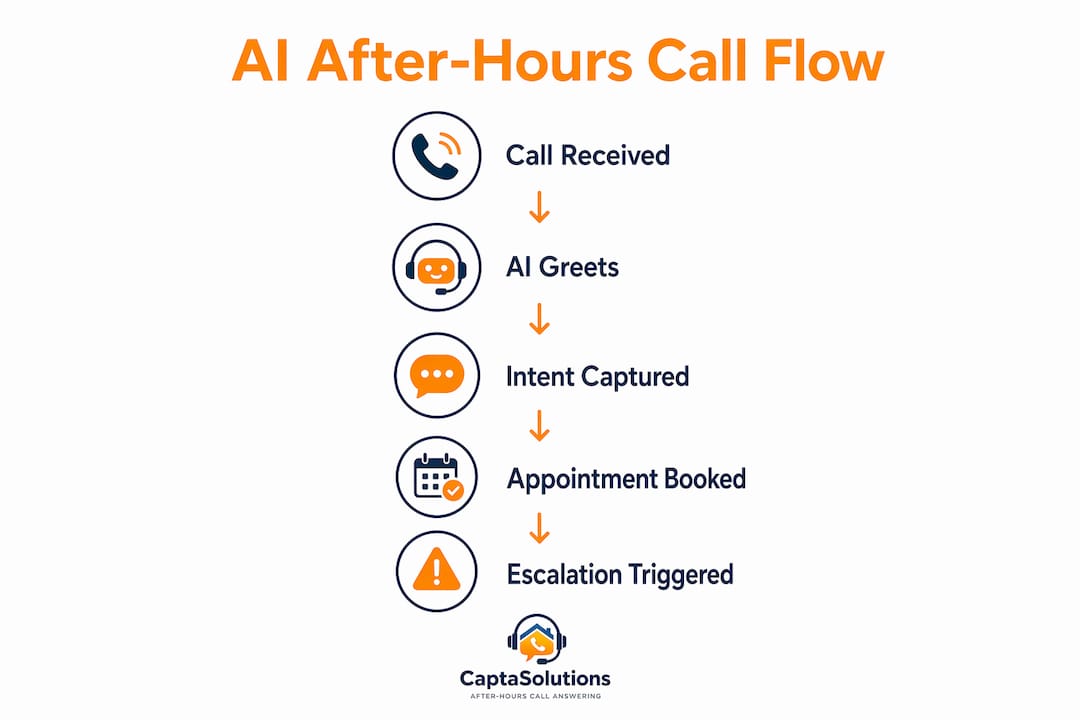
Call boundary detection is a technique that monitors the conversation in real time. When a caller's query exceeds the AI's configured scope, the system flags it and triggers a handover. This prevents the frustrating loop where a caller repeats themselves three times and still gets no useful response.
Escalation mechanisms in well-configured AI systems include:
- Live transfer to on-call staff: For genuine emergencies, the AI transfers the call directly to a designated mobile number or on-call team member.
- Urgent SMS alert: The AI sends an immediate text to the business owner or duty manager with a call summary and caller details.
- Scheduled callback: For non-urgent but complex queries, the AI books a specific callback time and confirms it with the caller.
- Voicemail detection: When the AI places a callback and reaches voicemail, sophisticated voicemail detection prevents it from mistaking the recorded greeting for a live person. It leaves a concise, professional message instead.
The escalation rules you set define the caller experience. A home services business might escalate any call mentioning "flood," "gas leak," or "no heating in winter" to an emergency line. A professional services firm might escalate any caller who mentions a court date or a regulatory deadline.
Pro Tip: Review your escalation logs monthly. If the same type of query keeps triggering human handover, that is a signal to expand your AI's training on that topic. Fewer escalations over time means your AI is getting better at serving your callers.
How AI integrates with business systems to capture leads after hours
Answering a call is only half the job. The real value of automated UK call services comes from what happens to the information afterwards. AI voice agents built for business integration connect directly with CRM platforms, booking calendars, and communication tools to turn every call into a recorded, actionable outcome.
Automatic CRM logging and appointment booking
When a caller books an appointment, the AI checks your calendar for real-time availability and confirms a slot without any manual input from your team. The booking is logged automatically, and the caller receives a confirmation. For businesses running Google Calendar, Microsoft Outlook, or specialist booking software, this integration removes the need for a receptionist to process the next morning's voicemails.
AI call answering uses across UK industries show that this integration is particularly valuable for trades businesses, clinics, and salons where appointment slots have direct revenue value.
SMS follow-up and call summaries
Automated SMS confirmation sent immediately after a call reassures the caller that their enquiry was received and tells them when to expect a response. This single step reduces repeat calls and increases caller satisfaction. Your team receives a structured call summary in their portal each morning, covering every interaction from the previous evening.
The table below shows the typical outcomes an integrated AI system delivers compared to a standard answerphone:
| Outcome | Answerphone | AI voice agent |
|---|---|---|
| Call answered immediately | No | Yes |
| Caller intent identified | No | Yes |
| Lead data captured | No | Yes |
| Appointment booked | No | Yes |
| SMS confirmation sent | No | Yes |
| Escalation for emergencies | No | Yes |
AI after-hours answering costs around £200–£500 per month for most UK businesses. That is significantly less than a part-time receptionist and covers unlimited concurrent calls with automatic logging included.
What are the best practices for deploying AI to handle after-hours calls?
Deploying an AI voice agent is not a one-time task. The quality of the system depends directly on how well it is configured and how consistently it is maintained. AI voice agents require business-specific training and periodic optimisation to perform at their best.
The most common mistakes UK businesses make when setting up after-hours AI call handling are:
- Vague training data: Feeding the AI generic FAQs instead of real customer questions leads to poor qualification. Use actual call transcripts or enquiry logs as your training source.
- No clear escalation boundaries: Without defined rules for what triggers a handover, the AI either escalates too often (frustrating callers) or not enough (missing genuine emergencies).
- Failing to disclose AI identity: UK callers respond better when the AI introduces itself clearly. Transparency builds trust and reduces the chance of a caller feeling misled.
- Overly long interactions: Keep AI conversations to the minimum number of questions needed to qualify the call. Every extra question increases the chance of the caller hanging up.
- Ignoring the data: Your call portal contains detailed records of every interaction. Reviewing these weekly reveals patterns, gaps in training, and opportunities to improve.
How AI answers booking calls for small businesses follows the same principles regardless of sector. The businesses that get the best results treat their AI configuration as a living document, updating it as their services, pricing, and processes change.
34.8% of after-hours callers have active buying intent. That means roughly one in three calls you receive outside office hours is from someone ready to spend money. Failing to answer those calls does not just mean a missed enquiry. 62% of callers who cannot reach a business contact a competitor instead.
Pro Tip: Set a quarterly review date in your calendar to audit your AI's performance. Check the escalation rate, the booking conversion rate, and any calls where the caller ended the interaction early. These three metrics tell you everything you need to know about where to improve.
Key takeaways
AI voice agents are the most cost-effective way for UK businesses to capture leads, book appointments, and protect their reputation outside office hours.
| Point | Details |
|---|---|
| Immediate call answering | AI picks up every call within seconds, removing voicemail and hold queues entirely. |
| Lead qualification at scale | Structured questions identify caller intent and urgency without human involvement. |
| Escalation prevents lost trust | Call boundary detection routes complex or emergency calls to the right person automatically. |
| Integration drives revenue | CRM logging and calendar booking turn every after-hours call into a recorded business outcome. |
| Ongoing optimisation matters | Regular review of call data and training updates keeps AI performance high over time. |
Why I think most UK businesses are still underestimating this
The businesses I see getting the most from AI call handling are not the ones with the biggest budgets. They are the ones that treat the AI as a member of staff rather than a piece of software. They brief it properly, review its performance, and update it when things change.
The common misconception is that AI after-hours call handling is a cost-cutting measure. It is not, or at least it should not be framed that way. Twelve positive customer experiences are needed to offset a single unresolved negative one. A missed call at 7PM on a Friday is not a minor inconvenience. It is a reputational event that takes a dozen good interactions to recover from.
What I find most interesting is how the technology changes the psychology of running a business. When you know every call is being answered, you stop worrying about what you are missing. A plumber on a job, a salon owner with a client in the chair, a solicitor in a meeting. None of them can answer the phone. But all of them can review a clean call summary at the end of the day and decide which leads to follow up.
The businesses that struggle with AI call handling are almost always the ones that configured it once and never looked at it again. Treating AI integration as an iterative process rather than a finished product is the single biggest differentiator between businesses that see strong results and those that do not. The technology is ready. The question is whether you are willing to invest the time to make it work properly.
— Daniel
Captasolutions: AI call answering built for UK businesses
Captasolutions is an AI-powered call answering service built specifically for UK businesses that cannot afford to miss a call. Whether you run a trades business, a clinic, a restaurant, or a professional office, Captasolutions answers every call in your business name, captures the caller's details, qualifies the enquiry, and organises everything into your client portal.
Setup takes less than an hour. There is no contract and no card required for the free 30-day trial. The system handles unlimited concurrent calls, integrates with your existing booking and CRM tools, and sends structured summaries to your team every morning. For UK businesses serious about converting after-hours enquiries into confirmed bookings, Captasolutions is the practical next step. Visit captasolutions.co.uk or call 07346 811329 to get started today.
FAQ
How does AI answer calls outside business hours?
An AI voice agent answers every inbound call immediately, identifies the caller's needs through natural conversation, and either books an appointment, captures lead details, or escalates to a human based on urgency.
What happens if the AI cannot handle a call?
Call boundary detection flags queries that exceed the AI's configured scope and triggers escalation. The system can transfer the call live, send an urgent SMS to the business owner, or schedule a callback.
Is AI call handling suitable for small UK businesses?
AI after-hours call handling costs around £200–£500 per month and covers unlimited calls, making it accessible for sole traders, small trades businesses, salons, and professional services firms.
Does the AI disclose that it is not a human?
Best practice and UK consumer trust standards require the AI to identify itself clearly at the start of the call. Transparent disclosure improves caller confidence and reduces the risk of complaints.
How quickly can an AI call answering service go live?
Services like Captasolutions can be configured and live within an hour, with no technical expertise required from the business owner.