

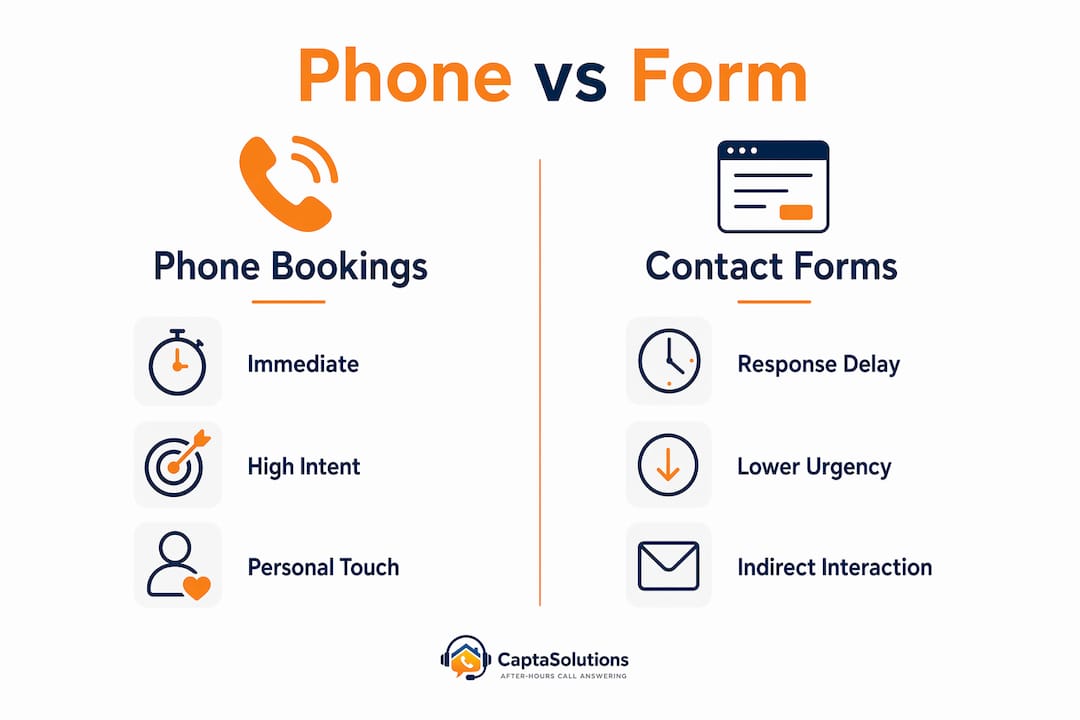
Phone bookings outperform online forms for high-intent enquiries because they resolve uncertainty, qualify leads, and close in a single interaction. Three reasons explain most of the gap:
- Immediacy. A caller is ready to act now. A form submission sits in a queue.
- Live qualification. You answer the right questions in real time, handle objections, and confirm the booking before the customer hangs up.
- Trust and friction reduction. First-time or uncertain customers need reassurance that a form cannot provide.
The single recommended action: make your phone number the primary call-to-action on every high-intent page, pair it with a reliable 24/7 call-answering partner such as Captasolutions, and use an SMS booking-link workflow to convert callers who prefer to confirm in writing.
Table of Contents
- Why phone bookings convert at higher rates
- Why contact forms lose bookings
- When online booking or forms are the better choice
- How a hybrid booking model captures the best of both
- How to implement a phone-first approach in your UK business
- Which KPIs tell you whether your phone-first approach is working
- Answers to the most common objections to phone-first
- Key takeaways
- The case for phone-first is stronger than most guides admit
- Captasolutions: answer every call, capture every booking
- Useful sources and further reading
Why phone bookings convert at higher rates
Phone calls signal intent immediately. Someone who picks up the phone and dials a local plumber, salon, or clinic has already decided they want the service. The only question is whether you capture them or lose them to the next result on Google.

The conversion advantage comes from three mechanisms. First, there is no delay between enquiry and answer. A caller gets a response in seconds; a form lead might wait hours. Second, qualification and booking happen in the same interaction. A trained member of staff, or an AI answering service, can confirm availability, take a deposit, and send a confirmation before the call ends. Third, phone calls build rapport. Perceived booking risk drops sharply when a customer hears a confident, knowledgeable voice, particularly for complex or first-time services.
Consider a homeowner who searches "emergency boiler repair London" at 8 PM. They are not browsing. They are cold and need help tonight. A business that answers immediately books the job. A business that relies on a contact form loses it.
Demographic data reinforces this. Older customers and those making high-value or urgent decisions prefer phone contact over digital self-service. Urgency-driven local searches, the kind that generate the most revenue per booking, skew heavily towards calls.
Why contact forms lose bookings
Forms introduce friction at every stage of the customer journey. The most common failure points are not technical; they are structural.
- Too many fields. Every additional field reduces completion. A 3-field form captures the information needed for about 95% of routine service enquiries; anything longer starts to feel like an application.
- Response delay. A form submission enters an asynchronous pipeline. By the time the business replies, the customer has often booked elsewhere.
- Poor mobile layout. Small tap targets, horizontal scroll, and auto-zoom on input fields all increase abandonment on smartphones, where the majority of local searches now happen.
- Spam and low-intent noise. Forms attract mis-specified or speculative enquiries that require manual triage before any real lead emerges.
- Hidden or unclear pricing. When a form offers no immediate answer on cost or availability, uncertain customers abandon rather than wait.
The response-delay problem is particularly damaging for urgent services. A drainage company, for example, receives a form submission about a blocked drain on a Saturday afternoon. By Monday morning, the customer has already called a competitor and had the job done. The form lead is worthless. Businesses in home services, healthcare, and hospitality face this scenario daily. A well-designed website from a specialist such as Wexla Websites can reduce form friction, but it cannot eliminate the fundamental delay between submission and reply.
When online booking or forms are the better choice
Phone-first is not the right primary channel for every booking type. Online booking wins when the service is clearly priced, the customer is a repeat visitor, and the booking requires no qualification.

| Scenario | Best channel | Why |
|---|---|---|
| Repeat appointment (e.g. monthly haircut) | Online booking | Customer knows the service; no questions to resolve |
| Class or group session with fixed capacity | Online booking | Real-time availability display prevents double-booking |
| Emergency or complex service (e.g. boiler repair) | Phone-first | Urgency, qualification, and trust all require a live voice |
| First-time clinic consultation | Hybrid | Phone for triage, online confirmation for convenience |
| Low-value, high-volume routine booking | Online booking | Scales without staff time; automated reminders reduce no-shows |
| High-value or bespoke service | Phone-first | Perceived risk is high; rapport and qualification matter |
Phone wins for uncertainty, complexity, or urgency; online wins for simple, repeat, and low-friction scheduling. The mistake most small businesses make is treating these as competing channels rather than complementary ones.
How a hybrid booking model captures the best of both
A hybrid model routes customers to the right channel based on their job-to-be-done. The implementation is straightforward.
- Place a tappable phone number in the header and footer of every page, not just the contact page.
- Use a short online booking widget (three fields maximum) for repeat or clearly priced services.
- Add a prominent click-to-call button on all mobile pages, above the fold.
- Send an SMS booking link during or immediately after a qualification call, so callers who prefer written confirmation can complete the booking in under 60 seconds.
- Route after-hours calls to an AI answering service rather than voicemail; SMS booking links sent during a short phone interaction recover high-intent callers without adding admin time.
Pro Tip: Use a 15–30 second qualification script at the start of every call: confirm the service needed, the location, and the preferred date. Then send the SMS booking link while the customer is still on the line. This reduces call time, eliminates follow-up, and produces a confirmed booking in a single interaction.
UX placement matters. The phone number should appear in the top-right corner of the desktop header and as a sticky bar on mobile. CTA language such as "Call us now — we answer 24/7" outperforms a generic "Contact us" label because it sets an expectation the customer can rely on. For appointment-based businesses, pairing a booking widget with a visible phone number on the same page consistently outperforms either channel alone. Guidance on organising appointment calls covers routing rules in more detail.
How to implement a phone-first approach in your UK business
Step-by-step setup
- Redesign your primary CTAs. Replace or supplement "Fill in our form" with "Call us" on every high-intent page (services, pricing, homepage hero).
- Shorten your backup form. Three fields: name, phone number, and service needed. Nothing else.
- Add your number to the header and footer of every page, formatted as a tappable link on mobile.
- Choose a call-answering partner. For businesses that cannot staff phones 24/7, an AI answering service handles calls in your name, captures lead details, and routes enquiries to your portal.
- Set up an SMS booking-link workflow. Your answering partner or CRM sends a booking link by text immediately after a qualifying call.
- Test and iterate. Track call-to-book conversion weekly for the first 30 days.
GDPR checklist (high level)
- Establish a lawful basis for processing call data (legitimate interest or consent).
- Inform callers that calls may be recorded, at the start of the call.
- Set a clear retention period for recordings and transcripts.
- Publish a privacy notice that covers call data and lead capture.
- Review ICO guidance on telephone marketing and call recording before going live.
This is general information, not legal advice. Confirm your specific obligations with a qualified professional or the ICO directly.
Captasolutions: what it does for UK businesses
Captasolutions answers every inbound call in your business name, 24 hours a day, seven days a week. The AI captures the caller's details, qualifies the enquiry against your custom criteria, and organises leads into a client portal for your review. Features include schedule-based call handling, custom AI voice configuration, call recording and transcription, and an SMS booking-link workflow that converts callers into confirmed bookings without staff involvement. Real-world phone booking results from UK businesses show consistent early improvements in captured leads and booking rates.
Onboarding timeline and typical costs
| Stage | Timeframe | What happens |
|---|---|---|
| Setup and go-live | Same day (within the hour) | AI configured, number active, portal ready |
| First-week improvements | Days 1–7 | Missed calls eliminated; leads captured overnight |
| Stabilisation period | Days 30–90 | Call scripts refined; lead quality improves |
| Setup fee | One-time charge at onboarding | Covers configuration and AI voice setup |
| Monthly subscription | Recurring fee | Covers 24/7 answering, portal, transcripts, SMS workflow |
Exact pricing is available at captasolutions.co.uk. Costs vary by call volume and feature set.
Hybrid implementations typically deliver a 28–42% lift in total bookings within the first 90 days by capturing after-hours demand that a phone-only daytime operation misses.
Which KPIs tell you whether your phone-first approach is working
Track these six metrics from day one.
- Calls received (total inbound volume by day and hour)
- Call-to-book conversion rate (bookings confirmed during or immediately after a call)
- Form-to-book conversion rate (for comparison against your call channel)
- No-show rate (target: reduce with automated SMS reminders)
- Average handling time (shorter is better once scripts are refined)
- Booking source revenue share (what percentage of revenue originates from phone vs online)
| KPI | What it measures | Benchmark range |
|---|---|---|
| Call-to-book conversion | Live phone bookings as a share of answered calls | Higher than form conversion for urgent services |
| Form-to-book conversion | Online form completions that become confirmed bookings | 24–38% on well-built forms |
| After-hours bookings | Share of bookings outside standard business hours | roughly 31% when self-serve or AI answering are active |
| No-show rate reduction | Impact of automated reminders vs manual follow-up | a notable reduction with automated confirmations |
| Hybrid booking lift | Total booking increase after adding phone prominence | a 28–42% increase within 90 days |
For tracking setup: use a unique phone number per campaign (Google Ads, organic, social) to attribute call volume accurately. Connect call transcripts to your CRM lead records. Set UTM parameters on your booking widget and form so you can compare channel revenue, not just volume. Reducing no-shows is covered in detail in the guide on call answering and no-show reduction.
Answers to the most common objections to phone-first
"Staffing a phone line is too expensive." It does not have to be. An AI call-answering service covers 24/7 inbound at a fraction of the cost of a full-time receptionist. The relevant comparison is not "phone vs form" but "answered call vs missed call." A missed high-value booking costs more than a month of answering-service fees.
"We can't be available 24/7." You do not need to be. An AI answering partner handles calls in your name at any hour, captures the lead, and sends you a qualified summary. The 31% of bookings that happen outside business hours are recoverable without any out-of-hours staff.
"GDPR makes call recording complicated." It is manageable with a short compliance checklist. Inform callers at the start of the call, establish your lawful basis, set a retention period, and publish a privacy notice. The ICO provides clear guidance; it is not a barrier to phone-first operation.
"Online booking scales better." Online booking reduces administrative labour and is the right primary channel for repeat, clearly priced services. The argument for phone-first is not that it replaces online booking; it is that phone handles the high-intent, high-value enquiries that forms routinely lose. Operators that adopt a hybrid model typically converge at roughly 80% online and 15–25% phone bookings within one quarter, with phone handling the bookings that generate the most revenue per transaction.
Key takeaways
Phone bookings outperform forms for high-intent, urgent, or complex service enquiries because they resolve uncertainty, qualify leads, and close in a single real-time interaction.
| Point | Details |
|---|---|
| Phone wins on intent | Callers are ready to act; form submissions enter a delay pipeline that loses high-intent leads. |
| Shorten forms to three fields | A 3-field form captures the information needed for most service enquiries and reduces abandonment. |
| Hybrid delivers the biggest lift | Adding phone prominence to an online booking system delivers a 28–42% lift in total bookings within 90 days. |
| Automate reminders to cut no-shows | Automated confirmations and SMS reminders reduce no-show rates by 30–50% versus manual follow-up. |
| Captasolutions covers the gaps | Captasolutions answers calls 24/7 in your business name, captures leads, and sends SMS booking links — live within the hour. |
The case for phone-first is stronger than most guides admit
The conventional wisdom in digital marketing has spent a decade telling small businesses to automate everything and push customers to self-serve. That advice is correct for repeat, low-complexity bookings. It is actively harmful when applied to high-value, first-time, or urgent enquiries.
The evidence is consistent: phone calls close faster, qualify better, and build the kind of trust that turns a one-off booking into a repeat customer. The businesses that understand this do not choose between phone and online. They design their booking system so that online handles the routine volume and phone captures the revenue that matters most.
What most guides miss is the cost of the missed call. A form that sits unanswered for four hours on a Saturday afternoon is not a neutral outcome. It is a lost booking, a lost customer, and a lost review. The businesses that grow fastest in competitive local markets are the ones that answer every call, qualify every lead, and confirm every booking before the customer has a chance to reconsider.
Captasolutions: answer every call, capture every booking
Every missed call is a missed booking. Captasolutions is the AI-powered call answering service built for UK small businesses that cannot afford to lose a high-intent enquiry to voicemail or a slow form response.
The service answers every inbound call in your business name, 24 hours a day, seven days a week. It captures caller details, qualifies the enquiry, and organises leads into your client portal. You review every lead and decide what to take on.
- Trades businesses: capture emergency and after-hours enquiries that forms miss entirely.
- Salons and clinics: handle appointment calls when staff are with clients, with no missed bookings during peak hours.
- Restaurants and hospitality: take reservations and enquiries around service, with every caller detail logged.
- Professional services: qualify new client enquiries 24/7, with call transcripts ready for your morning review.
No contract. No card required. Start your free 30-day trial at captasolutions.co.uk and be live within the hour.
Useful sources and further reading
Legal compliance (UK):
- ICO guidance on telephone marketing and call recording — the primary UK authority on lawful basis, consent, and retention for call data. Consult this before enabling call recording.
Practical how-to resources:
- Why to avoid contact forms for appointment scheduling — covers the structural reasons forms lose bookings and practical alternatives.
- Contact forms vs phone numbers: which gets more leads? — UK-focused comparison of lead volume and quality by channel.
- How call answering builds customer trust — Captasolutions blog post on the rapport and trust mechanisms that make phone bookings convert.
- How salons handle appointment calls — operational detail for appointment-based businesses managing phone-first workflows.