

Customer churn is defined as the loss of a caller to a rival business before a sale or booking is made. The primary reason why callers move to competitors is not price. It is speed. 78–79% of consumers choose the first business that responds, making response time the single most powerful factor in winning or losing a lead. Price, reviews, and reputation all matter, but they rarely get the chance to compete if you do not answer first. For UK business owners, understanding the mechanics of client migration is the first step to stopping it.
Why callers move to competitors: speed is the deciding factor
Response speed is the dominant driver of customer switching behaviour in service businesses. When a caller picks up the phone, they are in an active buying state. They have made a decision to spend money. They want an answer now, not a voicemail.
The first-responder advantage is not a marginal gain. It is the difference between winning and losing the majority of enquiries. Most service businesses do not compete on response speed. Simply answering calls faster produces an outsized competitive advantage, independent of price or reputation.
The switching window is also shorter than most business owners realise. Customers decide within minutes, often before they even consider leaving a voicemail. By the time you call back an hour later, the caller has already booked with someone else.

After-hours calls compound this problem significantly. About 28.5% of calls arrive after normal business hours, and a substantial portion of those carry genuine buying intent. A plumber who finishes a job at 6pm and checks missed calls at 8pm has already lost those leads to a rival who answered.
The pattern is consistent across trades, clinics, salons, and professional offices. Callers do not wait. They move on.
- A missed call during a busy period is not a minor inconvenience. It is a lost sale.
- Voicemail is not a safety net. Most callers do not leave one.
- Off-hours coverage is not optional for businesses that compete on availability.
- The first 60 seconds of a caller's decision window are the most critical.
Pro Tip: Set up a call answering solution that covers your phone 24 hours a day, 7 days a week. Even if you cannot take every call personally, the caller must hear a human or a well-trained AI voice within seconds. Silence or a generic voicemail message is a referral to your nearest competitor.
Does price cause customers to switch providers?
Price is a major factor in switching, but it is rarely the whole story. 74% of customers switch brands when a competitor offers a lower regular price. That is a significant number, but it tells only part of the story.
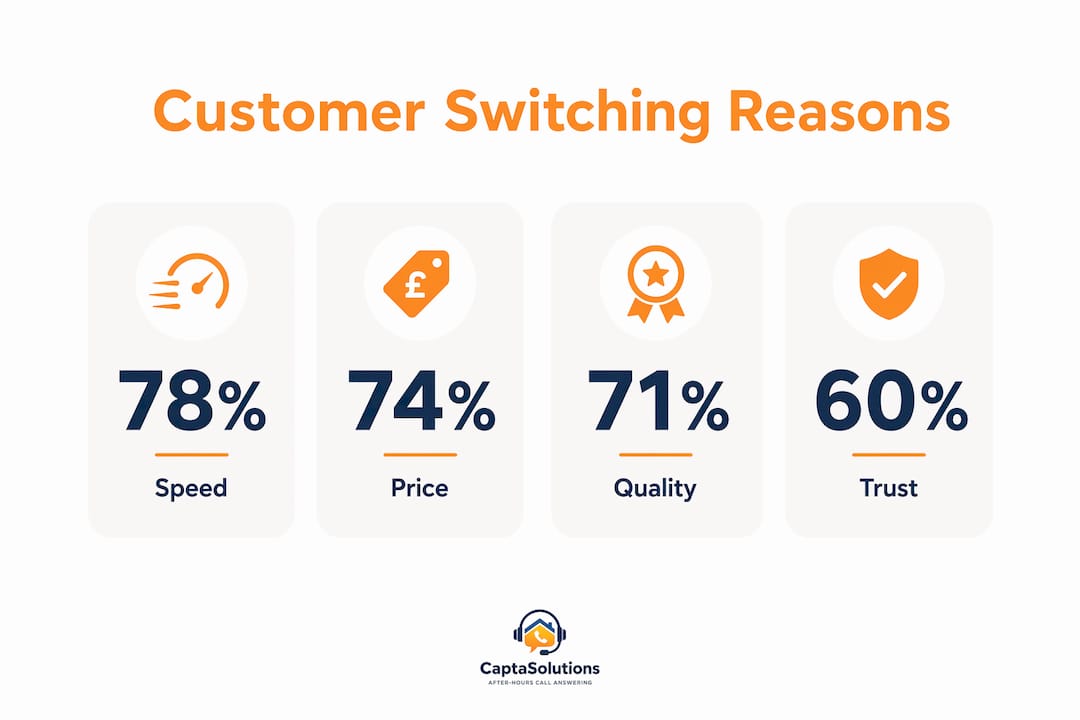
The more revealing figure is this: 71% of customers leave if they perceive a reduction in quality without being told about it. This is the shrinkflation effect. When a business quietly reduces service quality, shortens call-back windows, or changes its pricing structure without explanation, customers notice. They do not complain. They simply leave.
This means price sensitivity and transparency are closely linked. Customers are not always looking for the cheapest option. They are looking for the option that feels honest.
| Switching trigger | What it signals to the customer |
|---|---|
| Competitor offers lower regular price | Your pricing feels poor value by comparison |
| Perceived quality reduction without notice | You are not being honest about what they are getting |
| No clear communication about changes | You do not respect their time or intelligence |
| Faster response from a rival | The rival is more available and more committed |
Modern consumers run what researchers call value integrity tests. They assess whether a business is consistent, honest, and transparent over time. A business that raises prices without explanation, changes its service scope without notice, or fails to communicate clearly will fail these tests. The customer will not raise a complaint. They will simply find someone else.
The practical implication for UK business owners is clear. You do not need to be the cheapest. You need to be the most credible.
How does trust affect customer retention?
Trust is not built in a single interaction. It erodes gradually, and the erosion often goes unnoticed until a caller is already gone. Customers frequently switch not because they are actively dissatisfied, but because their emotional attachment to a brand has quietly worn away. A competitor's offer then becomes the trigger, not the root cause.
This distinction matters. If you are waiting for a customer to complain before you act, you are already too late. The switching decision is usually made in silence, over weeks or months, as small frustrations accumulate.
Consumers now evaluate brands on transparency, honest communication, and consistent value delivery, not just on price. A business that communicates clearly about pricing changes, service updates, and any disruptions to normal availability builds a credibility reserve. That reserve is what keeps customers loyal when a competitor makes them an offer.
Emotional loyalty and transactional satisfaction are not the same thing. A customer can be satisfied with a single job and still feel no particular attachment to your business. Attachment is built through repeated, reliable contact. It is built when you answer the phone, follow up after a job, and communicate proactively.
- Communicate pricing or service changes before they take effect, not after.
- Follow up after every completed job or appointment. A brief call or message reinforces the relationship.
- Be consistent. Customers who can predict your behaviour trust you more.
- Effective follow-up after calls is one of the most underused retention tools in UK service businesses.
Pro Tip: When you change a price or adjust your service offering, tell your existing customers first. A short message explaining why the change is happening builds trust rather than eroding it. Silence breeds suspicion.
Practical strategies to stop callers choosing competitors
Reducing churn requires action across three areas: availability, communication, and follow-up. Each one addresses a distinct reason why clients choose competitors.
-
Answer every call, every time. This is the single highest-impact change most UK service businesses can make. Automating the answering process creates a competitive advantage that does not depend on price or reviews. Captasolutions answers every call in your business name, 24 hours a day, captures the caller's details, and qualifies the enquiry. You review every lead in your client portal and decide what to take on.
-
Cover your phones after hours. The volume of after-hours calls with buying intent is too large to ignore. A caller who rings at 7pm and gets no answer will book with a competitor before morning. Off-hours coverage is not a luxury. It is a basic requirement for businesses that want to retain callers.
-
Communicate transparently about pricing and changes. Customers who feel informed stay loyal. Those who feel surprised by changes leave. Build a simple habit of notifying customers before any change takes effect.
-
Follow up after every interaction. A completed job or appointment is not the end of the relationship. A brief follow-up call or message reinforces trust and opens the door to repeat business. Read the practical guide to call follow-up for specific techniques that work in UK service businesses.
-
Use AI-powered call answering to remove the human bottleneck. 70% of consumers hold brands accountable for poor automated responses, but they accept AI initial contact when it is handled well. Captasolutions is built specifically for this. The AI answers professionally, captures the right information, and hands the lead to you cleanly. No missed calls. No lost leads.
Pro Tip: Review your missed call data weekly. If you are missing calls between 5pm and 8pm on weekdays, that is your highest-risk window. Address it first.
Key takeaways
The primary reason callers switch to competitors is speed of response, compounded by price transparency failures and the gradual erosion of trust through poor communication.
| Point | Details |
|---|---|
| Speed wins the lead | 78–79% of consumers choose the first business to respond, making availability the top priority. |
| Price alone does not cause switching | 71% of customers leave over perceived quality reduction without notice, not just lower competitor prices. |
| Trust erodes silently | Customers often switch without complaining; emotional detachment builds slowly before a rival triggers the final move. |
| After-hours calls carry real value | A significant share of after-hours calls carry buying intent; missing them hands leads directly to competitors. |
| Follow-up builds loyalty | Consistent post-call follow-up is one of the most underused retention tools available to UK service businesses. |
The uncomfortable truth about customer loyalty in 2026
Most UK business owners I speak with assume their customers are loyal because they have not complained. That assumption is costing them money every week.
The research is clear. Customers do not leave because they are angry. They leave because they were available to leave. Their attachment had already faded, and a faster or more transparent competitor gave them a reason to act. By the time you notice the drop in repeat bookings, the switching decision was made months ago.
The businesses I see retaining callers most effectively are not always the cheapest or the best reviewed. They are the ones who answer the phone every time, follow up consistently, and communicate honestly when anything changes. That combination builds the kind of credibility that makes a competitor's offer feel like a risk rather than an opportunity.
The first-responder advantage is real, and it is available to any business willing to invest in it. You do not need to outspend your competitors. You need to out-respond them. In a market where most businesses still rely on voicemail and callbacks, simply answering every call is a genuine differentiator.
The businesses that will struggle in 2026 are those still treating missed calls as an acceptable cost of doing business.
— Daniel
How Captasolutions helps UK businesses retain more callers
Every missed call is a caller who has already moved on. Captasolutions is built to make sure that does not happen to your business.
Captasolutions answers every call in your business name, 24 hours a day, 7 days a week. The AI captures the caller's details, qualifies the enquiry, and organises everything into your client portal. You stay in control of every lead without being chained to your phone. Whether you run a trades business, a clinic, a salon, or a professional office, the service is live within the hour with no contract and no card required for the free 30-day trial. Call 07346 811329 or visit captasolutions.co.uk to get started today.
FAQ
Why do most callers not leave a voicemail?
Callers in an active buying state move on within minutes of an unanswered call. Leaving a voicemail requires effort and patience that most customers in a competitive market will not extend.
Does price always cause customers to switch?
Price is a major factor, but 71% of customers switch due to perceived quality reduction without notice. Transparency and honest communication are equally important in preventing switching.
What is the switching window?
The switching window is the brief period, often under 60 seconds, during which a caller decides whether to wait or contact a competitor. Most businesses lose leads during this window without realising it.
How does after-hours call handling affect customer retention?
A significant share of calls with buying intent arrive outside normal business hours. Businesses without after-hours coverage lose those leads to competitors who answer, regardless of price or reputation.
Can AI call answering maintain customer trust?
Yes, when handled well. Consumers accept AI initial contact but hold brands accountable for poor execution. A well-configured AI answering service, such as Captasolutions, captures leads professionally and hands them to you cleanly, preserving trust from the first interaction.