

Missed calls are the single biggest source of silent revenue loss for UK tradespeople. The core reason why trades miss calls on jobs is structural, not personal. When you are under a sink, on a roof, or driving between sites, answering a phone is physically impossible. Research confirms that approximately 60 to 80% of inbound calls to solo tradespeople go unanswered during workday hours, with an estimated 8 to 15 booked jobs lost per month as a result. That is not a customer service failure. It is a workflow reality that most trades businesses have not yet built a system to address.
Why trades miss calls on jobs: the structural truth
The nature of trade work creates predictable gaps in phone availability. These are not random failures. They are baked into the daily rhythm of hands-on work, and understanding them is the first step toward fixing them.
Consider the typical day for a plumber, electrician, or gas engineer. The morning starts with a drive to site, tools in hand, often with no free moment to check a phone. Once on site, the work demands full physical attention. You cannot answer a call while cutting a live circuit, carrying a boiler up a flight of stairs, or working in a confined loft space. These are not excuses. They are the realities of skilled manual work.

Trade workflows naturally create phone coverage gaps during tool-heavy tasks and driving, and protecting these peak-risk windows with overflow coverage is the most effective approach available to tradespeople. The problem is that most trades businesses have not mapped those gaps, so they cannot protect them.
Common scenarios where calls go unanswered include:
- Working in confined spaces such as lofts, crawl spaces, or under kitchen units
- Operating power tools or machinery where hearing a phone ring is impossible
- Driving between jobs, particularly on motorways or in heavy traffic
- Conducting on-site estimates that require full concentration and client conversation
- Attending supplier yards or merchants to collect materials
Pro Tip: Peak call times for trades enquiries fall between 8am and 10am and again between 12pm and 2pm. These windows align almost exactly with the busiest periods of your working day. Mapping your own coverage gaps against these times will show you precisely where your leads are being lost.
How after-hours calls drain trade revenue
The missed call problem does not stop when the working day ends. More than half of the week's hours fall outside the standard 8am to 5pm window, and standard business phone setups cover none of that time by default.
The after-hours window, broadly defined as 5pm to 8am on weekdays plus all weekend hours, is when urgent calls arrive. A boiler breaking down on a Friday evening, a burst pipe on a Sunday morning, a landlord dealing with a tenant emergency at 9pm. These are not casual enquiries. Emergency jobs are valued between £200 and £800 or more for the initial call alone, and the caller is highly motivated to book immediately.
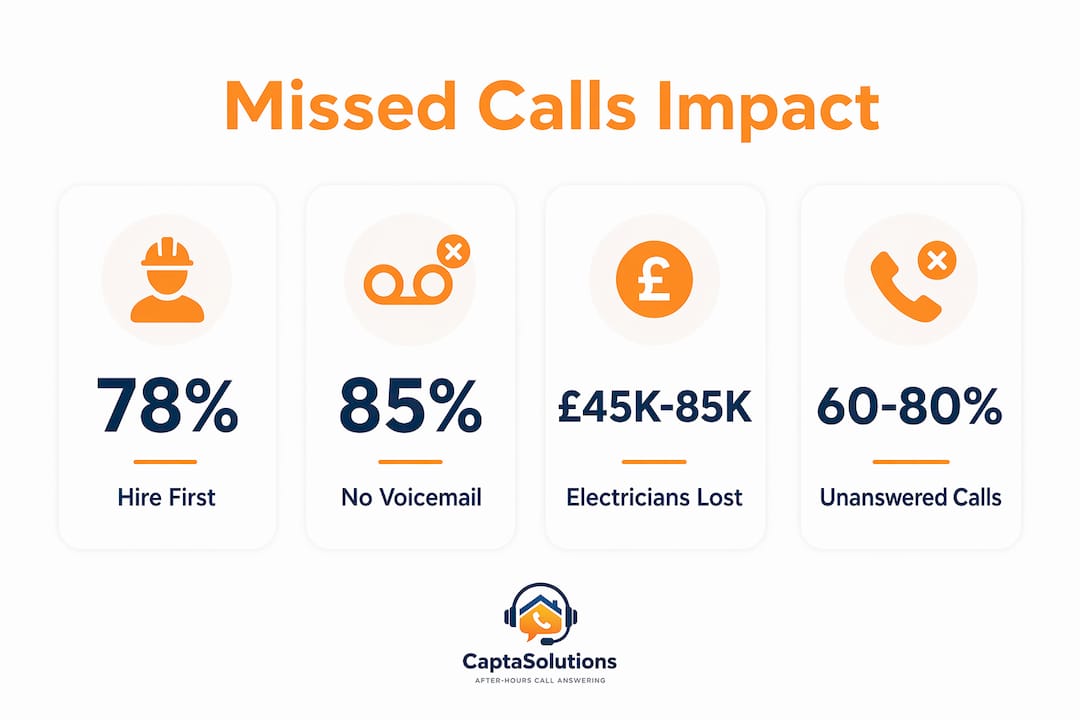
The financial scale of this problem is significant. Electricians alone lose an estimated £45,000 to £85,000 annually from missed calls, with emergency and after-hours work accounting for a disproportionate share of that figure. For a sole trader, that represents a substantial portion of annual turnover.
| Time window | Call type | Typical job value | Coverage with standard setup |
|---|---|---|---|
| 8am to 5pm weekdays | Routine enquiries | £80 to £300 | Partial (gaps during on-site work) |
| 5pm to 8pm weekdays | Urgent and emergency | £200 to £600 | None |
| 8pm to 8am weekdays | Emergency only | £300 to £800+ | None |
| Weekends (all hours) | Urgent and emergency | £200 to £800+ | None |
Pro Tip: Extending coverage with a call answering service or AI-powered answering tool during evenings and weekends costs a fraction of a single missed emergency job. The maths are straightforward once you know your average job value.
Why calling back rarely recovers the lost job
Many tradespeople assume a missed call can be recovered with a prompt callback. The data says otherwise. Contacting a lead within 5 minutes makes you approximately 21 times more likely to qualify that lead compared to contacting after 30 minutes. After an hour, the probability of converting that caller drops to near zero.
The reason is simple. When a homeowner or landlord calls a tradesperson, they are in a decision-making moment. They have a problem, they want it solved, and they are working through a shortlist. If you do not answer, they move to the next number. By the time you call back, they have often already booked someone else.
Up to 85% of missed callers do not leave a voicemail. This means you will not even know the call happened unless you check your missed call log and proactively chase every unknown number. Most tradespeople do not have time for that between jobs.
The concept of a "lost moment" captures this accurately. A missed call is not a delayed opportunity. It is a closed window. Speed-to-lead research confirms that the decision window for most trade enquiries is measured in minutes, not hours. Treating a missed call as something you can recover later is the most costly assumption a trades business can make.
| Response time | Likelihood of qualifying the lead |
|---|---|
| Under 5 minutes | Very high (benchmark standard) |
| 5 to 30 minutes | Drops sharply |
| 30 minutes to 1 hour | Low |
| Over 1 hour | Near zero |
| Callback next day | Effectively lost |
78% of customers hire the first tradesperson who answers their call. That single statistic explains why being second to respond, even by ten minutes, rarely wins the job.
Practical ways to reduce missed calls and win more jobs
Reducing missed calls does not require hiring a full-time receptionist or restructuring your entire business. The most effective approaches work around your existing workflow rather than against it.
The starting point is understanding which calls you are missing and when. Review your missed call log for one week and note the times. You will likely find a clear pattern tied to your busiest on-site hours and your after-hours window. That pattern tells you exactly where to focus.
Different lead platforms require different response methods, which adds complexity for tradespeople managing multiple channels. Google Local Services Ads require phone responses. Yelp uses messaging. Checkatrade and Rated People have their own enquiry systems. Managing all of these simultaneously while on a job is not realistic without some form of automation or assistance.
Practical options for improving call coverage include:
- AI-powered call answering: Tools that answer every call in your business name, capture caller details, and qualify the enquiry without you being present. Captasolutions operates exactly this way, providing 24/7 coverage for UK trades businesses. You can learn more about call answering benefits specifically for tradespeople.
- Virtual receptionist services: A human answering service that handles calls during business hours and routes urgent ones to you directly.
- Team call coverage: If you employ other tradespeople or an administrator, designating a call handler during peak hours removes the dependency on a single person being available.
- Workflow scheduling: Blocking specific times in your day for returning calls, such as 7.30am before site start and 5.30pm after finishing, creates a predictable callback window that customers can be directed to.
For a detailed breakdown of how to manage calls without adding headcount, the guide on covering calls without staff covers the options available to UK tradespeople in practical terms.
The AI receptionist model is increasingly adopted by trades businesses because it removes the human availability constraint entirely. Every call is answered, every lead is captured, and you review the information when it suits you.
Key takeaways
Missed calls cost UK tradespeople thousands of pounds annually because the decision window for most trade enquiries closes within minutes, not hours.
| Point | Details |
|---|---|
| Structural gaps cause most missed calls | On-site work, driving, and tool use create predictable windows where phones cannot be answered. |
| After-hours calls carry the highest value | Emergency jobs between 5pm and 8am are worth £200 to £800 or more and go unanswered by default. |
| Callbacks rarely recover lost leads | Contacting a lead after 30 minutes reduces qualification likelihood dramatically compared to a 5-minute response. |
| Most missed callers do not leave voicemail | 85% of callers move on silently, meaning you often do not know a lead was lost. |
| AI-powered answering closes the gap | 24/7 call answering captures every lead without requiring you to be available at all times. |
The part most tradespeople get wrong about missed calls
I have spoken with a lot of tradespeople who genuinely believe their missed call rate is low because they "always try to call back." That belief is costing them jobs every single week, and they cannot see it because the lost customers never complain. They simply disappear.
The uncomfortable truth is that the trades industry has normalised missed calls as an occupational hazard rather than treating them as a business problem with a measurable cost. When an electrician loses £45,000 to £85,000 a year from unanswered calls, that is not bad luck. It is a systems failure.
What I find most revealing is the voicemail data. If 85% of callers do not leave a message, then your missed call log is not showing you the full picture. For every missed call you can see, there are likely others you cannot, callers who rang, got nothing, and booked your competitor before you even knew they existed.
The fix is not complicated. It requires accepting that you cannot personally answer every call while doing skilled physical work, and then building a system that does it for you. That is not a compromise on customer service. It is the definition of good customer service. You can explore real examples of missed calls and their outcomes to see how this plays out in practice.
The tradespeople who grow consistently are not necessarily the most skilled. They are the ones who make it easiest for customers to reach them and book them, at any hour, on any day.
— Daniel
How Captasolutions helps UK trades stop losing jobs to missed calls
Captasolutions is an AI-powered call answering service built specifically for UK businesses that cannot afford to miss a call. For tradespeople, that means every inbound call is answered in your business name, 24 hours a day, 7 days a week, whether you are on a roof, under a boiler, or driving between jobs.
The service captures caller details, qualifies the enquiry, and organises everything into your client portal. You review every lead and decide what to take on. There is no contract, no card required to start, and the service goes live within the hour. Visit Captasolutions to start your free 30-day trial today, or call 07346 811329 to speak with the team directly.
FAQ
Why do tradespeople miss so many calls during the day?
60 to 80% of calls to solo tradespeople go unanswered during working hours because on-site tasks, driving, and tool use make it physically impossible to answer a phone safely or practically.
Does calling a customer back recover the missed job?
Rarely. Contacting a lead after 30 minutes reduces your chance of qualifying them dramatically, and 78% of customers hire the first tradesperson who answers, meaning the job is usually gone before you call back.
How much revenue do missed calls cost tradespeople?
The financial impact varies by trade, but electricians alone lose an estimated £45,000 to £85,000 annually from missed calls, with after-hours and emergency calls accounting for a significant share of those losses.
Do customers leave voicemails when a call is missed?
No. Up to 85% of missed callers do not leave a voicemail, which means most lost leads are invisible unless you have a system that captures every inbound call attempt.
What is the most effective way for a tradesperson to stop missing calls?
An AI-powered call answering service provides 24/7 coverage without requiring you to be available, capturing every lead and qualifying enquiries automatically so you never lose a job to an unanswered phone.