

Call qualification is the process of evaluating a prospect during a sales call to confirm they meet essential criteria before investing further sales time. Those criteria typically cover budget, authority, need, and timing. Get this process right, and your pipeline fills with genuine opportunities. Get it wrong, and poor qualification costs B2B businesses an average of £14,000 per sales rep annually in lost productivity. For business owners and sales professionals, understanding what call qualification means in practice is the difference between a pipeline that converts and one that stalls.
What is call qualification and which frameworks should you use?
Call qualification is defined as a structured assessment conducted during a sales call to determine whether a prospect is a realistic buyer. The industry standard term is "lead qualification," and the call itself is the primary tool for applying it. Frameworks give that assessment a repeatable shape.
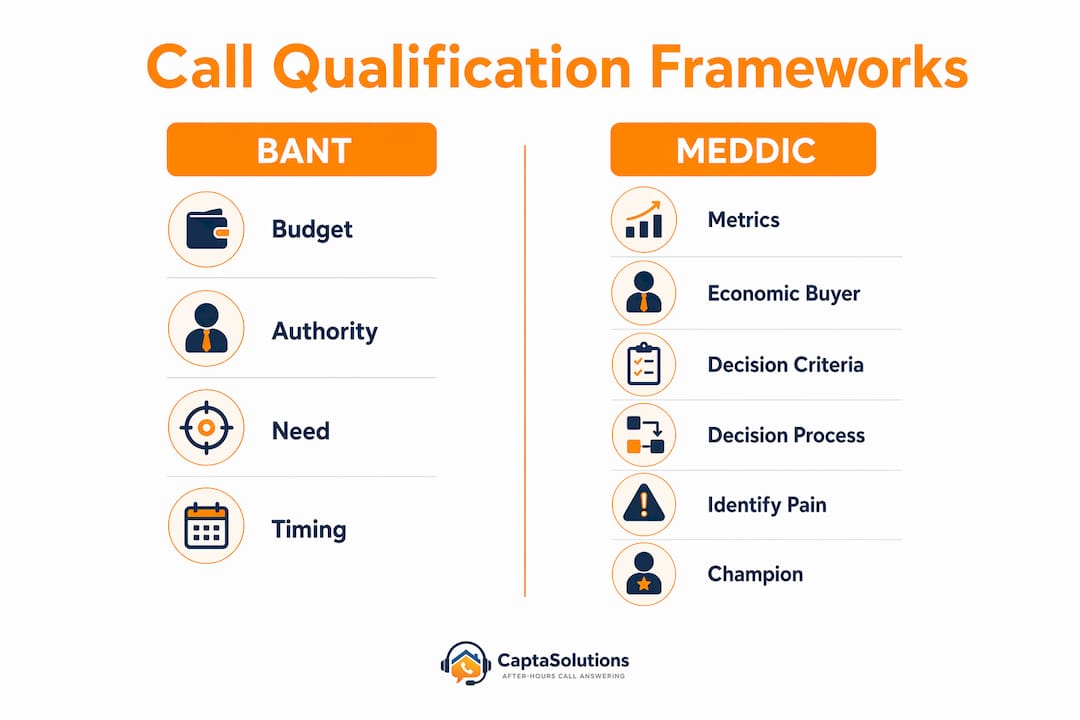
BANT is the most widely used framework for transactional and mid-market sales. It stands for Budget, Authority, Need, and Timing. BANT suits transactional sales because it is fast, simple, and easy to train. A plumber's receptionist or a salon coordinator can apply it without a sales background.

MEDDIC goes deeper. It stands for Metrics, Economic Buyer, Decision Criteria, Decision Process, Identify Pain, and Champion. MEDDIC suits complex enterprise deals where multiple stakeholders are involved and the sales cycle runs for months. GPCT (Goals, Plans, Challenges, Timeline) works best for consultative sales where the buyer needs help defining the problem before they can commit to a solution.
The table below shows which framework fits which sales context.
| Framework | Best suited for | Core strength |
|---|---|---|
| BANT | Transactional and mid-market sales | Speed and simplicity |
| MEDDIC | Enterprise and complex deals | Stakeholder and process mapping |
| GPCT | Consultative and advisory sales | Uncovering goals before pitching |
Choosing the right framework matters because framework choice depends on sales complexity and the buyer's journey stage. Applying MEDDIC to a £500 boiler service call wastes everyone's time. Applying BANT to a six-figure software contract leaves critical gaps.
How to conduct an effective qualification call step by step
The structure of a qualification call determines its outcome. Standard qualification calls last 15–20 minutes with a 70% listening to 30% talking ratio. That ratio matters because it keeps you in discovery mode rather than pitch mode.
A proven call structure breaks down as follows:
- Introduction (1 minute). State your name, your company, and the purpose of the call. Keep it brief. The prospect should be talking within 60 seconds.
- Discovery (5–6 minutes). Ask open questions about the prospect's current situation and challenges. This is where SPIN techniques apply. SPIN questioning uncovers deeper pain points rather than producing a superficial checklist of answers.
- Authority mapping (2–3 minutes). Confirm who makes the final decision. Ask directly: "Who else would be involved in approving this?" Avoid assuming the person on the call has buying power.
- Budget and timing (2–3 minutes). Confirm whether a budget exists and when the prospect expects to act. Vague answers here are a signal, not a minor detail.
- Closing the call (1–2 minutes). Agree on a clear next step. A qualified lead leaves the call with a booked follow-up. An unqualified lead gets a polite close.
One structural rule that top-performing sales development representatives apply consistently: place hard disqualifiers early in the call script. If a prospect cannot meet a non-negotiable criterion, find that out in the first two questions. Asking "Are you the homeowner?" or "Do you have a budget allocated for this?" at the start saves both parties time.
Pro Tip: Group related questions together to prevent topic whiplash. Jumping from budget to pain points to timeline and back again confuses the prospect and damages your credibility. Cluster your BANT or MEDDIC questions into logical blocks and move through them in sequence.
Pre-call research is equally important. Reviewing a prospect's LinkedIn profile before the call prevents you from asking questions you should already know the answers to. Skipping this step wastes call time and signals a lack of preparation.
What are the signs of a qualified versus unqualified lead?
Recognising the difference between a qualified and unqualified lead during a call is a skill that improves with practice. Effective qualification confirms that a lead has specific pain points, confirmed budget, decision-maker involvement, and timeline urgency. Each of these signals increases the likelihood of the deal progressing.
Signs of a qualified lead:
- The prospect describes a specific problem, not a vague interest
- Budget has been allocated or the prospect can confirm a spending range
- The person on the call is the decision-maker, or can name one
- There is a defined timeline or a clear trigger event driving urgency
- The prospect asks detailed questions about your solution
Red flags that indicate a poor fit:
- The prospect cannot articulate what problem they are trying to solve
- Budget is described as "not confirmed yet" with no timeline for approval
- Multiple unnamed stakeholders are mentioned without clarity on the process
- The prospect is gathering information with no intention to act soon
- Engagement is low and answers are consistently short or evasive
Qualification calls are checkpoints to protect company resources. The goal is a confident go or no-go decision before demos or extensive discovery sessions begin. Treating every enquiry as a live opportunity is the fastest way to clog a pipeline with leads that never close.
Disqualifying a lead gracefully is a professional skill. Thank the prospect for their time, explain that the fit is not right at this stage, and leave the door open for the future. A clean exit preserves your reputation and theirs.
The importance of call qualification for pipeline health cannot be overstated. Failure to qualify accurately causes 30% of meetings to never become actionable opportunities. That is a significant drain on sales capacity.
How can businesses apply call qualification to improve conversion?
Applying call qualification principles consistently across your business requires more than a good script. It requires a system. The call qualification process for home services businesses, for example, differs from enterprise software sales, but the underlying logic is identical: confirm fit before committing resources.
Practical steps to apply qualification effectively:
- Conduct pre-call research. Review the prospect's website, social profiles, or previous enquiry notes before picking up the phone. Tailored questions produce better answers.
- Use qualification data to route leads. A prospect who confirms budget and authority immediately should go to a senior closer. A prospect who needs more nurturing should enter a follow-up sequence.
- Avoid over-qualifying. Asking too many questions in one call creates friction. Stick to the criteria that matter most for your specific sales context.
- Track disqualification reasons. Recording why leads fail qualification reveals patterns. If 40% of your inbound calls fail on budget, your marketing may be attracting the wrong audience.
- Integrate qualification into your lead capture process. The best qualification starts before the call, with intake forms or pre-screening questions that filter obvious non-fits.
Proper qualification leads to 67% higher close rates. That figure reflects what happens when sales professionals stop treating every inbound enquiry as equal and start making deliberate decisions about where to focus their time.
Common pitfalls include skipping the authority check, accepting vague budget answers, and failing to agree on a next step before ending the call. Each of these errors allows weak leads to advance through the pipeline and consume resources that should go to genuine opportunities.
Key takeaways
Call qualification is the single most effective way to protect sales resources and improve close rates across any business that handles inbound enquiries.
| Point | Details |
|---|---|
| Define qualification criteria first | Use BANT, MEDDIC, or GPCT depending on your sales complexity and deal size. |
| Structure every call | A 15–20 minute call with a 70/30 listening ratio produces the most reliable qualification data. |
| Place disqualifiers early | Ask non-negotiable criteria questions within the first two exchanges to avoid wasted call time. |
| Track why leads fail | Disqualification data reveals marketing and targeting gaps that cost money over time. |
| Automate where possible | AI-powered call answering captures and qualifies enquiries before they reach your sales team. |
Why most businesses qualify too late
Sales teams tend to fall in love with their pipeline. I have seen it repeatedly: a business owner reviews their leads list and sees 40 open opportunities, feels confident, and then closes the month with two deals. The other 38 were never real. They were enquiries that no one had the discipline to disqualify.
The uncomfortable truth about call qualification is that it requires you to say no more often than you say yes. That feels counterintuitive when you are trying to grow. But a pipeline full of weak leads is worse than a short pipeline of strong ones. Weak leads consume time in follow-up calls, proposals, and demos that produce nothing.
The businesses I have seen grow fastest are the ones that treat qualification as a filter, not a formality. They ask the hard questions early, they record the answers, and they route leads based on data rather than gut feeling. They also revisit their qualification criteria regularly, because buyer behaviour shifts and what qualified a lead two years ago may not qualify one today.
The other mistake I see constantly is conflating enthusiasm with qualification. A prospect who is excited about your product is not necessarily a qualified buyer. Enthusiasm without budget, authority, or timeline is just a pleasant conversation. Discipline in qualification separates the two.
— Daniel
How Captasolutions supports call qualification for UK businesses
Captasolutions is an AI-powered call answering service built for UK businesses that cannot afford to miss an enquiry. The service answers every call in your business name, 24 hours a day, 7 days a week. It captures the caller's details, applies qualification criteria to the enquiry, and organises everything into your client portal. You review each lead and decide what to take on. For trades businesses, salons, clinics, and service providers across the UK, this means every inbound call is assessed before it reaches your diary. Explore how AI call answering works for UK businesses, or start a free 30-day trial with no card required and no contract.
FAQ
What is call qualification in sales?
Call qualification is the process of assessing a prospect during a sales call to confirm they meet key criteria such as budget, authority, need, and timing before progressing the opportunity further.
What is the BANT framework?
BANT stands for Budget, Authority, Need, and Timing. It is the most widely used call qualification framework for transactional and mid-market sales due to its speed and simplicity.
How long should a qualification call last?
Standard qualification calls last 15–20 minutes, with the sales professional listening for approximately 70% of the call and speaking for 30%.
How do you disqualify a lead without damaging the relationship?
Thank the prospect for their time, explain clearly that the fit is not right at this stage, and leave the conversation open for the future. A professional close preserves goodwill on both sides.
Why does call qualification improve close rates?
Proper qualification ensures sales resources focus only on prospects with confirmed budget, decision-making authority, and genuine need. This focus produces significantly higher close rates compared to pursuing unfiltered enquiries.