

A client portal is a secure, self-service online platform that gives clients direct access to their documents, project updates, invoices, and communications without contacting your team. UK business client portal benefits are measurable and immediate: businesses report up to 46% support ticket deflection after implementation, and each deflected call saves an average of £5.58 in handling costs. For UK businesses managing high enquiry volumes, that adds up to roughly £40,000 in annual savings on 2,000 calls per month alone. Client portals, also called customer portals, are no longer a luxury reserved for enterprise firms. They are a practical tool for any UK business that wants to reduce admin, retain clients, and stay competitive.
1. UK business client portal benefits: reduced support costs
The most direct financial gain from a client portal is call and ticket deflection. UK businesses using client portals achieve up to 46% support ticket deflection, cutting the volume of routine inbound queries significantly.
The maths is straightforward. At £5.58 per call, deflecting 600 calls per month from a 2,000-call base saves over £40,000 per year. That money goes back into the business rather than into answering questions clients could resolve themselves.

Portals resolve 70% of routine queries and reduce billing support tickets by 50–70%. Clients access their own invoices, payment histories, and account details without picking up the phone. That single feature alone removes a significant slice of daily admin from your team's workload.
Pro Tip: Track portal login frequency and self-service completion rates monthly. If clients still call after accessing the portal, that signals a gap in your content or navigation, not a gap in their willingness to self-serve.
2. Faster operations through process efficiency
Client portals reduce operational cycle times by 54% on average, with top-performing firms cutting cycle times by over 90%. That is not a marginal improvement. It is a structural change in how work moves through your business.
The mechanism is simple. Portals eliminate the email chains, phone tag, and manual status updates that slow every project down. Clients check progress themselves. Your team stops fielding "where are we up to?" calls and focuses on delivery instead.
Real-time project visibility is the feature that drives this. When clients can see task completion, milestone dates, and file versions without asking, the number of interruptions drops sharply. For trades businesses, consultancies, and professional services firms, this translates directly into more billable hours and fewer wasted ones.
Pro Tip: Set clear expectations with clients at onboarding. Tell them the portal is the primary channel for updates, documents, and approvals. Businesses that mandate portal use from day one avoid the dual-workflow problem where clients use both email and the portal simultaneously.
3. Higher client satisfaction and stronger retention
Two-thirds of companies report reduced support volume after implementing a client portal, and the knock-on effect is a measurable lift in client satisfaction. Fewer delays, faster answers, and 24/7 access all contribute to a better client experience.
The 24/7 access point matters more than it sounds. A client who needs a contract at 10PM on a Sunday does not want to wait until Monday morning. A portal gives them that access without requiring anyone on your team to be available. That reliability builds trust over time.
Proactive visibility is the primary advantage portals deliver to client relationships. When clients can see project milestones, approve deliverables, and track progress without chasing you, their confidence in your business grows. That confidence is what drives repeat business and referrals.
"The primary advantage of portals is proactive visibility, enabling clients to see project milestones and build confidence without extra staff effort." — droova-workflow.com
4. White-labelling and brand consistency
White-labelled client portals with custom domains and branded apps increase client adoption and retention. Clients are significantly more likely to use a portal that looks and feels like your business rather than a generic third-party tool.
White-labelling means the portal carries your logo, your colour scheme, and your domain name. From the client's perspective, they are logging into your platform. That consistency reinforces your brand at every touchpoint and removes any confusion about where to go for information.
For UK businesses competing on service quality, brand presentation matters. A portal that looks professional and consistent signals that your business is organised and reliable. That perception directly influences client loyalty and willingness to refer you to others.
5. Key business client portal features that drive value
The features you choose determine how much value your portal actually delivers. Not all portals are equal, and the right combination of features depends on your business type and client volume.
The features that consistently deliver the most value for UK businesses are:
- Secure login and role-based access controls. Permission layers and role-based controls prevent data leaks and ensure each client sees only their own information. Without granular permissions, you risk exposing sensitive data and undermining client trust.
- File sharing with version control. Clients access the latest document versions without emailing back and forth. Version history prevents confusion over which file is current.
- Real-time messaging and discussion threads. Centralised communication replaces scattered email chains. Every conversation is logged, searchable, and tied to the relevant project.
- Billing and payment history access. Clients view invoices, payment records, and outstanding balances without contacting your accounts team. This feature alone drives the 50–70% reduction in billing support tickets.
- Customisable dashboards. Clients see the information most relevant to them. A well-designed dashboard reduces the time clients spend looking for what they need.
The table below compares the two main portal approaches by feature depth and cost:
| Feature category | Entry-level SaaS portal | Custom-built portal |
|---|---|---|
| Setup time | Days to weeks | 8–12 weeks minimum |
| Branding options | Limited white-labelling | Full custom domain and design |
| Role-based access | Standard tiers | Granular, bespoke permissions |
| Integration depth | Pre-built connectors | Custom API integrations |
| Compliance certifications | Vendor-managed | SOC2, ISO 27001 available |
| Cost range | Low monthly subscription | £25,000–£45,000 development cost |
6. Choosing and adopting the right portal for your business
The build-versus-buy decision is the first choice UK businesses face. Mid-tier custom portals cost £25,000 to £45,000 and take 8–12 weeks to develop. Enterprise builds cost more and take longer. SaaS portals, by contrast, can be live within days and carry a predictable monthly cost.
For most small and medium-sized UK businesses, a SaaS portal delivers the fastest return. You get core features immediately, and you can upgrade or switch as your needs grow. Custom builds make sense when your workflows are highly specific or when enterprise clients require compliance certifications such as SOC2 or ISO 27001.
Adoption is where most portal projects fail. Technology is the easier part. Mandating portal use from day one is the critical step that prevents clients from defaulting back to email. If you allow parallel workflows, clients will use whichever channel feels easiest, and that is rarely the portal.
The practical steps for successful adoption are:
- Introduce the portal at the start of every client relationship, not after problems arise.
- Move all document sharing, approvals, and project updates exclusively to the portal.
- Redirect email queries to the portal with a brief explanation of where to find the answer.
- Review portal usage data monthly and address any features clients are not using.
Pro Tip: For managing client enquiries efficiently, pair your portal with a structured lead capture process. Clients who enter through a well-managed enquiry flow are more likely to adopt the portal from the outset.
7. Client portal security features UK businesses need
Security is not optional for any UK business handling client data. The UK GDPR and the Data Protection Act 2018 require businesses to protect personal data with appropriate technical measures. A client portal that lacks proper security controls creates legal exposure, not just operational risk.
The security features that matter most are role-based access controls, encrypted data transmission, and audit logs. Role-based controls ensure that each client sees only their own records. Encrypted transmission protects data in transit. Audit logs record every login and file access, which is essential for demonstrating compliance.
Failing to implement granular permission layering risks exposing sensitive client data and undermines the professionalism your portal is meant to project. This is not a theoretical risk. A single data exposure incident can cost a UK business its reputation and trigger regulatory investigation.
For businesses handling sensitive client information, such as clinics, legal firms, or financial advisers, compliance certifications on the portal platform provide an additional layer of assurance. Clients in regulated industries will often ask for evidence of these certifications before committing to a portal-based workflow.
Key takeaways
A client portal is the single most cost-effective tool a UK business can deploy to reduce support costs, speed up operations, and improve client retention simultaneously.
| Point | Details |
|---|---|
| Support cost reduction | Portals deflect up to 46% of support tickets, saving £5.58 per call avoided. |
| Operational efficiency | Average cycle time reductions of 54% come from eliminating manual status updates. |
| Client satisfaction | 24/7 self-service access and proactive visibility build trust and reduce churn. |
| Adoption is the hard part | Mandating portal use from day one prevents dual workflows and ensures ROI. |
| Security is non-negotiable | Role-based access and encrypted transmission are required under UK GDPR. |
Why most UK businesses underestimate the adoption challenge
The technology side of a client portal is genuinely straightforward now. You can have a branded, functional portal live within a week using any number of SaaS platforms. What I have seen trip up UK businesses repeatedly is not the setup. It is the behaviour change.
Clients have habits. They email because they have always emailed. They call because calling feels faster. When you introduce a portal without making it the only option for certain tasks, you end up managing two workflows instead of one. That doubles your admin rather than cutting it.
The businesses I have seen get the most from their portals are the ones that treat adoption as a client communication project, not a technology project. They introduce the portal at the first client meeting. They explain what it does and why it makes the client's life easier. They stop responding to email requests that the portal handles. That last step feels uncomfortable, but it is the one that actually changes behaviour.
The other thing worth saying: a portal does not replace human contact. It handles the transactional layer so your team can focus on the relational layer. The clients who feel best served are the ones who never have to chase you for a document or a status update, because the portal handles it automatically. That frees your team to have the conversations that actually build the relationship.
For businesses that also handle high inbound call volumes, pairing a portal with automated call answering creates a complete self-service layer that works around the clock.
— Daniel
How Captasolutions supports your client portal setup
Captasolutions is an AI-powered call answering service built for UK businesses that cannot afford to miss a lead. Every call is answered in your business name, 24 hours a day, 7 days a week. Caller details are captured, enquiries are qualified, and everything is organised directly into your client portal for you to review and act on.
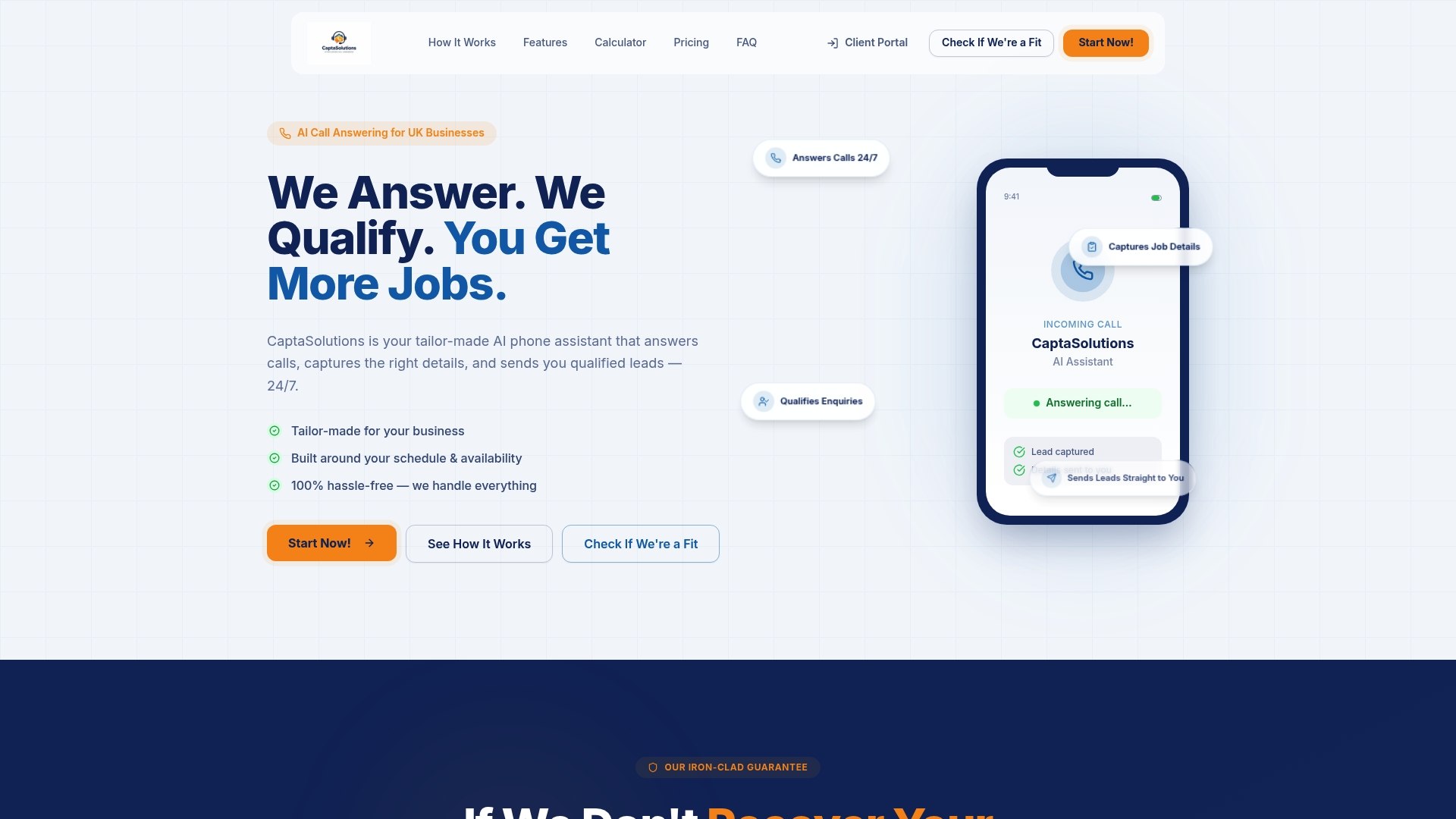
For trades businesses, salons, clinics, restaurants, and professional offices, Captasolutions removes the gap between a missed call and a lost client. You stay in control of every lead without being tied to your phone. There is no contract, no card required, and you can be live within the hour. Start your free 30-day trial at captasolutions.co.uk or call 07346 811329.
FAQ
What is a client portal?
A client portal is a secure, online platform where clients access documents, project updates, invoices, and communications without contacting your team directly. It gives clients 24/7 self-service access to their own account information.
How much can a client portal save a UK business?
UK businesses deflecting 30% of calls on a volume of 2,000 per month save approximately £40,000 per year, based on an average call handling cost of £5.58. Savings scale with call volume and portal adoption rate.
What security features does a client portal need?
A client portal requires role-based access controls, encrypted data transmission, and audit logs to comply with UK GDPR and the Data Protection Act 2018. Enterprise clients may also require SOC2 or ISO 27001 certification.
How long does it take to implement a client portal?
SaaS portals can be live within days. Custom-built portals for mid-tier businesses typically take 8–12 weeks and cost between £25,000 and £45,000, with enterprise builds requiring more time and budget.
Why do client portals fail to get adopted?
Portals fail when businesses allow clients to continue using email and phone for tasks the portal handles. Mandating portal use from the first client interaction is the most reliable way to prevent dual workflows and drive adoption.