

A UK business after-hours call checklist is a structured set of protocols that defines exactly how every inbound call is handled outside standard working hours. After-hours coverage spans evenings, weekends, public holidays, and even lunch breaks in smaller offices. Without a documented process, calls fall through the gaps, customers move on, and revenue disappears quietly. This checklist format, also known in contact centre practice as an out-of-hours call handling protocol, gives UK business owners a repeatable, auditable system they can implement without specialist knowledge.
1. What belongs in a UK business after-hours call checklist?
An effective after-hours checklist includes clarifying call intent, mapping call flows, setting escalation rules, system integration, and regular audits. Each element plays a distinct role. Miss one and the whole system develops blind spots.
The ten core items every UK business should cover are:
- Clarify call intent categories. Separate calls into emergency, urgent, and routine before you design any routing. Not every after-hours call needs an immediate human response, but emergencies demand one.
- Map your existing call flows. Draw out how calls currently reach your team. Identify where calls drop, where routing logic breaks, and where callers hit dead ends.
- Define escalation rules with named ownership. Every call type needs a named person or role responsible for it, plus a time target for response. Vague ownership produces missed calls.
- Integrate your systems. Connect your call handling to your CRM, ticketing platform, or job management software so that captured enquiries feed directly into your workflow.
- Set staff schedules and on-call rotations. Document who is on call, on which days, and within what hours. Publish this internally so there is no ambiguity.
- Prepare message templates and scripts. Write your greetings, hold messages, and voicemail prompts in advance. Keep greetings under 20 seconds to prevent callers hanging up before leaving a message.
- Establish follow-up protocols. Decide when callbacks happen, who makes them, and how they are logged. A next-day follow-up list should be generated automatically where possible.
- Test your routing regularly. Call your own number from an external mobile after hours and verify the experience from the caller's perspective.
- Set KPIs specific to after-hours calls. Track response time, escalation accuracy, and message capture rate separately from daytime metrics. Applying daytime SLAs to after-hours calls masks real performance gaps.
- Plan for volume fluctuations. Identify peak periods such as bank holidays or seasonal surges and adjust staffing or service capacity in advance.
Pro Tip: Write your checklist as a living document stored in a shared location. Review it every quarter, not just when something goes wrong.
2. How do after-hours call handling methods compare?

UK businesses use five main methods for after-hours calls: voicemail, mobile forwarding, on-call rotations, Interactive Voice Response (IVR), and outsourced 24/7 answering. The right choice depends on your call volume, industry urgency, and team size.
| Method | Best suited for | Key limitation |
|---|---|---|
| Voicemail | Low-volume, routine enquiries | No live interaction; high abandonment rate |
| Mobile forwarding | Small teams with available staff | Staff fatigue; no call qualification |
| On-call rotations | Businesses with urgent but infrequent calls | Requires clear scheduling and named ownership |
| IVR with emergency options | Medium-volume businesses needing triage | Poor experience if menu logic is too complex |
| Outsourced 24/7 answering | Businesses needing consistent, branded coverage | Requires script preparation and quality monitoring |
Voicemail is the most common starting point, but it carries the highest risk of lost leads. Callers who reach voicemail outside business hours rarely leave a message and rarely call back. Mobile forwarding solves the live-answer problem but burns out staff quickly without clear boundaries. IVR systems add structure, but a poorly designed menu frustrates callers more than a simple voicemail does.
Outsourced live answering, including AI-powered services such as Captasolutions, delivers consistent coverage without placing the burden on your team. The strongest setups combine methods: an IVR triage layer routes genuine emergencies to an on-call person, while routine enquiries go to a live answering service for capture and qualification.
Pro Tip: Never rely on a single method. Layer at least two so that if one fails, calls still reach a resolution point.
3. How to design escalation and emergency call procedures
Effective after-hours structures separate standard callbacks from emergency triage to avoid caller confusion and delay. The design principle is simple: every call type must have a defined resolution action, not just a destination.
Start by segmenting your after-hours calls into three response categories:
- Immediate response required. These are genuine emergencies: a gas leak reported to a plumbing firm, a security breach reported to a facilities company, a medical query to a clinic. These calls must reach a live person within minutes.
- Same-day or next-morning response. Urgent but not critical enquiries. A new customer wanting a quote, a client rescheduling an appointment. These go to a message capture service with a guaranteed callback window.
- Routine follow-up. General enquiries, information requests, and non-time-sensitive messages. These feed into a next-day queue.
Escalation paths that end at voicemail are ineffective. Mature systems dispatch emergencies immediately to on-call resources rather than allowing unattended message backlogs. Assign a named individual to each escalation tier, set a response time target in writing, and test the path monthly.
AI triage tools can support after-hours contact prioritisation, but they work best when combined with human escalation for complex or urgent calls. The technology qualifies the call; the human resolves it.
4. How to test, audit, and improve your after-hours system
Testing after-hours routing requires external calls to assess the customer experience accurately. Internal testing is misleading because internal numbers often bypass routing rules that external callers trigger. Use a personal mobile or ask a trusted contact to call your business number after hours and report exactly what they experience.
A structured audit cycle looks like this:
- Monthly external test calls. Call from outside the business after hours. Check that greetings play correctly, routing sends calls to the right destination, and voicemail or live answering captures the message.
- Quarterly routing logic review. Check that staff schedules, on-call assignments, and escalation contacts are still current. People change roles; routing lists often do not.
- Quarterly SLA review. Pull your after-hours KPIs separately from daytime data. Look at response time, escalation accuracy, and message capture rate. Identify which call types are underperforming.
- Customer feedback collection. Ask callers who contacted you after hours about their experience. A short follow-up question during the callback is enough. The feedback reveals problems that internal testing misses.
- Protocol update cycle. After each audit, update your checklist document. Record what changed, why, and when. This creates an audit trail and prevents the same gaps recurring.
Calibrate SLAs by contact type, not just time of day. An emergency call at 11pm and a routine enquiry at 7pm are not the same thing and should not share the same response target.
5. When should UK businesses outsource after-hours call handling?
Outsourced 24/7 answering services act as an extension of your brand, following your scripts and escalation protocols for a consistent customer experience. Outsourcing is the right move when internal capacity cannot reliably cover after-hours demand.
Signs that outsourcing suits your business:
- Staff are fielding calls during personal time and showing signs of fatigue or resentment. Clear boundaries matter, and dedicated on-call channels separate from general enquiries prevent burnout.
- Call volume after hours is growing but does not yet justify a full-time hire.
- Your industry carries urgency. Trades, healthcare, hospitality, and property management businesses regularly receive time-sensitive calls outside standard hours.
- You are losing leads to competitors who answer calls when you do not.
When evaluating an outsourced provider, look for these features:
- Script customisation so the service answers in your business name and follows your tone
- Defined escalation protocols that match your internal triage categories
- Integration with your CRM or job management system
- Transparent reporting on call volume, message capture, and response times
- A clear quality monitoring process so you can verify performance
Outsourcing works best when the provider operates as a genuine extension of your team, not as a generic answering bureau. Prepare a detailed brief covering your call types, escalation rules, and brand language before going live. Review call recordings or transcripts regularly to maintain quality.
Pro Tip: Treat your outsourced provider like a new member of staff. Give them a proper induction, share your scripts, and schedule monthly check-ins.
Key takeaways
A reliable after-hours call handling system requires documented protocols, named ownership at every escalation tier, and regular external testing to catch gaps before customers do.
| Point | Details |
|---|---|
| Document every call type | Categorise calls as emergency, urgent, or routine before designing any routing. |
| Name an owner for each tier | Every escalation level needs a named person and a response time target in writing. |
| Test from outside the business | Call your own number from an external mobile after hours to see what callers actually experience. |
| Keep greetings under 20 seconds | Longer greetings increase hang-ups and reduce message capture rates. |
| Review KPIs separately | Track after-hours response time and escalation accuracy apart from daytime metrics. |
What most businesses get wrong about after-hours calls
The most common mistake I see is treating after-hours as a single uniform window rather than a set of distinct states. A call at 6:30pm on a Tuesday is a different situation from a call at 2am on a bank holiday Sunday. The caller's expectation, the urgency level, and the appropriate response are all different. Businesses that apply one blanket voicemail greeting to both situations are not managing after-hours calls. They are ignoring them.
The second mistake is assuming that having something in place is enough. A voicemail box that nobody checks until 9am the next morning is not a protocol. It is a liability. I have spoken with business owners who lost significant contracts because a prospective client called after hours, reached a generic voicemail, and simply called the next name on their list.
The discipline-based approach treats after-hours operations with the same rigour as the core working day. That means written protocols, tested routing, named ownership, and scheduled audits. It also means protecting your staff. Setting clear boundaries for after-hours communications, such as no internal contact outside 7pm except through a dedicated on-call channel, prevents the slow burnout that comes from always being reachable.
Technology helps, but it does not replace clear thinking. AI triage and call answering without staff are genuinely useful tools when they sit inside a well-designed protocol. Without that protocol, they just automate the confusion.
— Daniel
Captasolutions: after-hours call handling for UK businesses
Every missed call after hours is a lead your competitor picks up. Captasolutions answers every call in your business name, 24 hours a day, 7 days a week, using AI-powered call answering built specifically for UK businesses.
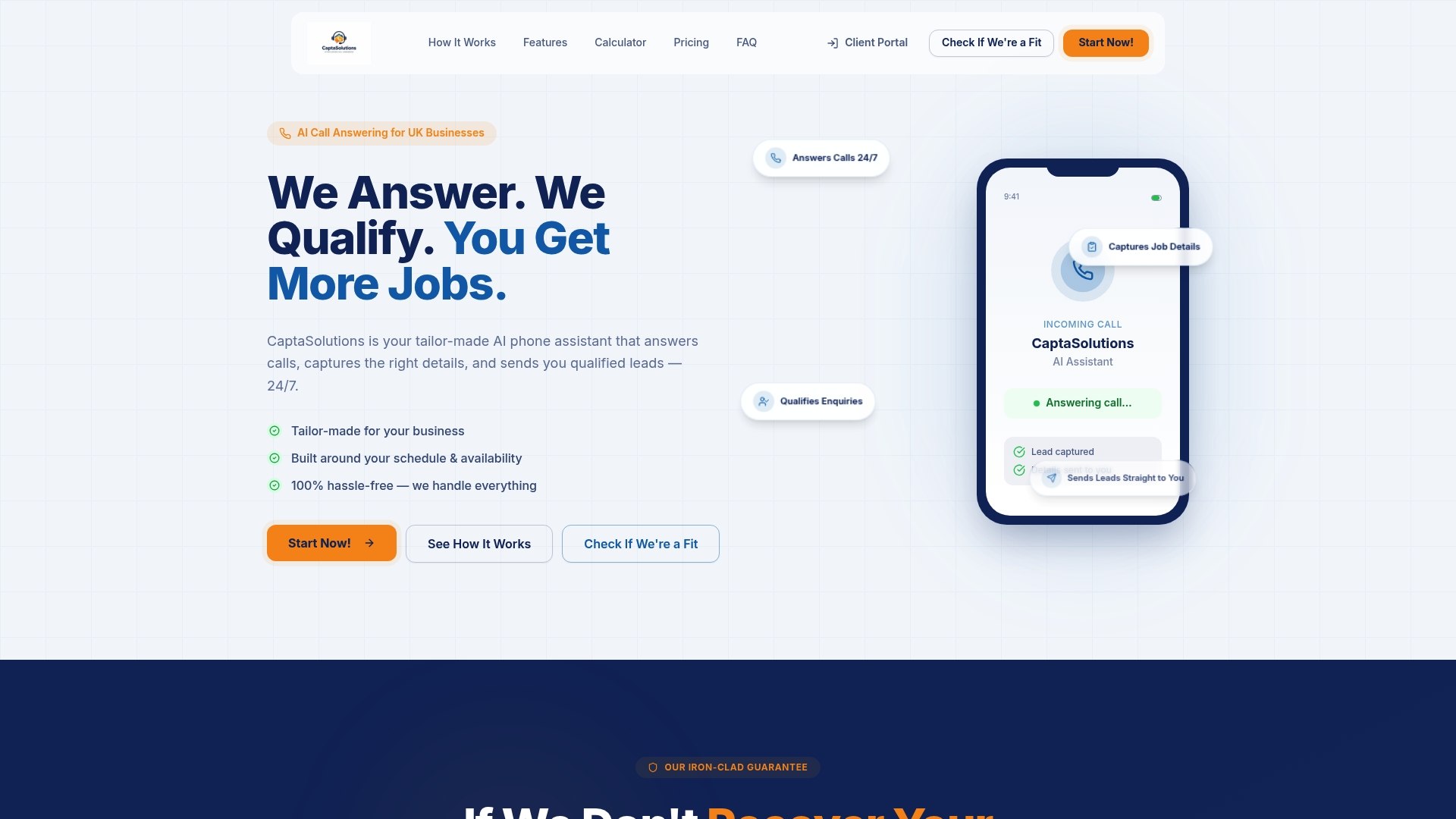
The service captures caller details, qualifies the enquiry, and organises everything into your client portal. You review every lead and decide what to take on. Captasolutions works for trades businesses, salons, clinics, restaurants, and professional offices across the UK. There is no contract, no card required, and you can be live within the hour. A free 30-day trial is available now at captasolutions.co.uk or by calling 07346 811329.
FAQ
What is an after-hours call checklist for UK businesses?
An after-hours call checklist is a documented set of protocols covering call routing, escalation rules, message capture, and follow-up actions for calls received outside standard business hours. It gives every team member clear instructions so no call is handled inconsistently.
How many methods exist for handling after-hours calls in the UK?
UK businesses use five main methods: voicemail, mobile forwarding, on-call rotations, IVR systems, and outsourced 24/7 answering services. Most effective setups combine at least two methods to cover different call types and urgency levels.
How long should an after-hours voicemail greeting be?
Keep your greeting under 20 seconds. Longer greetings cause callers to hang up before leaving a message, which reduces your message capture rate and increases lost leads.
How often should I test my after-hours call routing?
Test your routing at least monthly using an external mobile number. Internal tests bypass routing rules that external callers trigger, so they do not give an accurate picture of the caller experience.
When does outsourcing after-hours calls make sense for a small UK business?
Outsourcing makes sense when staff are fielding calls during personal time, when call volume is growing but does not justify a hire, or when your industry carries genuine urgency outside standard hours. A well-briefed outsourced provider follows your scripts and escalation protocols to deliver consistent coverage.