

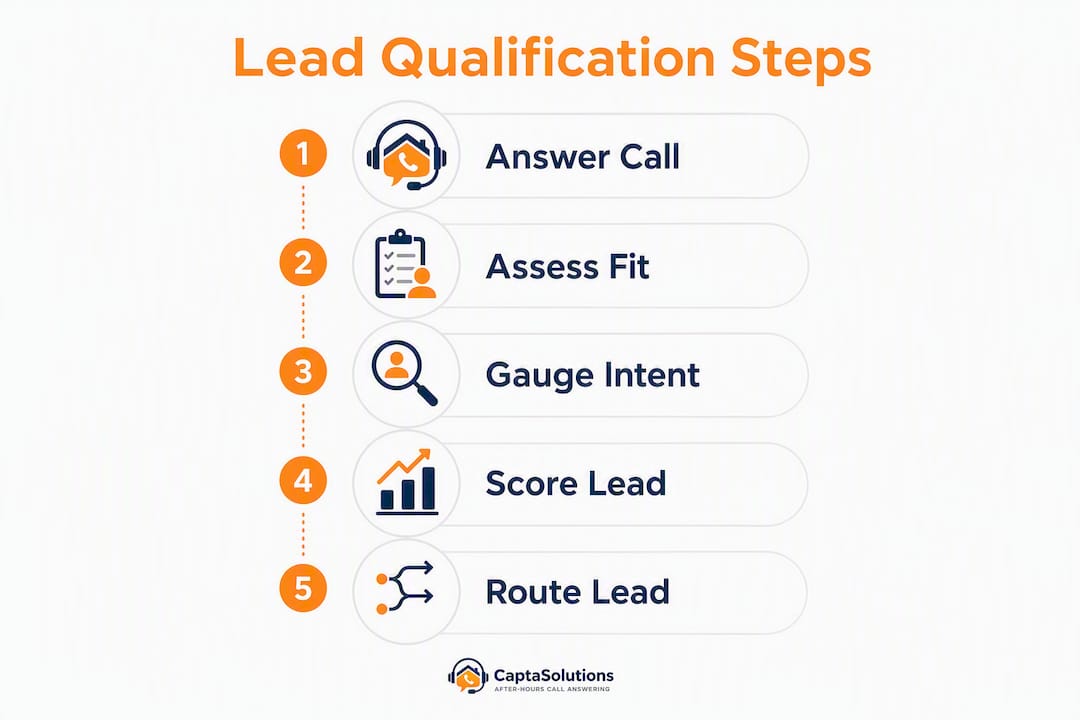
The most effective way to qualify leads from phone calls is a two-part approach: ask three decisive questions during the call itself, then run an automated post-call gate that scores each lead on fit and intent before routing it. Done well, the whole process takes under five minutes per call and removes guesswork from your pipeline entirely.
Three things you can implement in under an hour:
- Write a five-question script covering budget, authority, need, and timing. Keep it conversational, not interrogative.
- Set a five-minute SLA for automated acknowledgement after every call ends.
- Create one routing rule: Hot leads (high fit, high intent) go straight to a rep or booking; everyone else enters a nurture sequence.
Phone leads convert 10–15 times more than form fills, emails, or chat. Qualifying them without a repeatable process means you are burning your highest-value channel.
Captasolutions handles the automation layer for UK businesses that cannot staff a 24/7 qualification desk.
Table of Contents
- Why do phone-call leads need qualifying so urgently?
- How do you qualify a lead while they are on the call?
- How do you automate post-call qualification?
- What should you do with qualified and unqualified calls?
- What mistakes do teams make when qualifying phone-call leads?
- How do you choose the right framework and tools, and which KPIs matter?
- How does Captasolutions handle phone-call qualification for UK businesses?
- Key takeaways
- Captasolutions: qualify every inbound call from day one
Why do phone-call leads need qualifying so urgently?
Phone leads are your best leads. Research shows they convert 10–15 times more than form fills, emails, or chat enquiries. That gap exists because a caller has already invested time and shown active intent. They want an answer now.
The problem is that without a qualification process, that intent evaporates fast. Speed matters enormously: the target for a first qualifying touch is within five minutes of a call ending, yet many teams let response times stretch to 47 hours, by which point the lead has called a competitor. Every hour of delay costs conversion.
The cost of skipping qualification compounds quickly. A sales rep spending 40 minutes with an unqualified caller is not just wasting that call. They are unavailable for the three qualified leads that came in during the same window. For UK SMBs running lean teams, that opportunity cost is direct and measurable.
An effective phone-call qualification process delivers three concrete benefits:
- Higher close rates: reps speak only to leads that meet your ICP criteria.
- Faster sales cycles: pre-qualified leads arrive with context, so discovery is shorter.
- Better ROI on ad spend: you can trace which campaigns generate qualified calls, not just call volume.
How do you qualify a lead while they are on the call?
The most reliable on-call qualification model uses two dimensions: fit (does this caller match your ideal customer profile?) and intent (are they ready to act?). Both dimensions must feed the qualification gate, not just a single composite score. A caller with perfect fit but no budget timeline is not a Hot lead; neither is an urgent caller who is entirely outside your service area.

Choosing the right framework
Three frameworks dominate sales qualification. Each suits a different sales motion.
| Framework | Best for | Core questions | Weakness |
|---|---|---|---|
| BANT | High-volume SMB, short cycles | Budget, Authority, Need, Timing | Can feel transactional on short calls |
| CHAMP | Outbound, mid-market | Challenges, Authority, Money, Prioritisation | Requires more call time |
| MEDDIC | Enterprise, long cycles | Metrics, Economic buyer, Decision criteria, Decision process, Identify pain, Champion | Too complex for a 3-minute inbound call |
For most UK service businesses, BANT is the right starting point. It maps directly to the four questions a rep needs answered before booking a follow-up. Pick the framework that matches your sales motion and apply it consistently — inconsistency is what makes qualification data useless.
Short-cycle vs long-cycle question sets
High-frequency local services (trades, salons, clinics):
- "What's the job you need done, and roughly when are you looking to get it sorted?"
- "Have you got a budget in mind, or would a quote help you work that out?"
- "Is it your own property, or are you acting on behalf of someone else?"
Longer B2B sales cycles (professional services, SaaS, consultancy):
- "What's the main challenge you're trying to solve, and what's prompted you to look now?"
- "Who else is involved in the decision, and what does your evaluation process look like?"
- "What does success look like in the first 90 days, and is there a budget allocated?"
On-call script snippet
Opening: "Thanks for calling [Business Name]. To make sure I connect you with the right person, can I ask a couple of quick questions?"
Qualification probe 1 (after listening to their need): "And is this something you're looking to move forward with in the next few weeks, or are you still in the early stages?"
Qualification probe 2: "Just so we can give you an accurate quote, do you have a rough budget in mind?"
Route decision: Hot → "Let me get you booked in." Warm → "I'll have someone call you back within [X hours]." Cold → "Let me send you some information that might help."
Pro Tip: Spread your qualification questions across the conversation rather than front-loading them. Mixing a question with a brief, relevant observation ("We do a lot of work in that area — what's the scope of the job?") keeps the call feeling like a conversation, not a form.
How do you automate post-call qualification?
The on-call conversation captures raw signal. The post-call gate converts that signal into a routing decision without human intervention. The sequence runs like this:

Call ends → transcript generated → enrichment → fit and intent scoring → routing rule fires → CRM updated.
The technical components you need
| Component | Function | UK compliance note |
|---|---|---|
| Call recording | Captures audio for transcription and audit | Requires two-party notification under UK GDPR and PECR |
| Transcription engine | Converts audio to searchable text | Data must be stored within UK/EEA or under adequacy agreement |
| Conversation intelligence | Keyword spotting, sentiment, intent signals | Retention period should be defined in your privacy policy |
| Enrichment API | Populates firmographic fields from phone/email | Only enrich data you have a lawful basis to process |
| CRM workflow | Tags, scores, and routes the lead record | Audit trail required for data subject access requests |
| Webhook / integration | Triggers nurture sequences or rep alerts | Ensure processor agreements are in place with third parties |
Enrichment at capture speeds scoring significantly. Passing a caller's phone number through an enrichment layer to derive company size or sector means your scoring rule fires on real firmographic data, not just what the caller said.
UK compliance is not optional here. Under the UK GDPR and the Privacy and Electronic Communications Regulations (PECR), you must inform callers that the call is being recorded, state the purpose, and retain data only as long as necessary. Build the notification into your call opening script and set a defined retention window in your CRM.
Pro Tip: Before going live, test your transcription engine on a sample of real calls from your sector. Trades and regional accents can reduce accuracy. If accuracy drops below roughly 85%, switch engines or add a manual review step for borderline scores.
What should you do with qualified and unqualified calls?
Once the post-call gate fires, every lead needs a defined next action. Leaving routing to individual judgement is where most qualification processes break down.
Routing rules by lead tier
- Hot (high fit + high intent): route to a rep or booking system immediately. SLA: first contact within 15 minutes during business hours; within one hour outside hours.
- Warm (good fit, lower intent or timing unclear): enter a personalised nurture sequence. SLA: first automated touch within five minutes; human follow-up within four hours.
- Cold (poor fit or no budget/authority): automated disqualification message with a helpful resource. Flag the call source back to marketing so the campaign targeting can be reviewed.
SLA escalation rules
If a Hot lead is not contacted within the SLA window, the CRM should automatically escalate: first to the rep's manager, then to a shared team inbox. Uncontacted Hot leads are the most expensive failure mode in any qualification process.
Nurture sequence for Warm leads
- Immediate (within 5 minutes): automated SMS or email confirming you received their enquiry and will be in touch.
- +4 hours: personalised follow-up from a rep referencing the specific need they mentioned on the call.
- +23–24 hours: value-add message (a relevant case study, a short how-to, or a pricing guide) tied to their stated challenge.
- +3 days: a direct ask to book a call or get a quote, with a clear one-click option.
This cadence is consistent with recommended follow-up timing for phone-originated leads and keeps the conversation warm without becoming intrusive.
What mistakes do teams make when qualifying phone-call leads?
Most qualification failures are process failures, not people failures. The same errors appear repeatedly across UK sales teams.
Interrogation-style questioning. Firing five questions in 90 seconds signals that you care more about your CRM than the caller's problem. The fix: spread questions across the call and frame each one as a natural follow-on to what the caller just said.
Slow follow-up. A qualified lead that waits 24 hours for a response is not a qualified lead anymore. Set the five-minute SLA and automate the first touch so it fires regardless of whether a rep is available.
Poor handoff context. When a lead passes from the person who took the call to the person who closes it, context loss is the default outcome. The closer re-asks questions the caller already answered, which signals disorganisation and erodes trust.
Over-reliance on activity signals. A caller who rang three times is not necessarily a better lead than one who rang once. Frequency of contact is a behaviour signal, not a qualification signal. Score on fit and intent, not on persistence.
Pro Tip: Run a monthly audit of five closed-lost deals and trace each one back to the qualification call. In most cases, the disqualifying factor was visible on the first call but was never captured. That audit will tell you exactly which question your script is missing.
How do you choose the right framework and tools, and which KPIs matter?
Matching framework to sales motion
For UK SMBs with short sales cycles (trades, hospitality, health and beauty), BANT covers the essentials in three to four questions and fits naturally into a two-minute call. For professional services or SaaS businesses with longer cycles, CHAMP adds the challenge-first orientation that surfaces pain before budget. MEDDIC is rarely appropriate for inbound phone calls; it belongs in enterprise account reviews.
A documented, repeatable qualification workflow cuts wasted SDR time by roughly 30–50%. The framework matters less than the consistency with which it is applied.
Tool selection checklist
- CRM integration: does it push qualified lead data directly into your existing CRM without manual entry?
- Transcription accuracy: tested on your sector's vocabulary and regional accents?
- SLA support: can it trigger alerts and escalations automatically?
- GDPR features: does it support configurable data retention, consent logging, and data subject access?
- Pricing model: per-call, per-seat, or flat monthly? Match to your call volume.
Statistic to watch: speed to lead is the single highest-impact lever. Teams that acknowledge a lead within five minutes see materially better conversion than those whose median response time stretches to 47 hours.
KPIs to track
- Qualified lead rate: percentage of inbound calls that pass the gate. Benchmark against your previous period, not an industry average.
- Time-to-contact: median minutes from call end to first rep contact. Target under 15 minutes for Hot leads.
- Conversion from qualified to booked: the clearest measure of script and routing quality.
- Cost per qualified lead: total channel spend divided by qualified calls. Tells you which campaigns are worth scaling.
- SLA breach rate: percentage of Hot leads not contacted within the SLA window. Should trend toward zero.
For a typical UK SMB, a basic qualification setup (script, CRM tagging, automated acknowledgement) can be live within a day. A full automation layer with transcription, scoring, and routing typically takes one to two weeks to configure and test.
How does Captasolutions handle phone-call qualification for UK businesses?
Captasolutions is built specifically for UK businesses that cannot staff a qualification desk around the clock. The service answers every inbound call in your business name 24 hours a day, seven days a week, and runs your qualification logic on every call automatically.
What the platform does
- Answers calls in your business name with a custom AI voice.
- Asks your qualification questions in the order and phrasing you define.
- Records and transcribes every call.
- Scores each lead against your fit and intent criteria.
- Routes Hot leads to your team immediately; Warm leads into your nurture sequence.
- Delivers a full handoff packet per lead: transcript, qualification answers, ICP fit notes, and a summary.
- Organises everything into a client portal for review and follow-up.
Setting up qualification rules: a typical path
- Onboarding call (30 minutes): define your ICP, your three to five qualification questions, and your routing rules.
- Script configuration: Captasolutions configures the AI voice and question flow to match your business name and tone.
- CRM integration: connect your CRM via webhook or native integration so qualified leads land directly in your pipeline.
- Test calls: run five to ten test calls to verify transcription accuracy, scoring logic, and routing.
- Go live: the system is typically live within the hour.
UK use cases
A plumbing and heating business in the East Midlands uses Captasolutions to handle calls during jobs. Every caller is asked about the type of work, property ownership, and urgency. Hot leads (emergency repairs, confirmed budget) are texted to the engineer immediately. Warm leads (planned work, no fixed timeline) receive an automated quote request by email.
A private clinic in London uses the service after hours. Callers are qualified on treatment type, GP referral status, and preferred appointment window. The portal shows the clinic manager a ranked list of leads each morning, with transcripts attached.
The AI lead qualification examples on the Captasolutions blog show further sector-specific setups.
Captasolutions offers a 30-day free trial with no card required and no contract. The service goes live within the hour of setup. For businesses that want to qualify inbound calls automatically, the trial is the fastest way to see the process in action with real calls.
Key takeaways
Qualifying phone-call leads effectively requires a two-part process: a concise on-call script built on fit and intent, followed by an automated post-call gate that routes leads without human delay.
| Point | Details |
|---|---|
| Two-part qualification | Combine a three-to-five question on-call script with an automated post-call scoring gate for consistent results. |
| Speed to lead | Target a first qualifying touch within five minutes of call end; delays to 47 hours cause leads to go cold. |
| Framework choice | Use BANT for high-volume short-cycle UK SMBs; CHAMP for outbound or mid-market; MEDDIC for enterprise only. |
| KPIs to watch first | Track qualified lead rate and time-to-contact before any other metric; they reveal process gaps fastest. |
| Captasolutions | Answers, qualifies, and routes every inbound call 24/7 with a 30-day free trial and no card required. |
Why automation-first qualification is the only reliable approach at scale
The conventional advice is to train your reps to qualify better. That advice is not wrong, but it is incomplete. Human qualification is inconsistent by nature: it varies by rep, by time of day, by how busy the team is, and by whether the call comes in at 8 AM or 7 PM on a Friday. The leads that arrive outside office hours, which for many UK service businesses represent a significant share of total call volume, simply do not get qualified at all.
Automation does not replace good judgement. It creates the conditions under which good judgement can be applied consistently. When every call is answered, every qualification question is asked in the same order, and every lead arrives in the CRM with a transcript and a score, your reps spend their time closing, not re-qualifying. That is the real productivity gain, and it compounds over time.
The one practical observation worth making from UK deployments: businesses that resist automation because they want to "keep it personal" almost always discover that the personal touch they were protecting was already inconsistent. A caller who reaches a voicemail at 6 PM does not experience a personal touch. They experience a missed call. Automation fills that gap without replacing the human relationship that follows.
Captasolutions: qualify every inbound call from day one
Every missed call is a missed qualification opportunity. Captasolutions answers every inbound call in your business name, 24/7, asks your qualification questions, scores the lead, and delivers a full handoff packet to your team, whether you are on a job, in a meeting, or closed for the evening.
The 30-day free trial includes live qualification rules configured to your business, call recording and transcription from day one, full portal access, and a sample handoff packet so you can see exactly what your team receives after every call. No card required. No contract. Live within the hour.
Start your free trial at captasolutions.co.uk or call 07346 811329 to speak with the team about a quick pilot for your business.
Further reading and sources
The claims in this guide draw on the following sources. Each is worth reading for deeper technical or academic detail on the specific topic listed.
| Source | What it covers | Why it is useful |
|---|---|---|
| How to Qualify a Lead Over the Phone and Automate the Process | Phone lead conversion rates and automation patterns | Quantifies the conversion uplift from phone leads and maps the automation workflow |
| Lead Qualification Process: 7 Steps (SetSmart) | Speed-to-lead, question cadence, follow-up timing | Covers the 5-minute SLA, 47-hour median failure, and nurture sequence timings |
| Lead Qualification Process: 7 Steps (Sendspark) | Documented workflows and enrichment at capture | Supports the 30–50% SDR time saving and enrichment API recommendations |
| Telemarketing: How to Qualify Leads (Pipedrive) | Fit × intent model and framework selection | Core conceptual source for the two-dimension gate and framework comparison |
| The Complete Guide to Lead Qualification (Clay) | Qualification as a gate vs a score | Explains the routing distinction between scoring and qualification |
UK compliance reminder: recording calls for qualification purposes requires informing callers at the start of the call, under the UK GDPR and PECR. Data retention periods must be defined and documented. If you use third-party transcription or enrichment services, processor agreements must be in place. Consult the ICO's guidance on call recording for the current regulatory position.