

Automatic inbound call qualification is the process of using AI-powered systems and structured frameworks to instantly assess and prioritise leads the moment they call your business. UK business owners who qualify inbound calls automatically report significantly higher lead conversion rates, faster response times, and fewer missed opportunities. AI voice agents can improve appointment booking rates by up to 300% by removing the delays caused by manual scheduling and hand-off chains. That single figure explains why so many UK trades businesses, clinics, and service firms are moving away from manual call handling in 2026.
Which tools and frameworks do you need to qualify inbound calls automatically?
Three core components make automatic call qualification work: an AI voice agent with natural conversation capability, calendar integration for real-time booking, and CRM syncing for automatic data capture. Without all three, you create gaps where leads fall through. The AI handles the conversation, the calendar removes booking friction, and the CRM records every detail so your team picks up exactly where the call left off.
Qualification frameworks give your AI voice agent its questions. The right framework depends on deal size and sales complexity. Choosing the right framework should depend on deal value and sales motion rather than personal preference. The table below shows which framework suits which situation for UK SMEs.

| Framework | Best suited to | Typical deal size | Key focus |
|---|---|---|---|
| BANT | Transactional, short sales cycles | Under £20,000 | Budget, authority, need, timeline |
| CHAMP | Service businesses, SMEs | £5,000–£50,000 | Challenges, authority, money, prioritisation |
| MEDDIC | Complex B2B, consultative sales | Over £40,000 | Metrics, economic buyer, decision criteria |
BANT works well for most UK trades and service businesses. MEDDIC suits professional services firms handling larger contracts. CHAMP sits between the two and works particularly well for businesses where the caller's pain point drives the conversation more than their budget.
One rule applies across all frameworks: place disqualifiers early in your qualification script. Filtering out non-fit callers in the first 60 seconds saves your AI agent time and protects your team from wasted follow-up calls.
Pro Tip: Build your disqualifier questions around the two or three reasons you most commonly turn work away. If you don't serve a certain postcode or a certain job type, make those the first questions your AI asks.
How do you design an effective automatic call qualification workflow?
Script design is the single biggest factor in whether your automatic call assessment succeeds or fails. A poorly structured script creates confusion for callers and unreliable data for your team. A well-structured script feels like a natural conversation and delivers clean, usable lead data every time.
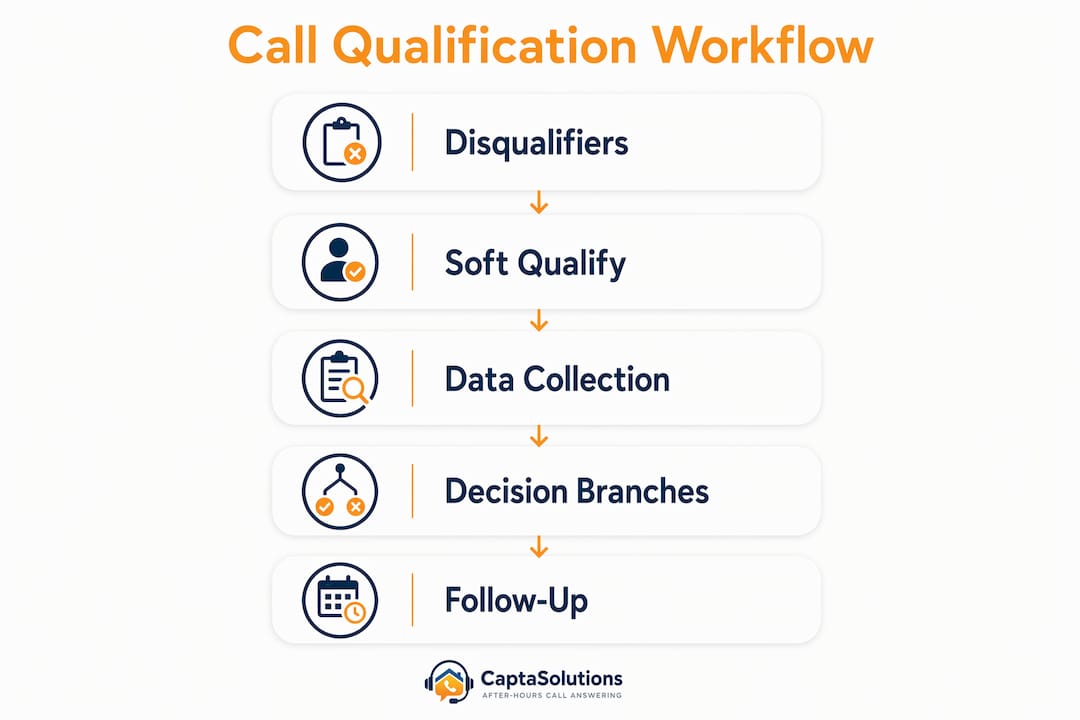
Follow this sequence when building your qualification script:
- Open with a disqualifier. Ask the one question that immediately separates fit callers from non-fit callers. For a plumber, that might be the caller's location. For a clinic, it might be the type of treatment needed.
- Move to soft qualifiers. These are questions that gather context without feeling intrusive. Ask about the nature of the enquiry, the urgency, and the preferred appointment window.
- Collect data last. Name, contact number, and email come at the end, once the caller is engaged and the enquiry is confirmed as a fit.
- Build in a repair loop. When the AI does not understand a response, it should ask the same question in a different way rather than moving on or failing silently.
- Set clear escalation rules. Define the exact conditions under which the AI transfers the call to a human. Angry callers, complex queries, and repeat callers are the most common triggers.
- Test with real scenarios. Run the script through at least ten realistic call simulations before going live. Listen for points where the conversation feels unnatural or where the AI loses context.
Limit your script to a maximum of two decision branches, and make sure both branches rejoin quickly. More than two branches creates reliability problems and makes the script difficult to maintain. Group related questions together to avoid "topic whiplash," where the AI jumps between unrelated subjects and the caller loses confidence in the interaction.
The table below shows a typical call flow with example questions and expected outcomes at each stage.
| Stage | Example question | Expected outcome |
|---|---|---|
| Disqualifier | "Are you based in [service area]?" | Filters out out-of-area callers immediately |
| Soft qualifier | "What type of work do you need?" | Identifies job type and urgency |
| Budget/timeline | "When are you looking to get this done?" | Establishes timeline and priority |
| Data collection | "Can I take your name and best contact number?" | Captures lead details for follow-up |
| Booking or handoff | "I can book you in for Thursday at 10AM. Does that work?" | Confirms appointment or escalates to human |
Pro Tip: Record the most common reasons callers drop off during your script. If more than 20% of callers exit at the same question, rewrite that question before changing anything else.
How do you integrate automatic call qualification into daily operations?
Integration is where most businesses either gain or lose the benefit of automatic call qualification. The AI voice agent captures the lead, but your calendar and CRM determine what happens next. Real-time calendar integration means a caller can book an appointment during the call itself, without any human involvement. That removes the most common source of lead loss: the gap between initial contact and confirmed booking.
Responding to leads within 5 minutes makes a business 21 times more likely to qualify that lead compared to a 30-minute delay. AI call qualification achieves this by definition, because the system responds the instant the call connects. No human team can match that consistently, particularly outside office hours.
CRM integration serves a different purpose. It logs every call outcome, the caller's details, the qualification result, and any notes the AI captured. Your sales team or manager sees a prepared summary before they make any follow-up contact. That preparation shortens the follow-up call and increases the chance of conversion.
Operational best practices for daily call handling include:
- Review your client portal each morning and prioritise leads flagged as high-fit by the qualification system.
- Set a daily cut-off time for same-day callbacks so no qualified lead waits more than a few hours for human contact.
- Use exit reason codes from your call analytics to track why calls are being disqualified, and review these weekly.
- Brief your team on any script changes before they go live so they understand what callers have already been asked.
- Check calendar availability daily to avoid the AI booking appointments into slots that are no longer open.
Pro Tip: The AI handles qualification, but a human should always make the first follow-up call to confirmed leads. That combination of speed and personal contact produces the highest conversion rates.
For a practical walkthrough of how AI handles booking call qualification in sectors like plumbing, HVAC, and cleaning, the process maps directly onto the workflow described here.
What are the most common problems with automatic call qualification?
The most frequent problem is script complexity. Business owners often try to qualify every possible scenario in a single call, which creates too many branches and a poor caller experience. A standardised six-step qualification workflow covering fit, authority, pain, budget, timeline, and decision process can increase sales win rates by 20–30% for B2B teams. The key is applying that structure without overloading a single interaction.
The second most common problem is poor question phrasing. Questions that are too open-ended confuse AI voice agents and produce inconsistent data. Questions that are too closed feel interrogative to callers and increase drop-off rates. The 70/30 listening-to-talking ratio recommended for human qualification calls applies equally to AI script design. The script should gather context, not pitch.
Mistakes to avoid:
- Trying to complete full discovery in a single short call. Use a two-call qualification approach: a short pre-qualification call of 3–5 minutes followed by a deeper 15–30 minute discovery call for complex enquiries.
- Ignoring caller experience in favour of data collection. If the script feels like a form, callers hang up.
- Failing to update scripts when your service offering changes. Outdated scripts qualify the wrong leads.
- Skipping escalation rules. Without clear handoff triggers, the AI will attempt to handle calls it cannot manage well.
- Reviewing call data only when something goes wrong. Weekly reviews catch problems before they affect lead quality.
Understanding call qualification best practices at a framework level helps you design scripts that avoid these pitfalls from the start.
Key takeaways
Automatic inbound call qualification works best when AI voice agents, structured frameworks, and CRM integration operate together within a well-designed, regularly reviewed script.
| Point | Details |
|---|---|
| Place disqualifiers first | Filter non-fit callers in the first 60 seconds to protect your team's time. |
| Match framework to deal size | Use BANT for smaller deals and MEDDIC for complex, high-value enquiries. |
| Limit script branches | Keep decision branches to a maximum of two to maintain reliability and flow. |
| Speed determines conversion | Responding within 5 minutes makes qualification 21 times more likely to succeed. |
| Review data weekly | Exit reason codes and call analytics reveal script problems before they compound. |
Why I think most UK businesses are still doing this the hard way
Having worked with UK service businesses across trades, hospitality, and professional services, I've noticed the same pattern repeatedly. Business owners know they're missing calls. They know those calls represent revenue. But they assume the solution is hiring another person to answer the phone, when the real problem is the absence of a system.
Manual call handling is not a staffing problem. It's a process problem. A tradesperson on a job cannot answer a call. A salon with every chair occupied cannot put a client on hold. The calls that go unanswered are not the result of bad intentions. They're the result of a gap between demand and capacity that no amount of hiring fully closes.
What I find most interesting is how straightforward the fix actually is. Starting with a simple script, three or four questions maximum, and a basic calendar integration produces measurable results within days. Businesses that wait for the perfect system before launching anything tend to miss months of leads in the meantime. The data is clear: speed matters more than perfection. A basic AI qualification system that responds in seconds outperforms a sophisticated manual process that responds in hours.
The technology complements your sales team rather than replacing them. The AI qualifies and books. Your team closes. That division of labour is where the real efficiency gain sits, and it's available to any UK business willing to set it up.
— Daniel
How Captasolutions helps UK businesses qualify calls automatically
Captasolutions is an AI-powered call answering service built specifically for UK businesses that cannot afford to miss a call. The system answers every call in your business name, 24 hours a day, 7 days a week, qualifies the enquiry using structured scripts, and organises every lead into your client portal.
Trades businesses, clinics, salons, and service firms across the UK use Captasolutions to capture leads they would otherwise lose outside office hours or during busy periods. There is no technical complexity to manage. The system goes live within the hour, with no contract and no card required for the free 30-day trial. Visit Captasolutions to get started today, or call 07346 811329 to speak with the team directly.
FAQ
What does it mean to qualify inbound calls automatically?
Automatic inbound call qualification uses an AI voice agent to assess and score callers in real time using structured questions. The system filters fit leads from non-fit callers without any human involvement.
Which qualification framework works best for UK small businesses?
BANT is the most practical framework for UK SMEs handling transactional enquiries under £20,000. For more complex or consultative sales, CHAMP or MEDDIC provides a better fit.
How quickly should a business respond to a qualified inbound lead?
Responding within 5 minutes makes a business 21 times more likely to qualify that lead compared to a 30-minute delay. AI call qualification achieves this automatically because the system responds the instant the call connects.
How many questions should an AI call qualification script contain?
A well-designed script covers four to six questions across disqualification, soft qualification, and data collection. Keeping the script short reduces caller drop-off and produces cleaner lead data.
Can AI call qualification work outside normal business hours?
AI call qualification operates 24 hours a day, 7 days a week, which is its primary advantage over manual call handling. Every call receives the same structured response regardless of when it arrives.